• Home
  • Latest
  • Fortune 500
  • Finance
  • Tech
  • Leadership
  • Lifestyle
  • Rankings
  • Multimedia
EconomyDonald Trump

3 things Trump did in 24 hours to show that he’s in control of American business

By
Eva Roytburg
Eva Roytburg
Fellow, News
Down Arrow Button Icon
By
Eva Roytburg
Eva Roytburg
Fellow, News
Down Arrow Button Icon
January 8, 2026, 1:41 PM ET
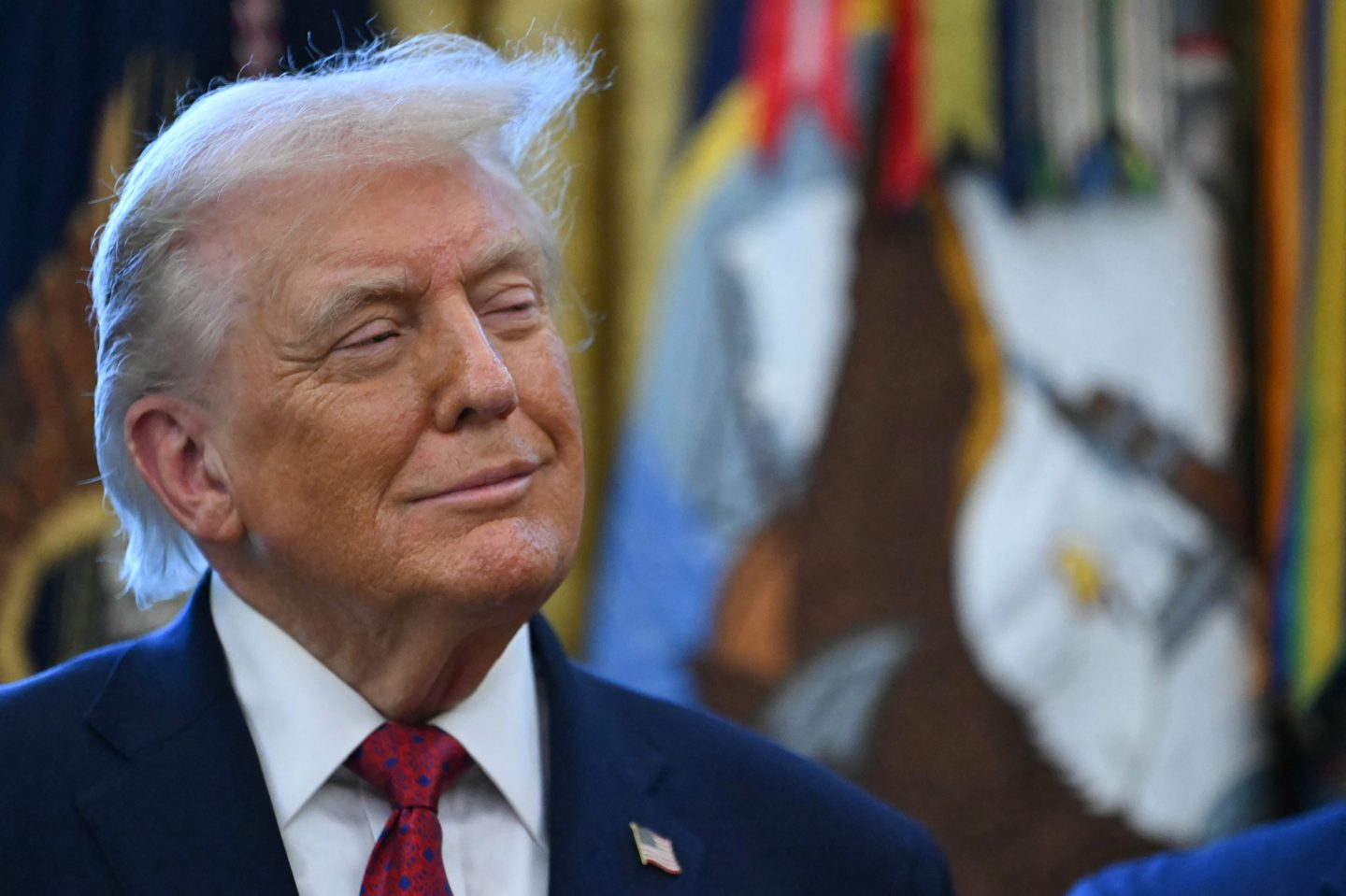
US President Donald Trump looks on during a Mexican Border Defense Medal presentation in the Oval Office of the White House in Washington, DC, on December 15, 2025. (Photo by ANDREW CABALLERO-REYNOLDS / AFP via Getty Images)
President Donald Trump. ANDREW CABALLERO-REYNOLDS / AFP via Getty Images

President Donald Trump woke up Wednesday morning and decided the market needed a little management.

In just 24 hours, the president unveiled three massive state interventions into different markets that might’ve once looked—and sounded—like unacceptable levels of socialist dirigisme for a Republican to champion. The speed and breadth of the actions reflect a defining feature of Trump’s second term: a growing willingness to abandon the GOP’s traditional laissez-faire posture and exercise direct control over private economic activity.

Recommended Video

“He’s taking an extreme left-wing position which looks like state capitalism,” said Jeffrey Sonnenfeld, a longtime corporate governance scholar and the founding dean of Yale’s Chief Executive Leadership Institute. “It is MAGA going Maoist. So it is taking away the discretion of individual managers—the control of the ownership of the business by its stakeholders, by its owners, the decision-making. And it is disrupting the wisdom of markets.”

Sonnenfeld—who says he has known Trump for decades, longer than any current cabinet member, and is preparing to release a book examining what he calls Trump’s “ten commandments”—argued the shift has nothing to do with ideology. 

“He’s come up with something new, which is the iron fist of an autocrat,” Sonnenfeld told Fortune. “That’s something which is not seen in capitalism too often.” 

In Sonnenfeld’s telling, the president’s recent moves substitute executive discretion for market outcomes, leaving managers and shareholders operating not within a free market, but at the pleasure of the White House.

Housing

A little after noon Wednesday, Trump announced on Truth Social he was banning “large institutional investors”—which include Wall Street conglomerates like private equity firms and real estate trusts— from buying single-family homes, and called on Congress to codify the law.

“People live in homes, not corporations,” Trump wrote. 

Stocks of these institutional investors took a hit on the news. Blackstone, a notorious corporate home buyer, sank 6% Wednesday. Invitation Homes, known as the largest institutional home buyer, also dove 6%, while American Homes 4 Rent (AMH) saw trading briefly halted due to volatility after shares hit a three-year low.

Large institutional investors currently own only 2% of the housing stock, according to CNBC, but their ownership is heavily concentrated in cities in the Southeast like Atlanta and Jacksonville, Fla. 

“I think [the ban] is a very tempting narrative that people on the left and the right have gravitated towards,” Skanda Amarnath,, cofounder of macroeconomic policy group Employ America, told Fortune. “I do not think it thinks through how much institutional investors are really buying, or what the effect actually is on affordability.”

Taking on the military industrial complex

Hours after the housing announcement, Trump turned his attention to the defense sector, arguably one of the most politically protected corners of American business. 

Citing frustration with the pace of weapons production and delivery, the President said around 2 p.m. Tuesday he would move to cap executive compensation at major defense contractors at $5 million annually until production is “spot on.” For context, CEOs at companies like Lockheed Martin, Raytheon, and Northrop Grumman routinely earn between $18 million and $25 million annually. 

“Executive Pay Packages in the Defense Industry are exorbitant and unjustifiable given how slowly these Companies are delivering vital Equipment to our Military, and our Allies,” Trump wrote. “Salaries, Stock Options, and every other form of Compensation are far too high for these Executives.”

It wasn’t just Truth Social talk, either. Trump formalized the policy in a sweeping executive order signed Wednesday that sharply curtails how defense contractors can use profits and compensate executives. The order bars stock buybacks and dividends for firms deemed by the Secretary of War to be underperforming on government contracts, allows the Pentagon to cap executive base salaries during remediation periods, and directs future defense contracts to tie incentive pay to production speed and quality. Enforcement will come through tools under the Defense Production Act. 

Sonnenfeld argued this move is a direct assault on the legal foundations of American business. He specifically cites the Fifth Amendment’s “takings clause,” which prohibits the government from seizing private property for public use without just compensation.

“There is a provision in the Fifth Amendment which is about illegal confiscatory behavior,” Sonnenfeld said. “What they’re doing now by demanding these stakes… with no compensation of the shareholders to the government is completely unjustified.” In his view, the administration is effectively expropriating the decision-making power of owners and handing it to the state.

The move has sent a wave of anxiety through the “Military-Industrial Complex”—the term coined by former President Dwight Eisenhower referring to the relationship between the government and private defense contractors—that is traditionally a bedrock of GOP support. While previous administrations have flirted with pay caps—most notably former President Barack Obama’s proposal to limit contractor pay to $400,000—none have attempted to use their podium to unilaterally dictate the internal dividend and buyback policies of private companies. This use of state power has led industry insiders to question the administration’s true economic end-game. 

“I thought we grabbed Maduro to stem socialism in the Americas, not to turn D.C. into Caracas on the Potomac,” an anonymous defense industry official, referring to former Venezuelan President Nicolás Maduro, told Politico.

Venezuela 

Speaking of Maduro: Following the dramatic arrest and extradition of Venezuela’s president over the weekend, Trump announced Tuesday the U.S. would take control of roughly 50 million barrels of Venezuelan crude oil. By Wednesday, the White House revealed the deal would operate under tightly controlled terms set directly by the president.

Under the arrangement, proceeds from the oil would be placed into an account Trump said was “controlled by me,” with Venezuela required to spend the funds exclusively on American-made goods. By taking control of the 50 million barrels of crude—valued at roughly $3.5 billion—and dictating the exact flow of the resulting capital, the administration has effectively turned another nation’s energy supply into a direct stimulus for the American manufacturing industry, a “closed-loop” system. 

Instead of Venezuela choosing its partners based on price or quality, the state has created a captive customer. While this “closed-loop” arrangement mirrors the 1980s Voluntary Export Restraints (VERs) used by the Reagan administration to protect Detroit from Japanese auto imports, the new Venezuela mandate marks a far more direct evolution of “managed trade.” Reagan’s VERs were, technically, negotiated concessions intended to preserve at least the idea of a free market while yielding to domestic protectionist pressure. By contrast, Trump’s deal explicitly subordinates market demand to a state-controlled barter system. 

Instead of allowing markets to allocate capital and determine winners, the administration is increasingly dictating outcomes: who can buy homes, how executives are paid and how trade itself is conducted. The cumulative effect, Sonnenfeld argued, is not just policy volatility, but also a structural shift in how American capitalism functions, and how we subjectively experience it.

“It’s hard to keep up with the constant shiny new object or wall of sound and distracting things that President Trump does to divert attention from the last fiasco,” Sonnefeld said. “He is always creating a new one.”


The Fortune 500 Innovation Forum will convene Fortune 500 executives, U.S. policy officials, top founders, and thought leaders to help define what’s next for the American economy, Nov. 16-17 in Detroit. Apply here.
About the Author
By Eva RoytburgFellow, News
Instagram iconLinkedIn icon

Eva covers macroeconomics, market-moving news, and the forces shaping the global economy.

See full bioRight Arrow Button Icon

Latest in Economy

Finance
Lorem ipsum dolor sit amet, consectetur adipiscing elit, sed do eiusmod tempor incididunt ut labore et dolore magna aliqua. Ut enim ad minim veniam
By Fortune Editors
October 20, 2025
Finance
Lorem ipsum dolor sit amet, consectetur adipiscing elit, sed do eiusmod tempor incididunt ut labore et dolore magna aliqua. Ut enim ad minim veniam
By Fortune Editors
October 20, 2025
Finance
Lorem ipsum dolor sit amet, consectetur adipiscing elit, sed do eiusmod tempor incididunt ut labore et dolore magna aliqua. Ut enim ad minim veniam
By Fortune Editors
October 20, 2025
Finance
Lorem ipsum dolor sit amet, consectetur adipiscing elit, sed do eiusmod tempor incididunt ut labore et dolore magna aliqua. Ut enim ad minim veniam
By Fortune Editors
October 20, 2025
Finance
Lorem ipsum dolor sit amet, consectetur adipiscing elit, sed do eiusmod tempor incididunt ut labore et dolore magna aliqua. Ut enim ad minim veniam
By Fortune Editors
October 20, 2025
Finance
Lorem ipsum dolor sit amet, consectetur adipiscing elit, sed do eiusmod tempor incididunt ut labore et dolore magna aliqua. Ut enim ad minim veniam
By Fortune Editors
October 20, 2025

Most Popular

Finance
Lorem ipsum dolor sit amet, consectetur adipiscing elit, sed do eiusmod tempor incididunt ut labore et dolore magna aliqua. Ut enim ad minim veniam
By Fortune Editors
October 20, 2025
Finance
Lorem ipsum dolor sit amet, consectetur adipiscing elit, sed do eiusmod tempor incididunt ut labore et dolore magna aliqua. Ut enim ad minim veniam
By Fortune Editors
October 20, 2025
Finance
Lorem ipsum dolor sit amet, consectetur adipiscing elit, sed do eiusmod tempor incididunt ut labore et dolore magna aliqua. Ut enim ad minim veniam
By Fortune Editors
October 20, 2025
Finance
Lorem ipsum dolor sit amet, consectetur adipiscing elit, sed do eiusmod tempor incididunt ut labore et dolore magna aliqua. Ut enim ad minim veniam
By Fortune Editors
October 20, 2025
Finance
Lorem ipsum dolor sit amet, consectetur adipiscing elit, sed do eiusmod tempor incididunt ut labore et dolore magna aliqua. Ut enim ad minim veniam
By Fortune Editors
October 20, 2025
Finance
Lorem ipsum dolor sit amet, consectetur adipiscing elit, sed do eiusmod tempor incididunt ut labore et dolore magna aliqua. Ut enim ad minim veniam
By Fortune Editors
October 20, 2025
Fortune Secondary Logo
Rankings
  • 100 Best Companies
  • Fortune 500
  • Global 500
  • Fortune 500 Europe
  • Most Powerful Women
  • Future 50
  • World’s Most Admired Companies
  • See All Rankings
Sections
  • Finance
  • Fortune Crypto
  • Features
  • Leadership
  • Health
  • Commentary
  • Success
  • Retail
  • Mpw
  • Tech
  • Lifestyle
  • CEO Initiative
  • Asia
  • Politics
  • Conferences
  • Europe
  • Newsletters
  • Personal Finance
  • Environment
  • Magazine
  • Education
Customer Support
  • Frequently Asked Questions
  • Customer Service Portal
  • Privacy Policy
  • Terms Of Use
  • Single Issues For Purchase
  • International Print
Commercial Services
  • Advertising
  • Fortune Brand Studio
  • Fortune Analytics
  • Fortune Conferences
  • Business Development
  • Group Subscriptions
About Us
  • About Us
  • Editorial Calendar
  • Press Center
  • Work At Fortune
  • Diversity And Inclusion
  • Terms And Conditions
  • Site Map
  • About Us
  • Editorial Calendar
  • Press Center
  • Work At Fortune
  • Diversity And Inclusion
  • Terms And Conditions
  • Site Map
  • Facebook icon
  • Twitter icon
  • LinkedIn icon
  • Instagram icon
  • Pinterest icon

Latest in Economy

elon
CommentarySpaceX
The SpaceX IPO is great — but it won’t deliver 100x returns 
By Jeffrey StewartApril 1, 2026
2 hours ago
Deutsche Bank asked AI if it’s true that AI will solve the economy’s inflation problems. The robots answered
Economydisruption
Deutsche Bank asked AI if it’s true that AI will solve the economy’s inflation problems. The robots answered
By Nick LichtenbergApril 1, 2026
5 hours ago
retail sales
EconomyConsumer Spending
Retail sales tick up 0.6% in February before Iran war, gas price spike
By Anne D'Innocenzio and The Associated PressApril 1, 2026
6 hours ago
Gen Z shoppers are actually more deliberate than baby boomers and agonize over their cart for days
RetailGen Z
Gen Z shoppers are actually more deliberate than baby boomers and agonize over their cart for days
By Jeena Sharma and Retail BrewApril 1, 2026
8 hours ago
receipts
EconomyFederal Reserve
‘Inflationary surge’: Fed economists warn AI hype is overheating the economy whether or not the technology ever delivers
By Jake AngeloApril 1, 2026
9 hours ago
AI
AIProductivity
AI is saving workers up to an hour a day—but Goldman Sachs says 80% of companies aren’t using it yet
By Nick LichtenbergApril 1, 2026
9 hours ago

Most Popular

Jerome Powell says the $39 trillion national debt is ‘not unsustainable,’ but warns the trajectory ‘will not end well’
Economy
Jerome Powell says the $39 trillion national debt is ‘not unsustainable,’ but warns the trajectory ‘will not end well’
By Fortune EditorsMarch 30, 2026
2 days ago
Two-thirds of parents say their adult Gen Z kids still rely on them financially  for support—even though it's putting them under strain
Success
Two-thirds of parents say their adult Gen Z kids still rely on them financially  for support—even though it's putting them under strain
By Fortune EditorsMarch 31, 2026
1 day ago
A man used AI to call 3,000 Irish bartenders to track the cost of Guinness. Now pubs are lowering their prices to compete
AI
A man used AI to call 3,000 Irish bartenders to track the cost of Guinness. Now pubs are lowering their prices to compete
By Fortune EditorsMarch 30, 2026
2 days ago
Kevin O'Leary says if you earn $68,000 a year and follow this rule, you'll retire a millionaire
Personal Finance
Kevin O'Leary says if you earn $68,000 a year and follow this rule, you'll retire a millionaire
By Fortune EditorsMarch 31, 2026
1 day ago
Hiring just hit a level not seen since the economy was ‘closed down literally’ during COVID, top economist says
Economy
Hiring just hit a level not seen since the economy was ‘closed down literally’ during COVID, top economist says
By Fortune EditorsMarch 31, 2026
1 day ago
Mark Carney lays down the gauntlet: 'It is essential that the next CEO of Air Canada is bilingual'
C-Suite
Mark Carney lays down the gauntlet: 'It is essential that the next CEO of Air Canada is bilingual'
By Fortune EditorsMarch 30, 2026
2 days ago

© 2026 Fortune Media IP Limited. All Rights Reserved. Use of this site constitutes acceptance of our Terms of Use and Privacy Policy | CA Notice at Collection and Privacy Notice | Do Not Sell/Share My Personal Information
FORTUNE is a trademark of Fortune Media IP Limited, registered in the U.S. and other countries. FORTUNE may receive compensation for some links to products and services on this website. Offers may be subject to change without notice.