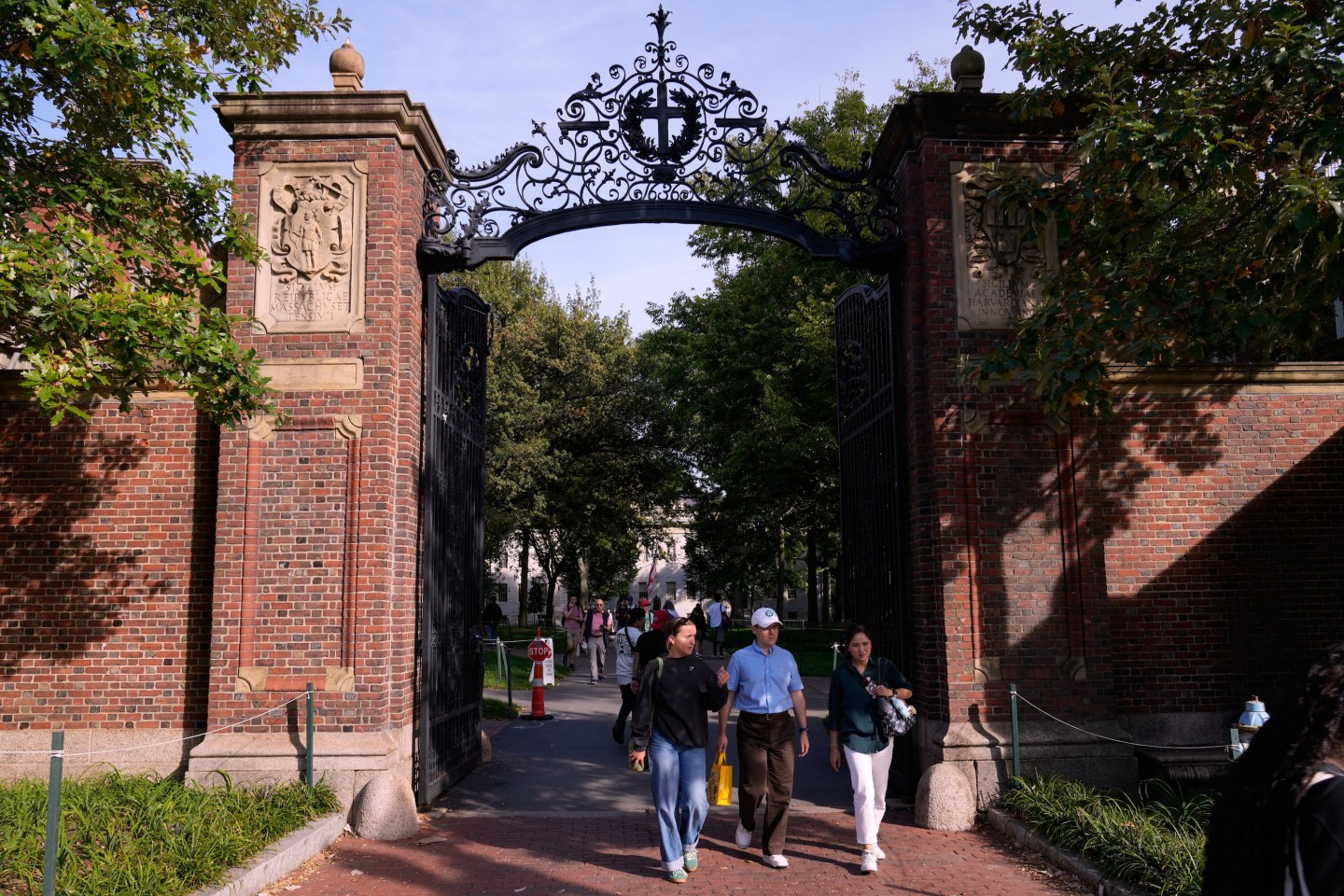
Higher education is undergoing an identity crisis. Repeated attacks from the Trump administration, the rise of AI and budget shortfalls have put top universities on the defensive as public sentiment on the value of a college degree sours. But a new trend in company hiring suggests that elite colleges aren’t losing their edge anytime soon.
A 2025 survey of over 150 companies found that more than a quarter, 26%, were recruiting from a brief selection of schools, up from 17% that were doing the same in 2022, according to recruiting intelligence firm Veris Insights, which conducted the research.
Even most of the surveyed companies that weren’t recruiting from a shortlist of universities said they were focusing on “target schools,” while also accepting applications from a list of other schools. That means candidates from prestigious universities that are located close to a company’s headquarters are typically given priority, according to Chelsea Schein, Veris’s vice president of research strategy, the Wall Street Journal reported.
“Employers are increasingly turning to degree and GPA in a hiring decision,” Schein told Fortune. “There’s an increasing recognition among employers that they can be more targeted in their approach.”
“Talent is everywhere” hiring seems to have fallen out of style for many reasons, according to entry-level recruiters. For one, it’s expensive. It takes high sums to set up meetings with candidates and get recruiters to campuses across the country. Further, AI-generated résumés have made many applications appear identical, causing some recruiters to fall back on university prestige to distinguish candidates. And for many companies, DEI is no longer a priority.
This hiring trend harkens back to pre-pandemic days and the tight labor market of 2018 and 2019, when firms prioritized in-person interaction, according to researchers specializing in entry-level recruitment. Today, most firms recruit from about 30 colleges out of 4,000 universities, looking first at elite colleges and then schools nearby a company’s corporate offices as companies seek to recruit candidates for in-person work.
This trend is evident among top firms. Once accustomed to multiple passes through 45 to 50 schools per year, GE Appliances has resigned to four or five events per semester at just 15 institutions.
Financial technology firm Bill says it is focused on recruiting from colleges near its corporate offices in San Jose, Calif., and Draper, Utah.
McKinsey, the prominent New York-based consulting firm, is “recommitting to a high-touch process,” hosting in-person events with alumni who work at the company at a shortlist of 20 universities, according to Blair Ciesil, a McKinsey recruiting partner. The announcement comes after the firm axed language on its career page that said, “We hire people, not degrees.”
The tides may be turning for higher education
This trend may lend a much-needed competitive edge to elite institutions as sentiment toward higher education sours. In 2025, just 35% of surveyed adults in the U.S. said that a college education was “very important.” That’s down from 70% in 2013. And just one-third of American voters said that a four-year degree was worth the cost over the same time period, according to NBC.
Yet enrollment in higher education is actually up. Despite skepticism of a four-year degree’s value proposition, institutions awarded nearly 2.2 million bachelor’s degrees in 2025, up from 1.6 million in 2010.
Some recruiters say college isn’t worth it, like recruitment agency Randstad CEO Sander van ’t Noordende, telling Fortune he believes people must “reflect on—taking a student loan, going to college and being trained or educated for a profession that is rapidly changing—whether that’s still the right path.” This comes as nearly half of Millennials and Gen Z say college was a waste of money, with Gen Z men feeling the impact most: their unemployment rate now matches that of Gen Z men without degrees.
For some, the payoff may still be worth it. College degree holders still earn more on average than those with just a high school degree. The college wage premium, or the earning’s gap between workers with a bachelor’s degree or higher and non-college-educated workers, sits at roughly 90%, according to the Federal Reserve of Cleveland. However, that number has plateaued over the past decade after rising steadily from the 1980s through the mid-2010s.
“I’d rather be a student with a degree than without a degree,” Schein said.
But even for students who enroll in the nearly 4,000 accredited institutions across the country, a bachelor’s degree may not be enough to grab the attention of some of the country’s top recruiters — unless it comes from an elite institution.