• Home
  • Latest
  • Fortune 500
  • Finance
  • Tech
  • Leadership
  • Lifestyle
  • Rankings
  • Multimedia
InvestingWarren Buffett

A vicious cycle beats a virtuous one: How Warren Buffett’s Geico fell behind Progressive in the auto insurance race

By
Adam Seessel
Adam Seessel
Down Arrow Button Icon
December 30, 2025, 7:30 AM ET
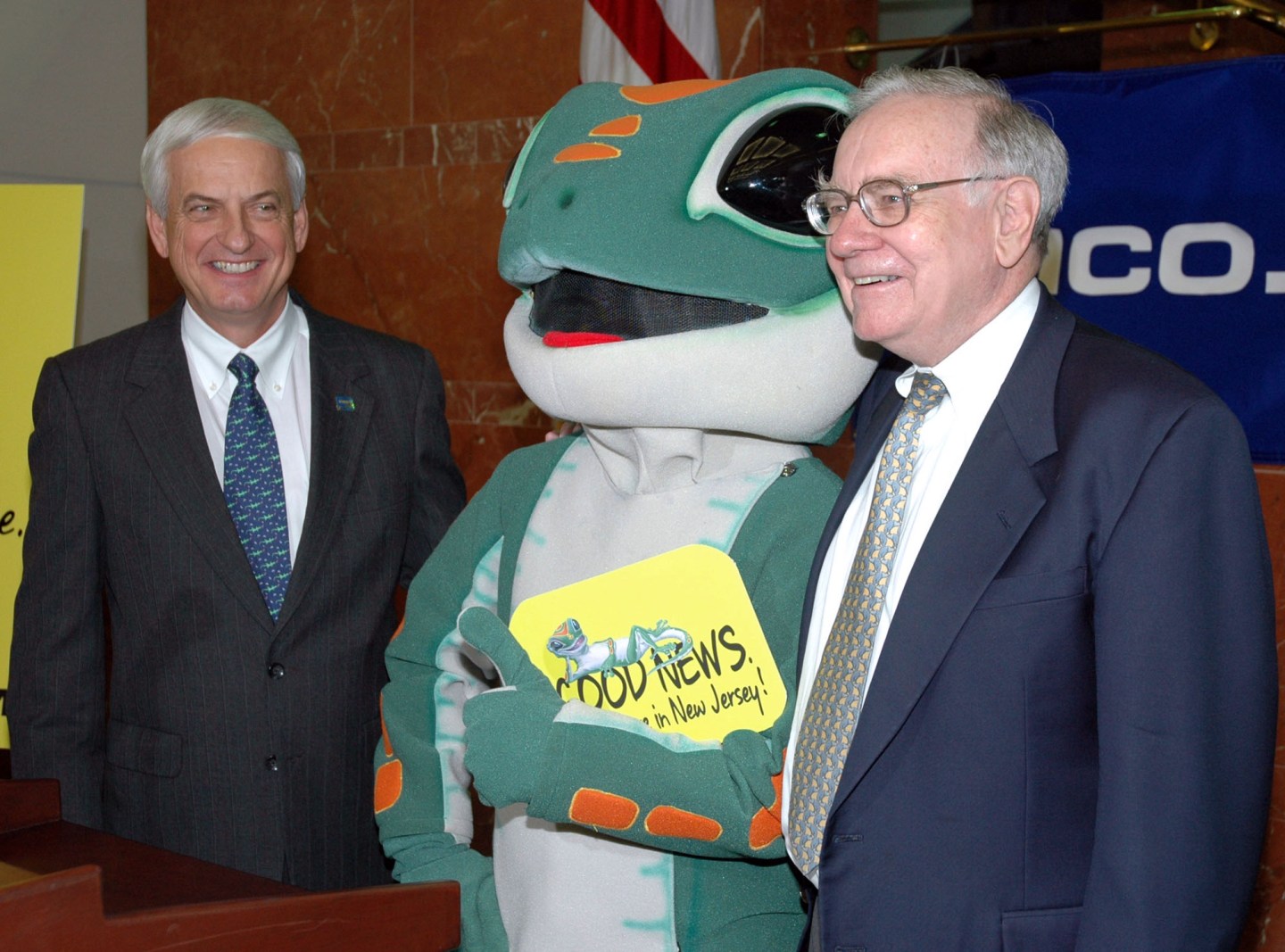
Warren Buffett and the Geico gecko.
Buffett with Geico's then-CEO Tony Nicely and the Geico gecko mascot at a 2004 event in New Jersey. Curt Hudson/Bloomberg—Getty Images

Warren Buffett’s failure to capitalize on the economy’s digital shift over the last two decades has hurt his otherwise enviable track record as an investor. His blind spot regarding tech didn’t stop at the stock market: It bled into how he ran Berkshire Hathaway’s operating companies as well. Across many of his wholly owned businesses, Buffett neglected technological upgrades, and Berkshire’s business value has suffered as a result.

Recommended Video

It’s important to understand this because the majority of Berkshire Hathaway’s assets are invested not in publicly traded securities, but in operating subsidiaries like Burlington Northern Santa Fe Railroad, Berkshire Hathaway Energy, and Geico. While it’s true that Buffett invested aggressively in wind energy, that was largely because of government tax incentives. In the main, he preferred to milk his operating subsidiaries for cash rather than reinvest in them for the digital age. Exhibit A is Geico, which thanks to a lack of IT investment has fallen behind Progressive as the nation’s leading for-profit auto insurer.

Buffett has called Geico his favorite child, and for good reason. Since it began in the 1930s, the auto insurer has used a direct-sales model to keep operating costs the lowest in the industry. In a commodity business like insurance, that’s a major competitive advantage. In the 1990s, after he bought all of Geico, Buffett found a second moat when he began to brand Geico as a trusted, even beloved American company. The gecko, the caveman, the camel who celebrated hump day—all these were marketing masterstrokes, ones directly derived from Buffett’s deep understanding of the mass brand-mass media industrial complex. The mascots also highlight how, while Buffett was comfortable investing in marketing, he was deeply uncomfortable with, and therefore didn’t understand, investing in tech.

When Buffett took control of Geico in 1996, he octupled its marketing budget. This wiped out almost all of Geico’s profits from a GAAP accounting standpoint, but Buffett was confident that increasing advertising outlays today would lead to more profitable customers tomorrow. And so it was: Under Buffett’s leadership, Geico’s market share grew from under 3% in 1996 to 12% in 2020, and it went from the No. 7 auto insurer to the #2 auto insurer, behind only State Farm.

So far, so good—but while Geico was investing in marketing, its rival Progressive was investing in technology. Founded only a year after Geico, Progressive began to upgrade its IT systems as early as the late 1970s. In the 1980s, it bought its agents computers and sent them floppy discs so they could better match price with risk. In 1996, Progressive became the first auto insurer to allow consumers to buy insurance online, and it continually streamlined its backend systems so that it could accurately quote new business. Today, Progressive brags that it has tens of billions of price points and that its tech stack allows the company to adjust its rates much faster than its competition—nearly once every business day. “We are a tech company that happens to sell insurance,” is one of Progressive’s internal mantras.

Driving the company’s tech investment was an insight that was perhaps even more astute than Buffett’s marketing insight. Thanks to its no-agent, no-commission model, Geico enjoyed a six-percentage-point cost advantage vs. Progressive in its operating costs. Because half of its business is through insurance agents, Progressive is unlikely ever to catch up here. But Progressive CEO Peter Lewis, who led the company from 1965 to 2000, understood that an auto insurer’s biggest cost center is the claims it must pay policyholders—four to five times bigger, in fact, than its administrative and advertising costs. If Progressive could manage these “loss costs” better than the competition, Lewis reasoned, then it could become the de facto low-cost auto insurer. 

The key to managing loss costs was technology in all its glorious variety. Back-end systems at headquarters that could parse price and risk for each driver were important, but so were front line innovations like Snapshot, a shoebox-sized device that in the 1990s Progressive began installing into the cars of willing customers. Snapshot, now an app on your mobile phone, tracks a customer’s driving behavior; more than one in three Progressive customers buying insurance directly from the company opts in for “usage-based” premiums. Thanks to Snapshot and other innovations, Progressive simply knows more about its drivers than any other insurer, and this creates a virtuous circle in which the company knows which to reward with discounts, which to punish with surcharges, and which to purge altogether. 

Thus, while Progressive’s operating costs have historically been six points worse than Geico, its loss costs have been 11 points better, which means that Geico’s low-cost moat has been breached by tech. In contrast to Progressive’s streamlined system, Geico has more than 600 legacy IT systems. It didn’t start working on a Snapshot-like product until 2019, twenty years after Progressive began. 

Buffett liked to say that when the tide goes out, you see who’s swimming naked, and COVID was the perfect storm to reveal how little Geico had paid attention to its digital wardrobe. During COVID, people suddenly stopped driving, and then, when the pandemic ended, they drove more than ever and more recklessly than ever. At the same time, the worst inflation in forty years hit all sectors of the economy, including auto-repair shops. Such rapidly changing conditions favored insurers with robust tracking tools, like Progressive, and punished insurers without them, like Geico. Since 2020, Progressive has almost doubled its personal auto policy count—but Geico has lost nearly 15% of its personal insurance base. Progressive, not Geico, is now the nation’s number two auto insurer.

It turns out that while the branding of the gecko was important, it wasn’t nearly as powerful as employing sophisticated digital tools. Geico is a good example of what happens when a company, even a powerful one, fails to reinvest in its future. Rather than a virtuous cycle—tech investment leading to better pricing and better products, which drives more profits, which can then be reinvested to drive the cycle on—Geico seems caught in the same vicious cycle that afflicts General Motors, Macy’s and other legacy companies. 

Join us at the Fortune Workplace Innovation Summit May 19–20, 2026, in Atlanta. The next era of workplace innovation is here—and the old playbook is being rewritten. At this exclusive, high-energy event, the world’s most innovative leaders will convene to explore how AI, humanity, and strategy converge to redefine, again, the future of work. Register now.
About the Author
By Adam Seessel
See full bioRight Arrow Button Icon

Latest in Investing

Finance
Lorem ipsum dolor sit amet, consectetur adipiscing elit, sed do eiusmod tempor incididunt ut labore et dolore magna aliqua. Ut enim ad minim veniam
By Fortune Editors
October 20, 2025
Finance
Lorem ipsum dolor sit amet, consectetur adipiscing elit, sed do eiusmod tempor incididunt ut labore et dolore magna aliqua. Ut enim ad minim veniam
By Fortune Editors
October 20, 2025
Finance
Lorem ipsum dolor sit amet, consectetur adipiscing elit, sed do eiusmod tempor incididunt ut labore et dolore magna aliqua. Ut enim ad minim veniam
By Fortune Editors
October 20, 2025
Finance
Lorem ipsum dolor sit amet, consectetur adipiscing elit, sed do eiusmod tempor incididunt ut labore et dolore magna aliqua. Ut enim ad minim veniam
By Fortune Editors
October 20, 2025
Finance
Lorem ipsum dolor sit amet, consectetur adipiscing elit, sed do eiusmod tempor incididunt ut labore et dolore magna aliqua. Ut enim ad minim veniam
By Fortune Editors
October 20, 2025
Finance
Lorem ipsum dolor sit amet, consectetur adipiscing elit, sed do eiusmod tempor incididunt ut labore et dolore magna aliqua. Ut enim ad minim veniam
By Fortune Editors
October 20, 2025

Most Popular

Finance
Lorem ipsum dolor sit amet, consectetur adipiscing elit, sed do eiusmod tempor incididunt ut labore et dolore magna aliqua. Ut enim ad minim veniam
By Fortune Editors
October 20, 2025
Finance
Lorem ipsum dolor sit amet, consectetur adipiscing elit, sed do eiusmod tempor incididunt ut labore et dolore magna aliqua. Ut enim ad minim veniam
By Fortune Editors
October 20, 2025
Finance
Lorem ipsum dolor sit amet, consectetur adipiscing elit, sed do eiusmod tempor incididunt ut labore et dolore magna aliqua. Ut enim ad minim veniam
By Fortune Editors
October 20, 2025
Finance
Lorem ipsum dolor sit amet, consectetur adipiscing elit, sed do eiusmod tempor incididunt ut labore et dolore magna aliqua. Ut enim ad minim veniam
By Fortune Editors
October 20, 2025
Finance
Lorem ipsum dolor sit amet, consectetur adipiscing elit, sed do eiusmod tempor incididunt ut labore et dolore magna aliqua. Ut enim ad minim veniam
By Fortune Editors
October 20, 2025
Finance
Lorem ipsum dolor sit amet, consectetur adipiscing elit, sed do eiusmod tempor incididunt ut labore et dolore magna aliqua. Ut enim ad minim veniam
By Fortune Editors
October 20, 2025
Rankings
  • 100 Best Companies
  • Fortune 500
  • Global 500
  • Fortune 500 Europe
  • Most Powerful Women
  • Future 50
  • World’s Most Admired Companies
  • See All Rankings
Sections
  • Finance
  • Leadership
  • Success
  • Tech
  • Asia
  • Europe
  • Environment
  • Fortune Crypto
  • Health
  • Retail
  • Lifestyle
  • Politics
  • Newsletters
  • Magazine
  • Features
  • Commentary
  • Mpw
  • CEO Initiative
  • Conferences
  • Personal Finance
  • Education
Customer Support
  • Frequently Asked Questions
  • Customer Service Portal
  • Privacy Policy
  • Terms Of Use
  • Single Issues For Purchase
  • International Print
Commercial Services
  • Advertising
  • Fortune Brand Studio
  • Fortune Analytics
  • Fortune Conferences
  • Business Development
About Us
  • About Us
  • Editorial Calendar
  • Press Center
  • Work At Fortune
  • Diversity And Inclusion
  • Terms And Conditions
  • Site Map

© 2025 Fortune Media IP Limited. All Rights Reserved. Use of this site constitutes acceptance of our Terms of Use and Privacy Policy | CA Notice at Collection and Privacy Notice | Do Not Sell/Share My Personal Information
FORTUNE is a trademark of Fortune Media IP Limited, registered in the U.S. and other countries. FORTUNE may receive compensation for some links to products and services on this website. Offers may be subject to change without notice.


Most Popular

placeholder alt text
Success
Gen Z could wave goodbye to résumés because most companies have turned to skills-based recruitment—and find it more effective, research shows
By Orianna Rosa RoyleDecember 29, 2025
1 day ago
placeholder alt text
Arts & Entertainment
Gen Zers and millennials flock to so-called analog islands 'because so little of their life feels tangible'
By Michael Liedtke and The Associated PressDecember 28, 2025
2 days ago
placeholder alt text
Success
MacKenzie Scott's close relationship with Toni Morrison long before Amazon put her on the path give more than $1 billion to HBCUs
By Sasha RogelbergDecember 28, 2025
2 days ago
placeholder alt text
Future of Work
Malcolm Gladwell tells young people if they want a STEM degree, 'don’t go to Harvard.' You may end up at the bottom of your class and drop out
By Sasha RogelbergDecember 27, 2025
3 days ago
placeholder alt text
AI
'Godfather of AI' Geoffrey Hinton predicts 2026 will see the technology get even better and gain the ability to 'replace many other jobs'
By Jason MaDecember 28, 2025
2 days ago
placeholder alt text
Banking
Former Russian banking billionaire says an Instagram post cost him $9 billion: His company was sold for 3% of its value in 'hostage' situation
By Nick LichtenbergDecember 29, 2025
23 hours ago

Latest in Investing

Elon Musk
CommentaryCorporate Governance
Corporate board service isn’t charity. It’s risk capital
By Jane SadowskyDecember 30, 2025
3 hours ago
Warren Buffett and the Geico gecko.
InvestingWarren Buffett
A vicious cycle beats a virtuous one: How Warren Buffett’s Geico fell behind Progressive in the auto insurance race
By Adam SeesselDecember 30, 2025
4 hours ago
Bill Gates and Warren Buffett.
InvestingWarren Buffett
Warren Buffett’s blind spot: Did the digital economy leave him behind?
By Adam SeesselDecember 30, 2025
4 hours ago
InnovationRobots
Silicon Valley summit offers rare insight into humanoid robots—and China is the clear winner
By Matt O'Brien and The Associated PressDecember 29, 2025
19 hours ago
Businesswoman reading a book on private jet while drinking champagne
SuccessBillionaires
The world’s wealthiest families adopt these 7 key habits for success, according to JPMorgan
By Preston ForeDecember 29, 2025
24 hours ago
Investingprecious metals
Silver pulls back after topping $80 in historic year-end rally
By Robin Paxton and BloombergDecember 28, 2025
2 days ago