
In late October, mortgage giant Fannie Mae announced its CEO Priscilla Almodovar was stepping down. The next day, defense contractor SAIC said it was parting ways with its CEO Toni Townes-Whitley. The following month, Walmart appointed its new CEO. and it was not chief executive of its international division, Kath McLay, who was thought to be a candidate.
CEO exits and chief executive contenders not getting the top job are normal machinations of corporate C-Suites, but this year they’ve added up to a stark trend: the number of female CEOs in the Fortune 500, long on a steady climb, has plateaued, underscoring a broader trend in which corporate workplaces seem to be pushing women to the margins once again. In the new year, the Fortune 500, the largest U.S. companies by revenue, will have 54 women CEOs, one fewer than it had when the 2025 Fortune 500 list was published in June.
Women’s momentum in gaining board seats has also slowed. Their share of board seats in the Russell 3000 and S&P 500 reached 30.3% and 34.3%, respectively, both records, according to The Conference Board. But the 0.1 percentage point year-over-year increase in women’s representation on Russell 3000 boards in the second quarter was the smallest uptick in over a decade, according to 50/50 Women on Boards and its data partner Equilar. At the same time, women’s share of new board appointments is declining. In the third quarter, women made up 22.5% of 448 new board seats in the Russell 3000, the lowest rate in more than ten years. “At this pace, the overall percentage of women on boards may begin to decline in upcoming quarters,” a Women on Boards report says.
Ironically, part of the problem women are facing nowadays is that it’s no longer extraordinary for them to be in positions of leadership. But that has meant companies are deprioritizing—consciously or not—efforts that helped women get to where they are today. They may assume there’s a healthy pipeline of talent based on where we are today. Says Jane Edison Stevenson, global vice chair of board and CEO services at Korn Ferry, an organizational consulting firm: “If there isn’t a specific intentionality about making sure that spots are filled by women, then we could lose ground.”
Slow-walking succession planning
It would be easy to blame the slowdown in female leadership gains on companies removing or at least rebranding their diversity, equity and inclusion policies amid the Trump’s administration’s attack on DEI.
And to some extent, that may be true, says Heather Spilsbury, CEO of 50/50 Women on Boards, a nonprofit focused on gender balance on corporate boards.
“There was a lot of angst with how companies were going to move forward this year, especially if they had government funding. That included what their board makeup looked like and how they recruited for board members and how they recruited for leadership as well,” says Spilsbury.
But at the board level, Spilsbury also places blame on companies slow-walking succession planning amid economic uncertainty. This year, companies have contended with on-again off-again tariffs, an immigration and worker visa crackdown, nagging inflation, and fickle consumers, all of which contribute to a sense of unease. In such environments, “companies tend to sit still in terms of advancing or looking at their leadership model,” says Spilsbury. “If you’re not looking for new talent outside of your own threshold or your own board, it becomes very limited in terms of who’s being appointed to a board and where you’re searching for expertise. That’s where you see the progress stall; when companies aren’t really paying attention to that or it’s not their priority.”
The Conference Board reports that board turnover and election of new directors slowed in 2025. Women recorded a net gain of 47 board seats in the Russell 3000 in 2025, compared to 258 in 2024 and 342 in 2023, and 59% of women’s board seat gains in 2025 came from expanding board size rather than replacing an existing male director.
‘Survival of the fittest’ for CEO hopefuls
CEO turnover overall is also slowing this year (down 3.5% through October compared to last year), and women are getting a smaller share of the new jobs that are available. Through October, 25.5% of new CEOs at U.S. firms were women this year, down from 26.4% for the same period last year and 3.2 percentage points off the peak of 28.7% for all of 2023, according to outplacement firm Challenger, Gray & Christmas, which tracks CEO turnover at U.S. companies in business at least two years with at least 10 employees. “It is the lowest rate for women rising to the CEO role since 2020, when 23% of new CEOs were women,” Challenger’s latest report says.
In the smaller universe of the Fortune 500, 52 women are currently CEOs, with that sum set to jump to 54 in the first quarter of 2026, one off from the high of 55 set in June 2025.
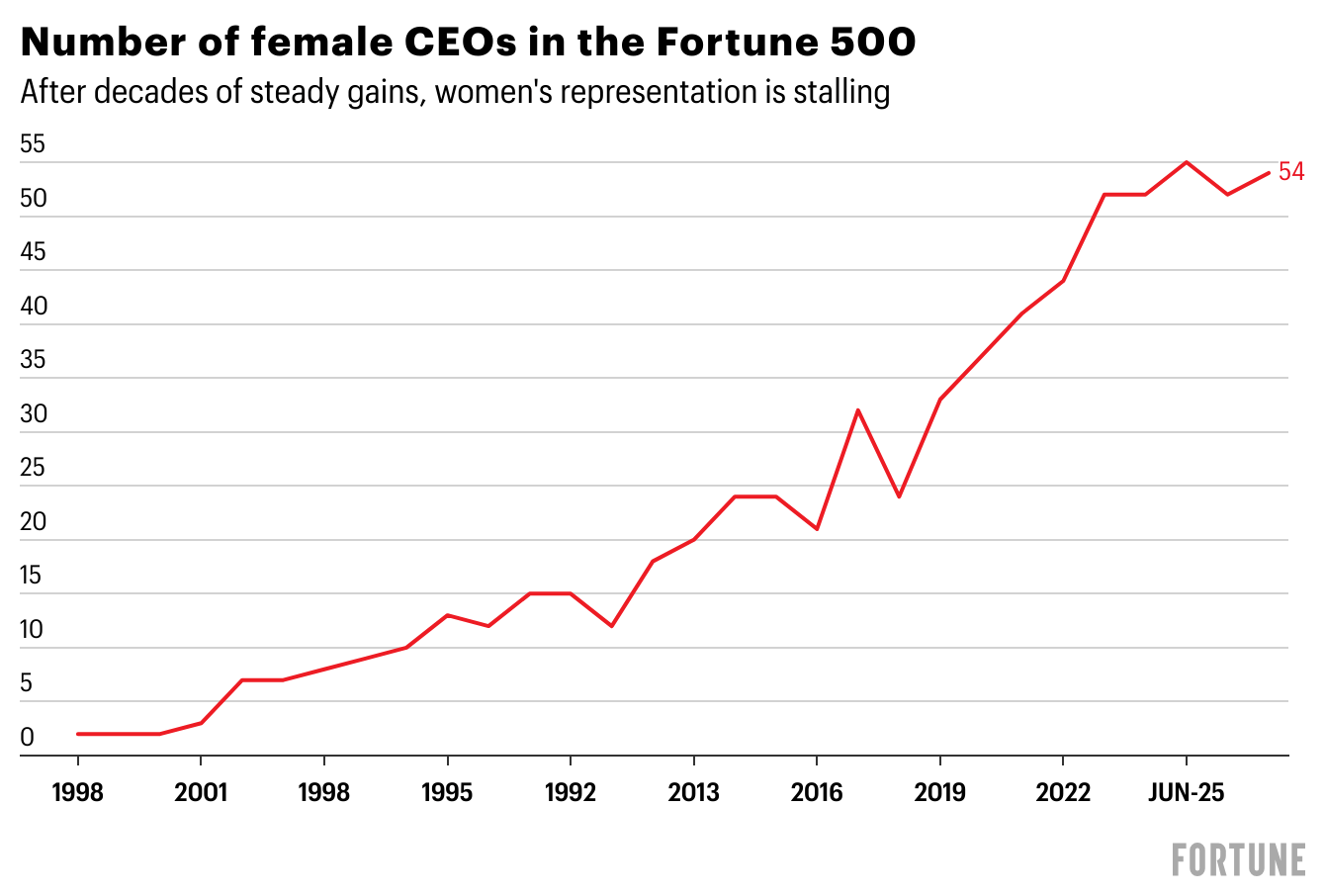
Women reaching the milestone of 10%-plus representation among Fortune 500 CEOs, first achieved in 2023, was hard won. One catalyzing force was corporate management programs that spotted and developed the female leaders who have occupied the C-suite for the last decade or so, says Stevenson. Such programs prepared women to fill “profit and loss” or P&L roles that have accountability for a company’s bottom line, an essential credential for any C-suite hopeful.
But as the current generation of female executives ages out of their jobs, Stevenson says many companies have dismantled those formal, centralized leadership development programs due to their cost and delayed pay-off and because talent job-hops more than it used to. “Our patience isn’t what it once was around development,” she says.
In what may be a sign of the shift, some Fortune 500 companies have offloaded their corporate campuses where management training took place: GE sold its storied Crotonville management academy as it split into three companies, 3M sold its Wonewok retreat in northern Minnesota, and Boeing sold its 285-acre leadership center near St. Louis. A recent survey found that large employers, with 10,000 or more employees, cut average training expenditures by 12% to $11.7 million in 2025. Two in 10 employers, meanwhile, say they are placing little or no priority on women’s career advancement, according to McKinsey and LeanIn.org’s 2025 Women in the Workplace report; the share increases to three in 10 for women of color’s advancement.
“Now almost no organization has a meaningful management development track, and so it’s very much survival of the fittest,” Stevenson says. “It’s a problem in general, and it’s especially a problem for women.”
By at least one measure, the share of women in P&L roles has increased. In the S&P 100, women in P&L jobs jumped from 20% in 2022 to 24% last year. But women remain severely underrepresented in the CEO-feeder positions and overrepresented in C-Suite jobs that rarely translate to the corner office, like CHRO, 72% of whom were women in 2024. And recent research shows that many women who land P&L jobs are doing so too late for it to alter their career trajectories.
“Just in general, CEO readiness is at an all-time low,” Stevenson said.
Employers are also rolling back other programs that tend to help working women. Thirteen percent of employers scaled back or discontinued flexible work arrangements this year while 25% reduced or eliminated remote or hybrid work options, according to McKinsey.
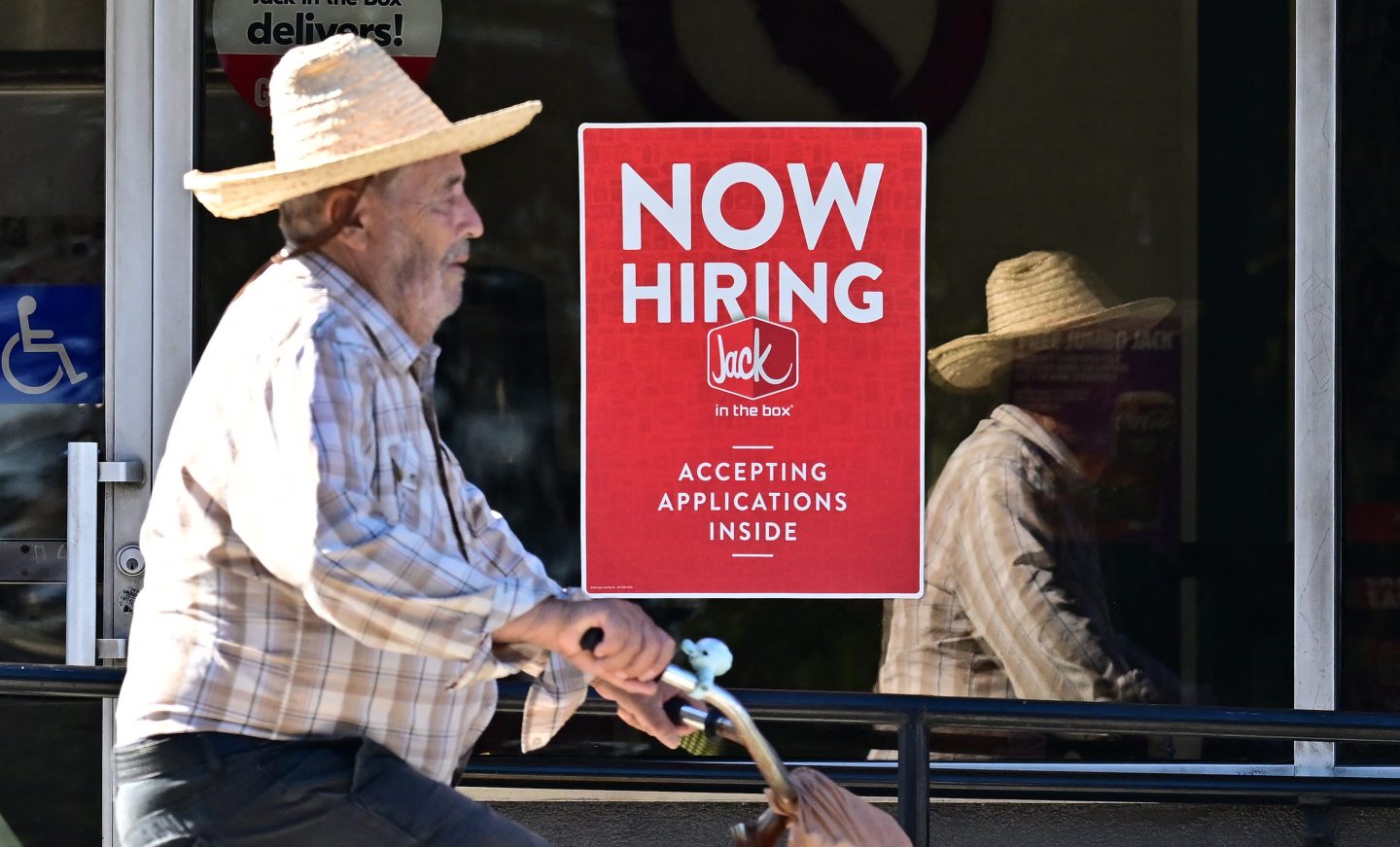
The reversal of such women-friendly workplace policies may be forcing some women out of the workforce. In November, 54.8% of working-age women were employed, down from 55.2% in January, according to the Bureau of Labor Statistics. Unemployment among women has ticked up alongside the overall rate; it reached 4.5% last month; for Black women it was 7.1%.
Meanwhile, female CEOs are leaving their jobs at a faster clip this year. The rate of outgoing women CEOs is 23% through October, compared to 21% during the same period last year, according to Challenger.
New Fortune 500 CEO promotions
There are a few bright spots at the individual level, of course. In the first quarter of 2026, three women will assume Fortune 500 CEO jobs (Natascha Viljoen at Newmont, Lisa Atheton at Textron, and Mindy West at Murphy USA) to bring the total number to 54 (as Insight CEO Joyce Mullen retires). Outside the Fortune 500, Meg O’Neill will become CEO of London-based BP in April, the first woman to ever lead a Big Oil firm.
But the outlook for a long-term surge in women’s representation among CEOs—at the corporate level, at least—is not great. The McKinsey study found that women, while just as dedicated to their jobs as men, are less likely to aspire to a promotion. At the entry level, 80% of men want to be promoted compared to 69% of women. At the senior level, the split is 92%-84%.
Stevenson has a message for employers: rededicate yourself to developing promising women and members of other underrepresented groups into competent leaders. It’s a matter of using every resource available to improve a business. “We have a huge dearth of great leadership, and we have these categories of people …that could be the incremental difference,” she says. “What asset of any kind, if you had it available, would you not use? If you had oil that was available, you would use it. If you have money available, you use it. Women are an available resource that are being underutilized.” But in corporate and political environments that are nosier than ever, it’s uncertain whether companies will listen.