• Home
  • Latest
  • Fortune 500
  • Finance
  • Tech
  • Leadership
  • Lifestyle
  • Rankings
  • Multimedia
EnergyVenezuela

A U.S. oil blockade on Venezuela could ‘devastate’ its economy and further pressure Maduro. But how far is Trump willing to take it?

Jordan Blum
By
Jordan Blum
Jordan Blum
Editor, Energy
Down Arrow Button Icon
Jordan Blum
By
Jordan Blum
Jordan Blum
Editor, Energy
Down Arrow Button Icon
December 17, 2025, 2:58 PM ET
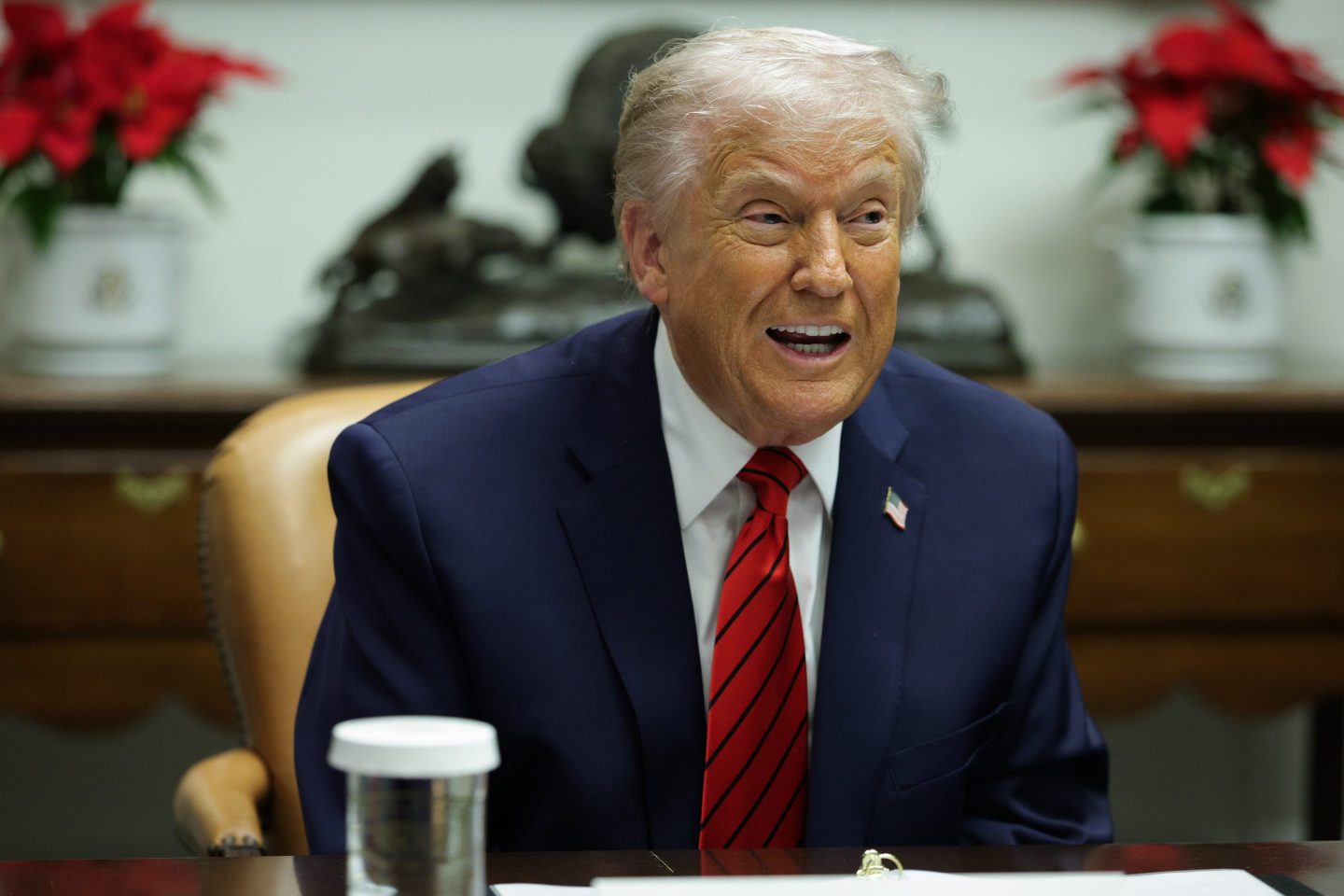
U.S. President Donald Trump speaks during a roundtable discussion with top business leaders in the Roosevelt Room at the White House on December 10, 2025 in Washington, DC. During the roundtable, Trump addressed questions on the Federal Reserve’s latest decision to cut interest rates and reports that the U.S. seized an oil tanker off the coast of Venezuela, among other topics.
President Donald Trump at a roundtable discussion with top business leaders in the Roosevelt Room at the White House, Dec. 10, 2025, in Washington, D.C. Alex Wong—Getty Images

Now that the U.S. has seized a Venezuelan oil tanker and President Donald Trump has declared an oil blockade, the results could “devastate” Venezuela’s struggling economy and put further pressure on President Nicolás Maduro and possible regime change, according to geopolitical and energy analysts.

The big question is how far the U.S. will take the sanctioned oil tanker blockade—Trump’s social media announcement was scant on details—and for how long, because it is unlikely Maduro would willingly step down in the near future, said Francisco Monaldi, director of the Latin America Energy Program at Rice University’s Baker Institute for Public Policy.

“This could be devastating. We’re talking about an economy where more than 80%—perhaps north of 90%—of the foreign exchange revenues for the government comes from oil. The oil is absolutely dominant,” Monaldi said, noting that Venezuela’s only other meaningful exports are modest mining and seafood industries.

The questionably legal effort—a blockade is historically an “act of war”—could result in “hyperinflation” within Venezuela, a further weakening of its currency, an economic recession, and a fuel shortage for its citizenry, he said.

Venezuela is home to the world’s largest proven oil reserves, but the country produces less than 1% of global oil production. Venezuela’s volumes have plunged from 3.2 million barrels daily in 2000 down to less than 1 million barrels today under the authoritarian socialist regimes of Maduro and his predecessor, Hugo Chávez, from a combination of mismanagement, underinvestment, and escalating U.S. sanctions.

Citing national security concerns over drug trafficking, the U.S. has bombed many boats from Venezuela—again under questionable legal authority—killing more than 80 people thus far, according to the U.S. military. Last week, the U.S. escalated the conflict by seizing the sanctioned oil tanker Skipper for allegedly making repeated, illegal shipments of Venezuelan and Iranian oil. 

Trump went further late on Dec. 16, posting on social media that he is “ordering A TOTAL AND COMPLETE BLOCKADE OF ALL SANCTIONED OIL TANKERS going into, and out of, Venezuela.”

“Venezuela is completely surrounded by the largest Armada ever assembled in the History of South America,” Trump stated. “It will only get bigger, and the shock to them will be like nothing they have ever seen before—Until such time as they return to the United States of America all of the Oil, Land, and other Assets that they previously stole from us.”

Trump is presumably referencing the 2007 expropriation of Venezuela’s oil assets from foreign companies, including Exxon Mobil and ConocoPhillips, under Chávez.

The U.S. State and Defense departments declined comment, and the White House did not respond to multiple requests for comment.

Although the administration has focused on drug trafficking concerns, Trump personally told assembled media late Dec. 17 he wants the oil back that was expropriated during the George W. Bush’s second term.

“Getting land, oil rights, whatever we had. They took it away because we had a president that maybe wasn’t watching,” Trump said. “But they’re not going to do that. We want it back. They took our oil rights. We had a lot of oil there. They threw our companies out, and we want it back.”

Regardless, it shouldn’t take too long to figure out how this will play out.

“In a blockade, it’s very easy to identify an oil vessel,” Monaldi said. “We will see how they move from the rhetoric of the present to the actual implementation of policy.”

Logistical questions abound

Trump’s statement specifically cited “sanctioned” oil tankers, but last week’s seizure triggered the turnaround of most vessels away from Venezuela—with a few exceptions—even those that are not facing sanctions. The brave few that did not change course from Venezuela weren’t seized.

So the big questions now are whether the U.S. will only seize sanctioned tankers and whether the White House will add new sanctions to crude oil vessels that dock in Venezuela, Monaldi said.

“If not, it wouldn’t be a true blockade at all, because there are plenty of vessels in the dark fleet,” Monaldi said. “But if you sanction them while they’re loading the oil, then it is a blockade.”

The dark or shadow fleet is a clandestine network of older oil tankers working with sanctioned nations, such as Iran and Russia, that conceal their oil trips by disabling tracking, using fake identities, and other tactics. The oil tanker Skipper was a part of the dark fleet; it was formally sanctioned three years ago.

The bottom line is it’s expensive for the U.S. to seize tankers, including the logistics of transporting the tanker to Galveston, Texas, which is what happened to the Skipper. And new sanctions also take time and a lot of paperwork.

“We are already seeing a tremendous impact just because of the one seizure. We’re seeing vessels turning around that were coming to Venezuela,” Monaldi said. “If all that was happening with just one seizure and the signal they might do more, I would imagine this is going to be a very heavy deterrence. The discounts are going to get so high.”

Because of the preexisting sanctions on Venezuelan oil, about 80% of its exports go to China under heavy discounts.

Monaldi estimates the blockade could easily cut Venezuela’s oil exports in half, placing even greater discounts on the remaining exports. A little more than 15% of Venezuela’s exports go to the U.S. because of Chevron’s special license to operate in the country and partner with state oil company PDVSA.

“Is it possible that Maduro says to Chevron, ‘I’m not allowing you to take any more oil. Why would I allow you to get paid if I cannot benefit?’” Monaldi asked.

In a statement, Chevron spokesman Bill Turenne said, “Chevron’s operations in Venezuela continue without disruption and in full compliance with laws and regulations applicable to its business, as well as the sanctions frameworks provided for by the U.S. government.”

If Venezuela’s oil exports are halved or reduced even further, the country would quickly run out of oil storage and be forced to reduce its own oil production. Eventually turning those oil flows back on takes time and money—often about a year, Monaldi said.

Maduro likely would prioritize domestic refining and fuel production with the remaining supplies, he said, but fuel shortages could still become a factor, further inflaming the Venezuelan populace.

“Even when people get worried about gasoline scarcity, then gasoline scarcity appears because people rush to fill their tanks,” Monaldi said.

But Maduro will cling to power as long as he is able. And it is even possible he sees the blockade as a sign of weakness from Trump, Monaldi added.

“This could also signal to Maduro that [Trump] is not willing to go the military route.”

Join us at the Fortune Workplace Innovation Summit May 19–20, 2026, in Atlanta. The next era of workplace innovation is here—and the old playbook is being rewritten. At this exclusive, high-energy event, the world’s most innovative leaders will convene to explore how AI, humanity, and strategy converge to redefine, again, the future of work. Register now.
About the Author
Jordan Blum
By Jordan BlumEditor, Energy

Jordan Blum is the Energy editor at Fortune, overseeing coverage of a growing global energy sector for oil and gas, transition businesses, renewables, and critical minerals.

See full bioRight Arrow Button Icon

Latest in Energy

Finance
Lorem ipsum dolor sit amet, consectetur adipiscing elit, sed do eiusmod tempor incididunt ut labore et dolore magna aliqua. Ut enim ad minim veniam
By Fortune Editors
October 20, 2025
Finance
Lorem ipsum dolor sit amet, consectetur adipiscing elit, sed do eiusmod tempor incididunt ut labore et dolore magna aliqua. Ut enim ad minim veniam
By Fortune Editors
October 20, 2025
Finance
Lorem ipsum dolor sit amet, consectetur adipiscing elit, sed do eiusmod tempor incididunt ut labore et dolore magna aliqua. Ut enim ad minim veniam
By Fortune Editors
October 20, 2025
Finance
Lorem ipsum dolor sit amet, consectetur adipiscing elit, sed do eiusmod tempor incididunt ut labore et dolore magna aliqua. Ut enim ad minim veniam
By Fortune Editors
October 20, 2025
Finance
Lorem ipsum dolor sit amet, consectetur adipiscing elit, sed do eiusmod tempor incididunt ut labore et dolore magna aliqua. Ut enim ad minim veniam
By Fortune Editors
October 20, 2025
Finance
Lorem ipsum dolor sit amet, consectetur adipiscing elit, sed do eiusmod tempor incididunt ut labore et dolore magna aliqua. Ut enim ad minim veniam
By Fortune Editors
October 20, 2025

Most Popular

Finance
Lorem ipsum dolor sit amet, consectetur adipiscing elit, sed do eiusmod tempor incididunt ut labore et dolore magna aliqua. Ut enim ad minim veniam
By Fortune Editors
October 20, 2025
Finance
Lorem ipsum dolor sit amet, consectetur adipiscing elit, sed do eiusmod tempor incididunt ut labore et dolore magna aliqua. Ut enim ad minim veniam
By Fortune Editors
October 20, 2025
Finance
Lorem ipsum dolor sit amet, consectetur adipiscing elit, sed do eiusmod tempor incididunt ut labore et dolore magna aliqua. Ut enim ad minim veniam
By Fortune Editors
October 20, 2025
Finance
Lorem ipsum dolor sit amet, consectetur adipiscing elit, sed do eiusmod tempor incididunt ut labore et dolore magna aliqua. Ut enim ad minim veniam
By Fortune Editors
October 20, 2025
Finance
Lorem ipsum dolor sit amet, consectetur adipiscing elit, sed do eiusmod tempor incididunt ut labore et dolore magna aliqua. Ut enim ad minim veniam
By Fortune Editors
October 20, 2025
Finance
Lorem ipsum dolor sit amet, consectetur adipiscing elit, sed do eiusmod tempor incididunt ut labore et dolore magna aliqua. Ut enim ad minim veniam
By Fortune Editors
October 20, 2025
Fortune Secondary Logo
Rankings
  • 100 Best Companies
  • Fortune 500
  • Global 500
  • Fortune 500 Europe
  • Most Powerful Women
  • Future 50
  • World’s Most Admired Companies
  • See All Rankings
Sections
  • Finance
  • Fortune Crypto
  • Features
  • Leadership
  • Health
  • Commentary
  • Success
  • Retail
  • Mpw
  • Tech
  • Lifestyle
  • CEO Initiative
  • Asia
  • Politics
  • Conferences
  • Europe
  • Newsletters
  • Personal Finance
  • Environment
  • Magazine
  • Education
Customer Support
  • Frequently Asked Questions
  • Customer Service Portal
  • Privacy Policy
  • Terms Of Use
  • Single Issues For Purchase
  • International Print
Commercial Services
  • Advertising
  • Fortune Brand Studio
  • Fortune Analytics
  • Fortune Conferences
  • Business Development
  • Group Subscriptions
About Us
  • About Us
  • Editorial Calendar
  • Press Center
  • Work At Fortune
  • Diversity And Inclusion
  • Terms And Conditions
  • Site Map
Fortune Secondary Logo
  • About Us
  • Editorial Calendar
  • Press Center
  • Work At Fortune
  • Diversity And Inclusion
  • Terms And Conditions
  • Site Map
  • Facebook icon
  • Twitter icon
  • LinkedIn icon
  • Instagram icon
  • Pinterest icon

Latest in Energy

A commercial ship anchored off the coast of Dubai.
EnergyMiddle East
The war in Iran could lead to a ‘guaranteed global recession’ because of one chokepoint that is crucial to the world economy, analyst says
By Tristan BoveMarch 2, 2026
1 hour ago
Middle EastIran
Iran’s Islamic Revolutionary Guard controls a sprawling business empire that dominates the economy
By Jason MaMarch 2, 2026
2 hours ago
oil
Energyoil and gas
Oil prices spike above $70 per barrel as Iran’s Straight of Hormuz grows tangled
By David McHugh and The Associated PressMarch 2, 2026
7 hours ago
President Donald Trump (C) oversees "Operation Epic Fury"
Economynational debt
Trump’s action against Iran is yet another wobble for government debt, warns UBS
By Eleanor PringleMarch 2, 2026
8 hours ago
EuropeLetter from London
European markets slide as Iran ‘war trade’ joins the global AI ‘scare trade’
By Kamal AhmedMarch 2, 2026
8 hours ago
An intercepted projectile falls into the sea near Dubai's Palm Jumeirah archipelago on March 1, 2026. The United States and Israel launched strikes against Iran on February 28, killing Iran's supreme leader and top military leaders, prompting authorities to retaliate with strikes on Israel and US bases across the Gulf. (Photo by FADEL SENNA / AFP)
EnergyMarkets
Stocks enter global selloff but some on Wall Street are looking for assets that respond well to war
By Jim EdwardsMarch 2, 2026
9 hours ago

Most Popular

placeholder alt text
Economy
Your grandparents are the reason the U.S. isn't in a recession right now. That won't last forever
By Eleanor PringleMarch 1, 2026
1 day ago
placeholder alt text
Success
MacKenzie Scott's close relationship with Toni Morrison long before Amazon put Scott on the path to give more than $1 billion to HBCUs
By Sasha RogelbergMarch 1, 2026
1 day ago
placeholder alt text
Middle East
U.S. military gives Iran a taste of its own medicine with cheap copycat Shahed drones, while concern shifts to munitions supply in extended conflict
By Jason MaMarch 1, 2026
24 hours ago
placeholder alt text
Middle East
As Iran attacks Dubai, the tax-free haven for the global elite could see 'catastrophic' fallout — 'this can also send shockwaves globally'
By Jason MaMarch 1, 2026
1 day ago
placeholder alt text
AI
American schools weren’t broken until Silicon Valley used a lie to convince them they were—now reading and math scores are plummeting
By Sasha RogelbergMarch 1, 2026
24 hours ago
placeholder alt text
Health
Gen Z men are eating ‘boy kibble,’ the human equivalent to dog food, to load up on protein cheaply
By Jake AngeloMarch 1, 2026
1 day ago

© 2026 Fortune Media IP Limited. All Rights Reserved. Use of this site constitutes acceptance of our Terms of Use and Privacy Policy | CA Notice at Collection and Privacy Notice | Do Not Sell/Share My Personal Information
FORTUNE is a trademark of Fortune Media IP Limited, registered in the U.S. and other countries. FORTUNE may receive compensation for some links to products and services on this website. Offers may be subject to change without notice.