• Home
  • Latest
  • Fortune 500
  • Finance
  • Tech
  • Leadership
  • Lifestyle
  • Rankings
  • Multimedia
AIregulation

Actor Joseph Gordon-Levitt wonders why AI companies don’t have to ‘follow any laws’

Nick Lichtenberg
By
Nick Lichtenberg
Nick Lichtenberg
Business Editor
Down Arrow Button Icon
December 15, 2025, 2:06 PM ET
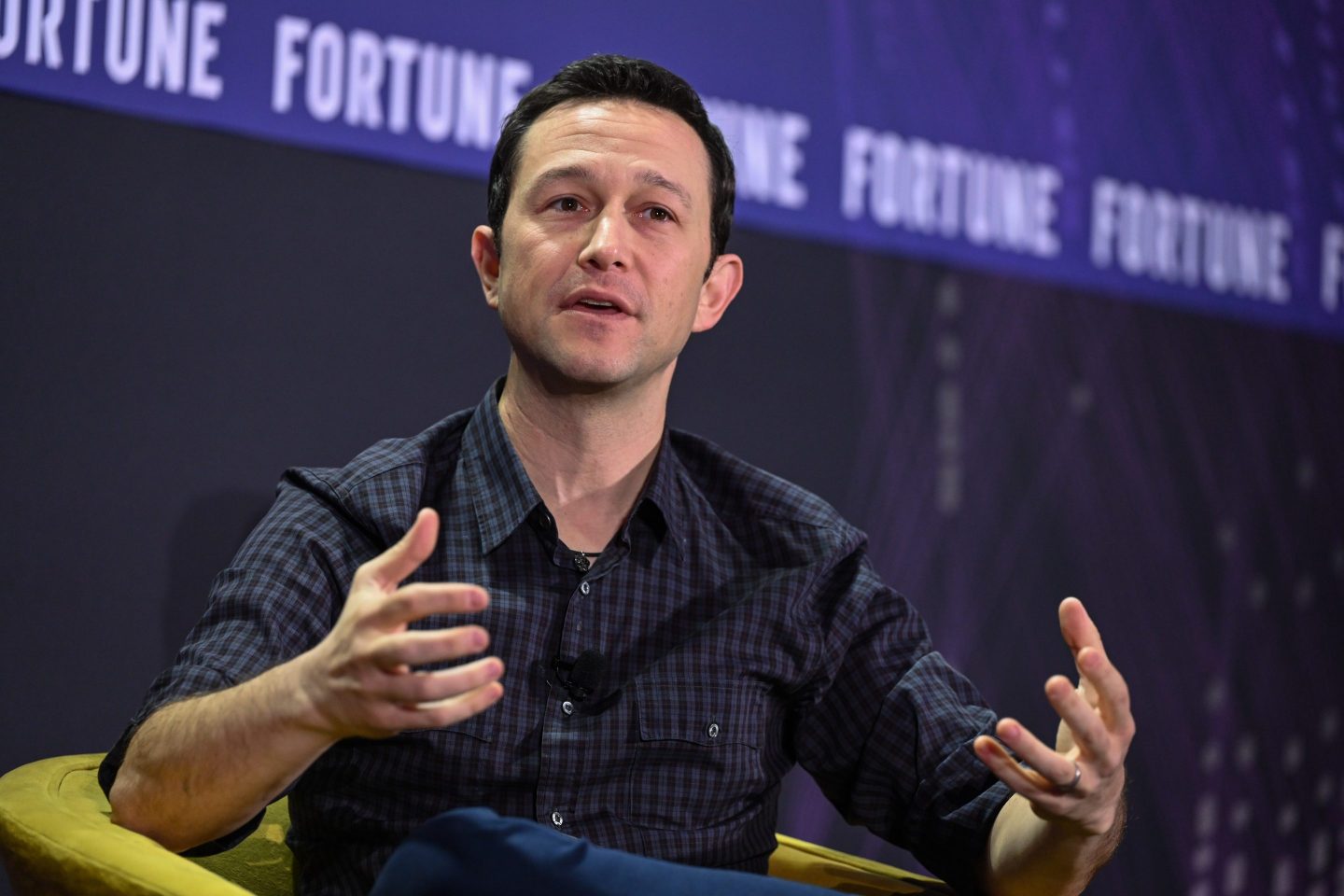
Joseph Gordon-Levitt at Fortune’s Brainstorm AI conference.
Joseph Gordon-Levitt at Fortune’s Brainstorm AI conference. Photograph by Stuart Isett/Fortune

In a sharp critique of the current artificial intelligence landscape, actor turned filmmaker turned (increasingly) AI activist Joseph Gordon-Levitt challenged the tech industry’s resistance to regulation, posing a provocative rhetorical question to illustrate the dangers of unchecked development: “Are you in favor of erotic content for 8-year-olds?”

Recommended Video

Speaking at the Fortune Brainstorm AI conference this week with editorial director Andrew Nusca, Gordon-Levitt used “The Artist and the Algorithm” session to pose another, deeper question: “Why should the companies building this technology not have to follow any laws? It doesn’t make any sense.”

In a broad-ranging conversation covering specific failures in self-regulation, including instances in which “AI companions” on major platforms reportedly verged into inappropriate territory for children, Gordon-Levitt argued relying on internal company policies rather than external law is insufficient, noting such features were approved by corporate ethicists.

Gordon-Levitt’s criticisms were aimed, in part, at Meta, following the actor’s appearance in a New York Times Opinion video series airing similar claims. Meta spokesperson Andy Stone pushed back hard on X.com at the time, noting Gordon-Levitt’s wife was formerly on the board of Meta rival OpenAI.

Gordon-Levitt argued without government “guardrails,” ethical dilemmas become competitive disadvantages. He explained that if a company attempts to “prioritize the public good” and take the “high road,” it risks being “beat by a competitor who’s taking the low road.” Consequently, he said he believes business incentives alone will inevitably drive companies toward “dark outcomes” unless there is an interplay between the private sector and public law.

‘Synthetic intimacy’ and children

Beyond the lack of regulation, Gordon-Levitt expressed deep concern regarding the psychological impact of AI on children. He compared the algorithms used in AI toys to “slot machines,” saying they use psychological techniques designed to be addictive.

Drawing on conversations with NYU psychologist Jonathan Haidt, Gordon-Levitt warned against “synthetic intimacy.” He argued that while human interaction helps develop neural pathways in young brains, AI chatbots provide a “fake” interaction designed to serve ads rather than foster development.

“To me it’s pretty obvious that you’re going down a very bad path if you’re subjecting them to this synthetic intimacy that these companies are selling,” he said.

Haidt, whose New York Times bestseller The Anxious Generation came recommended from Gordon-Levitt onstage, recently appeared at a Dartmouth–United Nations Development Program symposium on mental health among young people and used the metaphor of tree roots for neurons. Explaining tree-root growth is structured by environments, he brought up a picture of a tree growing around a Civil War–era tombstone. With Gen Z and technology, specifically the smartphone, he said: “Their brains have been growing around their phones very much in the way that this tree grew around this tombstone.” He also discussed the physical manifestations of this adaptation, with children “growing hunched around their phone,” as screen addiction is literally “warping eyeballs,” leading to a global rise in myopia shortsightedness.

The ‘arms race’ narrative

When addressing why regulations have been slow to materialize, Gordon-Levitt pointed to a powerful narrative employed by tech companies: the geopolitical race against China. He described this framing as “storytelling” and “hand-waving” designed to bypass safety checks. Companies often compare the development of AI to the Manhattan Project, arguing slowing down for safety means losing a war for dominance. In fact, the Trump administration’s “Genesis Mission” to encourage AI innovation was unveiled with similar fanfare just weeks ago in late November.

However, this stance met with pushback from the audience. Stephen Messer of Collective[i] argued Gordon-Levitt’s arguments were falling apart quickly in a “room full of AI people.” Privacy previously decimated the U.S. facial recognition industry, he said as an example, allowing China to take a dominant lead within just six months. Gordon-Levitt acknowledged the complexity, admitting “anti-regulation arguments often cherry-pick” bad laws to argue against all laws. He maintained that while the U.S. shouldn’t cede ground, “we have to find a good middle ground” rather than having no rules at all.

Gordon-Levitt also criticized the economic model of generative AI, accusing companies of building models on “stolen content and data” while claiming “fair use” to avoid paying creators. He warned a system in which “100% of the economic upside” goes to tech companies and “0%” goes to the humans who created the training data is unsustainable.

Despite his criticisms, Gordon-Levitt clarified he is not a tech pessimist. He said he would absolutely use AI tools if they were “set up ethically” and creators were compensated. However, he concluded that without establishing the principle that a person’s digital work belongs to them, the industry is heading down a “pretty dystopian road.”


Join us at the Fortune Workplace Innovation Summit May 19–20, 2026, in Atlanta. The next era of workplace innovation is here—and the old playbook is being rewritten. At this exclusive, high-energy event, the world’s most innovative leaders will convene to explore how AI, humanity, and strategy converge to redefine, again, the future of work. Register now.
About the Author
Nick Lichtenberg
By Nick LichtenbergBusiness Editor
LinkedIn icon

Nick Lichtenberg is business editor and was formerly Fortune's executive editor of global news.

See full bioRight Arrow Button Icon

Latest in AI

Finance
Lorem ipsum dolor sit amet, consectetur adipiscing elit, sed do eiusmod tempor incididunt ut labore et dolore magna aliqua. Ut enim ad minim veniam
By Fortune Editors
October 20, 2025
Finance
Lorem ipsum dolor sit amet, consectetur adipiscing elit, sed do eiusmod tempor incididunt ut labore et dolore magna aliqua. Ut enim ad minim veniam
By Fortune Editors
October 20, 2025
Finance
Lorem ipsum dolor sit amet, consectetur adipiscing elit, sed do eiusmod tempor incididunt ut labore et dolore magna aliqua. Ut enim ad minim veniam
By Fortune Editors
October 20, 2025
Finance
Lorem ipsum dolor sit amet, consectetur adipiscing elit, sed do eiusmod tempor incididunt ut labore et dolore magna aliqua. Ut enim ad minim veniam
By Fortune Editors
October 20, 2025
Finance
Lorem ipsum dolor sit amet, consectetur adipiscing elit, sed do eiusmod tempor incididunt ut labore et dolore magna aliqua. Ut enim ad minim veniam
By Fortune Editors
October 20, 2025
Finance
Lorem ipsum dolor sit amet, consectetur adipiscing elit, sed do eiusmod tempor incididunt ut labore et dolore magna aliqua. Ut enim ad minim veniam
By Fortune Editors
October 20, 2025

Most Popular

Finance
Lorem ipsum dolor sit amet, consectetur adipiscing elit, sed do eiusmod tempor incididunt ut labore et dolore magna aliqua. Ut enim ad minim veniam
By Fortune Editors
October 20, 2025
Finance
Lorem ipsum dolor sit amet, consectetur adipiscing elit, sed do eiusmod tempor incididunt ut labore et dolore magna aliqua. Ut enim ad minim veniam
By Fortune Editors
October 20, 2025
Finance
Lorem ipsum dolor sit amet, consectetur adipiscing elit, sed do eiusmod tempor incididunt ut labore et dolore magna aliqua. Ut enim ad minim veniam
By Fortune Editors
October 20, 2025
Finance
Lorem ipsum dolor sit amet, consectetur adipiscing elit, sed do eiusmod tempor incididunt ut labore et dolore magna aliqua. Ut enim ad minim veniam
By Fortune Editors
October 20, 2025
Finance
Lorem ipsum dolor sit amet, consectetur adipiscing elit, sed do eiusmod tempor incididunt ut labore et dolore magna aliqua. Ut enim ad minim veniam
By Fortune Editors
October 20, 2025
Finance
Lorem ipsum dolor sit amet, consectetur adipiscing elit, sed do eiusmod tempor incididunt ut labore et dolore magna aliqua. Ut enim ad minim veniam
By Fortune Editors
October 20, 2025
Rankings
  • 100 Best Companies
  • Fortune 500
  • Global 500
  • Fortune 500 Europe
  • Most Powerful Women
  • Future 50
  • World’s Most Admired Companies
  • See All Rankings
Sections
  • Finance
  • Leadership
  • Success
  • Tech
  • Asia
  • Europe
  • Environment
  • Fortune Crypto
  • Health
  • Retail
  • Lifestyle
  • Politics
  • Newsletters
  • Magazine
  • Features
  • Commentary
  • Mpw
  • CEO Initiative
  • Conferences
  • Personal Finance
  • Education
Customer Support
Commercial Services
  • Advertising
  • Fortune Brand Studio
  • Fortune Analytics
  • Fortune Conferences
  • Business Development
About Us
  • About Us
  • Editorial Calendar
  • Press Center
  • Work At Fortune
  • Diversity And Inclusion
  • Terms And Conditions
  • Site Map

Latest in AI

AItech stocks
Is the AI boom a bubble waiting to pop? Here’s what history says
By Henry Ren, Carmen Reinicke and BloombergJanuary 4, 2026
6 hours ago
AsiaTariffs and trade
Countries must move beyond seeing AI as a race, where one side must beat the other
By Boris Babic and Brian WongJanuary 3, 2026
1 day ago
data center
AIData centers
Angry town halls nationwide find a new villain: the data center driving up your electricity bill while fueling job-killing AI
By Marc Levy and The Associated PressJanuary 3, 2026
2 days ago
Sweden
CommentarySweden
Meet Sweden, the unicorn factory chasing America in the AI race
By Oscar TäckströmJanuary 3, 2026
2 days ago
Eric Schmidt sat in a white chair, speaking on a stage.
AIGoogle
How former Google CEO Eric Schmidt is motivated by Henry Kissinger to keep working past 70
By Jordan BlumJanuary 2, 2026
3 days ago
Eric Schmidt, former Google CEO, speaks during the Collision 2022 conference at Enercare Centre in Toronto, Canada.
AIElectricity
Google ex-CEO Eric Schmidt jumps into the AI data center business with a failed, 150-year-old Texas railroad turned oil giant
By Jordan BlumJanuary 2, 2026
3 days ago

© 2025 Fortune Media IP Limited. All Rights Reserved. Use of this site constitutes acceptance of our Terms of Use and Privacy Policy | CA Notice at Collection and Privacy Notice | Do Not Sell/Share My Personal Information
FORTUNE is a trademark of Fortune Media IP Limited, registered in the U.S. and other countries. FORTUNE may receive compensation for some links to products and services on this website. Offers may be subject to change without notice.


Most Popular

placeholder alt text
C-Suite
CEO of $90 billion Waste Management hauled trash and went to 1 a.m. safety briefings—‘It’s not always just dollars and cents’
By Amanda GerutJanuary 3, 2026
2 days ago
placeholder alt text
Economy
Mitt Romney says the U.S. is on a cliff—and taxing the rich is now necessary 'given the magnitude of our national debt'
By Dave SmithDecember 22, 2025
13 days ago
placeholder alt text
Future of Work
Bosses are fighting a new battle in the RTO wars: It's not about where you work, but when you work
By Nick LichtenbergJanuary 4, 2026
16 hours ago
placeholder alt text
Future of Work
Bank of America CEO says he hired 2,000 recent Gen Z grads from 200,000 applications, and many are scared about the future
By Ashley LutzJanuary 3, 2026
2 days ago
placeholder alt text
Future of Work
Meet the 'empowered non-complier': A certain kind of valuable worker who flouts return to office whenever they feel like it
By Nick LichtenbergJanuary 3, 2026
2 days ago
placeholder alt text
Politics
People in Venezuela didn't celebrate Maduro's capture out of fear of government repression, construction worker says
By Regina Garcia Cano, Megan Janetsky, Juan Arraez and The Associated PressJanuary 4, 2026
6 hours ago