

• Home
  • Latest
  • Fortune 500
  • Finance
  • Tech
  • Leadership
  • Lifestyle
  • Rankings
  • Multimedia

Trendingnow

1

Wyoming officials say Meta’s 715,000-square-foot data center is responsible for contaminating its water system with a rare bacterium

2

U.S. Treasury has borrowed $155 billion every month of this fiscal year—and is now paying $24 billion a week in interest on its debts

3

Billionaire MacKenzie Scott just donated $20 million to support America’s youth mental health, as a fifth of teens struggle with suicidal thoughts

1

Wyoming officials say Meta’s 715,000-square-foot data center is responsible for contaminating its water system with a rare bacterium

2

U.S. Treasury has borrowed $155 billion every month of this fiscal year—and is now paying $24 billion a week in interest on its debts

3

Billionaire MacKenzie Scott just donated $20 million to support America’s youth mental health, as a fifth of teens struggle with suicidal thoughts
AIConsulting

Deloitte’s CTO on a stunning AI transformation stat: Companies are spending 93% on tech and only 7% on people

Nick Lichtenberg
By
Nick Lichtenberg
Nick Lichtenberg
Business Editor
Down Arrow Button Icon
Nick Lichtenberg
By
Nick Lichtenberg
Nick Lichtenberg
Business Editor
Down Arrow Button Icon
December 15, 2025, 6:00 AM ET
Photo of Bill Briggs
Bill Briggs said that he’s seeing too much “institutional inertia” as companies try to fit AI into preexisting workflows rather than reimagine their processes holistically. courtesy of Deloitte
Add Fortune on Google for similar content.

In boardrooms around the globe, a specific anxiety is taking hold. It isn’t just the fear of robots taking jobs; it is the paralyzing worry of “buyer’s remorse” in a market moving at breakneck speed. According to Bill Briggs, Deloitte’s chief technology officer, as we move from AI experimentation to impact/value at scale, that fear is driving a lopsided investment strategy where companies are pouring 93% of their AI budget into technology and only 7% into the people expected to use it.

Recommended Video

Briggs highlighted this “93-7” split as something that really surprised him—and a critical error. Organizations are obsessing over the “ingredients”—the models, chips, and software—while ignoring the “recipe,” which includes the culture, workflow, and training required to make the technology work. Briggs compared this tech-heavy approach to “trying to get paella” but ending up with “just cilantro.”

Fortune was talking to Briggs at Deloitte’s New York City office, braving the holiday-shopping crowds at 30 Rockefeller Center, to discuss the firm’s 17th annual Tech Trends report, an initiative that Briggs has been a part of for nearly two decades. Back then, Briggs recalled, he was a senior manager, having been hired straight out of Notre Dame as part of a wide effort to bring a tech flair to what was then mostly a tax and audit firm. “Tech was a glint in the eye of what we might be doing more of in the future,” he recalled. The Tech Trends report came about when he was consulting with companies that were setting up CTO organizations, and Deloitte didn’t have one. “So I came back to our CEO, like, ‘Hey, we need this, regardless of if I play the role or not.’”

Briggs, who is based near Kansas City but is often back and forth to New York and all around the country, said this 93-7 split really surprised him. “I felt it in my travels, but I hadn’t been able to quantify it,” he said about this ratio. He likened it to every technology wave, when the easiest thing to do is apply the new tech to the way a company has always worked. “This incrementalism is a hard trap to get out of.”
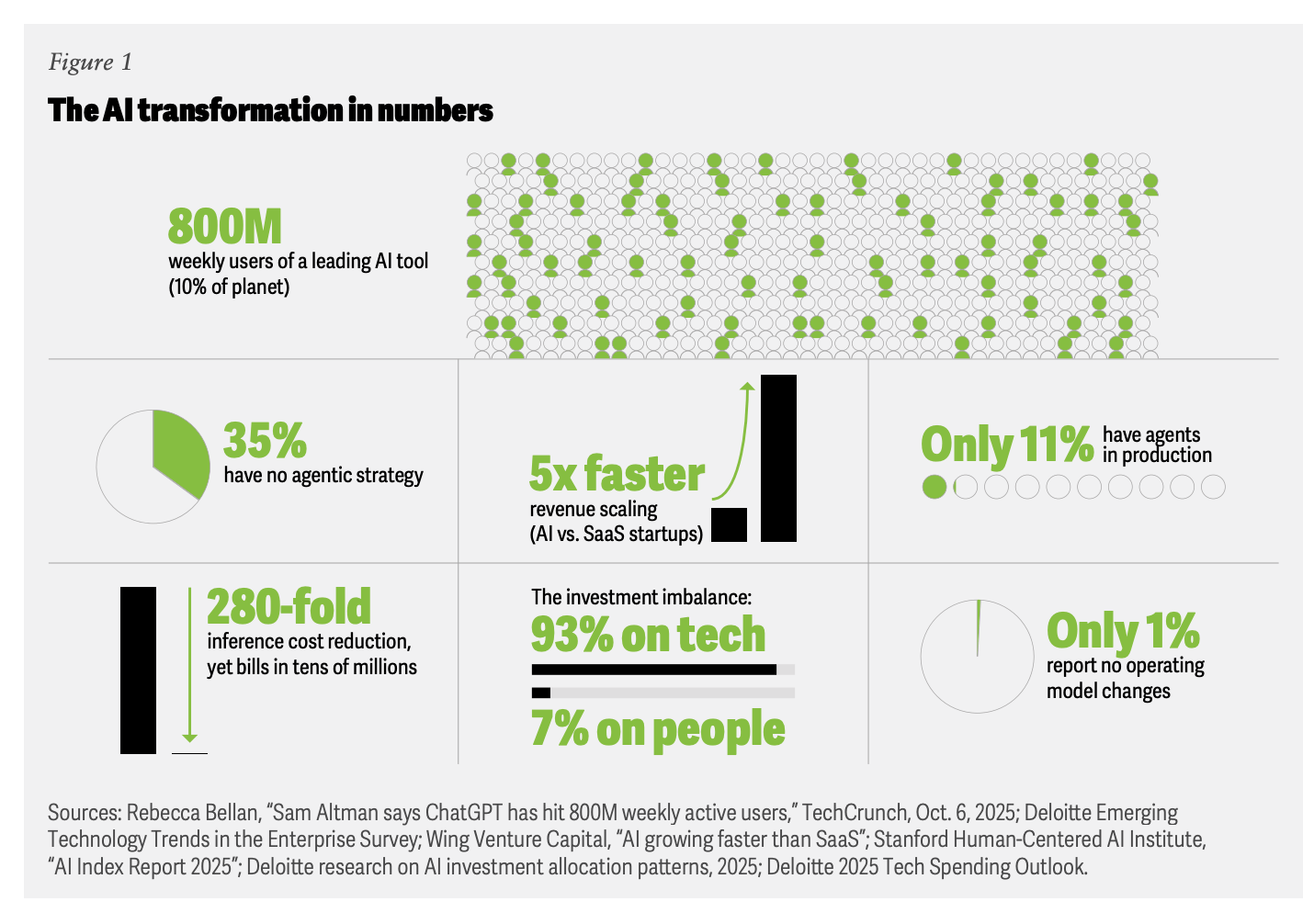
Although Briggs did not comment on whether companies are spending too much or too little on AI, he did say that he’s seeing too much “institutional inertia” winning the day as companies try to fit AI into preexisting workflows as if it is just another bolt-on, rather than reimagine their processes holistically. He recalled the famous quote from computer science legend Grace Hopper that the most damaging phrase of all is “We’ve always done it this way.” To succeed in this tech revolution, he argued, leaders will have to push through what’s comfortable, and that 93-7 ratio shows far too much leaning on the same old ways, when this moment calls for something new.

Briggs’s comments aligned with a massive global survey from consulting firm Protiviti, released the same week as his new Tech Trends report. In a briefing with journalists, Protiviti’s Fran Maxwell, who leads the HR consulting function globally, said simply that “HR functions and organizations are going to have to redesign jobs. That’s not necessarily a muscle that most functions have.” And, unintentionally echoing both Briggs and Hopper, he added: “You can’t solve today’s talent problems with yesterday’s talent.”

The consequence: loss of trust and rise of ‘shadow AI’

To correct the 93-7 imbalance, Briggs suggested a radical shift in how companies view AI agents. As organizations move from “carbon-based” to “silicon-based” employees (meaning a shift from humans to semiconductor chips, or robots), they must establish the equivalent of an HR process for agents, robots, and advanced AI, and complex questions about liability and performance management. This is going to be hard. He brought up the hypothetical of a human creating an agent, and that agent creating five more generations of agents. If wrongdoing occurs from the fifth generation, whose fault is that? “What’s a disciplinary action? You’re gonna put your line robot…in a timeout and force them to do 10 hours of mandatory compliance training?”

The consequences of ignoring the human side of the equation are already visible in the workforce. According to Deloitte’s TrustID report, released in the third quarter, despite increasing access to generative AI in the workplace, overall usage has actually decreased by 15%. Furthermore, a “shadow AI” problem is emerging: 43% of workers with access to gen AI admit to noncompliance, bypassing employer policies to use unapproved tools. This aligns with previous Fortune reporting on the scourge of shadow AI, as surveys show that workers at up to 90% of companies are using AI tools while hiding that usage from their IT departments.

Workers say these unauthorized tools are “easier to access” and “better and more accurate” than the approved corporate solutions. This disconnect has led to a collapse in confidence, with corporate worker trust in gen AI declining by 38% between May and July 2025. The data supports this need for a human-centric approach. Workers who received hands-on AI training and workshops reported 144% higher trust in their employer’s AI than those who did not.

The fear of ‘buyer’s remorse’

For CEOs and boards, the reluctance to address the cultural shift stems from a deeper fear that today’s investment will be obsolete by next week. Briggs noted that leaders are terrified of committing to a vendor only to face “buyer’s remorse” when a better model releases days later. “CEOs and boards, they’re scared because they don’t want to commit at the wrong time,” he said. It’s easy for them to delay committing to an AI tool because there could be another release next week, or the week after that.

Briggs likened this mentality to trying to time the stock market perfectly, but he argued that this hesitation is “almost like a pre-snap penalty” in sports. He insisted that the fastest path to progress is just getting started on a solution, regardless of how crowded the market is.

The urgency to fix this ratio is compounded by the arrival of “physical AI,” which moves beyond text generation to robotics and drones. Real-world applications are already proving the value of getting the integration right; for example, HPE saw 50% faster reporting from data to decision after deploying Zora AI.

For Briggs, the message to the C-suite is clear: The technology is ready, but unless leaders shift their focus to the human and cultural transformation, they risk being left with expensive technology that no one trusts enough to use. As Briggs warned, “No matter how much traffic there is, the sooner you leave, the sooner you can get there.”

Subscribe to Fortune Gulf Brief. Every Tuesday, this new newsletter delivers clear-eyed, authoritative intelligence on the deals, decisions, policies, and power shifts shaping one of the world’s most consequential regions, written for the people who need to act on it. Sign up here.
About the Author
Nick Lichtenberg
By Nick LichtenbergBusiness Editor
LinkedIn icon

Nick Lichtenberg is business editor and was formerly Fortune's executive editor of global news.

See full bioRight Arrow Button Icon
Add Fortune on Google for similar content.

Latest in AI

Finance
Lorem ipsum dolor sit amet, consectetur adipiscing elit, sed do eiusmod tempor incididunt ut labore et dolore magna aliqua. Ut enim ad minim veniam
By Fortune Editors
October 20, 2025
Finance
Lorem ipsum dolor sit amet, consectetur adipiscing elit, sed do eiusmod tempor incididunt ut labore et dolore magna aliqua. Ut enim ad minim veniam
By Fortune Editors
October 20, 2025
Finance
Lorem ipsum dolor sit amet, consectetur adipiscing elit, sed do eiusmod tempor incididunt ut labore et dolore magna aliqua. Ut enim ad minim veniam
By Fortune Editors
October 20, 2025
Finance
Lorem ipsum dolor sit amet, consectetur adipiscing elit, sed do eiusmod tempor incididunt ut labore et dolore magna aliqua. Ut enim ad minim veniam
By Fortune Editors
October 20, 2025
Finance
Lorem ipsum dolor sit amet, consectetur adipiscing elit, sed do eiusmod tempor incididunt ut labore et dolore magna aliqua. Ut enim ad minim veniam
By Fortune Editors
October 20, 2025
Finance
Lorem ipsum dolor sit amet, consectetur adipiscing elit, sed do eiusmod tempor incididunt ut labore et dolore magna aliqua. Ut enim ad minim veniam
By Fortune Editors
October 20, 2025

Most Popular

Finance
Lorem ipsum dolor sit amet, consectetur adipiscing elit, sed do eiusmod tempor incididunt ut labore et dolore magna aliqua. Ut enim ad minim veniam
By Fortune Editors
October 20, 2025
Finance
Lorem ipsum dolor sit amet, consectetur adipiscing elit, sed do eiusmod tempor incididunt ut labore et dolore magna aliqua. Ut enim ad minim veniam
By Fortune Editors
October 20, 2025
Finance
Lorem ipsum dolor sit amet, consectetur adipiscing elit, sed do eiusmod tempor incididunt ut labore et dolore magna aliqua. Ut enim ad minim veniam
By Fortune Editors
October 20, 2025
Finance
Lorem ipsum dolor sit amet, consectetur adipiscing elit, sed do eiusmod tempor incididunt ut labore et dolore magna aliqua. Ut enim ad minim veniam
By Fortune Editors
October 20, 2025
Finance
Lorem ipsum dolor sit amet, consectetur adipiscing elit, sed do eiusmod tempor incididunt ut labore et dolore magna aliqua. Ut enim ad minim veniam
By Fortune Editors
October 20, 2025
Finance
Lorem ipsum dolor sit amet, consectetur adipiscing elit, sed do eiusmod tempor incididunt ut labore et dolore magna aliqua. Ut enim ad minim veniam
By Fortune Editors
October 20, 2025
Fortune Secondary Logo
Rankings
  • 100 Best Companies
  • Fortune 500
  • Global 500
  • Fortune 500 Europe
  • Most Powerful Women
  • World's Most Admired Companies
  • See All Rankings
  • Lists Calendar
Sections
  • Finance
  • Fortune Crypto
  • Features
  • Leadership
  • Health
  • Commentary
  • Success
  • Retail
  • Mpw
  • Tech
  • Lifestyle
  • CEO Initiative
  • Asia
  • Politics
  • Conferences
  • Europe
  • Newsletters
  • Personal Finance
  • Environment
  • Magazine
  • Education
Customer Support
  • Frequently Asked Questions
  • Customer Service Portal
  • Privacy Policy
  • Terms Of Use
  • Single Issues For Purchase
  • International Print
Commercial Services
  • Advertising
  • Fortune Brand Studio
  • Fortune Analytics
  • Fortune Conferences
  • Business Development
  • Group Subscriptions
About Us
  • About Us
  • Press Center
  • Work At Fortune
  • Terms And Conditions
  • Site Map
  • About Us
  • Press Center
  • Work At Fortune
  • Terms And Conditions
  • Site Map
  • Facebook icon
  • Twitter icon
  • LinkedIn icon
  • Instagram icon
  • Pinterest icon

Latest in AI

OpenAI engineer’s ‘LOL’ moment set stage for legal fight with Apple
LawOpenAI
OpenAI engineer’s ‘LOL’ moment set stage for legal fight with Apple
By Mark Gurman and BloombergJuly 11, 2026
10 hours ago
Photo of Phoebe Gates
Startups & VentureEntrepreneurs
‘I have a chip on my shoulder.’ Phoebe Gates wants her $185 million AI startup Phia to succeed with ‘no ties to my privilege or my last name’
By Sydney LakeJuly 11, 2026
14 hours ago
usa
Commentary250 Years of Innovation
For 250 years, work defined American identity. That era Is ending
By Keith Ferrazzi and Wendy SmithJuly 11, 2026
15 hours ago
Meta added a privacy-safety feature to its AI glasses but is reportedly testing a ‘super-sensing’ prototype
Big TechMeta
Meta added a privacy-safety feature to its AI glasses but is reportedly testing a ‘super-sensing’ prototype
By Marco Quiroz-GutierrezJuly 11, 2026
15 hours ago
How SK Hynix just pulled off the second-largest U.S. share sale by quietly powering the AI boom
AsiaIPOs
How SK Hynix just pulled off the second-largest U.S. share sale by quietly powering the AI boom
By Nicholas GordonJuly 11, 2026
16 hours ago
Apple accuses OpenAI, and former design star Jony Ive’s io Products firm, of stealing hardware trade secrets in blockbuster lawsuit
Big TechApple
Apple accuses OpenAI, and former design star Jony Ive’s io Products firm, of stealing hardware trade secrets in blockbuster lawsuit
By Sebastian HerreraJuly 10, 2026
1 day ago

Most Popular

Wyoming officials say Meta’s 715,000-square-foot data center is responsible for contaminating its water system with a rare bacterium
Environment
Wyoming officials say Meta’s 715,000-square-foot data center is responsible for contaminating its water system with a rare bacterium
By Sasha RogelbergJuly 10, 2026
1 day ago
U.S. Treasury has borrowed $155 billion every month of this fiscal year—and is now paying $24 billion a week in interest on its debts
Economy
U.S. Treasury has borrowed $155 billion every month of this fiscal year—and is now paying $24 billion a week in interest on its debts
By Eleanor PringleJuly 10, 2026
2 days ago
Billionaire MacKenzie Scott just donated $20 million to support America’s youth mental health, as a fifth of teens struggle with suicidal thoughts
Success
Billionaire MacKenzie Scott just donated $20 million to support America’s youth mental health, as a fifth of teens struggle with suicidal thoughts
By Emma BurleighJuly 9, 2026
2 days ago
Top Iranian officials admitted to the supreme leader that the U.S. naval blockade was crushing the economy, report says, as Trump eyes reimposing it
Middle East
Top Iranian officials admitted to the supreme leader that the U.S. naval blockade was crushing the economy, report says, as Trump eyes reimposing it
By Jason MaJuly 10, 2026
1 day ago
'The first time ever in my career': Senior Citi executive on why the ultrawealthy want to diversify away from America
Banking
'The first time ever in my career': Senior Citi executive on why the ultrawealthy want to diversify away from America
By Nick LichtenbergJuly 11, 2026
14 hours ago
Americans are quietly abandoning the daily habit that billionaires say set them up for success—and it could have lasting consequences
Success
Americans are quietly abandoning the daily habit that billionaires say set them up for success—and it could have lasting consequences
By Preston ForeJuly 11, 2026
14 hours ago

© 2026 Fortune Media IP Limited. All Rights Reserved. Use of this site constitutes acceptance of our Terms of Use and Privacy Policy | CA Notice at Collection and Privacy Notice | Do Not Sell/Share My Personal Information
FORTUNE is a trademark of Fortune Media IP Limited, registered in the U.S. and other countries. FORTUNE may receive compensation for some links to products and services on this website. Offers may be subject to change without notice.