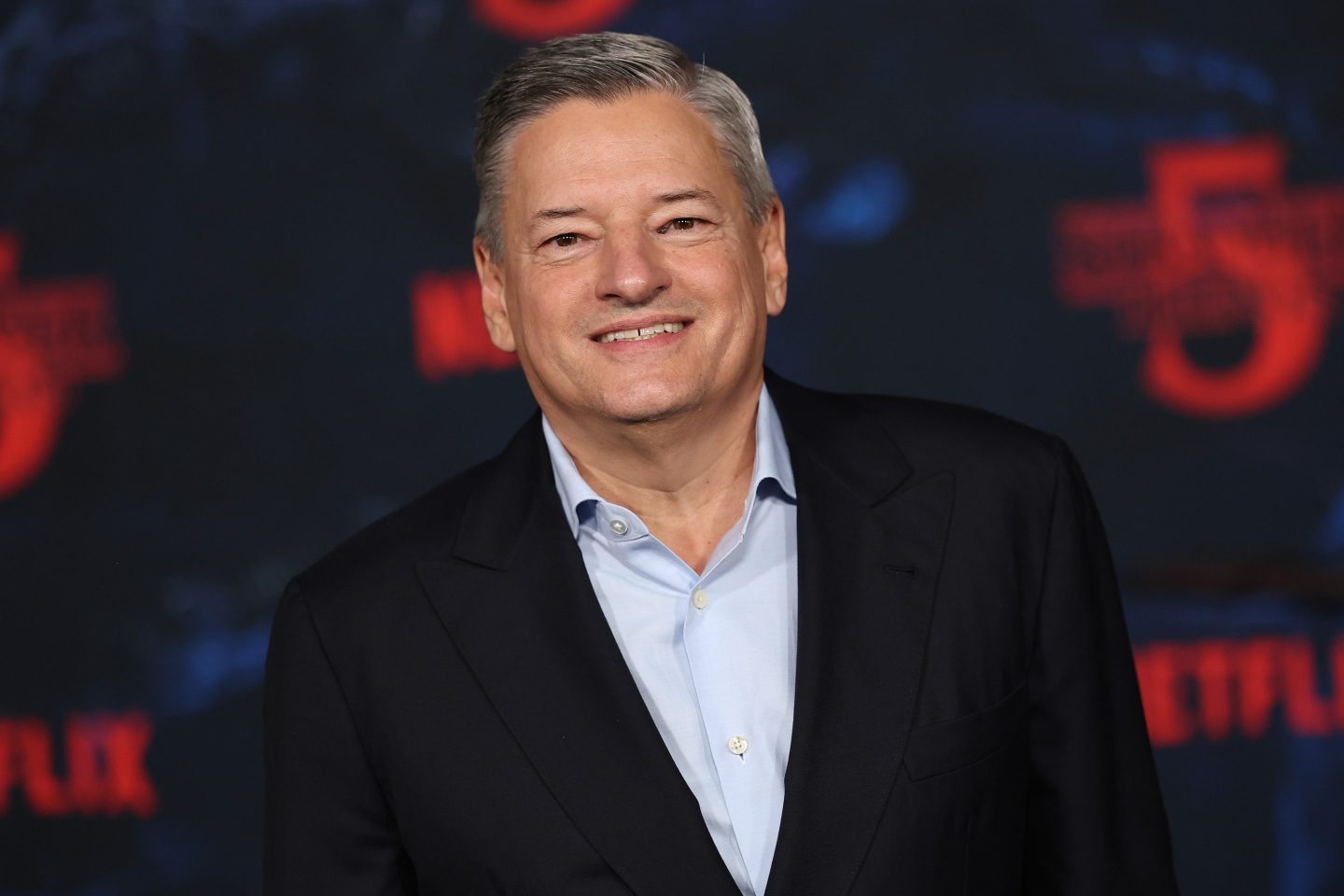
After announcing an almost $83 billion deal to buy most of Warner Bros. Discovery on Friday, Netflix’s top brass projected calm on Monday as Paramount Skydance lobbed a hostile bid to purchase all of WBD and investors seemed to recoil at the sheer size of Netflix’s own offer.
“Today’s move was entirely expected,” co-CEO Ted Sarandos told investors at a UBS conference, brushing off Paramount’s bid just hours earlier. “We have a deal done, and we are incredibly happy with the deal. We think it’s great for our shareholders. It’s great for consumers. We think it’s a great way to create and protect jobs in the entertainment industry.” From Netflix’s perspective, Sarandos added, “we have a deal done, and we’re incredibly happy with the deal.”
Sarandos’s co-CEO, Greg Peters, then walked the audience through Netflix’s three-phase plan to wring value from Warner Bros. and HBO. If the deal goes through, he said, Netflix would turbocharge licensing opportunities, “double down” on the HBO brand, and unlock upsides from Warner Bros.’ vast library of IP, which many analysts consider a “crown jewel” in the industry.
The executives’ comments came after investors sent Netflix stock tumbling down 6% in the two trading sessions since its Warner deal was announced, with some analysts blasting the $82.7 billion deal as “exorbitant” and “very risky.” Netflix stock is down more than 20% over the past six months.
Peters acknowledged that Netflix is known as a builder, not a buyer—generally developing its own intellectual property, rather than purchasing other companies’: “We haven’t done this before,” he said. But the company that started out lending DVDs by mail has pivoted several times to become the more than $400 billion behemoth now challenging Hollywood’s order.
And it’s worth noting that Netflix began streaming other companies’ content before it began producing its own programming. Its licensing operations are still vaunted in the industry, with the famous example of the legal drama Suits becoming a smash hit several years after it stopped airing on cable TV. As Peters put it: “Essentially, we are constantly in the business of evaluating various different licensing opportunities for titles and then trying to figure out, ‘How do we maximize the value of that asset on our platform?’ The Warner deal will just make official what Netflix already does, day in and day out.”
Netflix’s deal announcement on Friday rattled many in Hollywood, including creators and their unions, and movie theater owners, whose trade organization called it an “unprecedented threat” to their business.
Sarandos, the executive behind the model that made “Netflix and chill” a byword for the millennial dating practice of binging shows and movies at home, has largely refused to release movies in theaters, except to qualify for awards. At an event earlier this year, Sarandos dismissed going to the movies as “an outmoded idea for most people” and said Netflix was “saving Hollywood” with its stream-at-home model.
But on Monday he extended an olive branch to theater owners, saying of theatrical releases: “We didn’t buy this company to destroy that value. What we are going to do with this is we’re deeply committed to releasing those movies exactly the way they’ve released those movies today,” he said at the UBS conference. “When this deal closes, we are in that business, and we’re going to do it.”
Sarandos also discussed his conversations with President Donald Trump—which Bloomberg reported over the weekend began in November.
President Trump “cares deeply about American industry, and he loves the entertainment industry,” Sarandos said. Jobs were the president’s main concern, according to Sarandos, who reeled off statistics showing that Netflix original productions employed 140,000 people between 2020 and 2024, contributing $125 billion to the U.S. economy. “We are producing in all 50 states,” he said. “We’ve used 500 independent production companies to make content for us, about roughly 1,000 original projects.”
Sarandos and Peters pointed out that Paramount’s offer might entail more job cuts, because Paramount and Warner have more overlap in their operations than Netflix and Warner. “In the offer that Paramount was talking about today, they also were talking about $6 billion of synergies,” said Sarandos. “Where do you think synergies come from? Cutting jobs. Yeah, so we’re not cutting jobs, we’re making jobs.”
Sarandos also discussed HBO, the premium cable channel turned streamer—Netflix’s former rival and inspiration. Sarandos has famously said of Netflix that “the goal is to become HBO faster than HBO can become us,” comments he later modified to add that he wants “CBS and BBC,” too. Now that his company is set to become HBO’s parent, he said it can realize its true destiny as the leading light of prestige TV.
“They’ve been doing gymnastics to make themselves into a general entertainment brand,” Sarandos said of HBO in the HBO Max era overseen by WBD CEO David Zaslav. “Under this transaction, they don’t have to do that anymore.”
Both Netflix co-CEOs also hammered a message clearly aimed at regulators who might take antitrust action to halt the deal: The combined company would hardly dominate TV. The Netflix deal spins off CNN, TNT, Discovery, HGTV, the Food Network, and the company’s other cable channels, while the Paramount offer keeps the cable assets attached. Using Nielsen viewership data that appeared to include linear TV as well as streaming, Peters said Netflix commands just 8% of U.S. TV hours; adding HBO would raise that to 9%.
“We’d still be behind YouTube,” he noted. “And we’d still be behind a combined Paramount-WBD at 14%.”
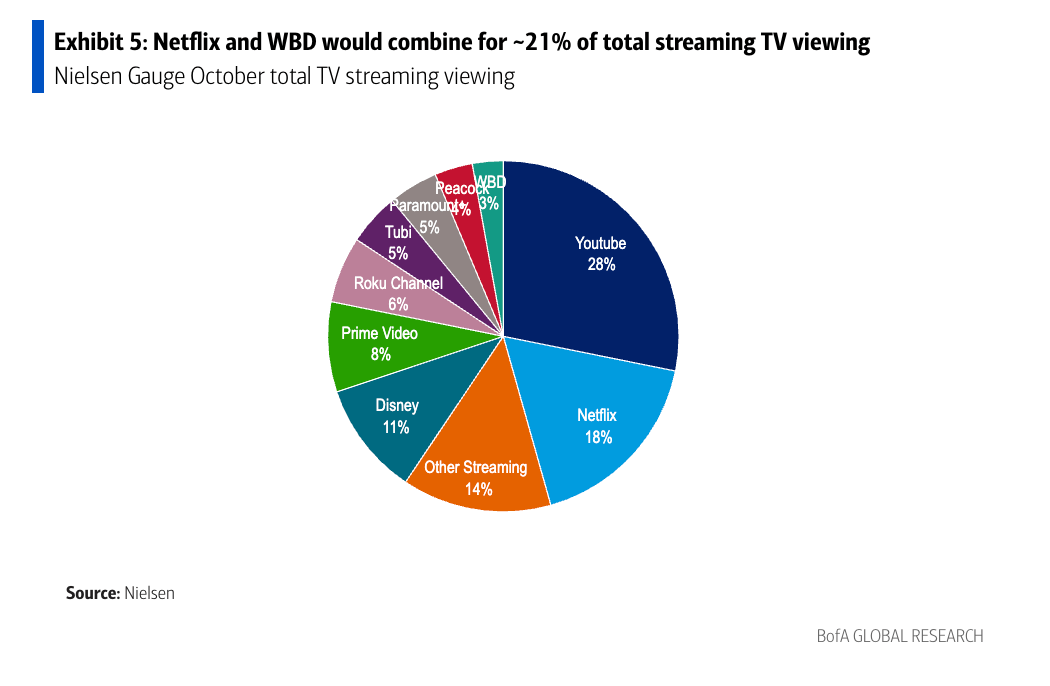
Bank of America Global Research’s media and entertainment team used a different metric—total TV streaming—from Nielsen data to calculate that Warner and Netflix combined would be about 21% of the market, whereas Paramount and Warner would be 8%. Both would still come in behind YouTube at 28%, however.
Trump weighed in on Sunday about his relationship with Sarandos and the pending antitrust question. Saying the Netflix co-CEO is a “fantastic person,” Trump added that the Warner-Netflix market share “could be a problem.” At any rate, Trump added, uncharacteristically for a sitting president, he would be involved in what happens next.
Sarandos finished the UBS panel by reiterating to everyone listening and watching, many of whom have been long-term holders of Netflix stock, that he was “excited” about the deal. (The question of whether Netflix would sweeten its bid for WBD wasn’t raised.)
“We think this deal with Warner Bros. is good for shareholders,” he said. “We think it’s good for consumers. We think it’s good for creators. We think it’s great for the entertainment industry as a whole.”
Editor’s note: One of the authors worked at Netflix from June 2024 through July 2025. The report was also updated to clarify that Paramount and Warner together would constitute 8% of TV time.