
• Home
  • Latest
  • Fortune 500
  • Finance
  • Tech
  • Leadership
  • Lifestyle
  • Rankings
  • Multimedia
Economynational debt

Ray Dalio says ‘a little bit of everything’ is needed to prevent a debt crisis—but it won’t happen anyway

Eleanor Pringle
By
Eleanor Pringle
Eleanor Pringle
Senior Reporter, Economics and Markets
Down Arrow Button Icon
Eleanor Pringle
By
Eleanor Pringle
Eleanor Pringle
Senior Reporter, Economics and Markets
Down Arrow Button Icon
December 5, 2025, 6:54 AM ET
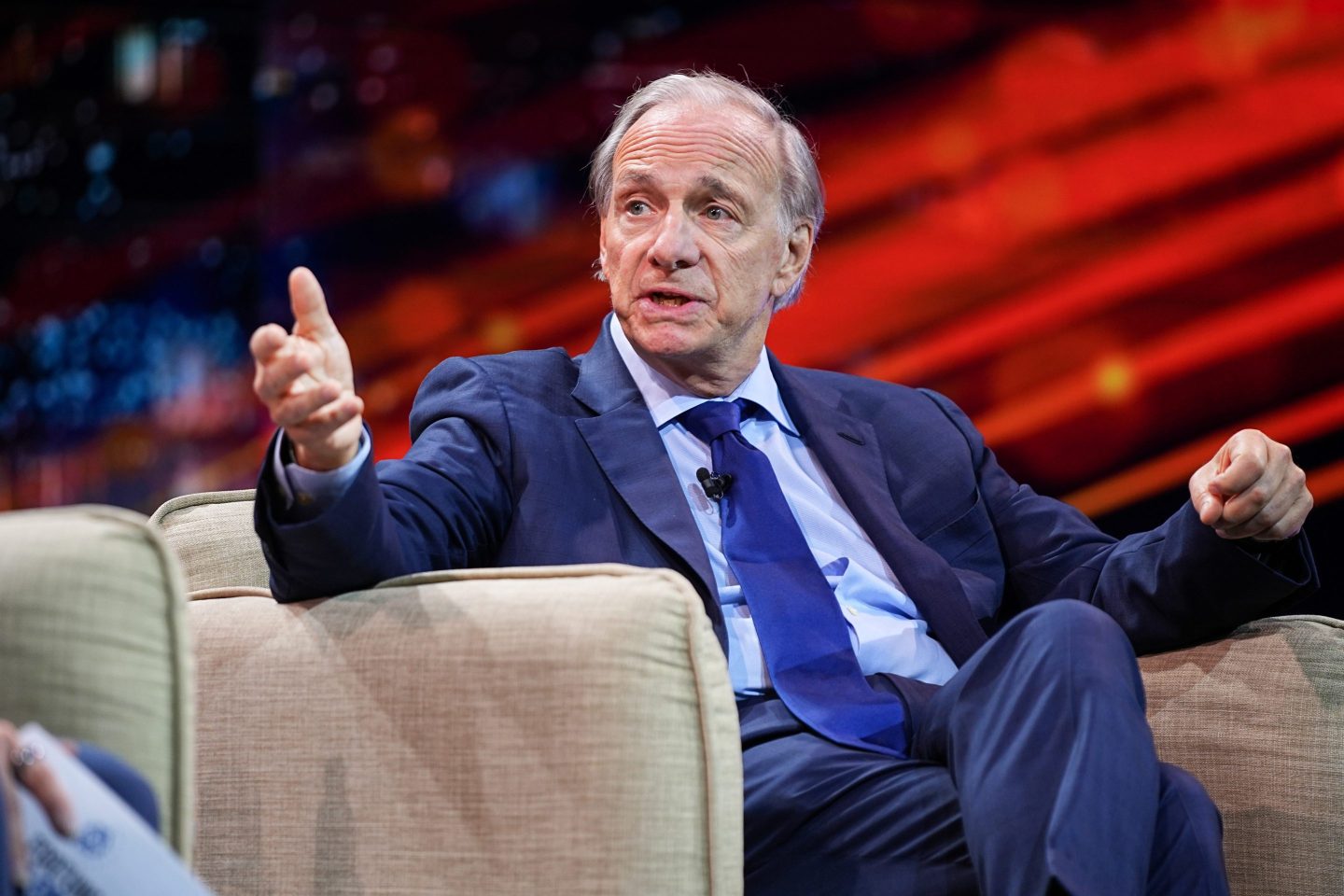
Ray Dalio attends the Fortune Global Forum Riyadh 2025 on October 27, 2025 in Riyadh, Saudi Arabia.
Ray Dalio at the Fortune Global Forum, Oct. 27, 2025, in Riyadh, Saudi Arabia. Amal Alhasan—Fortune Media

Ray Dalio has never been particularly optimistic when it comes to the subject of national debt. He has described America’s $38 trillion borrowing burden as an economic “heart attack” waiting to happen.

But there are options available to avert such a crisis, he believes, from increasing revenues in the form of taxes to lowering government spending. The only problem is, politicians on both sides of Capitol Hill would need to come to an agreement over the longer term to make that happen. This, the Bridgewater Associates founder fears, is not going to happen.

What has economists so worried isn’t necessarily the value of a nation’s debt, but rather its debt-to-GDP ratio, and how much of that debt is interest payments on existing borrowing. At the time of writing, America’s ratio is at approximately 120%, and the government is spending in excess of $10 billion a week to maintain this debt.

Recommended Video

Speaking at the Oxford Union in an interview released Thursday, Dalio was asked whether he would advise fiscal restraint to rebalance budgets, or investment in growth to even out the ratio.

“It really comes from a little bit of everything,” he said, but added that ultimately a political alliance of some sort would be the silver bullet to set America on a healthier fiscal path.

He added: “You need a strong [political] middle because both sides will fight each other and probably get to the point where there are irreconcilable differences, and they can’t resolve that—and difficult things will happen.” However, if a strong consensus can be created, this will allow for “difficult” decisions to be made to “achieve a better situation,” Dalio added.

But he continued: “It has to be done in a bipartisan way, in other words, I would like a bipartisan commission to deal with the mechanics and achieve that. I don’t think these things are going to happen.”

Dalio also reminded the audience of the outcome as he sees it.

First, he repeated his theory that government spending to grow the economy will be squeezed out by interest payments to service the debt—the “heart attack.”

But he also warned that the combination of high debt and rising geopolitical tensions could prove a worrying mix. “One man’s debts are another man’s assets,” Dalio pointed out. “When you have a lot of debt … they may not believe that they’re going to be good storeholds of wealth—particularly when you also have the clashes … between countries.

“Let’s say the Chinese, which are a creditor to the United States, if they understand history or even what’s been happening recently, [they might] feel threatened that those bonds they’re holding may not be produced full value, and can be used for sanctioning.”

Other options available

Many economists believe that the more extreme ends of Dalio’s outlook will not come to pass, because the Federal Reserve will intervene in the debt issue before a crisis truly comes to pass. They have a very simple tool in their arsenal: quantitative easing. Although an unpopular option for many reasons, by increasing the money supply, the Fed effectively lowers the cost of long-term borrowing, and makes it cheaper to service.

There’s also a wealth—literally—of opportunity set to become available in the coming decades. The Great Wealth Transfer is expected to see $80 trillion change hands over the next 20 years, according to UBS, and governments across the world are likely to want in on that shift.

Private wealth could be leveraged by incentivization, such as offering tax-free premium bonds, or legislatively by steering pension funds toward domestic government debt, UBS chief economist Paul Donovan recently told a media roundtable.

“More contentious options exist,” he added. “Such as taxing wealth through capital gains or inheritance levies. In practice, the initial focus tends to be on financial repression—using tax incentives or regulation to direct money into government bonds—before moving toward wealth taxation.”

The Fortune 500 Innovation Forum will convene Fortune 500 executives, U.S. policy officials, top founders, and thought leaders to help define what’s next for the American economy, Nov. 16-17 in Detroit. Apply here.
About the Author
Eleanor Pringle
By Eleanor PringleSenior Reporter, Economics and Markets
LinkedIn icon

Eleanor Pringle is an award-winning senior reporter at Fortune covering news, the economy, and personal finance. Eleanor previously worked as a business correspondent and news editor in regional news in the U.K. She completed her journalism training with the Press Association after earning a degree from the University of East Anglia.

See full bioRight Arrow Button Icon

Latest in Economy

Finance
Lorem ipsum dolor sit amet, consectetur adipiscing elit, sed do eiusmod tempor incididunt ut labore et dolore magna aliqua. Ut enim ad minim veniam
By Fortune Editors
October 20, 2025
Finance
Lorem ipsum dolor sit amet, consectetur adipiscing elit, sed do eiusmod tempor incididunt ut labore et dolore magna aliqua. Ut enim ad minim veniam
By Fortune Editors
October 20, 2025
Finance
Lorem ipsum dolor sit amet, consectetur adipiscing elit, sed do eiusmod tempor incididunt ut labore et dolore magna aliqua. Ut enim ad minim veniam
By Fortune Editors
October 20, 2025
Finance
Lorem ipsum dolor sit amet, consectetur adipiscing elit, sed do eiusmod tempor incididunt ut labore et dolore magna aliqua. Ut enim ad minim veniam
By Fortune Editors
October 20, 2025
Finance
Lorem ipsum dolor sit amet, consectetur adipiscing elit, sed do eiusmod tempor incididunt ut labore et dolore magna aliqua. Ut enim ad minim veniam
By Fortune Editors
October 20, 2025
Finance
Lorem ipsum dolor sit amet, consectetur adipiscing elit, sed do eiusmod tempor incididunt ut labore et dolore magna aliqua. Ut enim ad minim veniam
By Fortune Editors
October 20, 2025

Most Popular

Finance
Lorem ipsum dolor sit amet, consectetur adipiscing elit, sed do eiusmod tempor incididunt ut labore et dolore magna aliqua. Ut enim ad minim veniam
By Fortune Editors
October 20, 2025
Finance
Lorem ipsum dolor sit amet, consectetur adipiscing elit, sed do eiusmod tempor incididunt ut labore et dolore magna aliqua. Ut enim ad minim veniam
By Fortune Editors
October 20, 2025
Finance
Lorem ipsum dolor sit amet, consectetur adipiscing elit, sed do eiusmod tempor incididunt ut labore et dolore magna aliqua. Ut enim ad minim veniam
By Fortune Editors
October 20, 2025
Finance
Lorem ipsum dolor sit amet, consectetur adipiscing elit, sed do eiusmod tempor incididunt ut labore et dolore magna aliqua. Ut enim ad minim veniam
By Fortune Editors
October 20, 2025
Finance
Lorem ipsum dolor sit amet, consectetur adipiscing elit, sed do eiusmod tempor incididunt ut labore et dolore magna aliqua. Ut enim ad minim veniam
By Fortune Editors
October 20, 2025
Finance
Lorem ipsum dolor sit amet, consectetur adipiscing elit, sed do eiusmod tempor incididunt ut labore et dolore magna aliqua. Ut enim ad minim veniam
By Fortune Editors
October 20, 2025
Fortune Secondary Logo
Rankings
  • 100 Best Companies
  • Fortune 500
  • Global 500
  • Fortune 500 Europe
  • Most Powerful Women
  • Future 50
  • World’s Most Admired Companies
  • See All Rankings
Sections
  • Finance
  • Fortune Crypto
  • Features
  • Leadership
  • Health
  • Commentary
  • Success
  • Retail
  • Mpw
  • Tech
  • Lifestyle
  • CEO Initiative
  • Asia
  • Politics
  • Conferences
  • Europe
  • Newsletters
  • Personal Finance
  • Environment
  • Magazine
  • Education
Customer Support
  • Frequently Asked Questions
  • Customer Service Portal
  • Privacy Policy
  • Terms Of Use
  • Single Issues For Purchase
  • International Print
Commercial Services
  • Advertising
  • Fortune Brand Studio
  • Fortune Analytics
  • Fortune Conferences
  • Business Development
  • Group Subscriptions
About Us
  • About Us
  • Editorial Calendar
  • Press Center
  • Work At Fortune
  • Diversity And Inclusion
  • Terms And Conditions
  • Site Map
  • About Us
  • Editorial Calendar
  • Press Center
  • Work At Fortune
  • Diversity And Inclusion
  • Terms And Conditions
  • Site Map
  • Facebook icon
  • Twitter icon
  • LinkedIn icon
  • Instagram icon
  • Pinterest icon

Latest in Economy

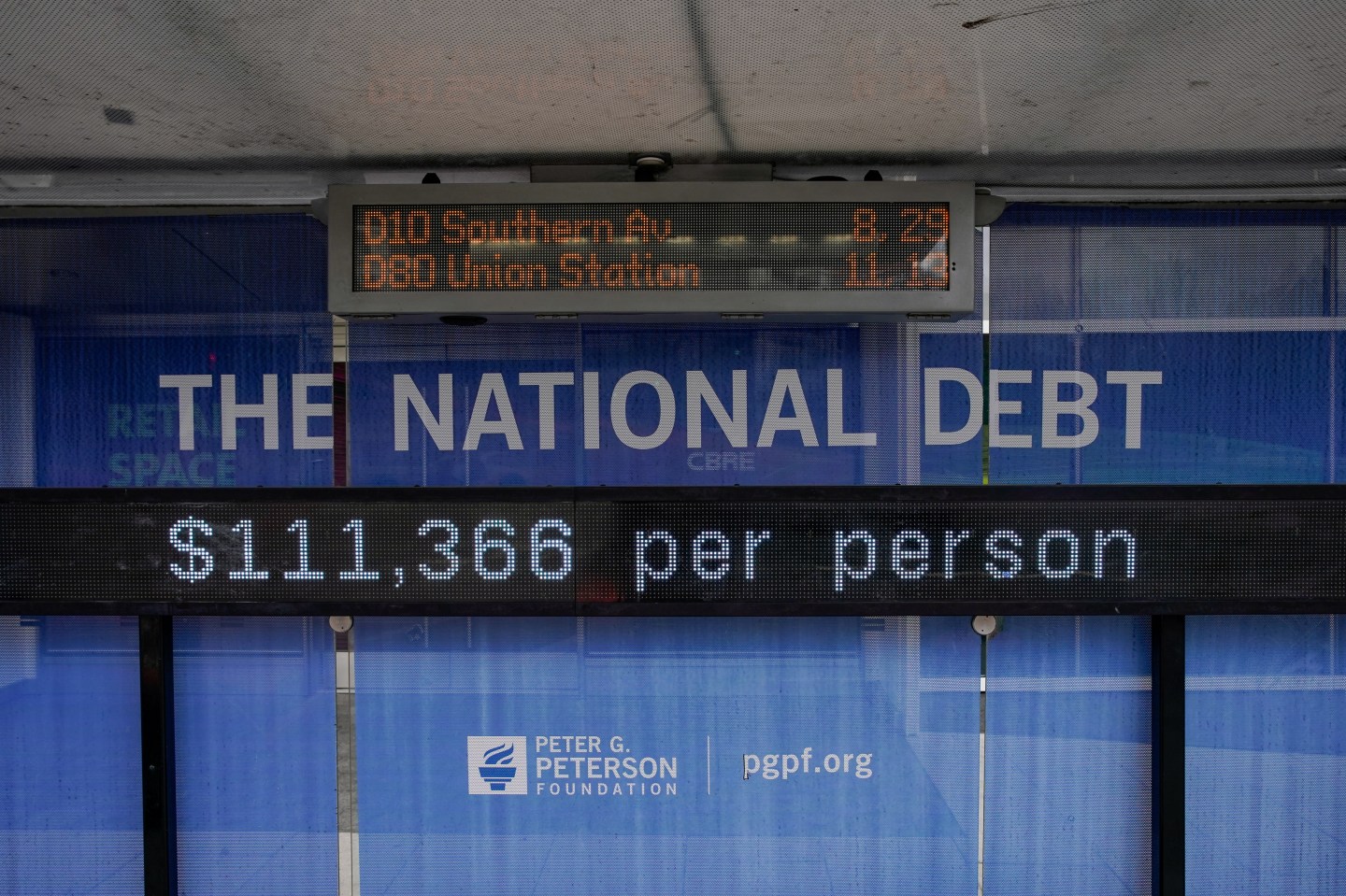
A view of a bus shelter at Pennsylvania Avenue and 22nd Street NW where an electronic billboard and a poster display the current U.S. National debt per person and as a nation at 38 Trillion dollars on October 28, 2025 in Washington, DC.
Economynational debt
‘We owe it to the next generation’ to get national debt under control, says think-tank boss, as U.S. borrowing hits $1.2 trillion in just six months
By Eleanor PringleApril 10, 2026
1 hour ago
‘Good for Russia, good for China, bad for America’: how the Iran war is reshaping global economies and power
EconomyOil
‘Good for Russia, good for China, bad for America’: how the Iran war is reshaping global economies and power
By Nick LichtenbergApril 10, 2026
1 hour ago
 The world’s 500 richest people made more than a quarter trillion yesterday as volatile markets react to fragile Iran war ceasefire
EconomyBillionaires
 The world’s 500 richest people made more than a quarter trillion yesterday as volatile markets react to fragile Iran war ceasefire
By Jacqueline MunisApril 9, 2026
11 hours ago
Only five ships crossed the Strait of Hormuz Thursday, far below Iran’s pledge as negotiations begin
EnergyIran
Only five ships crossed the Strait of Hormuz Thursday, far below Iran’s pledge as negotiations begin
By Eva RoytburgApril 9, 2026
13 hours ago
iran
EnergyFood and drink
A global food emergency: Why the closed Strait of Hormuz puts half the world’s calories at risk
By Aya S. Chacar and The ConversationApril 9, 2026
16 hours ago
Willie Walsh, wearing a blue suit, looks to his right with his mouth slightly open.
EnergyAviation
Jet fuel supply disruptions are comparable to 9/11 and could take months to replenish even if Hormuz Strait is reopening, airline trade group warns
By Sasha RogelbergApril 9, 2026
16 hours ago

Most Popular

The U.S. government is spending $88 billion a month in interest on national debt—equal to spending on defense and education combined
Economy
The U.S. government is spending $88 billion a month in interest on national debt—equal to spending on defense and education combined
By Fortune EditorsApril 9, 2026
21 hours ago
A Meta employee created a dashboard so coworkers can compete to be the company's No. 1 AI token user—and Zuckerberg doesn't even rank in the top 250
AI
A Meta employee created a dashboard so coworkers can compete to be the company's No. 1 AI token user—and Zuckerberg doesn't even rank in the top 250
By Fortune EditorsApril 9, 2026
24 hours ago
Gen Z doesn't want your full-time job. They want several part-time roles, and it's reshaping the entire workforce
Success
Gen Z doesn't want your full-time job. They want several part-time roles, and it's reshaping the entire workforce
By Fortune EditorsApril 9, 2026
1 day ago
White-collar workers are quietly rebelling against AI as 80% outright refuse adoption mandates
AI
White-collar workers are quietly rebelling against AI as 80% outright refuse adoption mandates
By Fortune EditorsApril 9, 2026
22 hours ago
Gen Z workers are so fearful AI will take their job they’re intentionally sabotaging their company’s AI rollout
AI
Gen Z workers are so fearful AI will take their job they’re intentionally sabotaging their company’s AI rollout
By Fortune EditorsApril 8, 2026
2 days ago
2 years ago, Saudi Arabia quietly canceled the ‘petrodollar’ deal with America that wired the world economy for 50 years. Then war broke out in Iran
Energy
2 years ago, Saudi Arabia quietly canceled the ‘petrodollar’ deal with America that wired the world economy for 50 years. Then war broke out in Iran
By Fortune EditorsApril 7, 2026
2 days ago

© 2026 Fortune Media IP Limited. All Rights Reserved. Use of this site constitutes acceptance of our Terms of Use and Privacy Policy | CA Notice at Collection and Privacy Notice | Do Not Sell/Share My Personal Information
FORTUNE is a trademark of Fortune Media IP Limited, registered in the U.S. and other countries. FORTUNE may receive compensation for some links to products and services on this website. Offers may be subject to change without notice.