
• Home
  • Latest
  • Fortune 500
  • Finance
  • Tech
  • Leadership
  • Lifestyle
  • Rankings
  • Multimedia
InvestingMarkets

Why your 401(k) is safe from a 40% crash in stocks—but not a 10% to 15% correction, top analyst says

Nick Lichtenberg
By
Nick Lichtenberg
Nick Lichtenberg
Business Editor
Down Arrow Button Icon
November 24, 2025, 12:08 PM ET
NYSE broker
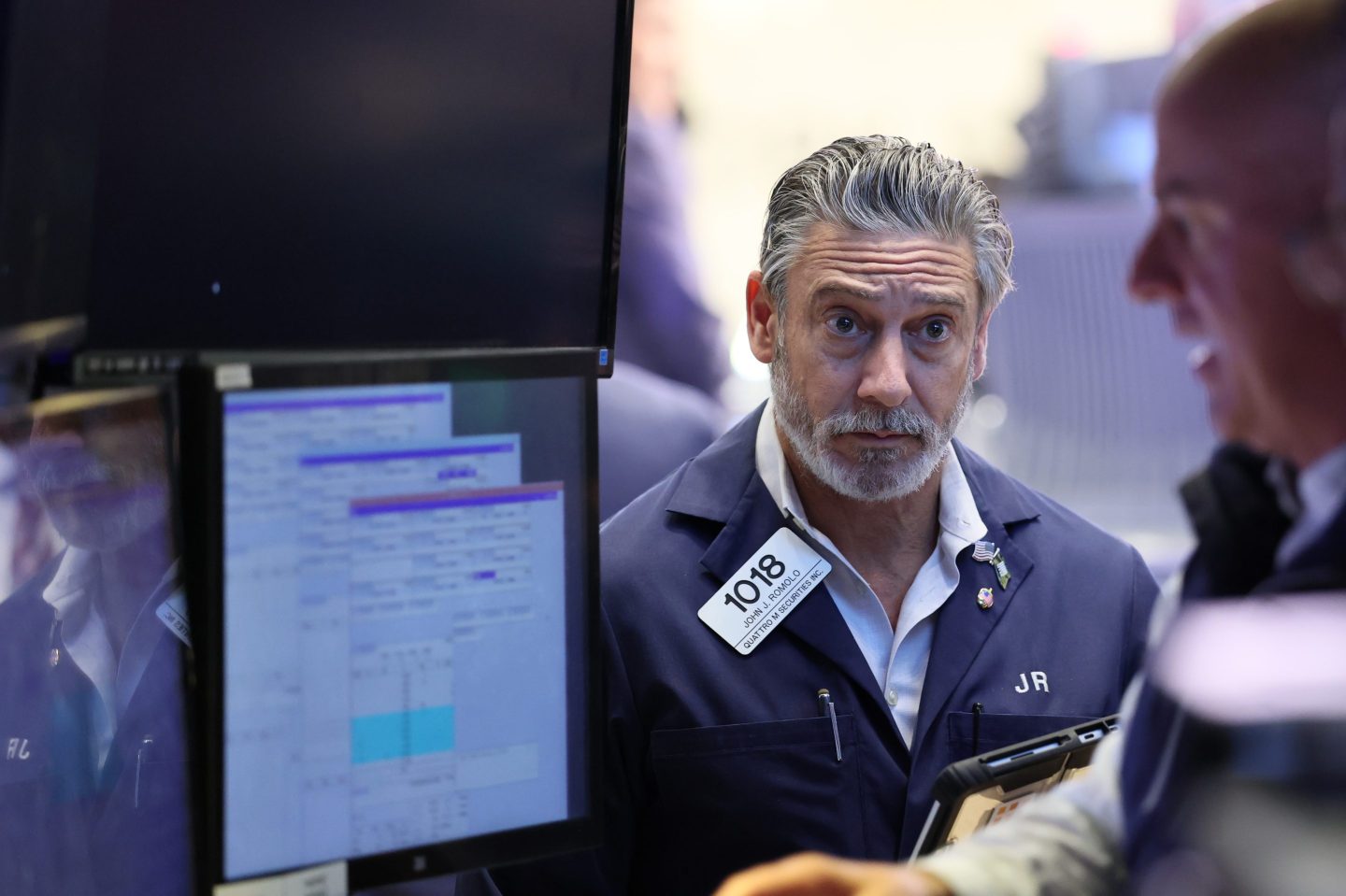
Traders on the floor of the New York Stock Exchange, Nov. 21, 2025.Michael M. Santiago—Getty Images

The recent euphoria surrounding the artificial intelligence mega-boom has led to massive concentration in the U.S. stock market, prompting fears of a catastrophic crash similar to the 2001 dotcom bust or the 2008 financial crisis. Many of these views have been aired recently on Scott Galloway and Ed Elson’s financial podcast, Prof G Markets, including a bearish stance from longtime bull NYU Stern finance professor Aswath Damodaran, who said the market was failing to price in a “potentially catastrophic” scenario.

Recommended Video

However, one of Wall Street’s most experienced strategists has suggested that while a major selloff is inevitable, the risk to diversified retirement accounts is far more contained. Michael Cembalest, chairman of market and investment strategy for J.P. Morgan Asset and Wealth Management, explained his measured view to Galloway and Elson, acknowledging the current market’s extraordinary valuations while expressing skepticism about a catastrophic 40% drop.

Cembalest referred to the financial figure known as “Dr. Doom” to summon up a picture of stock-market bears issuing warnings when the market begins to correct: “As soon as any asset falls by 10%, Nouriel Roubini and the rest of the [bearish] people come out of the woodwork and say, ‘Okay, this is it, this is the big one. Everything’s going to go down from here.’”

Fortune has covered similar warnings amid questions about an AI bubble, including those from self-described “perma-bear” Albert Edwards and the mega-popular Irish financial podcaster David McWilliams. But a correction doesn’t necessarily always pan out in a big crash, Cembalest pointed out.

He also weighed in on the bearish stance of Damodaran, who warned that everything was overvalued and that if the Magnificent 10 went down by 40%, the panic would ripple through the entire market. Damodaran even went so far as to suggest that investors should move large portions of their portfolios into cash or collectibles. With no disrespect intended, Cembalest said there’s a difference between what a finance professor sees and what actual market participants see.

“You know, professors are basically running fantasy baseball teams by coming out intermittently and telling you what their trades are. It’s not real money. It’s not real life,” he quipped.

While the J.P. Morgan analyst agreed that the market relies heavily on extraordinary expectations, Cembalest argued that the current AI build-out lacks the systemic risk present in previous bubbles.

Why a 40% crash is unlikely

In his view, the crucial difference lies in financing: Previous capital spending booms, such as in fiber-optics or gas turbines, were primarily financed with debt, making them vulnerable to a sudden, systemic “unplug” by the debt markets. Today, the massive capital spending fueling the AI revolution is largely being financed with internally generated cash flow, not debt, with the notable exception of Oracle, he said.

“That simply means it can go on for longer before it gets unplugged by the debt markets,” Cembalest noted, explaining that this dynamic “doesn’t relieve you of the ultimate need for there to be substantial profit generation,” but it does mitigate the risk of a sudden seizure in the financial system. This reduced systemic debt exposure suggests that the market will not “unravel into the big 40% corrections that we had in 2009” and then again in 2001, he added.

Instead of a 40% collapse, Cembalest’s base case for the next few years includes a likely and more modest correction. He stated that when assets are trading at 20- to 25-year highs, they usually correct, but by smaller percentages. “It would be kind of shocking if you didn’t have some kind of profit-taking correction in 2026 at some point on the order of 10% to 15%.”

What it means for the average investor

For the average investor or 401(k) participant, Cembalest said that the scale of the drawdown will require preparation but not panic. He noted that his firm’s normal balanced and conservative portfolios are already highly defensive, holding 30% to 40% in a combination of cash, cash equivalents, gold, diversified hedge funds, and short duration assets.

The so-called bond king Jeffrey Gundlach, founder and CEO of DoubleLine Capital, told Galloway and Elson in a previous episode that gold was his “number one best idea for the year” and advocated for it to represent 25% of a portfolio—with the percentage dropping to 15% after it seemed to plateau around $4,000 per ounce.

Individual investors can apply similar defensive strategies. Rather than drastically changing their allocation of funds, Cembalest said he was advising clients to switch from a growth portfolio to a more conservative or balanced one, aligning their risk tolerance with current high valuations.

Furthermore, individual investors have the flexibility to act quickly during market turmoil, which institutional funds often lack. Cembalest recommends that investors begin accumulating “dry powder” now to take advantage of opportunities. Since corrections often tend to be “very V-shaped,” with a rapid, violent unwinding of risk followed by a quick snapback, having spare cash available allows investors to buy assets when they temporarily sell off.

While Cembalest acknowledged the immense capital spending in AI—equivalent to the combined cost of the Manhattan Project, the Hoover Dam, and the Apollo program, relative to GDP—he concluded that a 12% to 15% correction scenario is currently more likely than the 40% worst-case outcome.

And yet, as Elson noted in the podcast’s introduction, this kind of correction would still be significant to millions of investors and the entire economy: Cembalest’s base-case scenario is “kind of a big deal in and of itself.”

Join us at the Fortune Workplace Innovation Summit May 19–20, 2026, in Atlanta. The next era of workplace innovation is here—and the old playbook is being rewritten. At this exclusive, high-energy event, the world’s most innovative leaders will convene to explore how AI, humanity, and strategy converge to redefine, again, the future of work. Register now.
About the Author
Nick Lichtenberg
By Nick LichtenbergBusiness Editor
LinkedIn icon

Nick Lichtenberg is business editor and was formerly Fortune's executive editor of global news.

See full bioRight Arrow Button Icon

Latest in Investing

Finance
Lorem ipsum dolor sit amet, consectetur adipiscing elit, sed do eiusmod tempor incididunt ut labore et dolore magna aliqua. Ut enim ad minim veniam
By Fortune Editors
October 20, 2025
Finance
Lorem ipsum dolor sit amet, consectetur adipiscing elit, sed do eiusmod tempor incididunt ut labore et dolore magna aliqua. Ut enim ad minim veniam
By Fortune Editors
October 20, 2025
Finance
Lorem ipsum dolor sit amet, consectetur adipiscing elit, sed do eiusmod tempor incididunt ut labore et dolore magna aliqua. Ut enim ad minim veniam
By Fortune Editors
October 20, 2025
Finance
Lorem ipsum dolor sit amet, consectetur adipiscing elit, sed do eiusmod tempor incididunt ut labore et dolore magna aliqua. Ut enim ad minim veniam
By Fortune Editors
October 20, 2025
Finance
Lorem ipsum dolor sit amet, consectetur adipiscing elit, sed do eiusmod tempor incididunt ut labore et dolore magna aliqua. Ut enim ad minim veniam
By Fortune Editors
October 20, 2025
Finance
Lorem ipsum dolor sit amet, consectetur adipiscing elit, sed do eiusmod tempor incididunt ut labore et dolore magna aliqua. Ut enim ad minim veniam
By Fortune Editors
October 20, 2025

Most Popular

Finance
Lorem ipsum dolor sit amet, consectetur adipiscing elit, sed do eiusmod tempor incididunt ut labore et dolore magna aliqua. Ut enim ad minim veniam
By Fortune Editors
October 20, 2025
Finance
Lorem ipsum dolor sit amet, consectetur adipiscing elit, sed do eiusmod tempor incididunt ut labore et dolore magna aliqua. Ut enim ad minim veniam
By Fortune Editors
October 20, 2025
Finance
Lorem ipsum dolor sit amet, consectetur adipiscing elit, sed do eiusmod tempor incididunt ut labore et dolore magna aliqua. Ut enim ad minim veniam
By Fortune Editors
October 20, 2025
Finance
Lorem ipsum dolor sit amet, consectetur adipiscing elit, sed do eiusmod tempor incididunt ut labore et dolore magna aliqua. Ut enim ad minim veniam
By Fortune Editors
October 20, 2025
Finance
Lorem ipsum dolor sit amet, consectetur adipiscing elit, sed do eiusmod tempor incididunt ut labore et dolore magna aliqua. Ut enim ad minim veniam
By Fortune Editors
October 20, 2025
Finance
Lorem ipsum dolor sit amet, consectetur adipiscing elit, sed do eiusmod tempor incididunt ut labore et dolore magna aliqua. Ut enim ad minim veniam
By Fortune Editors
October 20, 2025
Rankings
  • 100 Best Companies
  • Fortune 500
  • Global 500
  • Fortune 500 Europe
  • Most Powerful Women
  • Future 50
  • World’s Most Admired Companies
  • See All Rankings
Sections
  • Finance
  • Leadership
  • Success
  • Tech
  • Asia
  • Europe
  • Environment
  • Fortune Crypto
  • Health
  • Retail
  • Lifestyle
  • Politics
  • Newsletters
  • Magazine
  • Features
  • Commentary
  • Mpw
  • CEO Initiative
  • Conferences
  • Personal Finance
  • Education
Customer Support
  • Frequently Asked Questions
  • Customer Service Portal
  • Privacy Policy
  • Terms Of Use
  • Single Issues For Purchase
  • International Print
Commercial Services
  • Advertising
  • Fortune Brand Studio
  • Fortune Analytics
  • Fortune Conferences
  • Business Development
About Us
  • About Us
  • Editorial Calendar
  • Press Center
  • Work At Fortune
  • Diversity And Inclusion
  • Terms And Conditions
  • Site Map

Latest in Investing

Photo of Jerome Powell
EconomyFederal Reserve
‘We are now firmly back in a good is bad/bad is good regime’: Weak job data may lead to more rate cuts and boost stocks, Morgan Stanley economist says
By Sasha RogelbergDecember 15, 2025
3 hours ago
A close-up of Jeff Bezos
SuccessJeff Bezos
‘I had to take 60 meetings’: Jeff Bezos says ‘the hardest thing I’ve ever done’ was raising the first million dollars of seed capital for Amazon
By Dave SmithDecember 15, 2025
5 hours ago
AIChips
What happens to old AI chips? They’re still put to good use and don’t depreciate that fast, analyst says
By Jason MaDecember 15, 2025
5 hours ago
InvestingTech
The Magnificent 7 isn’t that magnificent: 5 of the stocks have underperformed the market this year
By Jim EdwardsDecember 15, 2025
10 hours ago
Real EstateHousing
A ‘new era’ in the housing market is about to begin as affordability finally improves ‘for the first time in a bunch of years,’ economist says
By Jason MaDecember 14, 2025
23 hours ago
Investingspace
Alphabet poised for another paper gain as SpaceX valuation jumps
By Edward Ludlow and BloombergDecember 14, 2025
1 day ago

Most Popular

placeholder alt text
Success
'I had to take 60 meetings': Jeff Bezos says 'the hardest thing I've ever done' was raising the first million dollars of seed capital for Amazon
By Dave SmithDecember 15, 2025
5 hours ago
placeholder alt text
Success
Sorry, six-figure earners: Elon Musk says that money will 'disappear' in the future as AI makes work (and salaries) irrelevant
By Orianna Rosa RoyleDecember 15, 2025
8 hours ago
placeholder alt text
Uncategorized
Transforming customer support through intelligent AI operations
By Lauren ChomiukNovember 26, 2025
19 days ago
placeholder alt text
Success
Meetings are not work, says Southwest Airlines CEO—and he’s taking action, by blocking his calendar every afternoon from Wednesday to Friday 
By Preston ForeDecember 15, 2025
7 hours ago
placeholder alt text
AI
Deloitte's CTO on a stunning AI transformation stat: Companies are spending 93% on tech and only 7% on people
By Nick LichtenbergDecember 15, 2025
11 hours ago
placeholder alt text
Success
Apple cofounder Ronald Wayne sold his 10% stake for $800 in 1976—today it’d be worth up to $400 billion
By Preston ForeDecember 12, 2025
3 days ago

© 2025 Fortune Media IP Limited. All Rights Reserved. Use of this site constitutes acceptance of our Terms of Use and Privacy Policy | CA Notice at Collection and Privacy Notice | Do Not Sell/Share My Personal Information
FORTUNE is a trademark of Fortune Media IP Limited, registered in the U.S. and other countries. FORTUNE may receive compensation for some links to products and services on this website. Offers may be subject to change without notice.