• Home
  • Latest
  • Fortune 500
  • Finance
  • Tech
  • Leadership
  • Lifestyle
  • Rankings
  • Multimedia
C-SuiteBook Excerpt

‘It’s always better to drink wine a year early than a day too late’: McKinsey’s CEO whisperers on successfully transitioning out of the top job

By
Carolyn Dewar
Carolyn Dewar
,
Scott Keller
Scott Keller
,
Vikram Malhotra
Vikram Malhotra
, and
Kurt Strovink
Kurt Strovink
Down Arrow Button Icon
By
Carolyn Dewar
Carolyn Dewar
,
Scott Keller
Scott Keller
,
Vikram Malhotra
Vikram Malhotra
, and
Kurt Strovink
Kurt Strovink
Down Arrow Button Icon
October 7, 2025, 8:00 AM ET
A CEO for all seasons
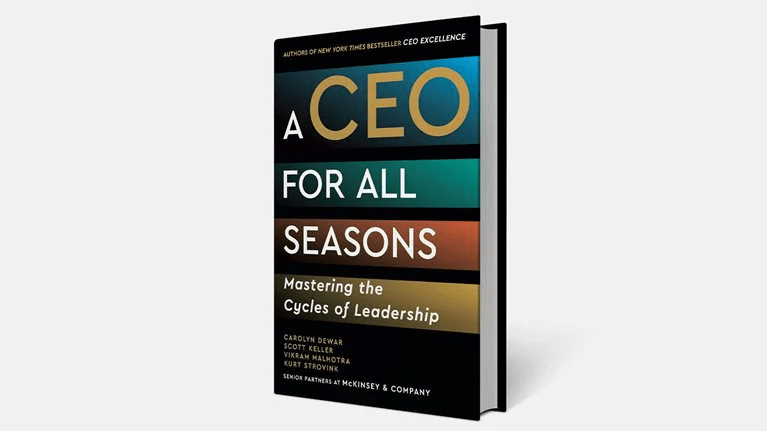
"A CEO For All Seasons."courtesy of Scribner

One of the most exciting athletic contests in the Summer Olympic Games is the 4×100-meter relay race. The event, which was inspired by ancient Greek couriers handing “message sticks” to one another, was introduced at the Stockholm Olympics in 1912. For the entirety of the twentieth century, the U.S. team dominated the event. Not once in the twenty-first century, however, has the U.S. team brought home a gold medal, despite many of its members having done so in their individual events.

Recommended Video

What’s the problem? Simple: bad handoffs. Consider New York magazine’s description of one such handoff at the 2020 Tokyo Olympics: “As the pair attempted to pass the baton, they looked more like Keystone Cops than two of the five fastest men in the world.” As a result, the team failed to even advance to the final. At the same time, when well-synchronized handoffs happen, relay times are typically two to three seconds faster than the sum of the best times of individual runners.

When you’re a celebrated CEO who has successfully led a company through multiple cycles of performance improvement, it’s hard to imagine looking like a Keystone Cop at the end of your career as you pass the baton. Yet as the transition gets closer, the reality that you’ve never actually done a CEO handover before can feel daunting. Unlike Olympic athletes who practice their handoff timing, pacing, technique, and communication over and over with the grandstands empty, you’ll only have one very public shot at it, and you’ll be doing so while under emotional strain. As Caterpillar’s former CEO Jim Owens puts it, “In the end, the hardest part of the CEO role is leaving.”

The best CEOs are less worried about how their own reputation might fare in the transition, and more focused on how the change will impact the institution moving forward. HCA Healthcare’s Sam Hazen describes the goal of the handover: “If you’re successful in the relay race, you’re not dropping the baton. And not just that; you’re also setting up the next runner to be better and go faster than you did in your leg of the race.” Dropped batons, on the other hand, exact a huge cost. In S&P 1500 companies, poorly managed CEO and C-suite transitions wipe out close to $1 trillion in market value every year.

Microsoft CEO Satya Nadella stresses the importance of taking an institutional view of transitions: “My dad, a civil servant in India, always used to talk about institution builders as those people whose successors do better than they did themselves. I love that definition. I feel that if the next CEO of Microsoft can be even more successful than I am, then maybe I’ve done my job right. If the next CEO of Microsoft crashes and burns, that may result in a different verdict.”

While the specifics of every transition differ depending on the circumstances, it’s recommended that any CEO who’s excelled in the role but senses it’s time to start thinking about the endgame do the following:

  • Firmly decide when to go.
  • Finish the job of preparing successors.
  • Hand over gracefully.
  • Embrace what’s next.

Firmly Decide When to Go

Some CEOs enter the job with a clear idea of how long they want to stay, as was the case with CCHMC’s Michael Fisher: “When I started the role, I told the board that if I’m healthy and stakeholders think I’m doing a good job, I’ll do this for, give or take, ten years.” In Fisher’s case, he ended up staying almost 12, which is a bit longer than the 11.2 years the highest-performing CEOs on average spend in the role. For all large-company CEOs, tenures are far shorter: just 7.3 years.

Getting the timing right for your departure is vital. Like fine wine, you’ll have become better at your role with time and experience—but at some point, there’ll be an inevitable decline. There are many warning signs that this is happening to a CEO. On one end of the spectrum, it’s when the desire to protect their reputation of making quarterly numbers causes them to shy away from making bold moves and investments in the future. On the other end, it’s when late-tenured CEOs whose strategies have played out become desperate to avoid a growth slowdown and opt to make large, complex acquisitions that are unlikely to be accretive for the institution. Beneath such moves often lurks a selfish desire to soothe increasing anxiety, unrest, and potentially even boredom.

The best chief executives know that there’s no place for ego in determining when to go; what matters is what’s best for the institution. Often there’s a natural need for the company to pivot in a new direction, but the sitting CEO isn’t the best one equipped to lead the transition. Gail Kelly chose to leave the Australian bank Westpac when she felt her customer-centric strategy was well in place and she had a successor ready who’d be better suited to lead the company into a more digital future. Sony’s Kazuo Hirai felt that, while he was the right person to transform the company, he was less suited for the more stable phase to follow.

While the experience of others is instructive, knowing when to step down is a very personal, and difficult, decision. “It’s hard to know when the right time to leave is,” shares former Goldman Sachs CEO Lloyd Blankfein. “When times are tougher, you can’t leave. And when times are better, you don’t want to leave.” Subsequent to his tenure at the helm of Medtronic, Bill George taught Harvard Business School classes that focused on the arc of a CEO’s tenure. He suggests that CEOs regularly ask themselves the following questions to know when the time is right:

  • Do you still find fulfillment and joy?
  • Are you continuing to learn and feel challenged?
  • Are there new personal circumstances that you should be taking into account (for example, family or personal health issues)?
  • Are there unique opportunities outside that won’t come around again?
  • How is succession shaping up? (Is more time needed to prepare someone? Are you blocking someone who can lead the next era?)
  • Are there company-specific milestones that make transitioning out more or less natural (such as the integration of a major acquisition, the launch of an important new product, or the completion of a long-running project)?
  • Is the industry changing so dramatically that the company would benefit from a new perspective?
  • Are you staying primarily because you can’t imagine what comes next?

With these considerations in mind, the best CEOs clarify and commit to a time frame with their board well in advance of their planned departure date. “Without a clear timetable,” says George, “grooming internal successors and following an orderly succession process become challenging.” Typically, the lead time given is at least two years.

Ultimately, the adage “It’s always better to drink wine a year early than a day too late” also applies to CEO succession. As Intuit’s Brad Smith explains: “I had friends who stayed a couple of years too long in the job. I thought to myself, ‘My gosh, how could they not have seen this coming?’ Then I thought about all the athletes that stay one or two years past their prime. And you think, ‘Man, I don’t want to be that.’ The only question you have to ask yourself is if you want to be the one choosing the date, or you want someone else to choose it for you.”

CEO FOR ALL SEASONS. Copyright © 2025, Dewar, Keller, Malhotra, Strovink. Reproduced by permission of Scribner, an imprint of Simon & Schuster. All rights reserved. 
At the invitation-only Fortune COO Summit, taking place June 1–2 in Arizona, COOs from the nation’s largest companies will come together to examine how AI and emerging technologies are reshaping operating models, strengthening resilience, and enabling faster and smarter decision-making. Register now.
About the Authors
By Carolyn Dewar
See full bioRight Arrow Button Icon
By Scott Keller
See full bioRight Arrow Button Icon
By Vikram Malhotra
See full bioRight Arrow Button Icon
By Kurt Strovink
See full bioRight Arrow Button Icon

Latest in C-Suite

Finance
Lorem ipsum dolor sit amet, consectetur adipiscing elit, sed do eiusmod tempor incididunt ut labore et dolore magna aliqua. Ut enim ad minim veniam
By Fortune Editors
October 20, 2025
Finance
Lorem ipsum dolor sit amet, consectetur adipiscing elit, sed do eiusmod tempor incididunt ut labore et dolore magna aliqua. Ut enim ad minim veniam
By Fortune Editors
October 20, 2025
Finance
Lorem ipsum dolor sit amet, consectetur adipiscing elit, sed do eiusmod tempor incididunt ut labore et dolore magna aliqua. Ut enim ad minim veniam
By Fortune Editors
October 20, 2025
Finance
Lorem ipsum dolor sit amet, consectetur adipiscing elit, sed do eiusmod tempor incididunt ut labore et dolore magna aliqua. Ut enim ad minim veniam
By Fortune Editors
October 20, 2025
Finance
Lorem ipsum dolor sit amet, consectetur adipiscing elit, sed do eiusmod tempor incididunt ut labore et dolore magna aliqua. Ut enim ad minim veniam
By Fortune Editors
October 20, 2025
Finance
Lorem ipsum dolor sit amet, consectetur adipiscing elit, sed do eiusmod tempor incididunt ut labore et dolore magna aliqua. Ut enim ad minim veniam
By Fortune Editors
October 20, 2025

Most Popular

Finance
Lorem ipsum dolor sit amet, consectetur adipiscing elit, sed do eiusmod tempor incididunt ut labore et dolore magna aliqua. Ut enim ad minim veniam
By Fortune Editors
October 20, 2025
Finance
Lorem ipsum dolor sit amet, consectetur adipiscing elit, sed do eiusmod tempor incididunt ut labore et dolore magna aliqua. Ut enim ad minim veniam
By Fortune Editors
October 20, 2025
Finance
Lorem ipsum dolor sit amet, consectetur adipiscing elit, sed do eiusmod tempor incididunt ut labore et dolore magna aliqua. Ut enim ad minim veniam
By Fortune Editors
October 20, 2025
Finance
Lorem ipsum dolor sit amet, consectetur adipiscing elit, sed do eiusmod tempor incididunt ut labore et dolore magna aliqua. Ut enim ad minim veniam
By Fortune Editors
October 20, 2025
Finance
Lorem ipsum dolor sit amet, consectetur adipiscing elit, sed do eiusmod tempor incididunt ut labore et dolore magna aliqua. Ut enim ad minim veniam
By Fortune Editors
October 20, 2025
Finance
Lorem ipsum dolor sit amet, consectetur adipiscing elit, sed do eiusmod tempor incididunt ut labore et dolore magna aliqua. Ut enim ad minim veniam
By Fortune Editors
October 20, 2025
Fortune Secondary Logo
Rankings
  • 100 Best Companies
  • Fortune 500
  • Global 500
  • Fortune 500 Europe
  • Most Powerful Women
  • World's Most Admired Companies
  • See All Rankings
  • Lists Calendar
Sections
  • Finance
  • Fortune Crypto
  • Features
  • Leadership
  • Health
  • Commentary
  • Success
  • Retail
  • Mpw
  • Tech
  • Lifestyle
  • CEO Initiative
  • Asia
  • Politics
  • Conferences
  • Europe
  • Newsletters
  • Personal Finance
  • Environment
  • Magazine
  • Education
Customer Support
  • Frequently Asked Questions
  • Customer Service Portal
  • Privacy Policy
  • Terms Of Use
  • Single Issues For Purchase
  • International Print
Commercial Services
  • Advertising
  • Fortune Brand Studio
  • Fortune Analytics
  • Fortune Conferences
  • Business Development
  • Group Subscriptions
About Us
  • About Us
  • Press Center
  • Work At Fortune
  • Terms And Conditions
  • Site Map
  • About Us
  • Press Center
  • Work At Fortune
  • Terms And Conditions
  • Site Map
  • Facebook icon
  • Twitter icon
  • LinkedIn icon
  • Instagram icon
  • Pinterest icon

Latest in C-Suite

capuano
C-SuiteHospitality
Marriott CEO on why you have to defend both DEI and ICE’s right to a hotel room: Dictating values is a ‘bad place for the country’
By Nick LichtenbergApril 30, 2026
34 minutes ago
AstraZeneca CFO Aradhana Sarin
BankingCFO Daily
How AstraZeneca’s 17,000 AI-certified employees are helping it reach a ‘stretch goal’ of $80 billion in revenue
By Sheryl EstradaApril 30, 2026
4 hours ago
mark
ConferencesHospitality
Hyatt’s CEO has built a ‘family’ culture for 20 years. Now he’s leaning on it
By Nick LichtenbergApril 30, 2026
4 hours ago
Aerie built a $2 billion brand by rejecting Victoria’s Secret’s old playbook. Now it wants to win the AI backlash.
C-SuiteRetail
Aerie built a $2 billion brand by rejecting Victoria’s Secret’s old playbook. Now it wants to win the AI backlash.
By Phil WahbaApril 30, 2026
9 hours ago
Photo of Thomas Kurian
Big TechGoogle
Google Cloud revenue is now 18% of Alphabet’s business. Is this the beginning of the end of Google’s search identity?
By Alexei OreskovicApril 29, 2026
14 hours ago
A man in a suit and tie
InvestingMeta
Meta just bumped its 2026 capex forecast up to as much as $145 billion for the AI boom—and investors flinched
By Amanda GerutApril 29, 2026
17 hours ago

Most Popular

Apple cofounder Ronald Wayne—whose stake would be worth up to $400 billion had he not sold it in 1976—says that at 91, he has no regrets
Success
Apple cofounder Ronald Wayne—whose stake would be worth up to $400 billion had he not sold it in 1976—says that at 91, he has no regrets
By Preston ForeApril 27, 2026
3 days ago
Jamie Dimon gets candid about national debt: ‘There will be a bond crisis, and then we’ll have to deal with it’
Economy
Jamie Dimon gets candid about national debt: ‘There will be a bond crisis, and then we’ll have to deal with it’
By Eleanor PringleApril 29, 2026
1 day ago
‘They left me no choice’: Powell isn’t going anywhere—blocking Trump from another Fed appointee
Banking
‘They left me no choice’: Powell isn’t going anywhere—blocking Trump from another Fed appointee
By Eva RoytburgApril 29, 2026
21 hours ago
‘The cost of compute is far beyond the costs of the employees’: Nvidia executive says right now AI is more expensive than paying human workers
AI
‘The cost of compute is far beyond the costs of the employees’: Nvidia executive says right now AI is more expensive than paying human workers
By Sasha RogelbergApril 28, 2026
2 days ago
Google Cloud revenue is now 18% of Alphabet's business. Is this the beginning of the end of Google's search identity?
Big Tech
Google Cloud revenue is now 18% of Alphabet's business. Is this the beginning of the end of Google's search identity?
By Alexei OreskovicApril 29, 2026
14 hours ago
‘Take the money and run’: Johns Hopkins economist Steve Hanke on why the UAE quit OPEC
Energy
‘Take the money and run’: Johns Hopkins economist Steve Hanke on why the UAE quit OPEC
By Shawn TullyApril 29, 2026
1 day ago

© 2026 Fortune Media IP Limited. All Rights Reserved. Use of this site constitutes acceptance of our Terms of Use and Privacy Policy | CA Notice at Collection and Privacy Notice | Do Not Sell/Share My Personal Information
FORTUNE is a trademark of Fortune Media IP Limited, registered in the U.S. and other countries. FORTUNE may receive compensation for some links to products and services on this website. Offers may be subject to change without notice.