• Home
  • Latest
  • Fortune 500
  • Finance
  • Tech
  • Leadership
  • Lifestyle
  • Rankings
  • Multimedia
EconomyJobs

Top economists and Jerome Powell agree that Gen Z’s hiring nightmare is real—and it’s not about AI eating entry-level jobs

By
Nick Lichtenberg
Nick Lichtenberg
and
Eva Roytburg
Eva Roytburg
Down Arrow Button Icon
By
Nick Lichtenberg
Nick Lichtenberg
and
Eva Roytburg
Eva Roytburg
Down Arrow Button Icon
September 21, 2025, 8:30 AM ET
Jerome Powell
Federal Reserve chair Jerome Powell. Chip Somodevilla/Getty Images

The dramatic rise in unemployment among Americans under 25—especially recent graduates—has become one of the most troubling economic headlines of 2025. Recent insights from economists, central bankers, and labor market analysts signal that this appears to be a uniquely American challenge, underpinned by a “no hire, no fire” economy rather than solely by the rapid ascent of artificial intelligence.

Recommended Video

For many Gen Z workers, the struggle to land a job can feel isolating and fuel self-doubt. But that frustration recently got some high-level validation: Federal Reserve Chair Jerome Powell echoed economists’ concerns about the cooling labor market, telling reporters at his regular press conference following the Federal Open Market Committee that it’s an “interesting labor market” right now, adding that “kids coming out of college and younger people, minorities, are having a hard time finding jobs.” Noting a low job finding rate, along with a low redundancy rate, he said, “you’ve got a low firing, low hiring environment.” and noting that it’s harder than ever for young jobseekers to break in.

While recent months have been dubbed by Deutsche Bank “the summer AI turned ugly,” and some major studies find AI adoption disrupting some entry-level roles, Powell was less sure. AI “may be part of the story,” but he insisted the main drivers are a broadly slowed economy and hiring restraint. Top economists at Goldman Sachs and UBS tackled the subject soon after and found Powell to be mostly on the money. This isn’t an AI story, at least not yet.

A deep freeze setting in

According to a Friday analysis by UBS chief economist Paul Donovan, titled “the kids are alright?” the spike in U.S. youth unemployment stands in stark contrast to global trends and cannot be blamed on artificial intelligence despite the current fascination with automation in public debate. “The U.S. labor market experience is peculiar,” he wrote. “Young Euro area workers have a record low unemployment rate. In the UK, the young persons’ unemployment rate has fallen steadily. Employment participation by young Japanese workers is near all-time highs. It seems highly implausible that AI uniquely hurts the employment prospects of younger US workers.”

Goldman Sachs economist Pierfrancesco Mei wrote on Thursday that “finding a job takes longer in a low-turnover labor market.” He argued that “job reallocation,” or the pace at which new jobs are created and existing ones destroyed, has been on the decline since the late 1990s, albeit more slowly as of late. Almost all job changes between existing jobs is taking place as “churn,” driving “almost all the variation in turnover since the Great Recession.” Goldman found that as of 2025, churn was well below its pre-pandemic levels, a “broad-based” pattern across industries and states, and this “mostly fall[s] on younger workers.” In 2019, it took a young unemployed worker about 10 weeks to find a new job in a low-churn state, now that’s 12 weeks on average.
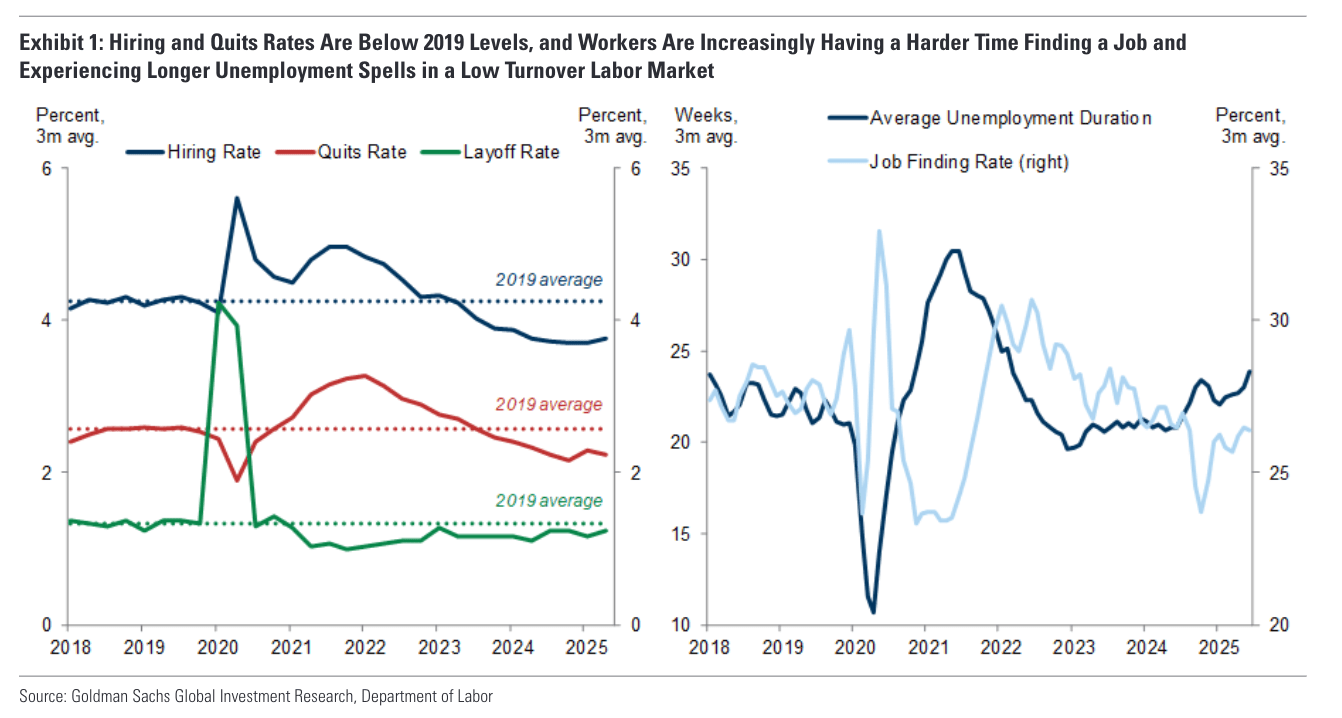
UBS’ Donovan writes that “it might be tempting to blame technology” for the plight of the Gen Z would-be entry-level worker. “Machines, robots, or computers replacing humans is an ever-popular dystopian scenario.” Donovan concludes, similarly to Goldman that the U.S. pattern “more convincingly fits a broader hiring freeze narrative, affecting new entrants to the workforce.”

A blue-collar alternative?

According to Donovan, this also has the benefit of explaining the smaller impact on less educated workers, with high school dropouts able to find full-time employment at a younger age than recent grads, and so they likely found work before the 2025 deep freeze set in. With college enrollment also in a long-term secular decline, trade employment is becoming increasingly popular with blue-collar entrepreneurs, some of whom find themselves earning six figures and calling themselves boss while their peers become saddled with student-loan debt.

Over the long run, recent college graduates are empirically hit the hardest during “no fire, no hire” periods. During the Great Recession, when entire industries froze hiring, college graduates between 2007 and 2011 were uniquely hit by a lack of open positions. Those graduates earned less than their counterparts who graduated during non-recessionary periods — effects that persisted for 10-15 years, according to a Stanford briefing.

The implications for Gen Z and minority jobseekers are severe. Experts warn of “scarring effects”—long-lasting damage to earnings, homeownership prospects, and wealth accumulation. History shows that starting a career during a downturn can result in lower wages and a steeper climb up the economic ladder. On Wednesday, Powell spoke of other factors reducing the labor supply, such as harsher immigration measures; he also mentioned that minorities are having a harder time finding employment during the 2025 freeze.

“The overall job finding rate is very, very low,” Powell said. “If layoffs begin to rise, there won’t be a lot of hiring going on.” The AI question remains open, in the Fed chair’s words. Saying “there’s great uncertainty” around how big an impact AI is having, he offered a perspective, almost a guess, that “you are seeing some effects [from AI], but it’s not the main, not the main thing driving” the youth unemployment picture. Still, “there may be something there. It may be that companies or other institutions that have been hiring younger people right out of college are able to use AI that more than they had in the past. That may be part of the story … Hard to say how big it is.”


Join us at the Fortune Workplace Innovation Summit May 19–20, 2026, in Atlanta. The next era of workplace innovation is here—and the old playbook is being rewritten. At this exclusive, high-energy event, the world’s most innovative leaders will convene to explore how AI, humanity, and strategy converge to redefine, again, the future of work. Register now.
About the Authors
Nick Lichtenberg
By Nick LichtenbergBusiness Editor
LinkedIn icon

Nick Lichtenberg is business editor and was formerly Fortune's executive editor of global news.

See full bioRight Arrow Button Icon
By Eva RoytburgFellow, News

Eva is a fellow on Fortune's news desk.

See full bioRight Arrow Button Icon

Latest in Economy

Nela Richardson, chief economist at Automatic Data Processing Inc. (ADP), at a Bloomberg Television interview during the Kansas City Federal Reserve's Jackson Hole Economic Policy Symposium in Moran, Wyoming, US, on Thursday, Aug. 22, 2024.
EconomyEmployment
‘We have not seen this rosy picture’: ADP’s chief economist warns the real economy is pretty different from Wall Street’s bullish outlook
By Eleanor PringleDecember 11, 2025
42 minutes ago
US Federal Reserve Board Chairman Jerome Powell speaks during a news conference following a Federal Open Market Committee (FOMC) meeting in Washington, DC, on December 10, 2025.
Bankingjerome powell
Top economist Diane Swonk: Jerome Powell risks losing the Fed’s credibility on a gamble over AI and immigration
By Eva RoytburgDecember 10, 2025
14 hours ago
Jerome Powell, chairman of the US Federal Reserve, during a news conference following a Federal Open Market Committee (FOMC) meeting in Washington, DC, US, on Wednesday, Dec. 10, 2025. Federal Reserve officials delivered a third consecutive interest-rate reduction and maintained their outlook for just one cut in 2026.
EconomyFederal Reserve
Powell warns of a ‘very unusual’ economy as tariffs keep goods inflation high amid a weakening labor market
By Eva RoytburgDecember 10, 2025
14 hours ago
Federal Reserve Bank Chair Jerome Powell speaks during the George P. Shultz Memorial Lecture Series at Stanford University on December 01, 2025 in Stanford, California.
EconomyFederal Reserve
The Fed delivers a rare ‘hawkish cut’ as Powell tries to steady a softening job market
By Eva RoytburgDecember 10, 2025
17 hours ago
Jerome Powell, chairman of the US Federal Reserve, during the Hoover Institution's George P. Shultz Memorial Lecture Series in Stanford, California, US, on Monday, Dec. 1, 2025. The Federal Reserve said it was monitoring community and regional banks' commercial real estate loan portfolios amid concerns over "elevated interest rates, tighter underwriting standards, and lower commercial property values." Photographer: Jason Henry/Bloomberg via Getty Images
EconomyFederal Reserve
‘Be careful what you wish for’: Top economist warns any additional interest rate cuts after today would signal the economy is slipping into danger
By Eva RoytburgDecember 10, 2025
18 hours ago
RetailGrocery
Instacart may be jacking up your grocery prices using AI, study shows—a practice called ‘smart rounding’
By Dave Lozo and Morning BrewDecember 10, 2025
19 hours ago

Most Popular

placeholder alt text
Success
At 18, doctors gave him three hours to live. He played video games from his hospital bed—and now, he’s built a $10 million-a-year video game studio
By Preston ForeDecember 10, 2025
1 day ago
placeholder alt text
Politics
Exclusive: U.S. businesses are getting throttled by the drop in tourism from Canada: ‘I can count the number of Canadian visitors on one hand’
By Dave SmithDecember 10, 2025
24 hours ago
placeholder alt text
Economy
‘Be careful what you wish for’: Top economist warns any additional interest rate cuts after today would signal the economy is slipping into danger
By Eva RoytburgDecember 10, 2025
18 hours ago
placeholder alt text
Economy
‘Fodder for a recession’: Top economist Mark Zandi warns about so many Americans ‘already living on the financial edge’ in a K-shaped economy 
By Eva RoytburgDecember 9, 2025
2 days ago
placeholder alt text
Uncategorized
Transforming customer support through intelligent AI operations
By Lauren ChomiukNovember 26, 2025
15 days ago
placeholder alt text
Success
Netflix–Paramount bidding wars are pushing Warner Bros CEO David Zaslav toward billionaire status—he has one rule for success: ‘Never be outworked’
By Preston ForeDecember 10, 2025
20 hours ago
Rankings
  • 100 Best Companies
  • Fortune 500
  • Global 500
  • Fortune 500 Europe
  • Most Powerful Women
  • Future 50
  • World’s Most Admired Companies
  • See All Rankings
Sections
  • Finance
  • Leadership
  • Success
  • Tech
  • Asia
  • Europe
  • Environment
  • Fortune Crypto
  • Health
  • Retail
  • Lifestyle
  • Politics
  • Newsletters
  • Magazine
  • Features
  • Commentary
  • Mpw
  • CEO Initiative
  • Conferences
  • Personal Finance
  • Education
Customer Support
  • Frequently Asked Questions
  • Customer Service Portal
  • Privacy Policy
  • Terms Of Use
  • Single Issues For Purchase
  • International Print
Commercial Services
  • Advertising
  • Fortune Brand Studio
  • Fortune Analytics
  • Fortune Conferences
  • Business Development
About Us
  • About Us
  • Editorial Calendar
  • Press Center
  • Work At Fortune
  • Diversity And Inclusion
  • Terms And Conditions
  • Site Map

© 2025 Fortune Media IP Limited. All Rights Reserved. Use of this site constitutes acceptance of our Terms of Use and Privacy Policy | CA Notice at Collection and Privacy Notice | Do Not Sell/Share My Personal Information
FORTUNE is a trademark of Fortune Media IP Limited, registered in the U.S. and other countries. FORTUNE may receive compensation for some links to products and services on this website. Offers may be subject to change without notice.