• Home
  • Latest
  • Fortune 500
  • Finance
  • Tech
  • Leadership
  • Lifestyle
  • Rankings
  • Multimedia

Trendingnow

1

Jeff Bezos wants the bottom half of earners to pay zero income tax—he says nurses making just $75K should save $12K a year

2

Indeed chief economist says we’re entering an era of ‘great mismatch’ thanks to a generational imbalance of workers

3

Apple’s Steve Wozniak says he cofounded the tech giant after 5 rejections from HP—not to ‘make money.’ For years, his paycheck was just $50

1

Jeff Bezos wants the bottom half of earners to pay zero income tax—he says nurses making just $75K should save $12K a year

2

Indeed chief economist says we’re entering an era of ‘great mismatch’ thanks to a generational imbalance of workers

3

Apple’s Steve Wozniak says he cofounded the tech giant after 5 rejections from HP—not to ‘make money.’ For years, his paycheck was just $50
EconomyElectric vehicles

Trump’s EV tax credit cuts are fueling a U.S. battery surplus that could lead to factory cancellations, ‘a poison pill for U.S. manufacturing hopes’

Sasha Rogelberg
By
Sasha Rogelberg
Sasha Rogelberg
Reporter
Down Arrow Button Icon
Sasha Rogelberg
By
Sasha Rogelberg
Sasha Rogelberg
Reporter
Down Arrow Button Icon
August 29, 2025, 5:13 AM ET
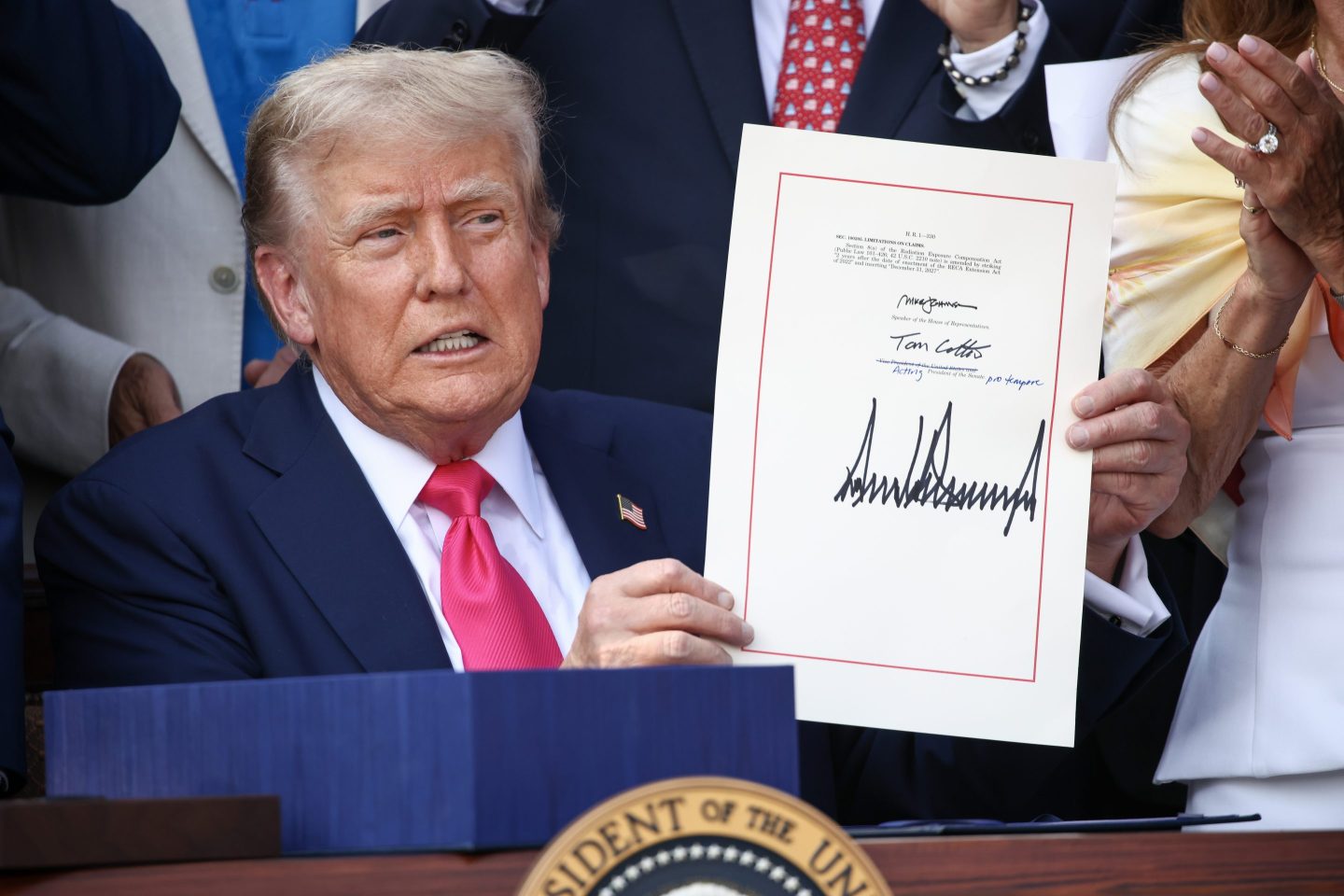
President Donald Trump holds up a sheet of paper with his signature on it.
President Donald Trump’s One Big Beautiful Bill Act eliminated a $7,500 EV tax credit.Samuel Corum—Getty Images
  • Since President Donald Trump took away $7,500 tax credits for EVs, demand for the vehicles has slumped, contributing to a widespread battery surplus. The shift has led to a divestment in battery factory plans, a hit to Trump’s goal of bolstering U.S. manufacturing. Meanwhile, China continues to lead the world in global battery production.

President Donald Trump’s crackdown on electric vehicle tax credits has contributed to a growing battery surplus that may hinder U.S. manufacturing, experts warn.

Recommended Video

The lack of incentives is driving slower EV sales, leaving battery producers with an overcapacity. This could lead to slower production and expansion, as well as higher energy costs, weakening U.S. manufacturing campaigns against China.

The U.S. is predicted to deploy about 378 gigawatt-hours of batteries by 2030, a 56% drop from what battery makers were expected to produce before Trump’s second term, according to a BloombergNEF report published Thursday and summarized by the publication.

This trend is likely to continue. According to June 2025 data from research firm Rhodium Group, announced investments in battery manufacturing peaked in 2022, following the Biden-era Inflation Reduction Act meant to incentivize the production of electric vehicles and components. In 2024 investments fell 80% from that 2022 peak, and in the first three months of 2025, companies cancelled a record $6 billion in battery manufacturing announcements. Clean-energy company Freyr Battery, for example, said earlier this year it was scrapping plans to build a $2.6 billion factory in Georgia, citing falling battery prices as one reason for the factory cancellation.

The massive drop-off in battery deployment is in large part the result of slowing electric vehicle demand, which has coincided with the passage of Trump’s One Big Beautiful Bill, ending a $7,500 tax credit on the vehicles. Consumer plans to buy an EV reached their lowest level since 2019, according to a recent AAA report, with only 19% of survey respondents saying they were “likely” or “very likely” to buy an EV as their next vehicle.

“It’s a combination of removal of the incentives, plus maybe a little stagnant interest from buyers, which is leading to lower demand,” Willy Shih, a professor of management practice in business administration at Harvard Business School, told Fortune. “But the incentives are substantial.”

BNEF analyst Matthew Hales, who specializes in trade and supply chains, told Bloomberg the surplus, as well as lack of government support for renewable energy, would be “a poison pill for U.S. manufacturing hopes.”

“The president is delivering on his promise to stop subsidizing electric vehicles with Americans’ tax dollars,” White House spokesperson Taylor Rogers told Fortune in a statement. “The administration remains committed to an America First economic agenda of tariffs, tax cuts, and deregulation that strengthens American manufacturing without forceful EV mandates.”

Losing ground on the U.S. manufacturing push

Trump has made U.S. reshoring efforts a focal point of his second administration through the implementation of steep tariffs intended to incentivize domestic manufacturing. U.S. Secretary of Commerce Howard Lutnick called factory roles the “great jobs of the future.” 

But increasing inventories of batteries threaten this vision, Shih said. Slowing demand and slowing manufacturing activity eliminates opportunity for innovation that comes with rampant production and iteration, meaning prices for locally produced batteries will likely tick upward. 

These demand shocks create a “bullwhip effect” across the supply chain, according to Li Chen, professor of operations, technology, and information management at Cornell University’s SC Johnson College of Business. Declines in consumer demand eventually amplify, leading not only to a surplus, but a likely battery shortage down the line as a result of decreased manufacturing capabilities.

“The initial effect is the battery surplus as we are seeing now,” Chen told Fortune. “But after the battery manufacturers cut back their capacity in response, my prediction is that there will be a shortage of [batteries] down the road with very high probability.”

Meanwhile, the global battery industry has continued to overproduce lithium-ion batteries, with China’s announced manufacturing capacity for lithium-ion batteries surpassing the expected 2025 global demand about threefold, according to BloombergNEF data. A price war among China’s EV manufacturing giants has continued to push down the cost of China-produced batteries. 

“Facing a demand falloff is actually very bad for the long-term health of the U.S. manufacturing of batteries,” Shih said. “And if you believe—as many people do—that batteries are a key technology as the world moves towards more electrification, that’s not a good scenario.”

Tenuous hopes for U.S. battery manufacturing

Because the EV sector is not poised for immediate growth, battery producers will likely look to other industries to offset low demand. The solar industry, for example, has a great need for batteries, Shih said. The industry is beholden to feed-in tariffs, a policy designed to support renewable energy by paying businesses a set rate for the energy they produce. 

This is a profitable model when demand for solar energy is high, but when demand is low, companies will sometimes have to pay negative feed-in tariffs for their oversupply. Batteries that can store energy help eliminate the risk of oversupply and negative feed-in tariffs, according to Shih.

However, the Trump administration has similarly gone after solar energy initiatives, saying earlier this month it would no longer approve wind or solar projects, claiming they increase energy prices. Trump’s vision of continuing to rely on fossil fuels and natural gas is myopic, according to Shih.

“He looks at one thing at a time, as opposed to looking at the bigger picture,” he said. This bigger picture, according to Shih, includes the argument that the U.S. has a lot to gain in the long term by looking at the long-term cost of energy, which could be cheaper if the U.S. invested in battery manufacturing.

“The U.S. would benefit by being globally competitive, but in order to do that, you have to have somebody who’s willing to buy products so that you can invest in manufacturing and growing that capability, right?” Shih said. “So it’s a bit of a contradiction.”

Subscribe to Fortune Gulf Brief. Every Tuesday, this new newsletter will deliver clear-eyed, authoritative intelligence on the deals, decisions, policies, and power shifts shaping one of the world’s most consequential regions, written for the people who need to act on it. Sign up here.
About the Author
Sasha Rogelberg
By Sasha RogelbergReporter
LinkedIn iconTwitter icon

Sasha Rogelberg is a reporter and former editorial fellow on the news desk at Fortune, covering retail and the intersection of business and popular culture.

See full bioRight Arrow Button Icon

Latest in Economy

Finance
Lorem ipsum dolor sit amet, consectetur adipiscing elit, sed do eiusmod tempor incididunt ut labore et dolore magna aliqua. Ut enim ad minim veniam
By Fortune Editors
October 20, 2025
Finance
Lorem ipsum dolor sit amet, consectetur adipiscing elit, sed do eiusmod tempor incididunt ut labore et dolore magna aliqua. Ut enim ad minim veniam
By Fortune Editors
October 20, 2025
Finance
Lorem ipsum dolor sit amet, consectetur adipiscing elit, sed do eiusmod tempor incididunt ut labore et dolore magna aliqua. Ut enim ad minim veniam
By Fortune Editors
October 20, 2025
Finance
Lorem ipsum dolor sit amet, consectetur adipiscing elit, sed do eiusmod tempor incididunt ut labore et dolore magna aliqua. Ut enim ad minim veniam
By Fortune Editors
October 20, 2025
Finance
Lorem ipsum dolor sit amet, consectetur adipiscing elit, sed do eiusmod tempor incididunt ut labore et dolore magna aliqua. Ut enim ad minim veniam
By Fortune Editors
October 20, 2025
Finance
Lorem ipsum dolor sit amet, consectetur adipiscing elit, sed do eiusmod tempor incididunt ut labore et dolore magna aliqua. Ut enim ad minim veniam
By Fortune Editors
October 20, 2025

Most Popular

Finance
Lorem ipsum dolor sit amet, consectetur adipiscing elit, sed do eiusmod tempor incididunt ut labore et dolore magna aliqua. Ut enim ad minim veniam
By Fortune Editors
October 20, 2025
Finance
Lorem ipsum dolor sit amet, consectetur adipiscing elit, sed do eiusmod tempor incididunt ut labore et dolore magna aliqua. Ut enim ad minim veniam
By Fortune Editors
October 20, 2025
Finance
Lorem ipsum dolor sit amet, consectetur adipiscing elit, sed do eiusmod tempor incididunt ut labore et dolore magna aliqua. Ut enim ad minim veniam
By Fortune Editors
October 20, 2025
Finance
Lorem ipsum dolor sit amet, consectetur adipiscing elit, sed do eiusmod tempor incididunt ut labore et dolore magna aliqua. Ut enim ad minim veniam
By Fortune Editors
October 20, 2025
Finance
Lorem ipsum dolor sit amet, consectetur adipiscing elit, sed do eiusmod tempor incididunt ut labore et dolore magna aliqua. Ut enim ad minim veniam
By Fortune Editors
October 20, 2025
Finance
Lorem ipsum dolor sit amet, consectetur adipiscing elit, sed do eiusmod tempor incididunt ut labore et dolore magna aliqua. Ut enim ad minim veniam
By Fortune Editors
October 20, 2025
Fortune Secondary Logo
Rankings
  • 100 Best Companies
  • Fortune 500
  • Global 500
  • Fortune 500 Europe
  • Most Powerful Women
  • World's Most Admired Companies
  • See All Rankings
  • Lists Calendar
Sections
  • Finance
  • Fortune Crypto
  • Features
  • Leadership
  • Health
  • Commentary
  • Success
  • Retail
  • Mpw
  • Tech
  • Lifestyle
  • CEO Initiative
  • Asia
  • Politics
  • Conferences
  • Europe
  • Newsletters
  • Personal Finance
  • Environment
  • Magazine
  • Education
Customer Support
  • Frequently Asked Questions
  • Customer Service Portal
  • Privacy Policy
  • Terms Of Use
  • Single Issues For Purchase
  • International Print
Commercial Services
  • Advertising
  • Fortune Brand Studio
  • Fortune Analytics
  • Fortune Conferences
  • Business Development
  • Group Subscriptions
About Us
  • About Us
  • Press Center
  • Work At Fortune
  • Terms And Conditions
  • Site Map
  • About Us
  • Press Center
  • Work At Fortune
  • Terms And Conditions
  • Site Map
  • Facebook icon
  • Twitter icon
  • LinkedIn icon
  • Instagram icon
  • Pinterest icon

Latest in Economy

U.S. debt is the ‘elephant in the room’ amid bond market rout as Fed-fueled interest costs could drive even larger deficits, analysts warn
EconomyDebt
U.S. debt is the ‘elephant in the room’ amid bond market rout as Fed-fueled interest costs could drive even larger deficits, analysts warn
By Jason MaMay 23, 2026
3 hours ago
The Fed’s worst inflation fears may be coming true as consumers lose faith in long-term prices—and even Trump supporters doubt he can bring relief
EconomyInflation
The Fed’s worst inflation fears may be coming true as consumers lose faith in long-term prices—and even Trump supporters doubt he can bring relief
By Jason MaMay 23, 2026
6 hours ago
c
EconomyEuropean Union
Europe Just admitted the Iran War’s price shock isn’t going away
By Menelaos Hadjicostis and The Associated PressMay 23, 2026
7 hours ago
w
BankingFederal Reserve
Trump on new Fed Chair Kevin Warsh: ‘Do your own thing’ but don’t lose your way like Jerome Powell did
By Will Weissert, Michelle L. Price and The Associated PressMay 23, 2026
8 hours ago
Mel Robbins
SuccessGen Z
Millionaire podcaster Mel Robbins hits back at Gen Z’s lazy label—she says they’re stuck in a world their baby boomer parents wouldn’t even recognize
By Emma BurleighMay 23, 2026
9 hours ago
employees
CommentarySuccession
Millions of business owners are about to retire. They should sell to their employees
By Matt Helmer and Maxwell JohnsonMay 23, 2026
11 hours ago

Most Popular

Jeff Bezos wants the bottom half of earners to pay zero income tax—he says nurses making just $75K should save $12K a year
Success
Jeff Bezos wants the bottom half of earners to pay zero income tax—he says nurses making just $75K should save $12K a year
By Preston ForeMay 21, 2026
2 days ago
Indeed chief economist says we’re entering an era of ‘great mismatch’ thanks to a generational imbalance of workers
Success
Indeed chief economist says we’re entering an era of ‘great mismatch’ thanks to a generational imbalance of workers
By Emma BurleighMay 22, 2026
1 day ago
Apple’s Steve Wozniak says he cofounded the tech giant after 5 rejections from HP—not to ‘make money.’ For years, his paycheck was just $50
Success
Apple’s Steve Wozniak says he cofounded the tech giant after 5 rejections from HP—not to ‘make money.’ For years, his paycheck was just $50
By Preston ForeMay 22, 2026
1 day ago
Microsoft reports are exposing AI's real cost problem: Using the tech is more expensive than paying human employees
AI
Microsoft reports are exposing AI's real cost problem: Using the tech is more expensive than paying human employees
By Jake AngeloMay 22, 2026
1 day ago
Bolt CEO says he let go of his entire HR team for creating problems that didn’t exist: ‘Those problems disappeared when I let them go’ 
Workplace Culture
Bolt CEO says he let go of his entire HR team for creating problems that didn’t exist: ‘Those problems disappeared when I let them go’ 
By Preston ForeMay 19, 2026
4 days ago
Current price of oil as of May 22, 2026
Personal Finance
Current price of oil as of May 22, 2026
By Joseph HostetlerMay 22, 2026
1 day ago

© 2026 Fortune Media IP Limited. All Rights Reserved. Use of this site constitutes acceptance of our Terms of Use and Privacy Policy | CA Notice at Collection and Privacy Notice | Do Not Sell/Share My Personal Information
FORTUNE is a trademark of Fortune Media IP Limited, registered in the U.S. and other countries. FORTUNE may receive compensation for some links to products and services on this website. Offers may be subject to change without notice.