
Stanford University has published a first-of-its-kind study on Tuesday that reveals “the AI revolution” is already beginning to have a “significant and disproportionate impact on entry-level workers in the U.S. labor market,” especially those ages 22 to 25 in highly AI-exposed professions like software engineering and customer service.
The research, led by Erik Brynjolfsson, a top economist and AI thought leader of sorts, analyzed high-frequency payroll records from millions of American workers, generated by ADP, the largest payroll software firm in the U.S. The analysis revealed a 13% relative decline in employment for early-career workers in the most AI-exposed jobs since the widespread adoption of generative-AI tools, “even after controlling for firm-level shocks.” In contrast, employment for older, more experienced workers in the same occupations has remained stable or grown.
The study highlighted six facts that Brynjolfsson’s team believe show early and large-scale evidence that fits the hypothesis of a labor-market earthquake headed for Gen Z.
1) Entry-level workers hit hardest
First, employment disruption is not happening evenly across the workforce. The largest declines are concentrated among young, entry-level workers—those whose skills are most easily replaced by AI systems automating routine, codified tasks. The report says experience and tacit knowledge are becoming crucial buffers against displacement as AI tools excel at replacing book learning over job-specific, hard-to-codify skills.
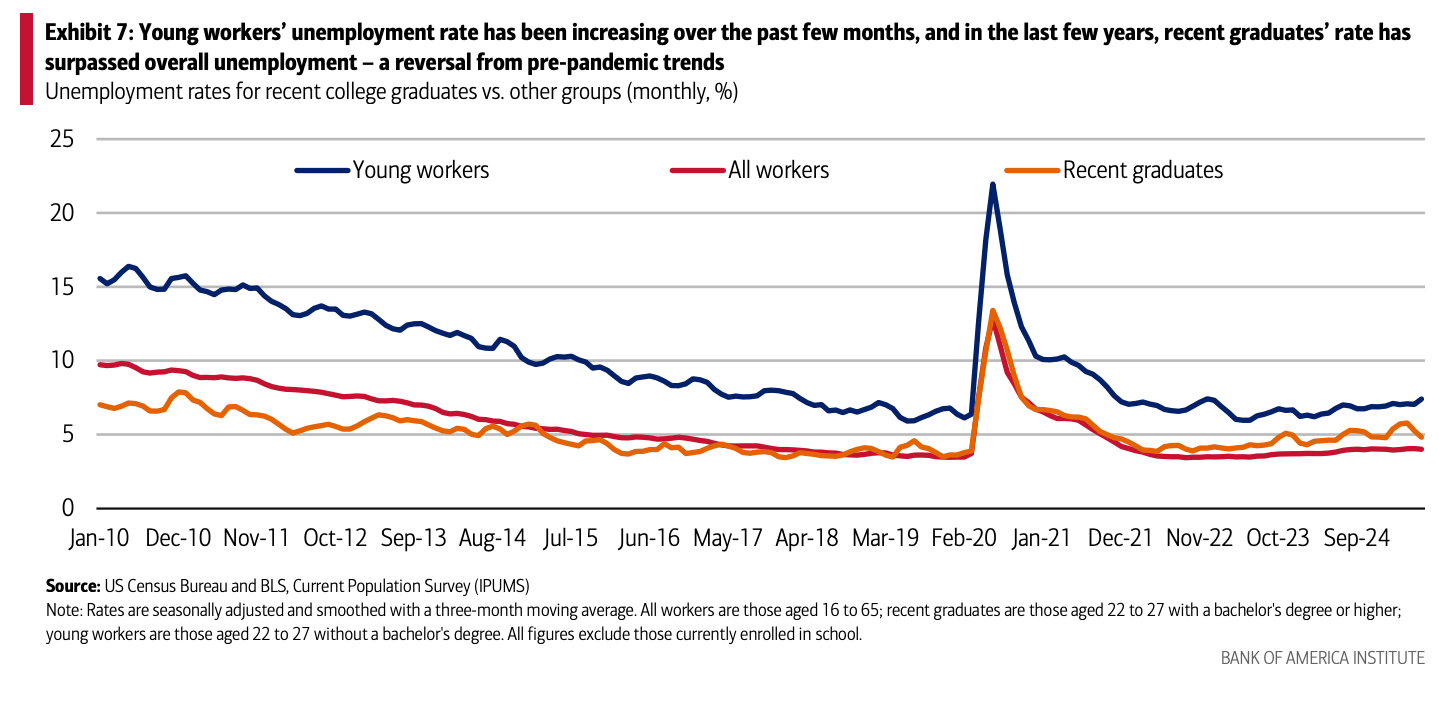
The report says it’s uncovered “substantial” declines in employment, especially for workers ages 22 to 25. This dovetails with mounting evidence from investment banks and surveys of layoff announcements, as Goldman Sachs has calculated a shrinking premium from a college degree, implying that entry-level workers are struggling to differentiate themselves in this hiring climate. Bank of America Global Research, meanwhile, has noted that since 2022, the unemployment rate for recent graduates has started to exceed the overall unemployment rate for the first time in recent memory.
2) A fading pattern since 2022
Second, the study finds fewer young people are being hired into AI-exposed occupations, with employment growth for young workers stagnant since late 2022—consistent with BofA’s analysis of census data.
In jobs less exposed to AI, the study says, young workers have experienced comparable employment growth to older workers. In contrast, entry-level workers in the occupations most exposed to AI have experienced a 6% decline in employment from late 2022 to July 2025, while older workers have seen 6% to 9% growth. The results suggest that the AI revolution is driving “tepid” overall employment growth for workers ages 22 to 25, the study adds.
3) Automation vs. augmentation
An important distinction is that not every use case for AI is leading to a decline in employment, the data suggests. The negative impacts are concentrated in fields where AI is more likely to automate tasks rather than augment work, and occupations with mainly augmentative AI applications have not seen similar declines in entry-level hires.
The team says it distinguished between automation and augmentation “empirically,” using estimates of the extent to which observed queries either substitute or complement for tasks in a given occupation. “These findings are consistent with automative uses of AI substituting for labor while augmentative uses do not,” the authors write.
This is similar to a line adopted by Joshua Wöhle, CEO of Mindstone, a firm that provides AI upskilling services to workforces. “We’re near the point where [AI is] more intelligent than most people doing knowledge work. But that’s precisely why augmentation beats automation,” Wöhle wrote on LinkedIn about his experiences with AI retraining. And Eric Vaughan, CEO of IgniteTech, took the drastic step of laying off nearly 80% of his company in 2023, telling Fortune that he didn’t do so because he wanted fewer workers, but because his team was not augmenting their work with AI tools fast enough.
4) Sturdiness
Stanford’s analysis rules out several other explanations, such as COVID-era disruptions or interest rate shocks. The effects only emerged after late 2022, coinciding with rapid generative-AI adoption, and are not limited to computer-related jobs, the authors write, stating the robustness of these findings as significant.
For workers ages 22 to 25, researchers say they found a decline in relative employment for the most AI-exposed quintiles compared to the least exposed quintile, a “large and statistically significant effect.” Other age groups had much smaller and statistically insignificant estimates, on the other hand.
5) Employment, not wages
Fears of collapsing income related to AI may be overblown, the study says, finding that the adjustment in the labor market is happening largely through decreased employment rather than lower wages. Pay rates have not shifted dramatically, according to Stanford, with “little difference in annual salary trends by age or exposure quintile, suggesting possible wage stickiness.” If this is true, they write, AI may have larger effects on employment than on wages, at least to begin with.
6) Widespread consistency
Finally, the Stanford team argues these facts are largely consistent across various samples, with patterns in the data appearing “most acutely starting in late 2022, around the time of rapid proliferation of generative AI tools.”
The authors caution that while these findings are early, their large-scale, real-time dataset provides some of the first direct empirical evidence that AI is shifting job opportunities away from America’s entry-level workers. The study repeatedly stresses it is assessing the beginning of what it calls the “AI revolution,” but the much-publicized economic anxiety among Gen Z is beginning to show up in employment data confirming that yes, something is going on here.