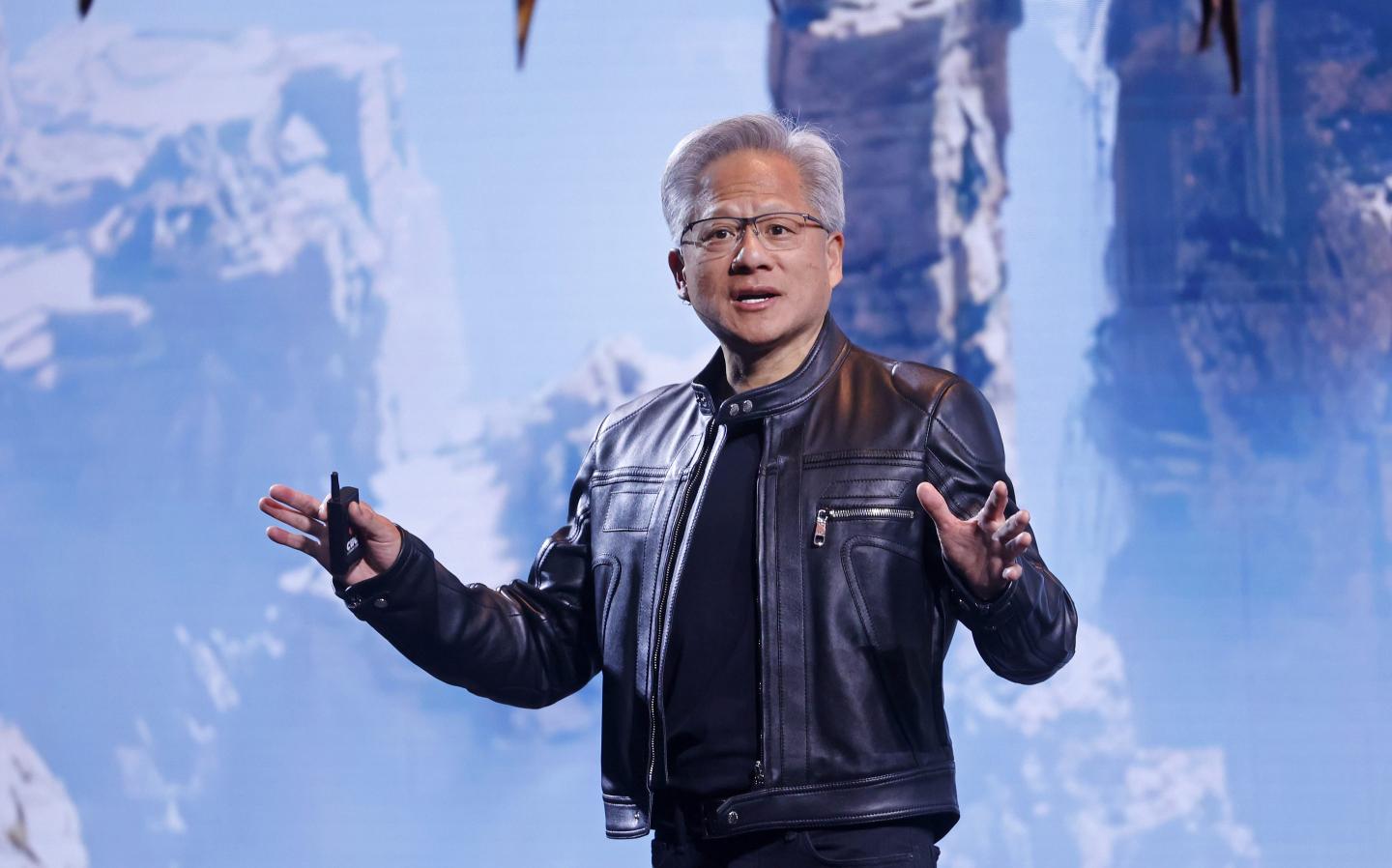
Nvidia’s earnings aren’t just about Nvidia anymore. The $4 trillion chipmaker’s quarterly financials have become a litmus test for the AI boom—and, by extension, for the whole stock market. Constituting 8% of the market-cap-weighted S&P 500 index and with an unrivaled grip on the chips that power generative AI, Nvidia sees its results treated more like a macroeconomic indicator by Wall Street than as a report card on a single company. The earnings announcement has even become a cultural phenomenon complete with watch parties.
Investors are bracing for the company’s latest quarterly results due after Wednesday’s market close, with trading in Nvidia options implying expectations that the stock will move 6%, up or down—equal to a $260 billion change in Nvidia’s market value.
In the three months since the company last gave investors a quarterly update, back in May, Nvidia’s stock has surged 35%. But the tension surrounding what is already the most closely watched earnings event of the season has been ratcheted up by recent jitters over what some worry is a dangerous financial bubble in AI-related stocks. And uncertainty about Nvidia’s China business continues to loom large.
Wall Street analysts are looking for Nvidia’s Q2 revenue to surge 53% year over year to $46 billion, at the high end of Nvidia’s guidance, with earnings per share of $1.01. Data center sales, the crux of Nvidia’s business, are expected to come in close to $40 billion. But with Nvidia’s shares having gained so much in recent months, a miss on Wednesday, or cautious guidance tied to China restrictions, could send the stock plummeting.
Nvidia in the U.S.-China crosshairs
Nvidia may remain one of the greatest beneficiaries of the generative AI boom, but a critical part of the company’s business has also become a geopolitical football as the U.S. and China compete for technological dominance. In April, Washington began requiring export licenses for the company’s H20 chips—stripped-down versions of Nvidia’s top-of-the-line AI chips that were specifically designed to comply with the U.S. export controls that took effect in late 2022 and were tightened again in 2023. Those tighter export licenses forced the company to take a $4.5 billion charge in Q1 tied to unsold inventory and purchase commitments.
From there, things only got more complicated for Nvidia’s China business. After Nvidia CEO Jensen Huang visited President Trump at Mar-a-Lago, the White House said it would permit the company to sell H20s after all. Nvidia applied for export licenses but faced extensive delays, thanks to the tougher U.S. stance and Chinese buyers hesitating to commit to purchasing. Then, earlier this month, Nvidia and AMD struck a deal with the Trump administration to grant licenses in exchange for a 15% revenue-sharing arrangement on China chip sales.
But as shipments of H20 chips resumed, China began discouraging companies from buying them, expressing concerns that the information Nvidia was asking customers to submit for U.S. government review could contain sensitive information. The Chinese government also reportedly claimed it had found evidence that Nvidia’s chips might contain back doors that would allow U.S. spy agencies to extract data on how they were being used. In addition, comments from U.S. Commerce Secretary Howard Lutnick about providing China with Nvidia’s “fourth-best chips” were considered “deeply insulting” by Chinese officials, according to the Financial Times.
Finally, last week Huang announced in Taipei that Nvidia has started winding down production of the H20 chip and begun work on a more powerful successor, saying the company was working on offering a “new product for AI data centers,” modified to reduce some of its performance, as required by the United States. He said he was seeking the Trump administration’s approval to sell the chip.
“It’s up to, of course, the United States government,” Huang said. “And we’re in dialogue with them, but it’s too soon to know.”
As a result of all the uncertainty, analysts predict Nvidia will not allude to China revenue in the earnings report.
“I suspect they will not count, nor forecast China revenue; there’s too much uncertainty involved,” said Karl Freund, founder and principal analyst at Cambrian-AI Research.
Jack Gold, founder and principal analyst at J. Gold Associates, told Fortune that Nvidia now has two primary groups to please: stockholders and the Trump administration. “They’re caught between a rock and a hard place,” he said. “It’s a really strange situation we’re in now where the government in the U.S. actually has their hands into the pockets, into the wallets of these companies.”
AI bubble trouble
Beyond geopolitics, Nvidia faces another challenge: growing unease that the AI boom is starting to look like a bubble. This would strike at the heart of Nvidia’s business and its stratospheric valuation—the company trades at more than 40 times its projected earnings—which rely on ever-growing demand for its powerful GPUs. Nvidia’s growth is heavily concentrated in a handful of cloud giants, including Meta, Amazon, Google, and Microsoft, as well as highly funded AI startups like OpenAI. If those companies slow spending, Nvidia could suddenly lose its biggest buyers.
“I do believe that everyone’s concerned about an AI bubble,” said Freund, though he added that those concerns have lasted for three years already. He did not, he emphasized, think it would pop now. “I think there are still two to five years of growth left,” he said.
Gold agreed, saying there were “at least several quarters, if not a couple of years of good profits” for Nvidia, but he cautioned, at some point, if the market crashed, that money spent on chips would go away.
“It concerns me,” he said. “This time, I’m sure the earnings will still be great—[Nvidia is] selling everything they can build at ridiculously inflated prices, which is fine, if you can get away with that.” But from a broader market perspective, he added, the massive AI data center build-outs “can’t go on forever.”
That’s why, said Freund, Huang is actually working to get investor attention to shift from the data-center-centric view to other areas of Nvidia’s business, including its automotive and robotics work: “That’s his game right now, how to get investors to shift to a more holistic view of AI as it moves out of the data center and into the real world.”
But those investors are likely more interested in the here and now—what tomorrow’s numbers show. Let the watch parties begin.