

- The mainstream AI economy is struggling, but the “shadow AI economy” is booming. That’s one of the key takeaways from a sweeping new MIT study on generative AI in the workplace. The study finds that workers at more than 90% of companies are using personal chatbot accounts for daily tasks, often without approval from IT, while only 40% of companies actually have official LLM subscriptions.
A sweeping new report from MIT’s Project NANDA, State of AI in Business 2025, has uncovered a dramatic split in the landscape of enterprise artificial intelligence: While official AI adoption in companies stalls, a robust “shadow AI economy” is flourishing under the radar, powered by employees using personal AI tools for day-to-day work.
The main thrust of the study is the “GenAI divide”: the finding by MIT that despite $30 billion to $40 billion invested in gen-AI initiatives, only 5% of organizations are seeing transformative returns. The vast majority—95%—report zero impact on profit and loss statements from formal AI investments. Lurking under the surface, though, MIT also finds huge engagement with LLM tools on the part of workers, a shadow economy of seemingly widespread AI adoption.
Rather than waiting for official enterprise gen-AI projects to overcome technical and organizational hurdles, employees are routinely leveraging personal ChatGPT accounts, Claude subscriptions, and other consumer-grade AI tools to automate tasks. This activity is often invisible to IT departments and C-suites.
Employees are already crossing the GenAI Divide through personal AI tools. This ‘shadow AI’ often delivers better ROI than formal initiatives and reveals what actually works for bridging the divide.
The 40% and 90% split
The study was based on a review of over 300 publicly disclosed AI initiatives, interviews with representatives from 52 organizations, and survey responses from 153 senior leaders.
It reveals that while only 40% of companies have purchased official LLM subscriptions, employees in over 90% of companies regularly use personal AI tools for work. In fact, nearly every respondent reported using LLMs in some form as part of their regular workflow.
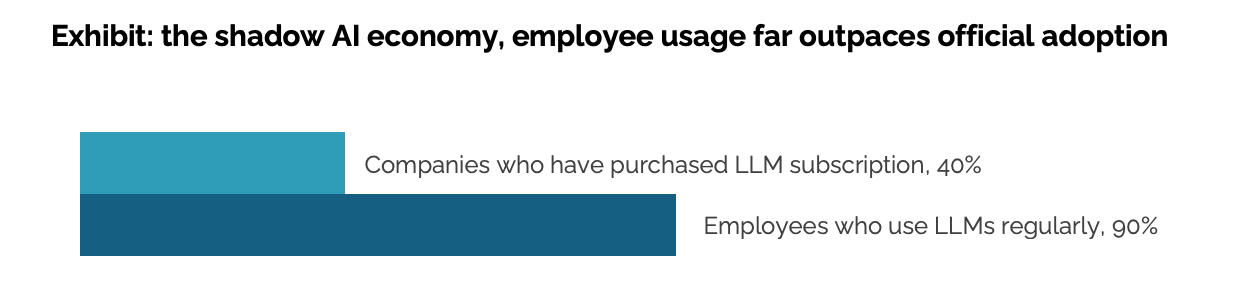
Many shadow users describe interacting with LLMs multiple times a day, every workday—with adoption often far outpacing their companies’ sanctioned AI initiatives, which remain stuck in pilot stages.
Project NANDA’s analysis highlights key reasons for this divide:
- Flexibility and immediate utility: Tools like ChatGPT and Copilot are praised for their ease of use, adaptability, and instantly visible value—qualities missing from many custom-built enterprise solutions.
- Workflow fit: Employees customize consumer tools to their specific needs, bypassing enterprise approval cycles and integration challenges.
- Low barriers: Shadow AI’s accessibility accelerates adoption, as users can iterate and experiment freely.
As the report notes, “The organizations that recognize this pattern and build on it represent the future of enterprise AI adoption.”
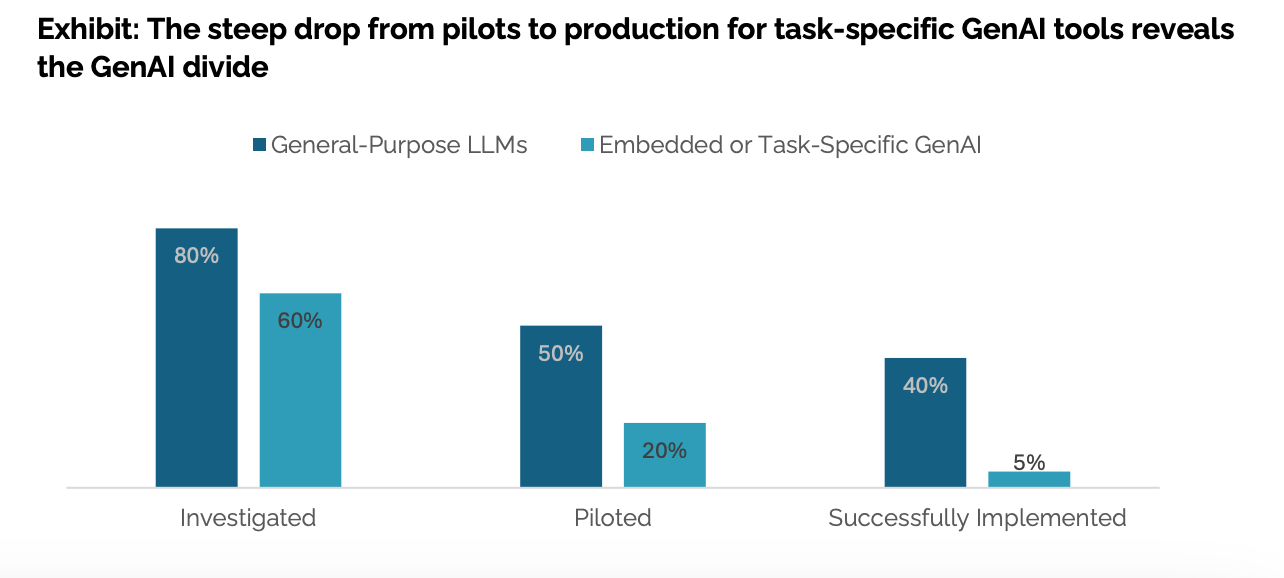
These advantages contrast sharply with official gen-AI deployments, where complex integrations, inflexible interfaces, and lack of persistent memory often stall progress. This helps explain a “chasm” in between pilots and production.
The ‘war for simple work’
According to the report, shadow AI usage creates a feedback loop: As employees become more familiar with personal AI tools that suit their needs, they become less tolerant of static enterprise tools.
“The dividing line isn’t intelligence,” the authors write, explaining that the problems with enterprise AI have to do with memory, adaptability, and learning capability.
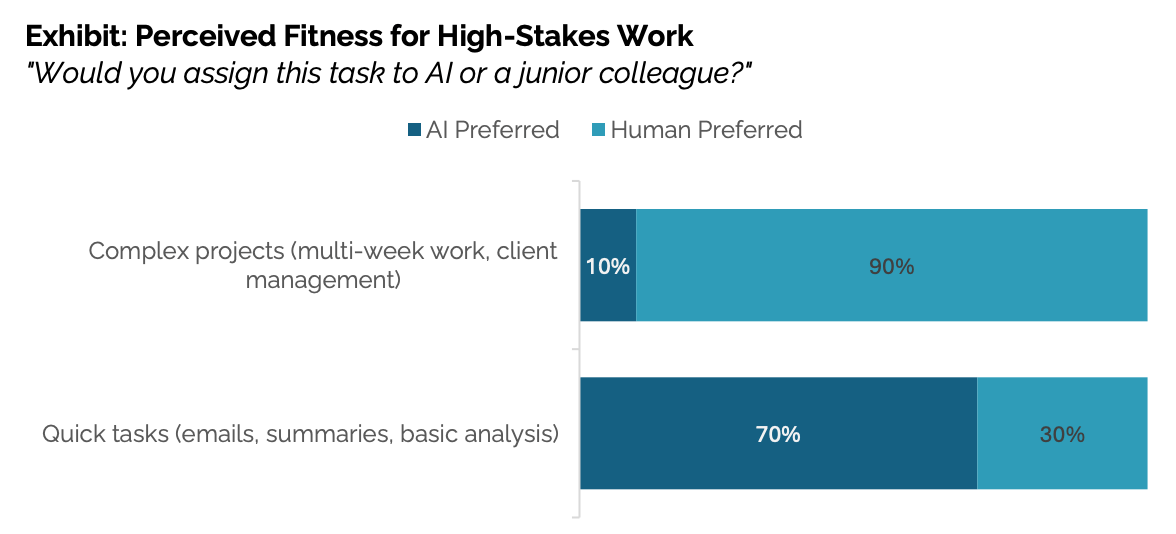
As a result, 90% of users said they prefer humans to do “mission-critical work,” while AI has “won the war for simple work,” with 70% preferring AI for drafting emails and 65% for basic analysis.
Meanwhile, the study engages in some myth-busting, puncturing five commonly held beliefs about enterprise AI. Contrary to the hype, it finds:
- Few jobs have been replaced by AI.
- Beyond the limited impact on jobs, generative AI also isn’t transforming the way business is done.
- Most companies have already invested heavily in gen-AI pilots.
- Problems stem less from regulations or model performance, and more from tools that fail to learn or adapt.
- Internal AI development “build” projects fail twice as often as externally sourced “buy” solutions.
That being said, the tech sector layoffs of the last several years have become entrenched in the economy, whether they are related to AI adoption or not. And research on the declining wage premium of the college degree suggests that a fundamental shift is occurring in the labor market.
But the AI sector may be hitting a plateau, with the underwhelming launch of OpenAI’s ChatGPT-5 leading some prominent writers to wonder: What if this is as good as AI gets?
In fact, the Federal Reserve commissioned several staff economists to consider the question, and their base case is that it will significantly boost productivity. But they also said it could end up having an import more like an invention that literally banished shadows when it appeared over 100 years ago: the light bulb.
For this story, Fortune used generative AI to help with an initial draft. An editor verified the accuracy of the information before publishing.