- To land the historic job as the first Egyptian, Arab, and African woman to go to space, Sara Sabry trained and researched every morning before her full-time tech job and didn’t see daylight for years. The grind to space isn’t for the faint of heart—and it’s a reality check, she suggests, for work-life balance-loving Gen Z. In an exclusive interview with Fortune, she shares the brutal routine that helped her defy a “0.0%” chance of becoming an astronaut.
Sara Sabry became the world’s first Egyptian astronaut after flying to space on Blue Origin’s New Shepard rocket on Aug. 4, 2022—marking the first time an Arab or African women has ever gone to space, all before even turning 30.
It’s a common childhood dream, but one that few realize. For starters, you need access to a plane just to rack up the 1,000 flight hours required to apply to programs like NASA.
For Sabry, the mission was even more impossible. She wasn’t born into a country with a space agency. There were no astronauts who looked like her. And she didn’t have elite connections or deep pockets.
So to get her foot in the door, the then 28-year-old had to wake up at 4:30 a.m. to squeeze in early-morning training and bioastronautics research, all before reporting to her full-time job as CTO of a Berlin-based tech startup by 9 a.m.
Then after work, she’d work some more on her own start-up and space training—and it’s the kind of gruelling discipline she says young people today shouldn’t shy away from if they want to unlock their dreams.
“Back then it was, it was really, really, it was really tough,” she recalls in those early days of her career, speaking exclusively to Fortune during her stay in London for the 2025 American Express Leadership Academy. “You would wake up at night, and then you would go back at night, so you barely see the daylight ever.”
She says that she’d tackle the most important tasks of the day before 10 a.m., when others start to trickle online.
“I see a lot of young people now they’re wanting to take the easy route without working so hard. But the truth is, you have to make sacrifices. You have to put yourself through a lot of discomfort,” Sabry adds. “Of course, it’s not easy to wake up 4:30 a.m. every morning and be completely isolated from the world, right? But it goes to show that you can really transform your life—and you have so much control over your life.”
Sabry says the experience radically shifted how she viewed limitations tied to class, geography, and identity.
She didn’t have the passport, the platform, or the privilege, but she pushed through anyway. And in doing so, proved what’s possible when ambition is backed by relentless effort.
“It changed the way I see things now. Having gone to space and having done the thing that was impossible, honestly the likelihood of that happening was around 0.0%, unless I changed my nationality.”
She beat the odds—and over 7,000 other applicants for that Blue Origin flight—to make history.
Now, she’s made it—but still pulling 13-hour days and has a jet-setter schedule
Despite finding success, you still won’t find Sabry kicking up her feet.
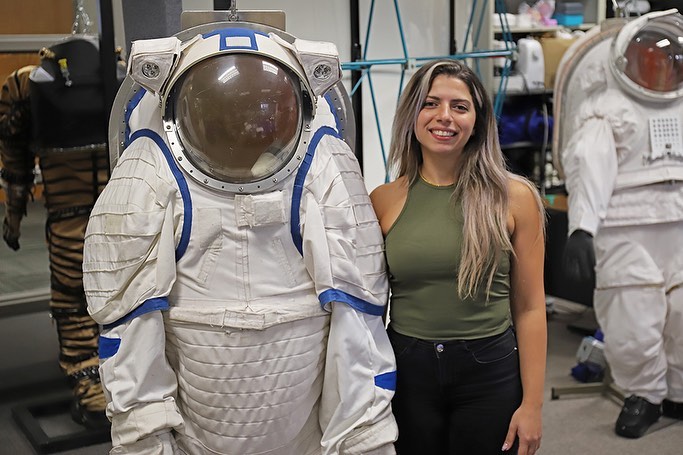
On top of being an astronaut, the now 32-year-old is also the executive director of Deep Space Initiative—a nonprofit she founded to make space more accessible—co-founder of the Egyptian Space Agency’s Ambassador program, and is completing a PhD in aerospace engineering. She is also conducting research on the engineering of the next generation of planetary spacesuits at the NASA-funded Humanspaceflight lab.
If that wasn’t enough, Sabry is building new ventures and growing a speaking career that’s taking her around the world. And with such a packed, jet-setting schedule, she’s learned to adapt her rigid routine into something more flexible. But that doesn’t mean she lies in.
“I haven’t lived in a one place in three years,” she says. “I have to live out of my suitcase, so you have to adapt.”
Nowadays, Sabry starts her day at around 6 a.m. with a workout, before responding to emails and doing “admin stuff.”
“It’s not 4:30 a.m. anymore, because I have to work late these days,” she explains, adding that the time difference for international calls she has to take while often based in Egypt pushes her work schedule back, bringing her total workday to 13 hours.
“My first meeting is at 9 a.m. and my last meeting is from 9 p.m. to 10 p.m. so I can’t be waking up too early,” Sabry continues. Eight hours of sleep is non-negotiable—and so is having every task for the day blocked out in her calendar.
“Because I’m balancing a PhD, two companies, my public speaking, and more, I think it’s really about scheduling. As soon as tasks are scheduled in my calendar, I don’t have to think about them,” she adds.
“It’s so easy to get distracted when you’re working on other things, and you think, ‘Oh I have to work on my research or I have to answer emails.’ But no, emails are going to stay in the inbox until the scheduled time for me to be looking at emails. Sometimes, of course, you have to do urgent things. But the things that are not super urgent? You pre-schedule.”
Eyes on the prize: The cure for exhaustion
If you feel exhausted just reading about Sabry’s routine, let alone copying it, she says there’s only one way to survive it: become obsessed by your mission.
Sabry said she had no other choice because the alternative was not giving it all and risk not achieving her dream.
“It was always this fight,” she explains. “I was never going to be given an opportunity. Having grown up knowing that things are just not going to be given to me, I never expected anything. It makes you work so much harder. But I never really resented it, or felt like, ‘Oh, I’m doing too much,’ because that was just the necessary thing to do to move forward. There was no other option.”
And she says having a packed schedule helped her move forward with her goals because she didn’t even have time to think about anything else.
“Most of the day you’re in the dark, but you’re so consumed by it—having that focus and not having time to look at what’s going on in different places was really, really key,” she tells Fortune.
“So being so consumed and having just a really packed schedule, and knowing that I was investing in myself. When you’re working on things that you know are towards your purpose, it just gives you so much peace.”
Ultimately, she’d only be kicking herself today if she knew there was an extra hour or two in the day that she hadn’t used to push herself forward.
“If I wasn’t doing everything that I can and I could do more, then I wouldn’t feel at peace. Then I would kind of go through like the other rabbit hole of, you know, being kind of like extra tough on yourself. So by doing so much, it gave me peace.”