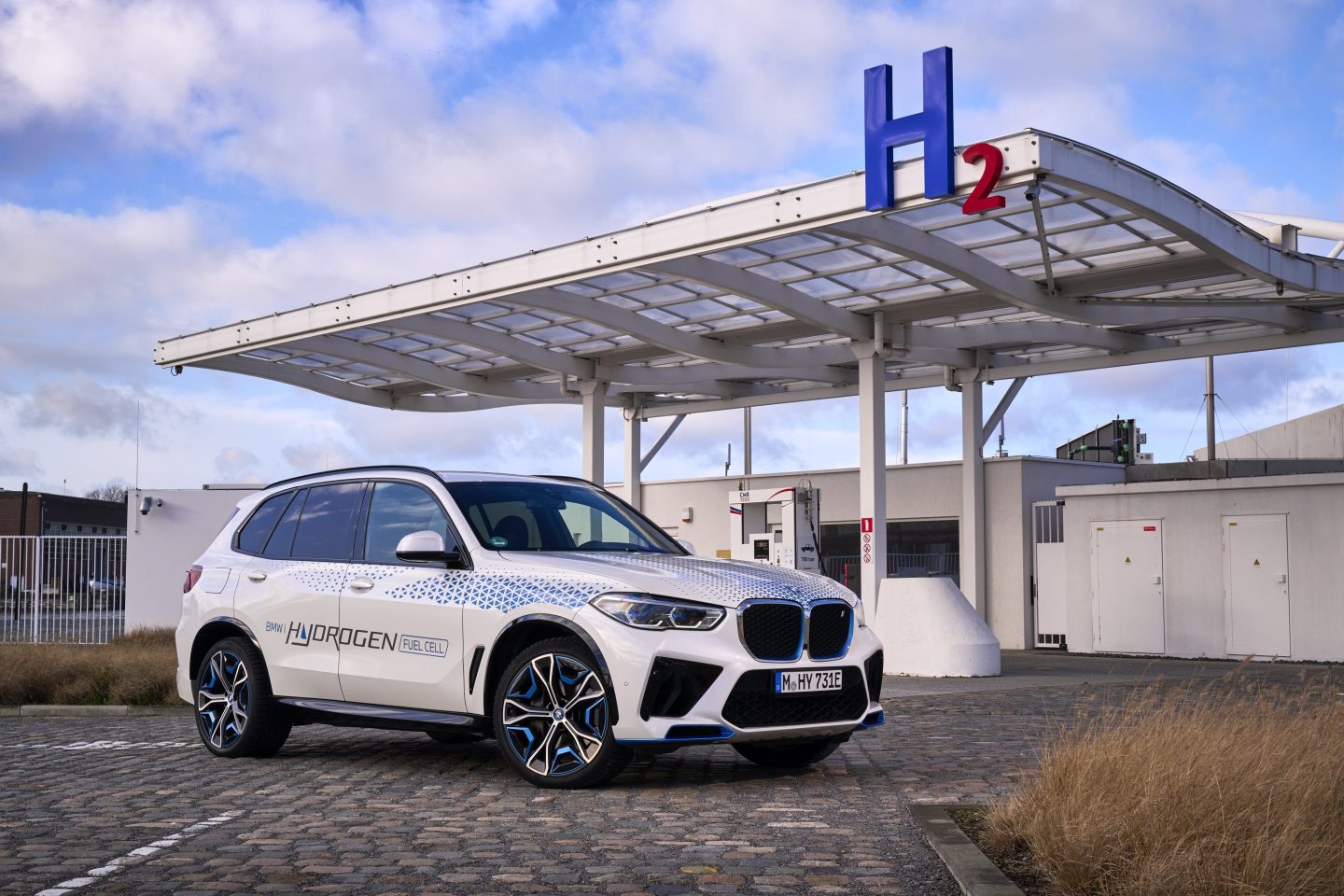
Hydrogen fuel cell cars (FCEVs) have been on the market for a similar duration to the current wave of battery EVs (BEVs). But they have sold a tiny fraction in comparison. In 2024, 12,866 FCEVs were registered globally, versus 10.8 million BEVs. Still, some manufacturers have hopes that hydrogen has a role to play in transport.
One of these is BMW, which recently announced it would be bringing its first FCEV into series production in 2028. Fortune caught up with BMW Group’s General Project Manager Hydrogen Technology and Vehicle Projects, Jürgen Guldner, at a recent summit promoting FCEVs, among other hydrogen evangelists.
Toyota has been the leading seller of FCEVs with the Mirai launched in 2014, but it isn’t the only player. Hyundai has been selling its Nexo since 2018, and Honda, after offering various cars under the Clarity name from 2008 to 2021, brought its CR-V e:FCEV plug-in hybrid hydrogen car to market in 2024. BMW has been more cautious. The company has been trialling FCEVs with a pilot run of vehicles based on X5 since 2023. The iX5 Hydrogen is already a credible vehicle, with smooth driving and a familiar X5 interior. However, this won’t necessarily be the vehicle that BMW will launch in 2028.
“The good news is a hydrogen vehicle is an electric vehicle,” says Guldner. “It’s just a different way of storing the energy versus a battery, which also means that we can reuse a lot of the components like the electric motors in the car from our BEVs. It also has a unique value proposition. It’s the best of both worlds, with all the benefits of electric driving—acceleration, silent driving, zero emission—but you can refuel in 3 to 4 minutes and you’re 100% full and ready to go again.”
The problem of hydrogen infrastructure
This has always seemed like a compelling argument for hydrogen on paper, but the reality has been that hydrogen refueling hasn’t proliferated like BEV charging stations. In fact, it has gone backwards in many countries. In the UK, in 2019 there were as many as 15 hydrogen fuel stations, whereas today in 2025 only four were listed, with two potentially not in service. By contrast, according to Zap-Map, there were 39,733 public charging locations in the UK in May 2025, with 80,998 devices and 115,241 connectors. Germany is better served for hydrogen refueling, but some European countries have no stations at all, such as Spain, Portugal and Italy.
Some hydrogen proponents argue that this is a strategic mistake if your goal is to decarbonize road transport.
“FCEVs are complementary to battery electric vehicles and heading towards one common direction,” says David Wong, head of technology and innovation at the Society of Motor Manufacturers and Traders. “If you invest in both charging infrastructure and the fuel cell hydrogen refilling infrastructure, the overall cost is lower. We’ve done modelling where they use Germany as an example. It shows that if we have a motor park penetration of 90% BEVs and 10% FCEVs, the overall cost of investing in infrastructure is $40 billion lower than the scenario where 100% of infrastructure is public charge points.”
There is also concern about resource usage when manufacturing BEVs. Guldner points out batteries requires a lot of raw materials, which could lead to scarcity.
“Having a second technology, not putting all eggs in one basket, provides resilience,” he explains. “BMW having two technologies is better than one. We got a lot of feedback from people saying BEVs don’t work for them. We’re thinking about those people who can’t or don’t want to use battery electric cars because maybe they don’t have electric charging at home, or are on the road a lot and don’t want to depend on charging stops, even if you can get them down to maybe 20 minutes. We have issues like towing and cold weather conditions. In the fuel cell you can use excess heat, so you don’t lose any range.”
This still leaves the problem with how you ramp up the infrastructure to support hydrogen. A commercial DC charger might be $50,000, a home charger can cost $1,000, or you can even use a very slow $200 mains plug cable.
But the price for a hydrogen station is much greater—between $1.5 and $2 million, although some estimate as much as $4 million. The solution, at least in the UK, is to target the long-haul commercial sector first and build out from that. HyHAUL is a project aiming to achieve that.
“The biggest challenge with hydrogen is the fact that it works very well at large scale, but not so good at small scale,” says Chris Jackson, CEO and founder of Protium Green Solutions, which co-founded HyHAUL. “One single hydrogen fueling station requires hundreds of passenger cars to make the economics work, but only a very small number of trucks. We are initially developing three major refueling stations and all we need to get the project off the ground is 30 fuel cell trucks. The first stage will be along the M4 corridor. We’ll be covering from Wales all the way into the M25 around London. Over time, we plan to expand across other networks, going up the M5 and M6.”
For consumer adoption of FCEVs, however, it would be necessary to cover the UK completely within half an hour driving distance, which would require about 1,300 stations. One of the reasons why Tesla was able to kickstart the BEV revolution so effectively was its two-pronged approach of building the supportive charging infrastructure to go with its cars.
Automakers developing FCEVs have traditionally left this to third parties, leading to a chicken-and-egg situation where car adoption awaited infrastructure, and vice versa. This has meant that as BEVs have reached a tipping point in many markets, including the UK, EU and China, while FCEVs wait in the wings.
Can fuel cells prevail?
This hasn’t prevented Toyota from persevering with FCEVs. “Our role is to provide customers with choice,” says Jon Hunt, senior manager, Hydrogen Transformation, Toyota GB. “We can’t have people dismissing technologies that are there to enable us all to learn and develop.”
Commercial vehicles could help FCEVs reach that tipping point. In Paris, around 1,000 FCEV taxis have been operated by Hype since 2015, the majority of which are Toyota Mirais. For this reason, Paris has six hydrogen fuel stops with three more being built. This could lay the groundwork for consumers to adopt FCEVs in the city. However, outside Paris there is no supportive infrastructure yet, preventing long journeys beyond the urban limits. Hype has also recently said it is pivoting away from FCEVs to BEVs.
Even with full launch still three years away, BMW is placing a heavy bet on infrastructure having improved sufficiently for hydrogen to be a viable choice for consumers by 2028.
Guldner notes BMW hasn’t yet decided which countries it will bring those vehicles to market, adding that it will depend on the infrastructure.
“Right now, it’s simply not here in the UK. But hopefully in the next few years, development will pick up,” he says.
The exact model that will go into production in 2028 also hasn’t been announced. And while a price hasn’t been unveiled either, BMW is hoping for parity with BEVs, Guldner says, pointing to previous dramatic cost reductions in other technologies like batteries and solar cells.
For these cost reductions to materialize, though, there has to be enough demand for FCEVs to deliver sufficient scale.
“I am always surprised by surveys in newspapers where so many people say they would prefer a hydrogen vehicle over battery power,” he says. “There seems to be demand there.”
The question will be whether these survey responses translate into vehicle sales. In 2028, when BMW launches its production FCEV, we could find out.