
• Home
  • Latest
  • Fortune 500
  • Finance
  • Tech
  • Leadership
  • Lifestyle
  • Rankings
  • Multimedia
TechFortune Intelligence

How much is AI really replacing jobs? Goldman Sachs looks under the hood and has 3 takeaways to defuse the hype

By
Nick Lichtenberg
Nick Lichtenberg
and
Fortune Intelligence
Down Arrow Button Icon
By
Nick Lichtenberg
Nick Lichtenberg
and
Fortune Intelligence
Down Arrow Button Icon
July 17, 2025, 12:35 PM ET
Man staring at computer
How bad is the AI disruption, really?Getty Images

There’s a lot of speculation, including in the pages of Fortune Intelligence, about the impact that artificial intelligence will have on the jobs of the future. Goldman Sachs Chief Economist Jan Hatzius is on the case, leading a team that draws from a breadth of industry surveys, government data, and proprietary analysis to produce an AI Adoption Tracker.

Recommended Video

For the second quarter of 2025, Hatzius’ team found “notable progress” in AI adoption, with 9.2% of U.S. companies using AI to produce goods or services, compared to 7.4% in the first quarter. The report also delivers a nuanced picture, finding that while generative AI and related technologies are rapidly reshaping corporate investment and productivity, their effect on employment is evolving at a slower, subtler pace.

Here are three takeaways from the Goldman AI Adoption Tracker.

1. Limited labor market disruption (so far)

Despite a surge in AI adoption across U.S. firms, the research note found overall labor market outcomes remain largely unaffected for now. Simply put, “AI’s impact on the labor market remains limited and there is no sign of a significant impact on most labor market outcomes.” This contrasts with signs that the tech sector is cutting jobs exposed to AI, and with several prominent CEOs warning AI could displace upward of 50% of the white-collar workforce.

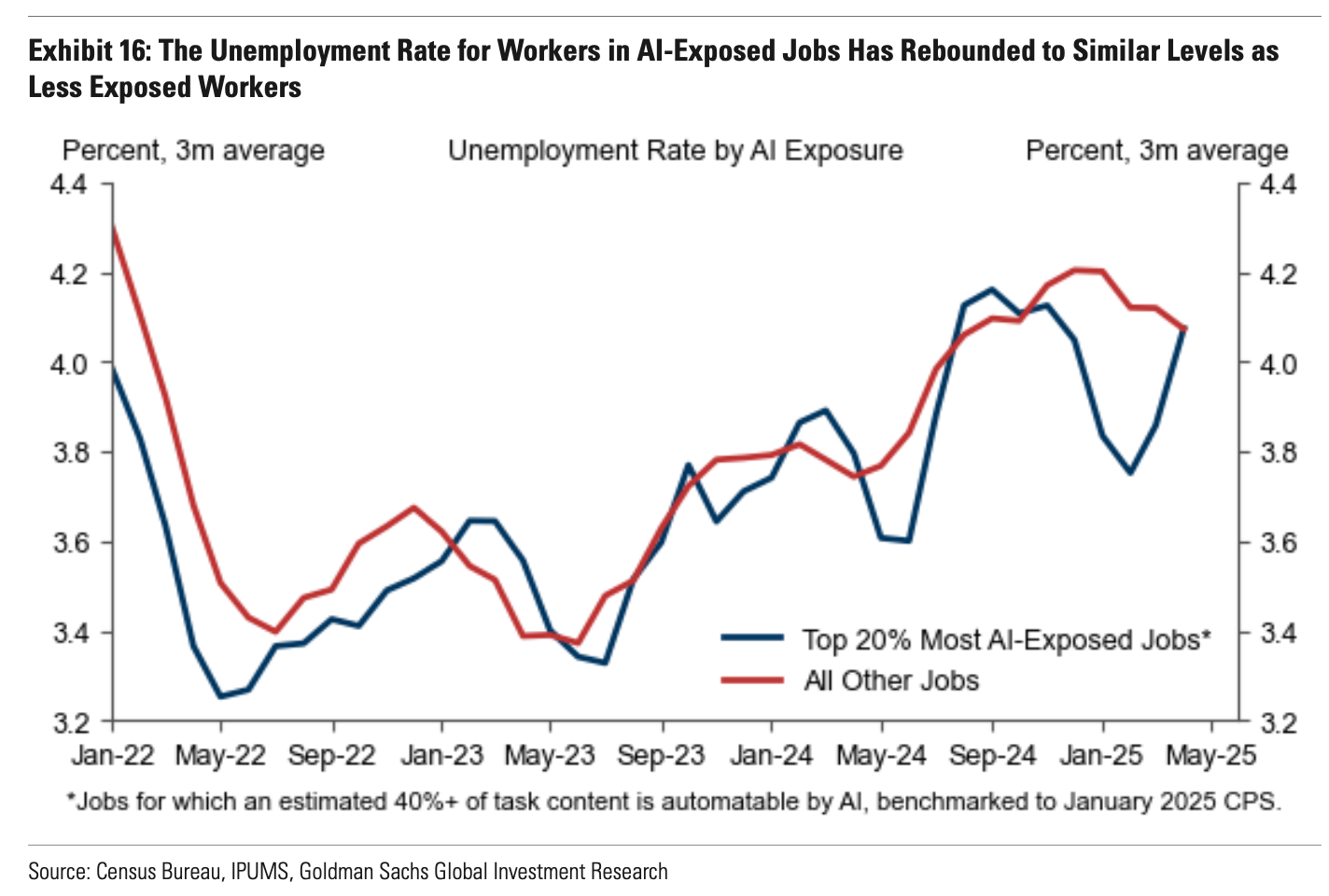
Specifically, Goldman says key metrics such as job growth, wage gains, unemployment rates, and layoff rates in AI-exposed industries have shown little statistically significant deviation from less exposed sectors. AI-related job postings now account for 24% of all IT openings, but still represent just 1.5% of total job postings, indicating that while technology roles are adapting, the broader workforce shift is gradual.

Notably, the unemployment rate for AI-exposed occupations has now reconciled with the wider economy, refuting early fears of mass displacement. There have been no recent layoff announcements explicitly citing AI as the cause, further underscoring the current containment of disruption to specific functions rather than entire industries.
Goldman Sachs

On the other hand, the analysts noted, payrolls growth continues to underperform in occupations where AI is having an anecdotal impact, as with the notable example of telephone call centers. This suggests that something is happening that is only being whispered about. Still, it’s early days.

2. Productivity gains concentrated, but significant

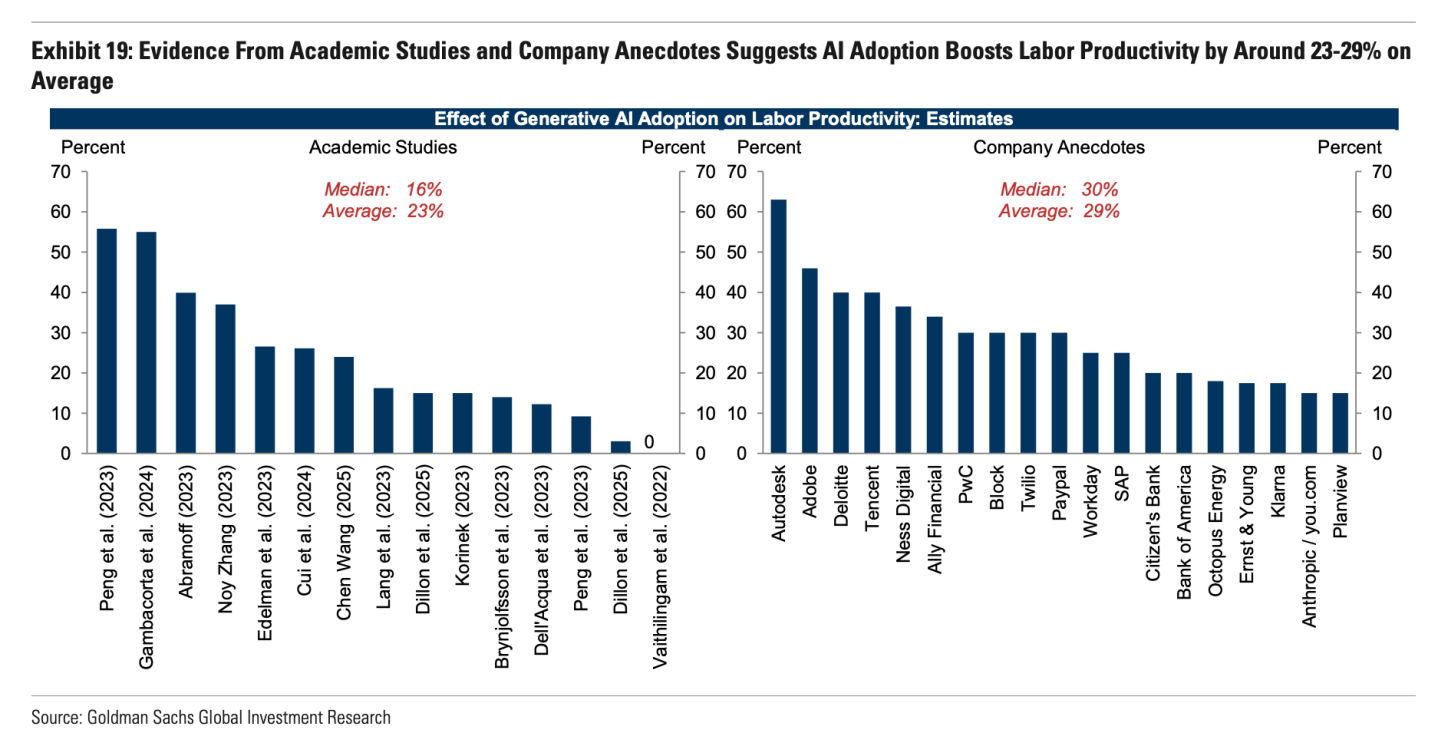
Goldman says AI’s influence on productivity where it’s already been deployed is pronounced. Hatzius’ team cited academic studies and company anecdotes indicating generative AI adoption delivers, on average, a 23%–29% boost to labor productivity. The estimates vary, with academic studies generating a median of 16% and average of 23%, while company anecdotes produce a median of 30% and average of 29%. Still, this suggests tangible efficiency improvements for early adopters.

Sectors leveraging generative AI most actively—information, finance, and professional services—are seeing the largest increases in productivity as firms move from experimentation to integrating AI into their core workflows.
Goldman Sachs

Business leaders and economists expect that as adoption deepens and more organizations build AI into their infrastructure, the aggregate productivity impact will become more visible in macroeconomic data.

3. The AI employment story: still in its early chapters

A recurring theme in the Goldman Sachs analysis is that the full employment effect of AI is still developing. While AI-related openings are growing, especially in IT, there is also an uptick in demand for roles such as machine-learning engineers and AI researchers. Surveys reflect that a substantial share of companies are planning to hire for these skillsets.

Productivity improvements may eventually widen to more industries, and “AI intensity” (share of roles heavily using AI) remains highest in information-technology and professional-service sectors, signaling where future employment shifts might first materialize.

The report said the current impact of AI on the labor market is limited, but the seeds of transformation are being sown. Increases in corporate AI adoption, especially among large and medium-sized firms, point toward future productivity and role changes. But for now, fears of widespread AI-induced job loss appear overstated—at least until broader, deeper integration of the technology with business processes occurs.

As companies continue to scale AI and as supporting infrastructure matures, opportunities and challenges will both be amplified, warranting close observation by policymakers, business leaders, and workers alike.

Goldman Sachs declined to comment further.

For this story, Fortune used generative AI to help with an initial draft. An editor verified the accuracy of the information before publishing. 

Join us at the Fortune Workplace Innovation Summit May 19–20, 2026, in Atlanta. The next era of workplace innovation is here—and the old playbook is being rewritten. At this exclusive, high-energy event, the world’s most innovative leaders will convene to explore how AI, humanity, and strategy converge to redefine, again, the future of work. Register now.
About the Authors
Nick Lichtenberg
By Nick LichtenbergBusiness Editor
LinkedIn icon

Nick Lichtenberg is business editor and was formerly Fortune's executive editor of global news.

See full bioRight Arrow Button Icon
Fortune Intelligence
By Fortune Intelligence

Fortune Intelligence uses generative AI to help with an initial draft, thereby bringing you breaking business news faster while maintaining our high standards of accuracy and quality. These stories are edited by Fortune's senior business editors to verify the accuracy of the information before publishing.

See full bioRight Arrow Button Icon

Latest in Tech

NewslettersCIO Intelligence
Inside tractor maker CNH’s push to bring more artificial intelligence to the farm
By John KellDecember 10, 2025
2 hours ago
NewslettersTerm Sheet
5 VCs sounds off on the AI question du jour
By Amanda GerutDecember 10, 2025
2 hours ago
Databricks co-founder and CEO Ali Ghodsi (right) with Fortune editorial director Andrew Nusca at Fortune Brainstorm AI 2025 in San Francisco. (Photo: Stuart Isett/Fortune)
NewslettersFortune Tech
How Databricks could achieve a trillion-dollar valuation
By Andrew NuscaDecember 10, 2025
3 hours ago
Zhenghua Yang
SuccessSmall Business
At 18, doctors gave him three hours to live. He played video games from his hospital bed—and now, he’s built a $10 million-a-year video game studio
By Preston ForeDecember 10, 2025
4 hours ago
AsiaCoupang
Coupang CEO resigns over historic South Korean data breach
By Yoolim Lee and BloombergDecember 10, 2025
6 hours ago
AIpalantir
New contract shows Palantir is working on a tech platform for another federal agency that works with ICE
By Jessica MathewsDecember 9, 2025
13 hours ago

Most Popular

placeholder alt text
Economy
‘Fodder for a recession’: Top economist Mark Zandi warns about so many Americans ‘already living on the financial edge’ in a K-shaped economy 
By Eva RoytburgDecember 9, 2025
16 hours ago
placeholder alt text
Success
When David Ellison was 13, his billionaire father Larry bought him a plane. He competed in air shows before leaving it to become a Hollywood executive
By Dave SmithDecember 9, 2025
1 day ago
placeholder alt text
Banking
Jamie Dimon taps Jeff Bezos, Michael Dell, and Ford CEO Jim Farley to advise JPMorgan's $1.5 trillion national security initiative
By Nino PaoliDecember 9, 2025
18 hours ago
placeholder alt text
Uncategorized
Transforming customer support through intelligent AI operations
By Lauren ChomiukNovember 26, 2025
14 days ago
placeholder alt text
Real Estate
The 'Great Housing Reset' is coming: Income growth will outpace home-price growth in 2026, Redfin forecasts
By Nino PaoliDecember 6, 2025
4 days ago
placeholder alt text
Success
Even the man behind ChatGPT, OpenAI CEO Sam Altman, is worried about the ‘rate of change that’s happening in the world right now’ thanks to AI
By Preston ForeDecember 9, 2025
21 hours ago
Rankings
  • 100 Best Companies
  • Fortune 500
  • Global 500
  • Fortune 500 Europe
  • Most Powerful Women
  • Future 50
  • World’s Most Admired Companies
  • See All Rankings
Sections
  • Finance
  • Leadership
  • Success
  • Tech
  • Asia
  • Europe
  • Environment
  • Fortune Crypto
  • Health
  • Retail
  • Lifestyle
  • Politics
  • Newsletters
  • Magazine
  • Features
  • Commentary
  • Mpw
  • CEO Initiative
  • Conferences
  • Personal Finance
  • Education
Customer Support
  • Frequently Asked Questions
  • Customer Service Portal
  • Privacy Policy
  • Terms Of Use
  • Single Issues For Purchase
  • International Print
Commercial Services
  • Advertising
  • Fortune Brand Studio
  • Fortune Analytics
  • Fortune Conferences
  • Business Development
About Us
  • About Us
  • Editorial Calendar
  • Press Center
  • Work At Fortune
  • Diversity And Inclusion
  • Terms And Conditions
  • Site Map

© 2025 Fortune Media IP Limited. All Rights Reserved. Use of this site constitutes acceptance of our Terms of Use and Privacy Policy | CA Notice at Collection and Privacy Notice | Do Not Sell/Share My Personal Information
FORTUNE is a trademark of Fortune Media IP Limited, registered in the U.S. and other countries. FORTUNE may receive compensation for some links to products and services on this website. Offers may be subject to change without notice.