• Home
  • News
  • Fortune 500
  • Tech
  • Finance
  • Leadership
  • Lifestyle
  • Rankings
  • Multimedia
Leadershipreturn to office

The CEO of one of the largest office maintenance firms in America says employers are changing their workspaces in 4 key ways

Brit Morse
By
Brit Morse
Brit Morse
Leadership Reporter
Down Arrow Button Icon
Brit Morse
By
Brit Morse
Brit Morse
Leadership Reporter
Down Arrow Button Icon
July 6, 2025, 6:00 AM ET
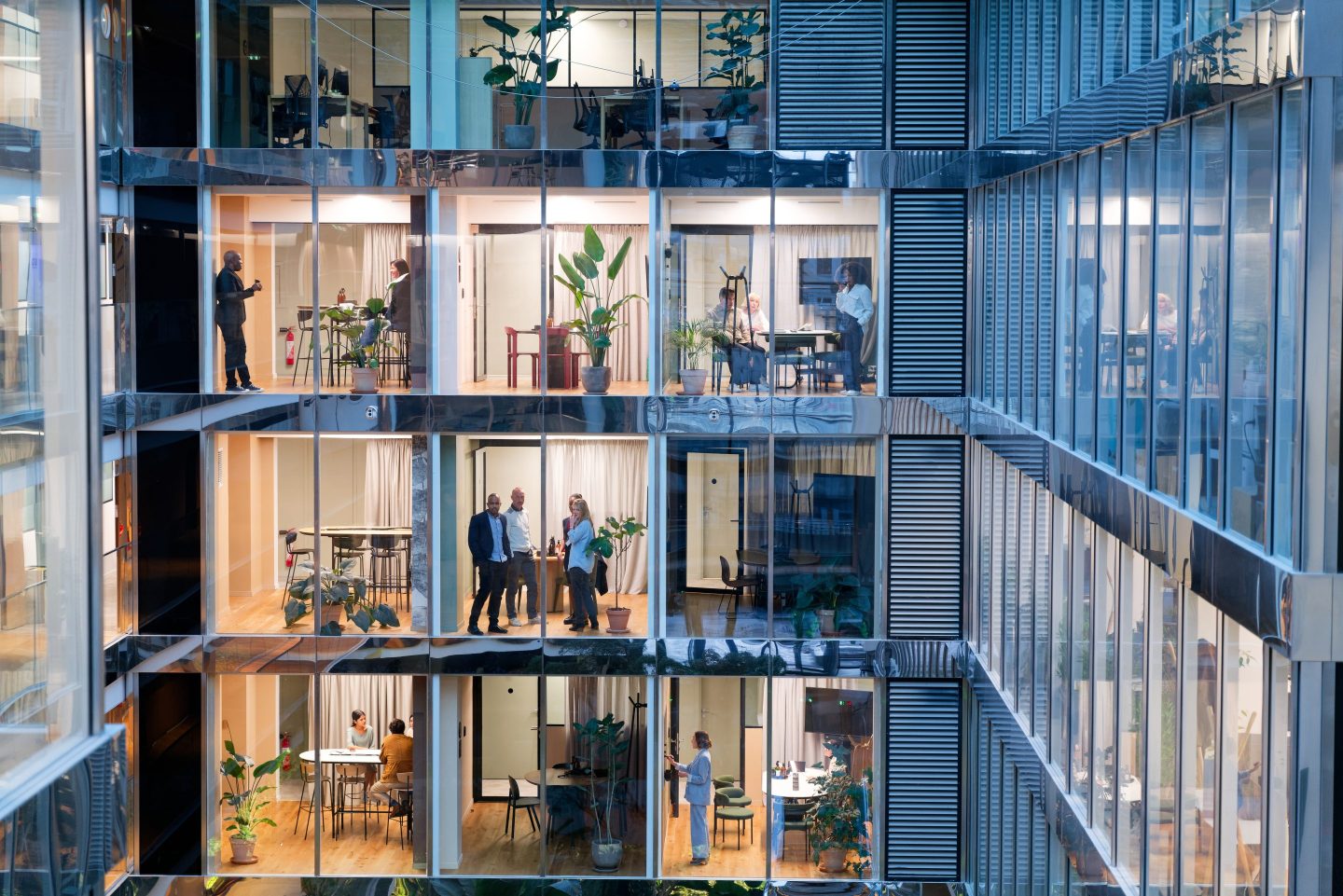
Business people working in several floors of an office building
Business people working in several floors of an office building jean-marc payet—Getty Images

Scott Salmirs has a unique view of the RTO tug of war between workers and bosses that has taken over American offices over the past few years. For 22 years, Salmirs has served as the CEO of ABM Industries, a company that maintains work spaces for more than half the companies on the Fortune 500. 

Recommended Video

While it seems like the RTO battles have reached a plateau, with companies settling into a hybrid detente, Salmirs says the fight isn’t over; many CEOs are secretly hoping to add on another day to two of in-person work to employee schedules. That’s particularly true now that the labor market has shifted power away from workers, and back into the hands of bosses. 

“This return to office, it’s still happening, absolutely. I think with this economic climate, we’ll really see what companies are thinking,” Salmirs tells Fortune. 

But there are a few key changes that businesses are making to their offices as they try to lure workers back, says Salmirs. Many large companies are cutting headcount and streamline operations; as a result, they’re trading in more outdated buildings for smaller, higher-quality spaces in centralized locations as a way to attract workers. They’re also ditching their open-plan offices and adding more private spaces to make the space “more hospitable,” he says. And of course, bosses are making sure that the pantries are fully stocked with snacks.  

“They’re looking closely at pantries and what they’re serving, including the coffee, the snacks, all that good stuff,” he says. “It really matters to employees.”

Fortune sat down with Salmirs to discuss the future of office space and what workers can expect going forward.

Fortune: What kinds of trends are you seeing when it comes to RTO? 

Salmirs: There’s been this commercial real estate crisis, if you will, about people not coming to work, and what’s going to happen with office buildings. Predominantly Class A buildings have been really resilient. As people are coming back, the benchmark now is a solid three to four days per week. Over the last 18 months, it’s been more and more. 

But the little-known fact about this more difficult time that we’re having right now economically, is that it gives management teams the ability, especially with the hiring market not being great, to ask workers to come back into the office more. Four years ago there was no way that a management team could tell people they’re coming back. they’ll just go get another job. Not so much now.

What does the future of RTO look like? 

I think with this economic climate, we’ll really see what companies are thinking. It’ll be an incremental “one more day.” So if you’re at three, it’s going to be four, if you’re at four it could be five. This will be, in my mind, over the next six to nine months.

We were promised an office apocalypse a few years ago, when people were saying that corporate real estate would be empty. What are you seeing in the market right now?

We classify real estate into three buckets, class A, class B and class C. Class A is the good buildings, the ones with really good amenities, and those are doing great. I mean the leasing rates are off the hook, the occupancy rate is like 95%. It’s the B and C class spaces that are struggling a lot more. 

Say you have 20,000 square feet, and are in a class B building, paying $50 a square foot for rent. Now with not as many people coming in, you can pay $100 a foot for a 10,000 square foot building with top amenities in the best location because they know that if you want to get your people back to the office, you’ve got to give them good space. 

What are you seeing as the top priorities for companies right now when it comes to office space? 

I think it’s how they organize the space, because now that more people are coming back, there’s usually a shortage of private spaces. People used to want this big open plan where everyone was sitting at long desks. To get people back, companies are realizing that they have to give people some more privacy. So we’re seeing them convert open space into conference rooms, or areas with more secluded space.

Also, they’re looking closely at pantries and what they’re serving, including the coffee, the snacks, all that good stuff. It really matters to employees.

Since COVID, companies are also prioritizing clean spaces. We’re seeing a lot of [companies] making sure that they could say to employees that their workspace is healthy and clean. Some clients are moving some of our cleaning people on to the day staff, so they’re more visible, so people can see them cleaning and walking around the office.  

The most important thing is to really pay attention to people’s work habits. Are they working in groups collaboratively? Is it solo work? Are they on the phone a lot? Are they on video a lot? What we always say to our clients is that you really have to start with understanding the culture of the organization and the different use cases.

Fortune Brainstorm AI returns to San Francisco Dec. 8–9 to convene the smartest people we know—technologists, entrepreneurs, Fortune Global 500 executives, investors, policymakers, and the brilliant minds in between—to explore and interrogate the most pressing questions about AI at another pivotal moment. Register here.
About the Author
Brit Morse
By Brit MorseLeadership Reporter
LinkedIn icon

Brit Morse is a former Leadership reporter at Fortune, covering workplace trends and the C-suite. She also writes CHRO Daily, Fortune’s flagship newsletter for HR professionals and corporate leaders.

See full bioRight Arrow Button Icon

Latest in Leadership

Man on private jet
SuccessWealth
CEO of $5.6 billion Swiss bank says country is still the ‘No. 1 location’ for wealth after voters reject a tax on the ultra-rich
By Jessica CoacciDecember 2, 2025
40 minutes ago
Big TechInstagram
Instagram CEO calls staff back to the office 5 days a week to build a ‘winning culture’—while canceling every recurring meeting
By Marco Quiroz-GutierrezDecember 2, 2025
47 minutes ago
layoffs
EconomyLayoffs
What CEOs say about AI and what they mean about layoffs and job cuts: Goldman Sachs peels the onion
By Nick LichtenbergDecember 2, 2025
51 minutes ago
Man on laptop puts hand on face
SuccessColleges and Universities
Harvard MBA grads are landing jobs paying $184K—but a record number are still ditching the corporate world and choosing entrepreneurship instead
By Preston ForeDecember 2, 2025
53 minutes ago
Workplace CultureHuman resources
‘Ambulances had to be called, it was a whole thing’: How HR leaders deal with too much fun at holiday parties
By Vicky Valet and HR BrewDecember 2, 2025
2 hours ago
Ayesha and Stephen Curry (L) and Arndrea Waters King and Martin Luther King III (R), who are behind Eat.Play.Learn and Realize the Dream, respectively.
Commentaryphilanthropy
Why time is becoming the new currency of giving
By Arndrea Waters King and Ayesha CurryDecember 2, 2025
2 hours ago

Most Popular

placeholder alt text
Economy
Ford workers told their CEO 'none of the young people want to work here.' So Jim Farley took a page out of the founder's playbook
By Sasha RogelbergNovember 28, 2025
4 days ago
placeholder alt text
Success
Warren Buffett used to give his family $10,000 each at Christmas—but when he saw how fast they were spending it, he started buying them shares instead
By Eleanor PringleDecember 2, 2025
7 hours ago
placeholder alt text
Success
Forget the four-day workweek, Elon Musk predicts you won't have to work at all in ‘less than 20 years'
By Jessica CoacciDecember 1, 2025
1 day ago
placeholder alt text
Innovation
Google CEO Sundar Pichai says we’re just a decade away from a new normal of extraterrestrial data centers
By Sasha RogelbergDecember 1, 2025
24 hours ago
placeholder alt text
Personal Finance
Current price of gold as of December 1, 2025
By Danny BakstDecember 1, 2025
1 day ago
placeholder alt text
Big Tech
Elon Musk, fresh off securing a $1 trillion pay package, says philanthropy is 'very hard'
By Sydney LakeDecember 1, 2025
1 day ago
Rankings
  • 100 Best Companies
  • Fortune 500
  • Global 500
  • Fortune 500 Europe
  • Most Powerful Women
  • Future 50
  • World’s Most Admired Companies
  • See All Rankings
Sections
  • Finance
  • Leadership
  • Success
  • Tech
  • Asia
  • Europe
  • Environment
  • Fortune Crypto
  • Health
  • Retail
  • Lifestyle
  • Politics
  • Newsletters
  • Magazine
  • Features
  • Commentary
  • Mpw
  • CEO Initiative
  • Conferences
  • Personal Finance
  • Education
Customer Support
  • Frequently Asked Questions
  • Customer Service Portal
  • Privacy Policy
  • Terms Of Use
  • Single Issues For Purchase
  • International Print
Commercial Services
  • Advertising
  • Fortune Brand Studio
  • Fortune Analytics
  • Fortune Conferences
  • Business Development
About Us
  • About Us
  • Editorial Calendar
  • Press Center
  • Work At Fortune
  • Diversity And Inclusion
  • Terms And Conditions
  • Site Map

© 2025 Fortune Media IP Limited. All Rights Reserved. Use of this site constitutes acceptance of our Terms of Use and Privacy Policy | CA Notice at Collection and Privacy Notice | Do Not Sell/Share My Personal Information
FORTUNE is a trademark of Fortune Media IP Limited, registered in the U.S. and other countries. FORTUNE may receive compensation for some links to products and services on this website. Offers may be subject to change without notice.