• Home
  • Latest
  • Fortune 500
  • Finance
  • Tech
  • Leadership
  • Lifestyle
  • Rankings
  • Multimedia

Trendingnow

1

The rise of 'conspicuous waiting': The 19th-century economic theory that explains why Gen Z posts their place in line

2

Tim Cook signed off on his final Apple earnings call with a warning about a ‘100-year flood’ in memory chip pricing

3

He worked 100-hour weeks to save a nearly bankrupt boat company. At 83, he’s just turned down $400 million for it—and gave it all to charity instead

1

The rise of 'conspicuous waiting': The 19th-century economic theory that explains why Gen Z posts their place in line

2

Tim Cook signed off on his final Apple earnings call with a warning about a ‘100-year flood’ in memory chip pricing

3

He worked 100-hour weeks to save a nearly bankrupt boat company. At 83, he’s just turned down $400 million for it—and gave it all to charity instead
FinanceDebt

Goldman Sachs says Trump’s spending plan won’t stop the national debt from hitting ‘unsustainable’ highs not seen since World War II

By
Greg McKenna
Greg McKenna
News Fellow
Down Arrow Button Icon
By
Greg McKenna
Greg McKenna
News Fellow
Down Arrow Button Icon
June 19, 2025, 6:33 AM ET
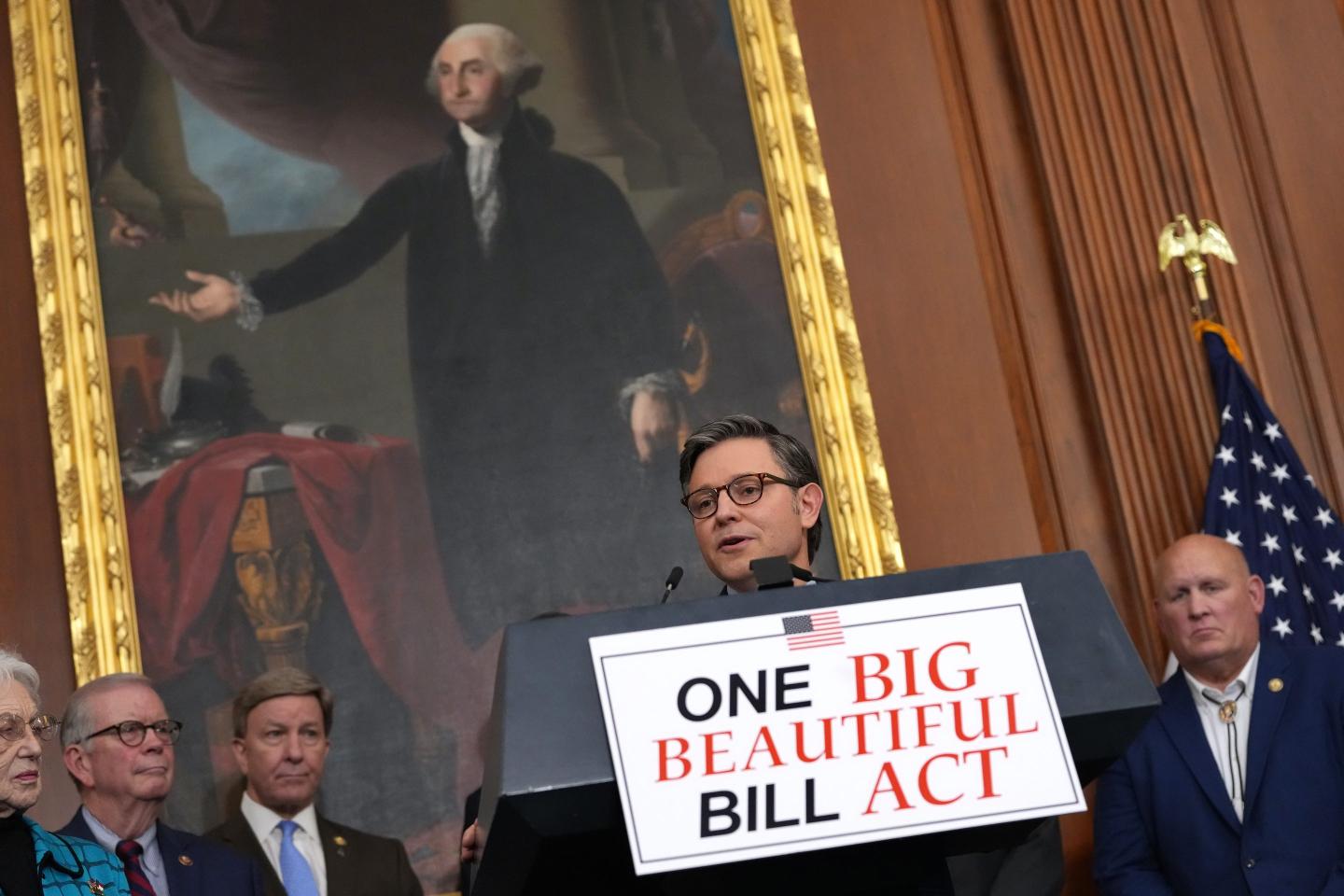
Speaker of the House Mike Johnson speaks at a podium with a placard reading "ONE BIG BEAUTIFUL BILL ACT." A portrait of George Washington hangs in the background.
Speaker of the House Mike Johnson (R-La.) talked to the media after the House narrowly passed a version of the GOP’s “One Big Beautiful Bill” last month. Kevin Dietsch—Getty Images
Add Fortune on Google for similar content.
  • The U.S. will pay $1 trillion in interest on the $36 trillion national debt next year, more than it spends on Medicare and defense. If lawmakers wait too long to address deficits, Goldman economists warn, a historic austerity push could be needed to avert disaster.

President Donald Trump has claimed the GOP’s “Big, Beautiful Bill” will put the U.S. on a sustainable fiscal path. Economists at Goldman Sachs say it won’t prevent the nation’s debt from surpassing levels only seen during World War II.

Recommended Video

The spending bill passed by House Republicans, combined with increased tariff revenue, will slightly lower the budget deficit when excluding interest payments, Goldman’s Manuel Abecasis, David Mericle, and Alec Phillips acknowledged in a note Tuesday. Coupled with rising borrowing costs, they said, the bill leaves the total deficit’s course essentially unchanged.

“But that path remains unsustainable: The primary deficit is much larger than usual in a strong economy, the debt-to-GDP ratio is approaching the post-[WWII] high, and much higher real interest rates have put the debt and interest expense as a share of GDP on much steeper trajectories than appeared likely last cycle,” the Goldman team wrote.
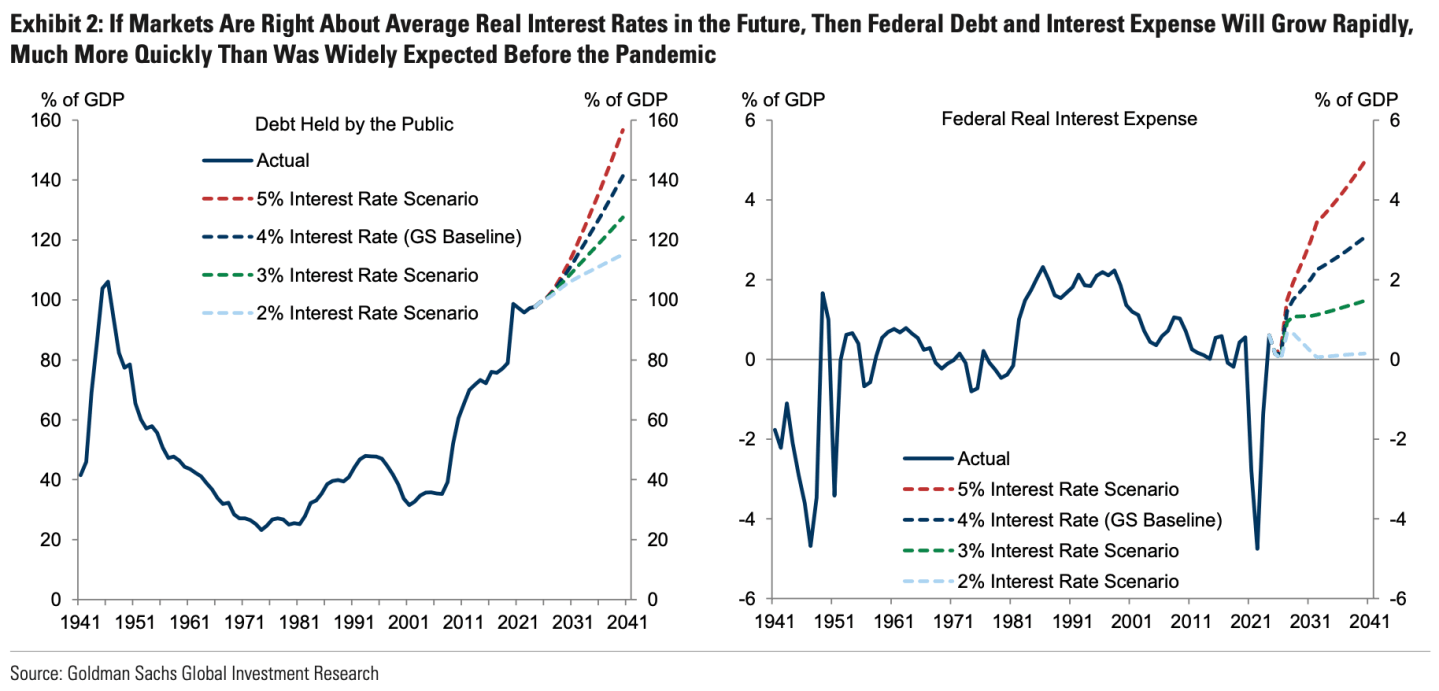
On the left, a chart showing projections from Goldman Sachs for debt-to-GDP through 2041 based on various interest rate scenarios. On the right, Goldman's projections for federal real interest expense as a percentage of GDP based of various interest rate scenarios.
Goldman Sachs

As the charts above show, the scale of the debt going forward depends greatly on how interest rates move over the next couple of decades. Right now, the $36 trillion national debt accounts for roughly 120% of GDP, and the Treasury Department finds itself borrowing more just to meet the rising cost of servicing it.

The U.S. pays more in interest on its debt than it spends on Medicare and defense. Those interest payments will hit $1 trillion next year, trailing only Social Security as the government’s biggest outlay, according to the Committee for a Responsible Federal Budget, a think tank.

“If the debt grows large enough,” the Goldman team wrote, “interest expense could become so large that stabilizing debt-to-GDP would require running persistent fiscal surpluses of a size that has seldom been sustained historically because it is economically costly and politically difficult.”

The first Trump and Biden administrations responded to the COVID-19 pandemic with a wartime-like budget. But the spigot never got turned off, even when the U.S. economy moved back to full employment.

The nonpartisan Congressional Budget Office estimates the version of the GOP spending bill passed by the House would increase deficits by $2.8 trillion over the next decade. The White House and some Republican lawmakers argue that projection should not include the cost of extending Trump’s 2017 tax cuts, which are set to expire this year without the bill.

But the crux of the $36 trillion problem is that no one knows at what level the debt becomes unsustainable, Gennadiy Goldberg, head of U.S. rates strategy at TD Securities, told Fortune.

Treasury Secretary Scott Bessent has said the U.S. government has a “spending problem,” but not a “revenue problem.” Goldberg agrees with the former argument, but he said the U.S. also does not tax much compared with both the size of the country’s GDP and government outlays. 

“So either taxes have to go up, spending has to come down, or some combination of the two,” Goldberg said last month. “And it sounds simple, but it’s politically very, very complicated to figure out.”

Higher interest rates would increase deficit pressure

Continuing to avoid taking action puts future lawmakers in a tighter spot, however, especially if borrowing costs rise.

Yields on long-term U.S. Treasury bonds have remained elevated as investors wait for a patient Federal Reserve to cut interest rates, and concerns about the burgeoning deficit and a possible resurgence of inflation might also continue to put upward pressure on rates.

Fixed-income experts are also closely monitoring any changes to foreign demand for U.S. debt. If rising trade and geopolitical tensions undermine the dollar’s status as the world’s reserve currency, the U.S. government would also find itself borrowing at higher rates than it’s become accustomed to.

That means Congress may eventually be forced to make increasingly tough choices when it comes to both spending and taxes. If lawmakers wait too long, a historic austerity push could be needed to avert disaster, the Goldman team said.

“In that scenario, one might worry either that a large fiscal consolidation and a persistent fiscal surplus could be self-defeating—if GDP declines enough, the debt-to-GDP ratio might not shrink,” they wrote.

Of course, politicians would also face the temptation of printing way more money to pay the government’s bills. Germany’s Weimar Republic tried that tactic in the aftermath of World War I. It resulted in ruinous hyperinflation, fueling the economic malaise and social unrest that led to the rise of the Nazi Party.  

That warning from history, however, is not always heeded by governments.

About the Author
By Greg McKennaNews Fellow
LinkedIn icon

Greg McKenna is a news fellow at Fortune.

See full bioRight Arrow Button Icon
Add Fortune on Google for similar content.

Latest in Finance

Finance
Lorem ipsum dolor sit amet, consectetur adipiscing elit, sed do eiusmod tempor incididunt ut labore et dolore magna aliqua. Ut enim ad minim veniam
By Fortune Editors
October 20, 2025
Finance
Lorem ipsum dolor sit amet, consectetur adipiscing elit, sed do eiusmod tempor incididunt ut labore et dolore magna aliqua. Ut enim ad minim veniam
By Fortune Editors
October 20, 2025
Finance
Lorem ipsum dolor sit amet, consectetur adipiscing elit, sed do eiusmod tempor incididunt ut labore et dolore magna aliqua. Ut enim ad minim veniam
By Fortune Editors
October 20, 2025
Finance
Lorem ipsum dolor sit amet, consectetur adipiscing elit, sed do eiusmod tempor incididunt ut labore et dolore magna aliqua. Ut enim ad minim veniam
By Fortune Editors
October 20, 2025
Finance
Lorem ipsum dolor sit amet, consectetur adipiscing elit, sed do eiusmod tempor incididunt ut labore et dolore magna aliqua. Ut enim ad minim veniam
By Fortune Editors
October 20, 2025
Finance
Lorem ipsum dolor sit amet, consectetur adipiscing elit, sed do eiusmod tempor incididunt ut labore et dolore magna aliqua. Ut enim ad minim veniam
By Fortune Editors
October 20, 2025

Most Popular

Finance
Lorem ipsum dolor sit amet, consectetur adipiscing elit, sed do eiusmod tempor incididunt ut labore et dolore magna aliqua. Ut enim ad minim veniam
By Fortune Editors
October 20, 2025
Finance
Lorem ipsum dolor sit amet, consectetur adipiscing elit, sed do eiusmod tempor incididunt ut labore et dolore magna aliqua. Ut enim ad minim veniam
By Fortune Editors
October 20, 2025
Finance
Lorem ipsum dolor sit amet, consectetur adipiscing elit, sed do eiusmod tempor incididunt ut labore et dolore magna aliqua. Ut enim ad minim veniam
By Fortune Editors
October 20, 2025
Finance
Lorem ipsum dolor sit amet, consectetur adipiscing elit, sed do eiusmod tempor incididunt ut labore et dolore magna aliqua. Ut enim ad minim veniam
By Fortune Editors
October 20, 2025
Finance
Lorem ipsum dolor sit amet, consectetur adipiscing elit, sed do eiusmod tempor incididunt ut labore et dolore magna aliqua. Ut enim ad minim veniam
By Fortune Editors
October 20, 2025
Finance
Lorem ipsum dolor sit amet, consectetur adipiscing elit, sed do eiusmod tempor incididunt ut labore et dolore magna aliqua. Ut enim ad minim veniam
By Fortune Editors
October 20, 2025
Fortune Secondary Logo
Rankings
  • 100 Best Companies
  • Fortune 500
  • Global 500
  • Fortune 500 Europe
  • Most Powerful Women
  • World's Most Admired Companies
  • See All Rankings
  • Lists Calendar
Sections
  • Finance
  • Fortune Crypto
  • Features
  • Leadership
  • Health
  • Commentary
  • Success
  • Retail
  • Mpw
  • Tech
  • Lifestyle
  • CEO Initiative
  • Asia
  • Politics
  • Conferences
  • Europe
  • Newsletters
  • Personal Finance
  • Environment
  • Magazine
  • Education
Customer Support
  • Frequently Asked Questions
  • Customer Service Portal
  • Privacy Policy
  • Terms Of Use
  • Single Issues For Purchase
  • International Print
Commercial Services
  • Advertising
  • Fortune Brand Studio
  • Fortune Analytics
  • Fortune Conferences
  • Business Development
  • Group Subscriptions
About Us
  • About Us
  • Press Center
  • Work At Fortune
  • Terms And Conditions
  • Site Map
  • About Us
  • Press Center
  • Work At Fortune
  • Terms And Conditions
  • Site Map
  • Facebook icon
  • Twitter icon
  • LinkedIn icon
  • Instagram icon
  • TikTok icon
  • YouTube icon

Latest in Finance

Warsh considering reducing number of Fed meetings, NYT reports
EconomyFederal Reserve
Warsh considering reducing number of Fed meetings, NYT reports
By Enda Curran and BloombergJuly 31, 2026
2 hours ago
Asia’s aging population doesn’t have to be a fiscal burden. With smart planning, it can be a growth opportunity
Commentaryaging
Asia’s aging population doesn’t have to be a fiscal burden. With smart planning, it can be a growth opportunity
By Runchana Pongsaparn and Koon Hui TeeJuly 31, 2026
4 hours ago
Mike Wirth, chief executive officer of Chevron.
EnergyIran
Chevron posts largest quarterly profit ever, and Exxon income surges as Iran war squeezes oil supply
By Jordan BlumJuly 31, 2026
6 hours ago
cuban
Arts & EntertainmentMark Cuban
Mark Cuban’s Las Vegas A’s investment is his ‘Sports 2.0’ Dallas Mavericks playbook all over again — with one key change
By Joshua HongJuly 31, 2026
8 hours ago
After a nearly 1,000% surge, the AI debt orgy can’t last forever, while hidden borrowing has exploded to $1.65 trillion
Big TechDebt
After a nearly 1,000% surge, the AI debt orgy can’t last forever, while hidden borrowing has exploded to $1.65 trillion
By Jason MaJuly 31, 2026
8 hours ago
‘Retiring backwards’: How cold economic reality forced Gen X into something like the reverse of baby boomers’ golden years
SuccessRetirement
‘Retiring backwards’: How cold economic reality forced Gen X into something like the reverse of baby boomers’ golden years
By Nick LichtenbergJuly 31, 2026
9 hours ago

Most Popular

The rise of 'conspicuous waiting': The 19th-century economic theory that explains why Gen Z posts their place in line
Retail
The rise of 'conspicuous waiting': The 19th-century economic theory that explains why Gen Z posts their place in line
By Tatiana SatauaJuly 31, 2026
18 hours ago
Tim Cook signed off on his final Apple earnings call with a warning about a ‘100-year flood’ in memory chip pricing
Big Tech
Tim Cook signed off on his final Apple earnings call with a warning about a ‘100-year flood’ in memory chip pricing
By Alexei OreskovicJuly 30, 2026
1 day ago
He worked 100-hour weeks to save a nearly bankrupt boat company. At 83, he’s just turned down $400 million for it—and gave it all to charity instead
Success
He worked 100-hour weeks to save a nearly bankrupt boat company. At 83, he’s just turned down $400 million for it—and gave it all to charity instead
By Preston ForeJuly 29, 2026
2 days ago
Millennials say they’ll refuse to care for aging boomer parents—but they’ll be forced to as their inheritance shrinks to 40 cents on the dollar
Personal Finance
Millennials say they’ll refuse to care for aging boomer parents—but they’ll be forced to as their inheritance shrinks to 40 cents on the dollar
By Nick LichtenbergJuly 31, 2026
18 hours ago
Costco's $14 million email settlement: Who qualifies for an up-to $500 payment and how to claim before the Aug. 24 deadline
Retail
Costco's $14 million email settlement: Who qualifies for an up-to $500 payment and how to claim before the Aug. 24 deadline
By Sydney LakeJuly 29, 2026
2 days ago
The millennial generation is split in 2: an older crowd with boomer-style comfort, a younger set going 'back to the early 1900s'
Real Estate
The millennial generation is split in 2: an older crowd with boomer-style comfort, a younger set going 'back to the early 1900s'
By Nick LichtenbergJuly 25, 2026
7 days ago

© 2026 Fortune Media IP Limited. All Rights Reserved. Use of this site constitutes acceptance of our Terms of Use and Privacy Policy | CA Notice at Collection and Privacy Notice | Do Not Sell/Share My Personal Information
FORTUNE is a trademark of Fortune Media IP Limited, registered in the U.S. and other countries. FORTUNE may receive compensation for some links to products and services on this website. Offers may be subject to change without notice.