
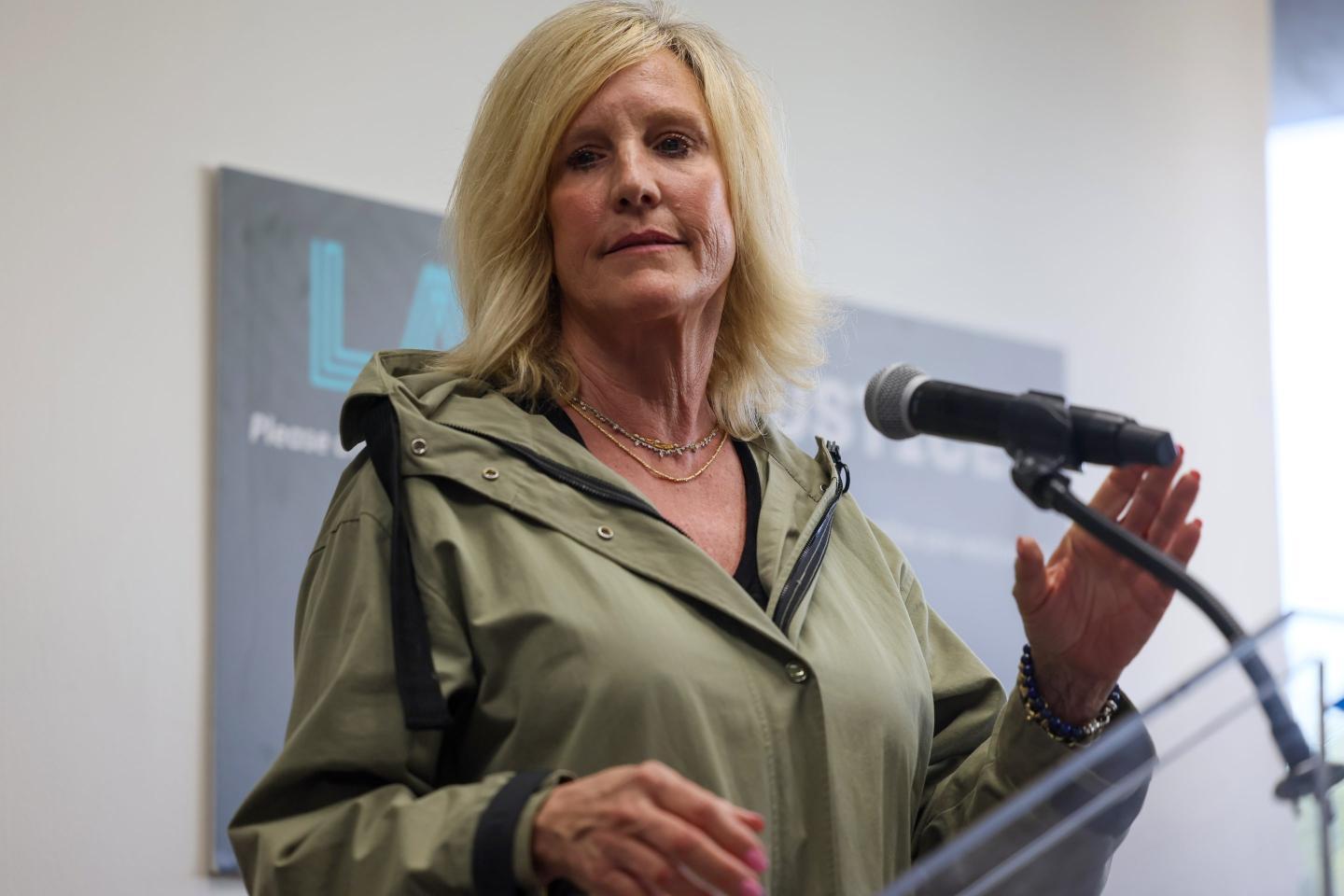
The environmental activist who won $333 million for hundreds of people affected by utility company PG&E’s groundwater contamination is now turning her focus to data centers.
Portrayed by Julia Roberts in a 2000 film that shares her name, Erin Brockovich is most well-known for the millions she secured for residents of Hinkley, Calif., in the largest direct-action lawsuit in history. Following that case, Brockovich has gone on to write several books on environmental issues and has continued to advocate for victims of environmental damage across the country.
Her latest project, Brockovich AI Data Center Reporting, is helping tackle one of the fastest-growing environmental concerns today: the proliferation of data centers in the U.S.
While Brockovich wrote in a Substack post last week that she is not universally opposed to data centers, she noted that people living near proposed projects are increasingly concerned with the covert tactics and obfuscation that has surrounded efforts to build them.
“The single most common concern—more than noise, more than water usage, more than rising utility bills—is the one word that keeps appearing in submission after submission: transparency,” she wrote.
Her website, brockovichdatacenter.com, is compiling complaints from across the U.S. to create an interactive map of data center projects that have been proposed, are under construction, or are operational. While the map isn’t exhaustive, she has received nearly 4,000 reports from people about data center developments in their communities in nearly all 50 states.
Brockovich pointed to several examples of how companies pushing to build data centers have kept nearby residents in the dark. In Holly Ridge, La., for example, local resident Diane Cobb told New Orleans Public Radio that she and other residents weren’t notified ahead of time about Meta’s planned $27 billion Hyperion data center that is set to take up 4,000 acres nearby.
“Nobody told us anything,” she told the outlet. “They supposedly had a big meeting. The whole community was supposed to come. Nobody knew anything about it. Ever.”
Meta did not immediately respond to Fortune’s request for comment.
It’s true that data centers can create jobs and boost tax revenue. A fact sheet from the local government in Loudon County, Va., which is home to about 200 data centers, showed that they generated $875 million in tax revenue for the county in 2024, $35 million more than the general operations budget for the Loudon County government.
Yet data center opposition is growing nationwide over concerns about how local resources will be affected. In 2023, the Lawrence Berkeley National Laboratory estimated that data centers in the U.S. used 176 terawatt-hours of energy, representing 4.4% of the country’s annual energy consumption. That is an increase from the 76 terawatt-hours they used in 2018, equal to about 1.9% of the country’s annual energy consumption.
Residents near data centers are increasingly feeling the financial strain of data centers’ power use. A Carnegie Mellon University study estimates that data centers could raise average U.S. electricity bills by 8% by 2030, with even bigger hikes in hot spots like northern Virginia. Water consumption is another growing concern. A single hyperscale data center can use millions of gallons of water daily for cooling, putting pressure on local water supplies.
Brockovich noted that companies seeking to build data centers need to make sure that local residents are informed ahead of time, not after the fact.
This lack of transparency has already played out in some states. In Box Elder County, Utah, a rural county of fewer than 60,000 residents, a public meeting for a $100 billion data center project backed by Shark Tank star Kevin O’Leary drew a packed room of citizens seeking more information. Still, one commissioner told the audience to “grow up,” and the public officials then went into a separate room to unanimously approve the project.
“Transparency means notifying residents before decisions are made, not after. It means public hearings with real, complete information about energy consumption, water use, noise levels, and effects on local infrastructure,” wrote Brockovich on Substack. “It means elected officials who answer to their constituents first, not to the corporations seeking tax breaks and zoning variances.”