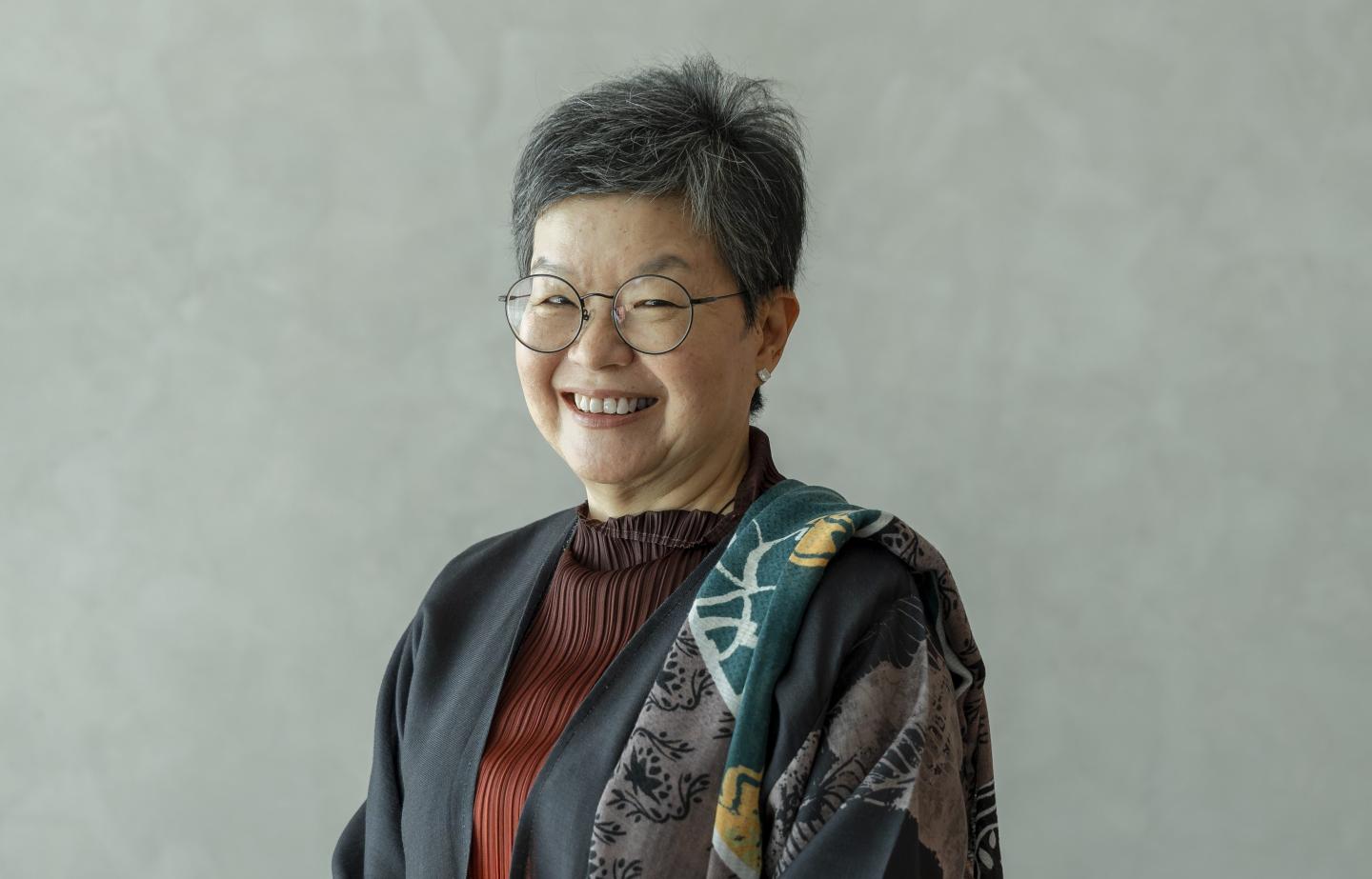
When Amy Lee retired from a four-decade-long career in law and finance in 2020, she felt it might be a chance to relax. Instead, she found herself getting antsy.
“For my whole life, I thought I would enjoy retirement,” she tells Fortune at her home in central Singapore. “To my horror, I developed insomnia because there was no structure in my life.” Her boredom sent her in an interesting direction: When Singapore lifted its COVID movement restrictions in 2022, Lee recalls she put on a face mask “and sat through an eight-hour course on blockchain.”
Lee, who is also the niece of Lee Kuan Yew, Singapore’s first prime minister, now chairs the global advisory board of the Singapore Gulf Bank, a fully licensed, Bahrain-based digital bank which offers investors access to both traditional and digital assets. The bank comes from a partnership between the Whampoa Group, a multi-family office Lee had co-founded, and Mumtalakat, Bahrain’s sovereign wealth fund.
SGB hopes to tap increasing trade between the Gulf and Asia, which hit $516 billion in 2024, according to a November 2025 analysis from Asia House, a think tank. The Middle East’s trade with Asia is now larger than its trade with the West.
“Under this geopolitical climate, the Asia-Middle East corridor is growing in significance and importance,” Lee explains. “Trade and investment flows are increasing between the two regions, especially with the U.S.-China bifurcation.”
The SGB is also betting on digital assets, branding itself as “the world’s first fully integrated bank” where users can make transactions around the clock in both fiat currencies and cryptocurrencies. In 2025, it recorded over $4 billion in deposits and $12 billion in transaction value.
“If commerce is 24/7, banking shouldn’t be limited,” Lee says. “Increasingly, family offices, individuals, corporations and even governments are starting to take on digital currency—so how relevant are you going to be if you don’t?”
Why Bahrain?
Though the team had considered several locations, they eventually established the SGB in 2024 in Bahrain, a tiny Middle Eastern nation just 300 square miles large, approximately the size of New York City. “Bahrain is very small: small population, small island,” Lee said. “They were the first country in the Arabian Gulf to discover oil, so they ran low on resources and recalibrated their economy, with finance recently overtaking natural resources.”
Lee and her team visited Bahrain in 2023 to meet with the crown prince and prime minister Salman bin Hamad Al Khalifa, finance minister Shaikh Salman bin Khalifa Al Khalifa, and the then-governor of the Central Bank of Bahrain, Rasheed Mohammed Al Maraj. Though it was her first visit to the Gulf nation, Lee said Bahrain reminded her of Singapore. “The mindset felt very familiar,” she explained. “The first thing Rasheed did when he sat down was to read us the Riot Act. We also have riot acts in Singapore, and we’re comfortable with rules,” she said. “Set up the boundaries and we will move with great confidence.”
The SGB team was also drawn to Bahrain’s progressive, crypto-friendly policies, and its comprehensive national roadmap to embracing digital assets. The country also holds the crypto industry to high standards, with several regulatory bodies—including the Central Bank of Bahrain, Financial Intelligence Directorate and Ministry of Industry and Commerce—involved in enforcing rules governing digital assets.
“We wanted to look for a jurisdiction that is progressive, yet mature,” Lee explained. “The crypto industry is moving towards greater regulation and compliance.”
Since its inception, the SGB has inked numerous partnerships with both traditional giants like JP Morgan and Standard Chartered, and newer decentralized financial firms like Binance and Solana.
“At the end of the day, the name of the game is still your correspondent record,” Lee said. “We are a start-up, so when the big boys look at you, it is a huge compliment to the team.”
In February, the SGB also introduced a stablecoin layer to its real-time settlement platform, SGB Net, which allows clients to mint, convert, hold and trade stablecoins like USDT and USDC, which are digital currencies pegged to the U.S. dollar.
“Our ambition is to become the one bank for all of finance,” Shawn Chan, the SGB’s CEO, said in a Feb 2 press release. “Stablecoins have become the working capital of the digital asset economy, yet managing them remains unnecessarily complex.”
‘Never say die‘
Lee is part of Singapore’s leading political family. Her uncle, Lee Kuan Yew, was Singapore’s first prime minister, credited with setting down an approach to economic development that helped make the city-state one of Asia’s richest and most developed societies. Her cousin, Lee Hsien Loong, was Singapore’s third prime minister, who led the city for two decades and stepped down in 2024.
Growing up, Lee was sent to a Chinese school for her first ten years of schooling, taking GCE ‘O’ Levels subjects including physics, chemistry and mathematics. She then pivoted to attend Raffles Institution, one of Singapore’s top English schools, at age 17, before going on to read law at the National University of Singapore.
“As you can imagine, it was a bit of a struggle, since all of a sudden I had to read all my subjects in a different language,” Lee said. “And when I went to law school, they even decided Latin was still relevant.”
After graduating in 1982, she began her career as a lawyer at Lee & Lee, a law firm founded by her father, Lee Kim Yew; uncle, Lee Kuan Yew; and his wife, Kwa Geok Choo, in 1955. In 2011, she started Whampoa Group alongside Lee Han Shih, a member of the Singaporean business family behind OCBC bank, the city-state’s second largest bank by assets.
Intrigued by the potential of cryptocurrency to reshape the financial sector, Lee launched Whampoa Digital, the group’s technology and Web3 investment arm, in 2021. Whampoa Digital then joined a consortium led by Chinese tech giant ByteDance, which applied for but didn’t receive a digital bank license in Singapore, forcing the group to turn to other jurisdictions.
Despite operating outside of Singapore, Lee and her team opted to retain the city-state in its name. “We’re not licensed in Singapore, so we do not market in the country, but we are very proud of the Singapore brand, which I like to think represents integrity and trustworthiness,” she explained. “Also, our original founding team members are all entrepreneurial Singaporeans.”
Lee credits her matriarchal Hakka and Peranakan roots, and her grandmother, Chua Jim Neo, who had raised a daughter and four boys (the eldest of whom was Lee Kuan Yew) in pre-war Singapore, as the biggest reasons for her unflinching, “never say die” attitude.
“My grandmother never spoke about female liberation,” Lee said. “She just looked at me and said, “Girl, anything a boy can do, you can do”—and she repeated that every day.”