
• Home
  • News
  • Fortune 500
  • Tech
  • Finance
  • Leadership
  • Lifestyle
  • Rankings
  • Multimedia
AINvidia

Nvidia is nixing China from its financial forecasts because U.S. restrictions on chip sales have tightened so much, Jensen Huang says

Sasha Rogelberg
By
Sasha Rogelberg
Sasha Rogelberg
Reporter
Down Arrow Button Icon
Sasha Rogelberg
By
Sasha Rogelberg
Sasha Rogelberg
Reporter
Down Arrow Button Icon
June 13, 2025, 1:29 PM ET
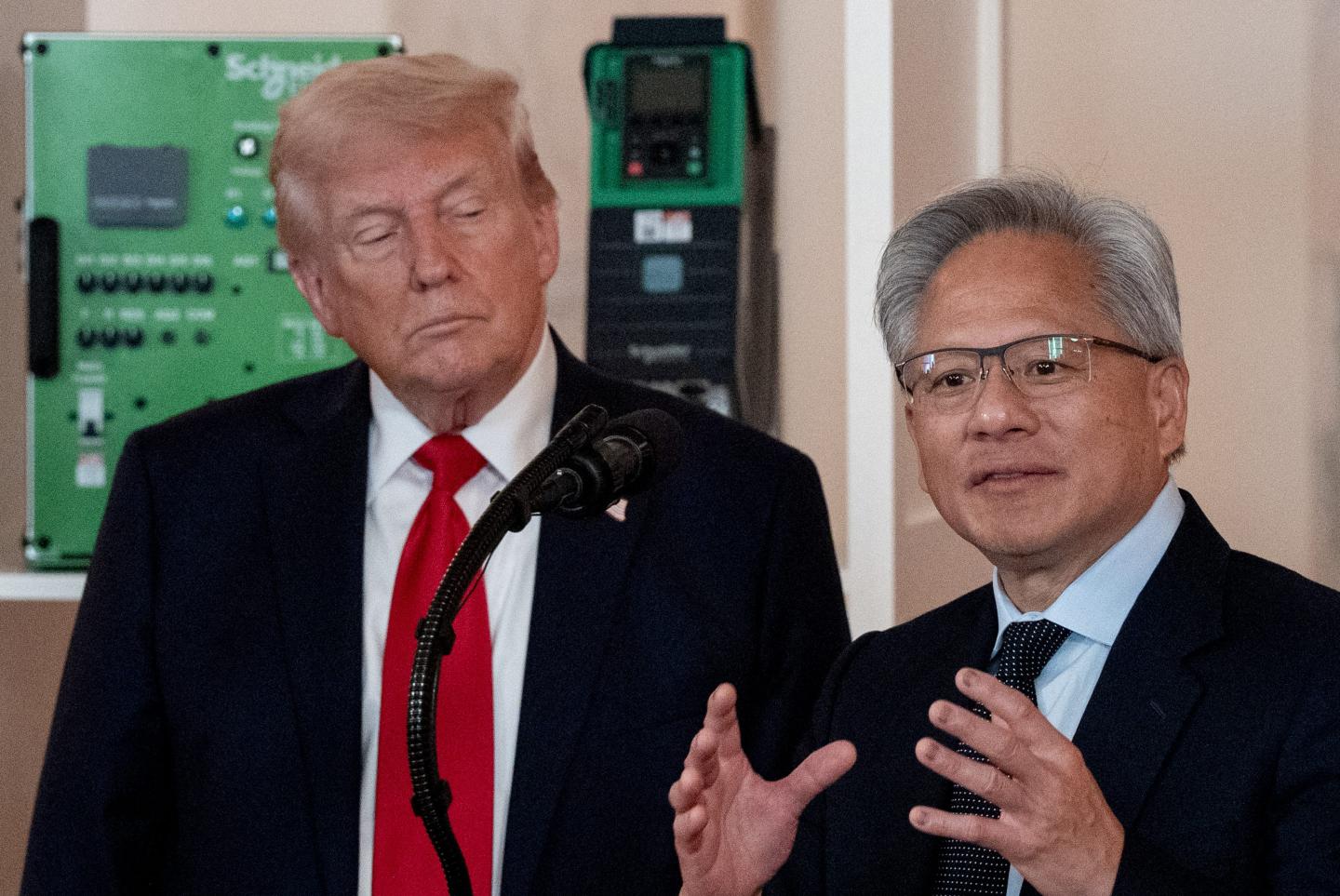
Donald Trump looks on at Jensen Huang, who is speaking in front of a podium.
Nvidia CEO Jensen Huang has repeatedly criticized the Trump administration's export controls as hampering U.S. business opportunities. Ken Cedeno/UPI/Bloomberg—Getty Images
  • Nvidia is not including the Chinese market in its financial forecasts as a result of strict export controls hampering business with the country, CEO Jensen Huang told CNN on Thursday. Huang has repeatedly criticized the Trump administration’s export restrictions as limiting U.S. manufacturing and growth opportunities. Export controls may loosen as a result of a trade deal with China in exchange for greater access to rare earths.

AI chipmaker Nvidia will no longer include Chinese business in its financial forecasts after President Donald Trump’s efforts to tighten export controls to China.

Recommended Video

CEO Jensen Huang told CNN on Thursday that a trade deal between the U.S. and China would be “a great bonus,” but he wasn’t counting on that outcome. 

“I’ve told all of our investors and shareholders that, going forward, our forecasts will not include the China market,” he said.

The Department of Commerce last month initiated a series of export controls that would revoke a Biden-era “diffusion” rule capping the number of chips other countries are able to buy, while also “warning the public about the potential consequences of allowing U.S. AI chips to be used for training and interference of Chinese AI models.” Weeks later, the administration reportedly restricted chip design software companies like Synopsys and Siemens from selling to China without a U.S. government license, according to Bloomberg.

While Huang touted the removal of the “diffusion” rule as helping to bolster U.S. manufacturing, he’s concerned the crackdown on trade with China will have the opposite effect. The export controls on China have had a tangible impact on Nvidia, which, despite reporting a blockbuster 69% increase in quarterly revenue, missed out on $2.5 billion in revenue from being unable to ship its H20 chips to China, the company said. Nvidia’s H20 chips, less powerful than their Blackwell counterparts, were designed specifically to comply with U.S. export controls on the country and resulted in a $4.5 billion charge due to excess inventory, still less than the $5.5 billion expected.

Huang warned more broadly of the dangers of export controls. He doubled down on previous comments that rather than cutting China off from a burgeoning resource in U.S. semiconductor chips, the restrictions are actually spurring the country to jump-start its own development efforts. 

“The goals of the export controls are not being achieved,” Huang told CNN. “Whatever those goals are that were being discussed initially, [they] are apparently not working. And so I think, with all export controls, the goals have to be well-articulated and tested over time.”

The Department of Commerce did not immediately respond to Fortune’s request for comment. Nvidia declined to comment beyond Huang’s remarks.

The future of export controls

While Huang won’t want to hand Nvidia’s business in China to Huawei “on a silver platter,” according to Wedbush managing director Dan Ives, the CEO is also being strategic with investors by cutting China from Nvidia’s profit and revenue forecasts. 

“He’s 10% politician, 90% CEO,” Ives told Fortune. “He needs to be cautious on their financial guidance, given the China variable.”

Ives, however, agreed with Huang that the export controls present a problem to the entire U.S. industry, arguing they would give an opportunity for China to catch up with U.S. development progress. Huawei CEO Ren Zhengfei told state media on Tuesday the China-produced chips are one generation behind Nvidia’s, but the company is finding workarounds to improve performance.

“This is a work in progress,” Ives said. “For the first time in 30 years, the U.S. is ahead of China when it comes to tech. You don’t want to give China the opportunity to leapfrog the U.S. again.”

There’s a big asterisk next to the state of export controls, however, as the U.S. and China finalize a trade framework after officials met in London earlier this week. As part of the trade deal, China may consider speeding up issuing rare-earths export licenses in exchange for lifted restrictions on technology to make semiconductor chips.

“It does seem like some of the U.S. controls introduced in recent weeks, including on software for designing semiconductors, will be relaxed as part of the deal,” Geoffrey Gertz, a Center for a New American Security fellow and former National Security Council official, said in a LinkedIn post on Wednesday.

“The key point is that [the U.S. government] has now opened the door to negotiating away export controls, and so [China] (and others) will keep on pushing on this point,” he added.

Fortune Brainstorm AI returns to San Francisco Dec. 8–9 to convene the smartest people we know—technologists, entrepreneurs, Fortune Global 500 executives, investors, policymakers, and the brilliant minds in between—to explore and interrogate the most pressing questions about AI at another pivotal moment. Register here.
About the Author
Sasha Rogelberg
By Sasha RogelbergReporter
LinkedIn iconTwitter icon

Sasha Rogelberg is a reporter and former editorial fellow on the news desk at Fortune, covering retail and the intersection of business and popular culture.

See full bioRight Arrow Button Icon

Latest in AI

Big TechApple
Apple rocked by executive departures, with chip chief at risk of leaving next
By Mark Gurman and BloombergDecember 6, 2025
7 hours ago
Nvidia CEO Jensen Huang said China is better equipped for an AI data center buildout than the U.S.
AITech
Nvidia CEO says data centers take about 3 years to construct in the U.S., while in China ‘they can build a hospital in a weekend’
By Nino PaoliDecember 6, 2025
9 hours ago
Amit Walia
CommentaryM&A
Why the timing was right for Salesforce’s $8 billion acquisition of Informatica — and for the opportunities ahead
By Amit WaliaDecember 6, 2025
14 hours ago
AITech
Nvidia’s CEO says AI adoption will be gradual, but when it does hit, we may all end up making robot clothing
By Marco Quiroz-GutierrezDecember 6, 2025
16 hours ago
AIMeta
It’s ‘kind of jarring’: AI labs like Meta, Deepseek, and Xai earned some of the worst grades possible on an existential safety index
By Patrick Kulp and Tech BrewDecember 5, 2025
1 day ago
data center
EnvironmentData centers
The rise of AI reasoning models comes with a big energy tradeoff
By Rachel Metz, Dina Bass and BloombergDecember 5, 2025
1 day ago

Most Popular

placeholder alt text
Big Tech
Mark Zuckerberg rebranded Facebook for the metaverse. Four years and $70 billion in losses later, he’s moving on
By Eva RoytburgDecember 5, 2025
1 day ago
placeholder alt text
AI
Nvidia CEO says data centers take about 3 years to construct in the U.S., while in China 'they can build a hospital in a weekend'
By Nino PaoliDecember 6, 2025
9 hours ago
placeholder alt text
Success
Nvidia CEO Jensen Huang admits he works 7 days a week, including holidays, in a constant 'state of anxiety' out of fear of going bankrupt
By Jessica CoacciDecember 4, 2025
2 days ago
placeholder alt text
Economy
Two months into the new fiscal year and the U.S. government is already spending more than $10 billion a week servicing national debt
By Eleanor PringleDecember 4, 2025
3 days ago
placeholder alt text
Success
‘Godfather of AI’ says Bill Gates and Elon Musk are right about the future of work—but he predicts mass unemployment is on its way
By Preston ForeDecember 4, 2025
2 days ago
placeholder alt text
Real Estate
The 'Great Housing Reset' is coming: Income growth will outpace home-price growth in 2026, Redfin forecasts
By Nino PaoliDecember 6, 2025
15 hours ago
Rankings
  • 100 Best Companies
  • Fortune 500
  • Global 500
  • Fortune 500 Europe
  • Most Powerful Women
  • Future 50
  • World’s Most Admired Companies
  • See All Rankings
Sections
  • Finance
  • Leadership
  • Success
  • Tech
  • Asia
  • Europe
  • Environment
  • Fortune Crypto
  • Health
  • Retail
  • Lifestyle
  • Politics
  • Newsletters
  • Magazine
  • Features
  • Commentary
  • Mpw
  • CEO Initiative
  • Conferences
  • Personal Finance
  • Education
Customer Support
  • Frequently Asked Questions
  • Customer Service Portal
  • Privacy Policy
  • Terms Of Use
  • Single Issues For Purchase
  • International Print
Commercial Services
  • Advertising
  • Fortune Brand Studio
  • Fortune Analytics
  • Fortune Conferences
  • Business Development
About Us
  • About Us
  • Editorial Calendar
  • Press Center
  • Work At Fortune
  • Diversity And Inclusion
  • Terms And Conditions
  • Site Map

© 2025 Fortune Media IP Limited. All Rights Reserved. Use of this site constitutes acceptance of our Terms of Use and Privacy Policy | CA Notice at Collection and Privacy Notice | Do Not Sell/Share My Personal Information
FORTUNE is a trademark of Fortune Media IP Limited, registered in the U.S. and other countries. FORTUNE may receive compensation for some links to products and services on this website. Offers may be subject to change without notice.