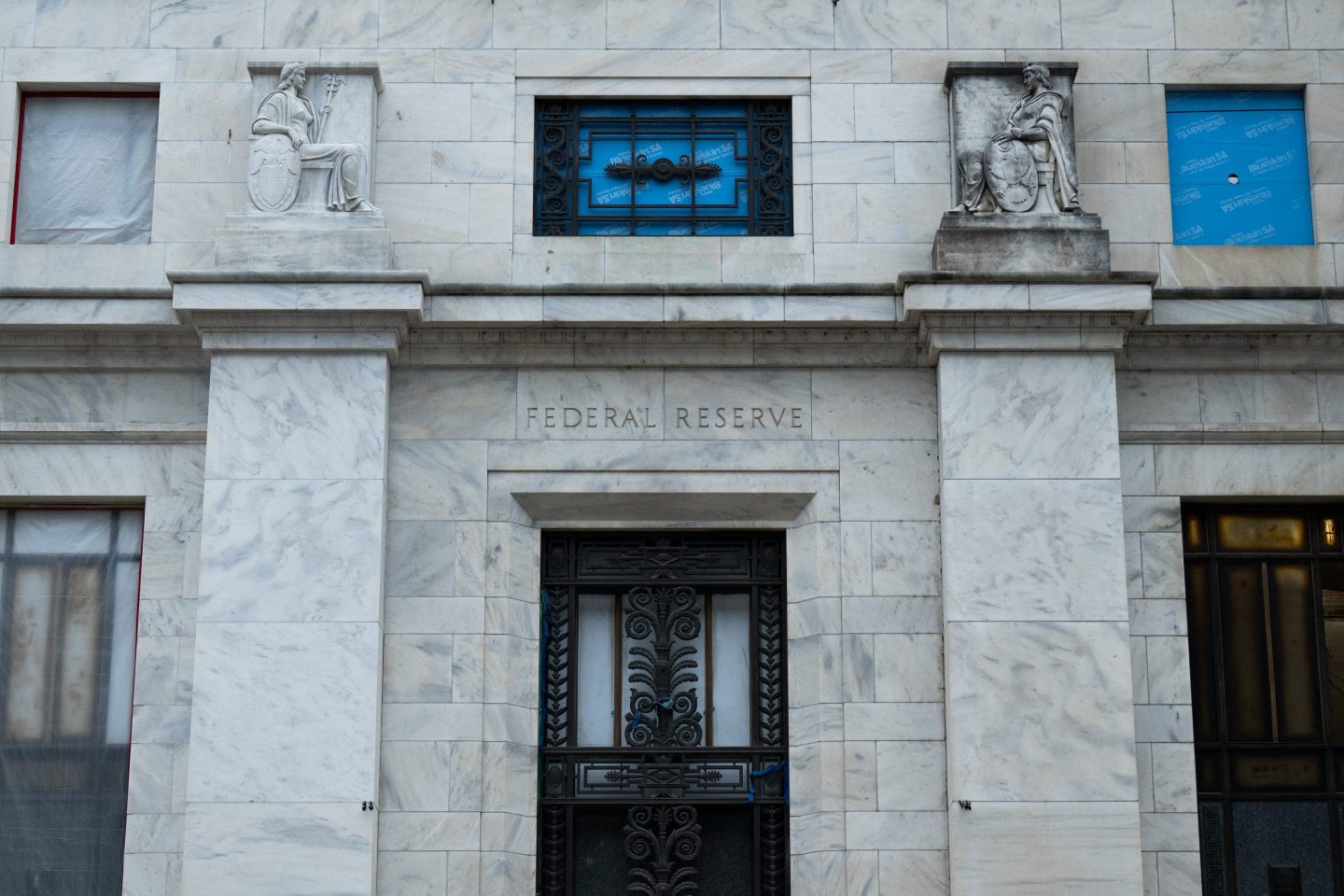
- The Federal Reserve has yet to cut interest rates in 2025 as it seeks greater clarity on the eventual effects of President Donald Trump’s tariff policy. While Fed Chair Jerome Powell suggested it’s in a “good position” to act decisively if necessary, some economists worry this approach could make the central bank slow to respond to a downturn.
Consumer sentiment has plummeted amid trade policy uncertainty, Federal Reserve Chair Jerome Powell acknowledged Wednesday, and commentary in the central bank’s own “Beige Book” suggests businesses are already feeling the effects of President Donald Trump’s tariffs.
Fed policymakers have not been moved by this “soft data,” however, and have yet to move interest rates this year. After the central bank’s latest decision to keep the Federal funds rate steady between 4.25% and 4.5%, Powell told reporters he and his colleagues are ready to act decisively—but not until the so-called hard data on unemployment and inflation gives them a clear reason to.
“Look at the state of the economy,” he said. “The labor work is solid, inflation is low. We can afford to be patient as things unfold. There’s no real cost to our waiting at this point.”
Other economists, however, note that a “wait and see” approach carries its own risks.
“Central banks that react rather than preempt data tend to be late in changing policy,” said Paul Donovan, chief economist at UBS Global Wealth Management. “Economic data is also increasingly less reliable, making data dependency more dangerous.”
For now, however, Powell thinks key measures of economic conditions have bought the Fed valuable time. The jobs report for April came in stronger than expected last week, with the unemployment rate remaining low, the Fed chair noted, at 4.2%. The central bank’s preferred inflation measure has also come down, though it remains above the Fed’s 2% target.
“It’s still a healthy economy,” Powell said, “albeit one that is shrouded in some very downbeat sentiment on the part of people and businesses.”
Other economists, meanwhile, are warning that signs of a recession are already brewing at the country’s ports amid a dramatic slowdown in shipping, particularly between the U.S. and China. Torsten Sløk, chief economist at private-equity giant Apollo, predicted mass layoffs could hit the industry this month and spur a recession by the summer.
“We see the shipping data, we see all that,” Powell said.
However, he mentioned the possibility of trade talks altering the situation, a day before Trump announced an agreement with the U.K. Meanwhile, Treasury Secretary Scott Bessent and U.S. Trade Representative Jamieson Greer will meet with Chinese counterparts this week; Bessent previously said the current standoff between the world’s two biggest economies is not sustainable.
Powell added the Fed doesn’t need to hurry because the Federal funds rate, its traditional monetary policy weapon, remains “moderately restrictive.” In other words, the central bank could lower rates quickly and dramatically if necessary, giving it plenty of ammunition if a downturn materializes.
“The data may move quickly or slowly,” he said, “but we do think we’re in a good position where we are to let things evolve and become clearer.”
Stagflation fears keep Fed on hold
The more uncomfortable message, however, might be that the Fed feels it has no choice but to stand pat and watch what unfolds next like everyone else. The central bank noted risks of both higher unemployment and higher inflation had risen, hinting at the worst-case scenario of “stagflation.”
If tariff disruptions do end up causing both runaway price growth and increasing unemployment, the central bank’s conundrum is that the solution to one of those problems usually exacerbates the other. When inflation rises, the Fed hikes interest rates to cool the economy. But when unemployment rises, the bank does the opposite and cuts rates to stimulate growth.
When both variables surge in tandem, it creates a “complex and challenging judgment,” Powell said. He stressed that such a scenario hasn’t played out yet.
“The assessment is, you wait,” the Fed chair said.
When push comes to shove, many on Wall Street believe the Fed will prioritize supporting the labor market. Traders are currently pricing in three to four cuts by the end of the year, according to the CME Group’s FedWatch tool, projecting the Fed holds rates steady again in June before a 25-point reduction in July.
For now, however, the Fed feels pulled in two directions, said Chris Zaccarelli, chief investment officer at Northlight Asset Management in Charlotte.
“Because of this, the Fed is going to have to wait for unemployment to spike before they resume cutting rates,” he wrote in a note Wednesday, “and by that point it might be too late.”
This also means the central bank will be trying to play catch-up, said Matthew Pallai, chief investment officer at Nomura Capital Management.
“Perhaps fiscal policy is better suited for this constellation of risks than monetary policy,” Pallai wrote in a Wednesday note. “Managing interest rates may be too blunt a tool to navigate between two obstacles.”