• Home
  • Latest
  • Fortune 500
  • Finance
  • Tech
  • Leadership
  • Lifestyle
  • Rankings
  • Multimedia
FinanceTariffs

Nobel-winning economist warns Trump’s tariff walk-back makes them ‘worse’ than they were in the first place

Eleanor Pringle
By
Eleanor Pringle
Eleanor Pringle
Senior Reporter, Economics and Markets
Down Arrow Button Icon
Eleanor Pringle
By
Eleanor Pringle
Eleanor Pringle
Senior Reporter, Economics and Markets
Down Arrow Button Icon
April 25, 2025, 6:41 AM ET
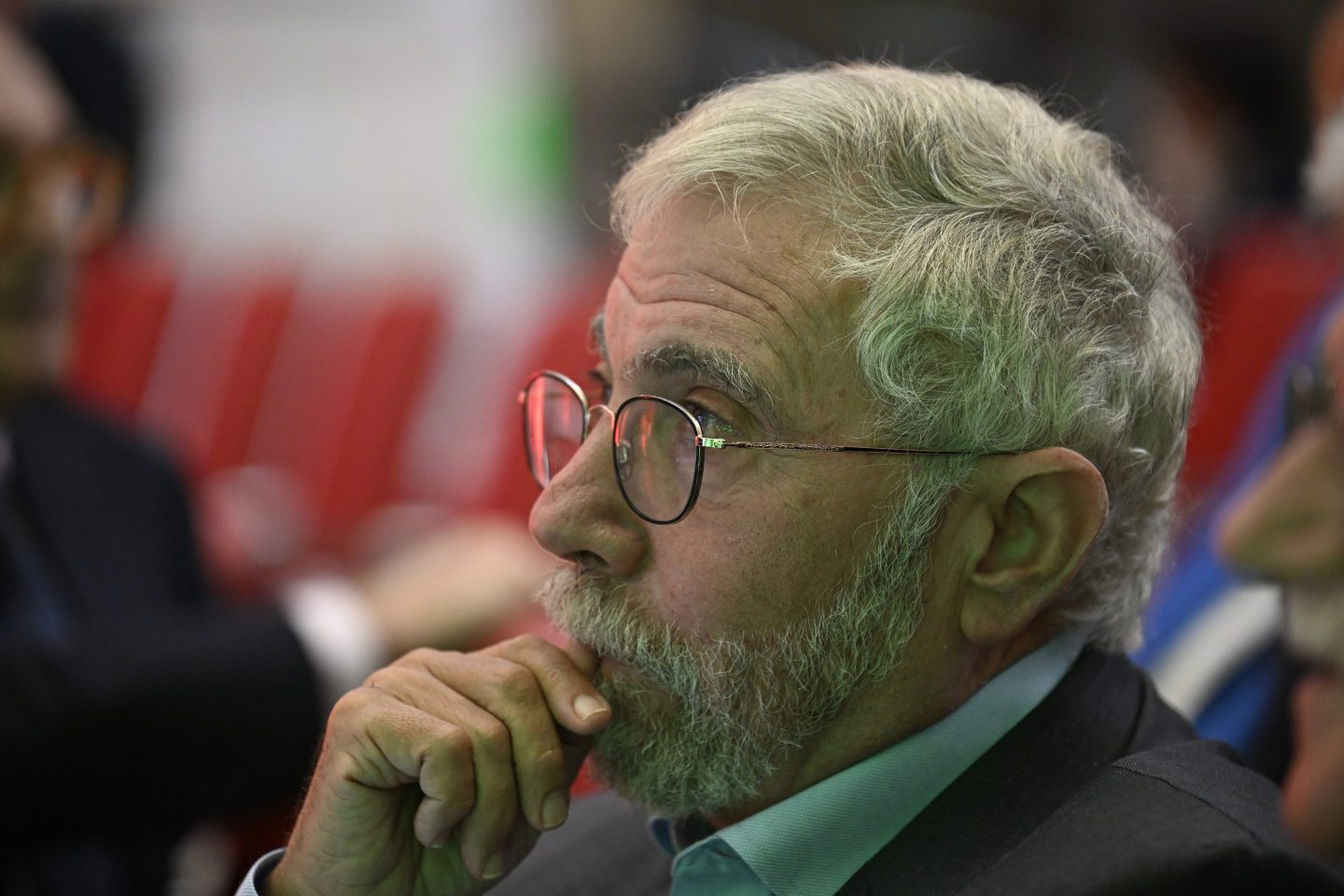
Nobel Memorial Prize in Economic Sciences winner Dr. Paul Krugman
Krugman believes a recession may be prompted by a slowdown in business investment. Horacio Villalobos#Corbis—Corbis/Getty Images
  • Nobel laureate Paul Krugman warns that President Trump’s unpredictable and often reversed tariff policies are creating deep uncertainty, discouraging business investment and thus increasing the risk of recession. While concerns over inflation exist, Krugman emphasizes that the greater threat lies in declining investment in trade-sensitive sectors owing to the lack of stability in U.S. foreign policy.

If there’s one thing investors don’t like it’s uncertainty, and President Trump’s ever-evolving stance on tariffs is not helping matters.

Recommended Video

Investors have no way to shield themselves from the impact of the White House’s foreign policy decisions, said economist and Nobel laureate Paul Krugman, adding that the political system offers no safety net to prevent extreme proposals.

“The secret sauce of the Trump tariffs is that they are extremely uncertain,” Krugman told the Goldman Sachs Exchanges podcast earlier this week. “Nobody knows what they will be. Nobody knows what comes next. Now, if you’re a business trying to make plans, would you want to invest under those conditions?”

He added: “An unpredictable tariff rate that can change the next day is really a depressing effect on demand. And that’s clear for business investment, but it also affects consumers. It affects homebuilders. So the uncertainty is the reason why a recession seems likely.”

11th-hour U-turns

President Trump has developed a habit for 11th-hour reprieves when it comes to foreign policy.

The precedent was set with Mexico and Canada, when early in his term he announced economic sanctions on the neighboring nations in a bid to stem the flow of drugs into the U.S. and tighten immigration.

These tariffs were then paused before going into effect a month later.

The story was similar with the tariffs announced on “Liberation Day,” which included hikes for specific, major trading partners, including a 20% increase on the European Union, 24% on Japan, and 26% on India.

A week later the Oval Office announced a 90-day pause on the sweeping policy—which included a 10% blanket duty raise on all other nations—for every country except China, which had responded with retaliatory action and as such now faces a 145% duty on exports to America.

It could be argued that by announcing the pause, President Trump acted on the appeals of analysts begging him not to spark a global trade war and potentially implode the stock market.

Conversely, a flip-flopping routine on major foreign policy doesn’t do much to bolster confidence in Trump’s administration—putting the Oval Office in something of a lose-lose situation.

Krugman said: “In some ways I almost think that the policy reversals, to the extent they happen … make it worse, because the reversal may be reversed a day or a week or a month later, so it doesn’t make investing any easier, because you still have no idea what the world will look like by the time your investment matures.”

Krugman argues that, unfortunately, American law presents no barriers to this continuing indefinitely.

“It’s hard, because the thing about trade policy in particular is that, under the way it’s set up in the United States, the law gives the president enormous discretion,” he added. “No legislation has to be passed. No commitments need to be made. Which means that he can change his mind overnight.

“We set up that system to create some flexibility around tariffs that were negotiated with other countries. We needed something that would let the United States respond if the political pressures became too great, but it was never intended to be used to make massive changes in trade policy. But that’s what’s happening now.

“And so even if they said, ‘No, this is going to be our tariff policy, and it will remain unchanged for the next three years,’ a week later they could say, ‘Actually, we’ve decided to change it.’ And who can guard against that?”

Outlook is down to investments, not inflation

One of the major questions about Trump’s tariff plan is how inflationary it would prove to be: Would businesses push the price increases in their supply chain through to consumers?

The general consensus is that yes, the increases will be passed on, with members of the Federal Open Market Committee (FOMC) saying they’re aware this may pose a threat to their 2% inflation target.

It’s worth reiterating that this is a potential future outcome, but if markets and the public begin acting as though they are already in that inflationary environment it may become a self-fulfilling prophecy—and that’s before the tariffs have even come into effect.

Krugman warns a slowdown will likely occur because of slowing business investments as opposed to a drop-off in consumer demand.

“I’d say it’s mostly business investment in tradable goods, in sectors that are either competing with imports or exports, or things that are more strongly affected by the tariff regime,” Krugman added. “It’s not clear to me why investments in health care, say, should be particularly affected by this. And our economy is probably about 75% non-tradable, so it’s a limited set of stuff.”
Join us at the Fortune Workplace Innovation Summit May 19–20, 2026, in Atlanta. The next era of workplace innovation is here—and the old playbook is being rewritten. At this exclusive, high-energy event, the world’s most innovative leaders will convene to explore how AI, humanity, and strategy converge to redefine, again, the future of work. Register now.
About the Author
Eleanor Pringle
By Eleanor PringleSenior Reporter, Economics and Markets
LinkedIn icon

Eleanor Pringle is an award-winning senior reporter at Fortune covering news, the economy, and personal finance. Eleanor previously worked as a business correspondent and news editor in regional news in the U.K. She completed her journalism training with the Press Association after earning a degree from the University of East Anglia.

See full bioRight Arrow Button Icon

Latest in Finance

InvestingSports
Big 12 in advanced talks for deal with RedBird-backed fund
By Giles Turner and BloombergDecember 13, 2025
5 hours ago
Spanish Prime Minister Pedro Sánchez often praises the financial and social benefits that immigrants bring to the country.
EuropeSpain
In a continent cracking down on immigration and berated by Trump’s warnings of ‘civilizational erasure,’ Spain embraces migrants
By Suman Naishadham and The Associated PressDecember 13, 2025
7 hours ago
EconomyAgriculture
More financially distressed farmers are expected to lose their property soon as loan repayments and incomes continue to falter
By Jason MaDecember 13, 2025
8 hours ago
InvestingStock
There have been head fakes before, but this time may be different as the latest stock rotation out of AI is just getting started, analysts say
By Jason MaDecember 13, 2025
11 hours ago
Politicsdavid sacks
Can there be competency without conflict in Washington?
By Alyson ShontellDecember 13, 2025
11 hours ago
Investingspace
SpaceX sets $800 billion valuation, confirms 2026 IPO plans
By Loren Grush, Edward Ludlow and BloombergDecember 13, 2025
12 hours ago

Most Popular

placeholder alt text
Success
Apple cofounder Ronald Wayne sold his 10% stake for $800 in 1976—today it’d be worth up to $400 billion
By Preston ForeDecember 12, 2025
2 days ago
placeholder alt text
Economy
Tariffs are taxes and they were used to finance the federal government until the 1913 income tax. A top economist breaks it down
By Kent JonesDecember 12, 2025
2 days ago
placeholder alt text
Success
40% of Stanford undergrads receive disability accommodations—but it’s become a college-wide phenomenon as Gen Z try to succeed in the current climate
By Preston ForeDecember 12, 2025
2 days ago
placeholder alt text
Economy
The Fed just ‘Trump-proofed’ itself with a unanimous move to preempt a potential leadership shake-up
By Jason MaDecember 12, 2025
1 day ago
placeholder alt text
Economy
For the first time since Trump’s tariff rollout, import tax revenue has fallen, threatening his lofty plans to slash the $38 trillion national debt
By Sasha RogelbergDecember 12, 2025
1 day ago
placeholder alt text
Success
Apple CEO Tim Cook out-earns the average American’s salary in just 7 hours—to put that into context, he could buy a new $439,000 home in just 2 days
By Emma BurleighDecember 12, 2025
1 day ago
Rankings
  • 100 Best Companies
  • Fortune 500
  • Global 500
  • Fortune 500 Europe
  • Most Powerful Women
  • Future 50
  • World’s Most Admired Companies
  • See All Rankings
Sections
  • Finance
  • Leadership
  • Success
  • Tech
  • Asia
  • Europe
  • Environment
  • Fortune Crypto
  • Health
  • Retail
  • Lifestyle
  • Politics
  • Newsletters
  • Magazine
  • Features
  • Commentary
  • Mpw
  • CEO Initiative
  • Conferences
  • Personal Finance
  • Education
Customer Support
  • Frequently Asked Questions
  • Customer Service Portal
  • Privacy Policy
  • Terms Of Use
  • Single Issues For Purchase
  • International Print
Commercial Services
  • Advertising
  • Fortune Brand Studio
  • Fortune Analytics
  • Fortune Conferences
  • Business Development
About Us
  • About Us
  • Editorial Calendar
  • Press Center
  • Work At Fortune
  • Diversity And Inclusion
  • Terms And Conditions
  • Site Map

© 2025 Fortune Media IP Limited. All Rights Reserved. Use of this site constitutes acceptance of our Terms of Use and Privacy Policy | CA Notice at Collection and Privacy Notice | Do Not Sell/Share My Personal Information
FORTUNE is a trademark of Fortune Media IP Limited, registered in the U.S. and other countries. FORTUNE may receive compensation for some links to products and services on this website. Offers may be subject to change without notice.