
• Home
  • Latest
  • Fortune 500
  • Finance
  • Tech
  • Leadership
  • Lifestyle
  • Rankings
  • Multimedia
Finance

Trump’s tariff formula used the wrong value in its calculations, conservative think tank says. ‘This whole thing was rigged’

Paolo Confino
By
Paolo Confino
Paolo Confino
Reporter
Down Arrow Button Icon
Paolo Confino
By
Paolo Confino
Paolo Confino
Reporter
Down Arrow Button Icon
April 7, 2025, 8:52 PM ET
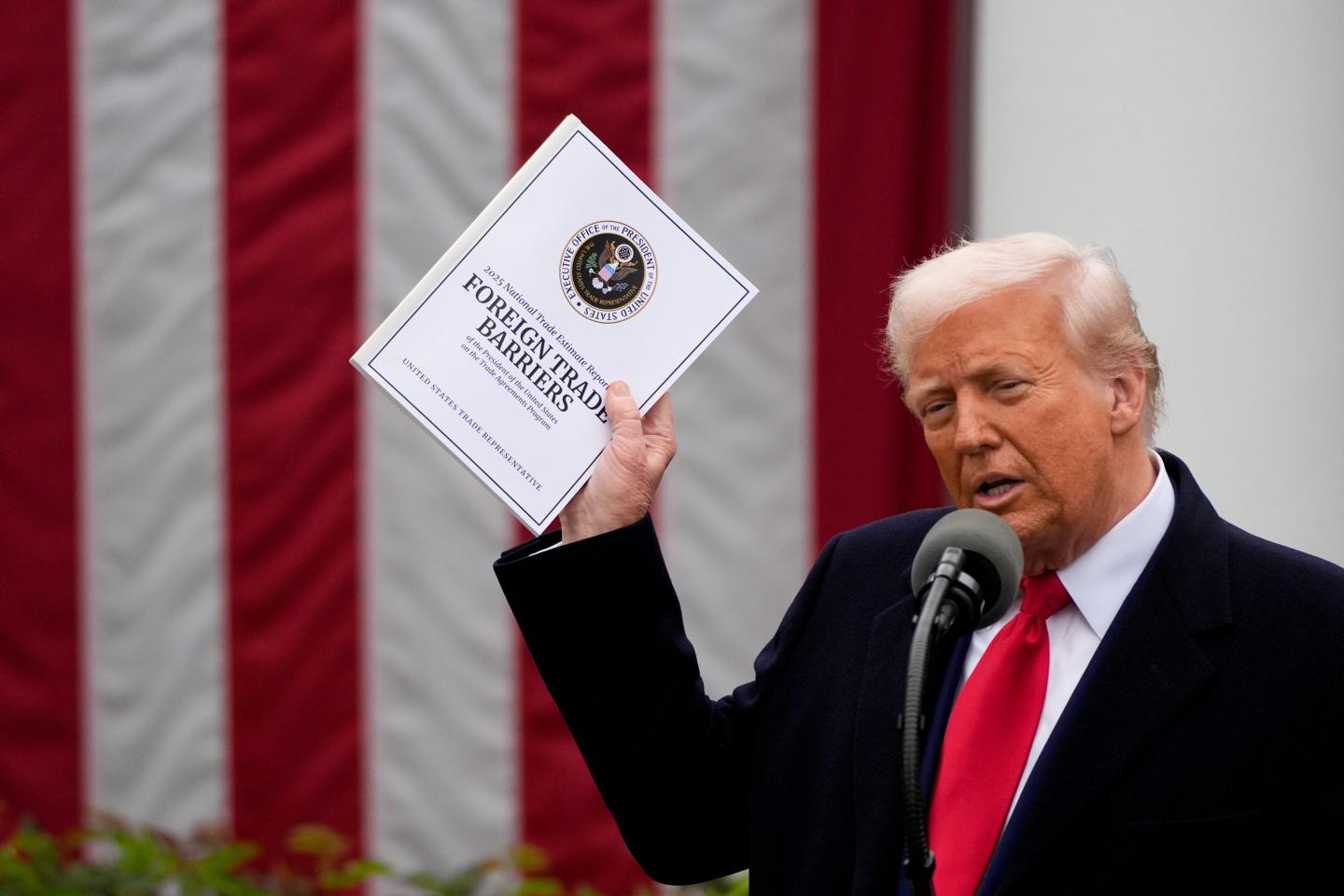
Photo of Donald Trump
President Donald Trump holds up a report authored by the Office of the U.S. Trade Representative that he cited as instrumental in his tariff policy. Kent Nishimura/Bloomberg
  • A conservative think tank found the White House measured retail price elasticity when it should have used import price elasticity. That mistake meant the tariff outputs were about four times higher than they should have been. 

The formula the White House used to calculate its recent tariff is based on an error that roughly quadrupled the rates from what they should have been. 

Recommended Video

Two scholars at the American Enterprise Institute (AEI), a conservative think tank, found the White House used the wrong value when assessing the rate at which prices would change as a result of tariffs. The correct version of the formula uses price changes in the cost of imports, meaning how much it costs a U.S.-based company to buy a good from a foreign seller. Instead, the White House factored in the retail price change, which is what consumers pay. 

That meant the formula was off by a factor of four, because the White House valued the elasticity of import prices at 0.25 when it should have been 0.945, according to AEI. 

“It’s pretty bush league,” Stan Veuger, one of the AEI fellows, told Fortune in a phone call. “For such a big policy you’d expect a much higher level of professionalism.”

Using the wrong value rendered the formula inaccurate, according to Veuger and his coauthor Kevin Corinth.

“Now, our view is that the formula the administration relied on has no foundation in either economic theory or trade law,” Corinth and Veuger wrote. “But if we are going to pretend that it is a sound basis for U.S. trade policy, we should at least be allowed to expect that the relevant White House officials do their calculations carefully.”

Another AEI economist, Derek Scissors, went even further, saying the administration hadn’t made a mistake so much as intentionally fudged the math to get the outcome officials wanted. 

“This whole thing was rigged,” Scissors said Monday on CNBC. “It was a manipulated way to get very high tariffs because President Trump wanted to announce very high tariffs.” 

In their original report Corinth and Veuger said they hoped the White House would lower its tariff rates as a result of their discovery. “Hopefully they will correct their mistake soon: The resulting trade liberalization would provide a much-needed boost to the economy and may yet help us stave off a recession,” they wrote. 

The three trading days since President Donald Trump announced the U.S.’s new tariff regime saw markets across the world tank. In the U.S., the Dow Jones, S&P 500, and Nasdaq composite index all cratered. In Asia, stocks in Japan and Hong Kong sank even further on Monday, after Trump vowed to escalate the ongoing trade war. In Europe stocks fell roughly 4.5% on Monday, after a dismal performance last week. 

The calculations used by the White House were already somewhat controversial after it became apparent that discounted “reciprocal tariff” amounts were based on a simple formula of dividing the U.S.’s trade deficit with a foreign country by that country’s total exports to the U.S. The resulting number was then divided by two and used as the tariff rate for said country. 

Even without the error, the formula was dubious, Corinth and Veuger said. The formula “does not make economic sense,” they wrote. “The trade deficit with a given country is not determined only by tariffs and nontariff trade barriers, but also by international capital flows, supply chains, comparative advantage, geography, etc.”  

Given that the Trump administration’s tariffs were billed as reciprocal tariffs, analysts and investors had expected they would be based on a careful examination of a country’s trade and non-trade barriers with respect to American-made goods. Instead they were based on the formula, which the Washington Post reports President Donald Trump personally insisted on using.  

Trump’s personal views on tariffs were, in Veuger’s view, the principal reason for the recent tariff policy.

“What’s driving the policy is that since the 1980s Trump has been a protectionist, and he thinks trade deficits are losses and trade surpluses are profits,” Veuger said. “He just likes tariffs. Then you can backfill them with more sophisticated, intellectualized rationalizations. But that’s what it is—it’s rationalization.”

The White House said using retail prices instead of import prices was warranted because consumers make purchasing decisions based on retail rather than wholesale prices. A spokesperson added that in their view the tariff rates should actually have been larger.

Corinth and Veuger pointed to research from Harvard Business School professor Alberto Cavallo cited in the U.S. trade representative’s (USTR) memo about the tariff formula, as evidence the calculations misinterpreted the difference between retail prices and import prices. Cavallo’s work “makes this distinction clear,” they wrote. 

Cavallo himself also addressed the fact his work was referenced in the USTR’s report. 

“It is not entirely clear how they use our findings,” Cavallo wrote on X last week. “Based on our research, the elasticity of import prices with respect to tariffs is closer to 1. If that figure were used instead of 0.25, the implied reciprocal tariffs would come out about four times smaller.”

If that version of the formula were adopted it would drastically lower the tariff rates imposed on countries. For example, Cambodia’s 49% rate would drop down to 13%, and Vietnam’s would go from 46% to 12.2%. The vast majority of countries would end up being subject to the 10% tariff minimum that is part of the White House’s new policy.

Join us at the Fortune Workplace Innovation Summit May 19–20, 2026, in Atlanta. The next era of workplace innovation is here—and the old playbook is being rewritten. At this exclusive, high-energy event, the world’s most innovative leaders will convene to explore how AI, humanity, and strategy converge to redefine, again, the future of work. Register now.
About the Author
Paolo Confino
By Paolo ConfinoReporter

Paolo Confino is a former reporter on Fortune’s global news desk where he covers each day’s most important stories.

See full bioRight Arrow Button Icon

Latest in Finance

Finance
Lorem ipsum dolor sit amet, consectetur adipiscing elit, sed do eiusmod tempor incididunt ut labore et dolore magna aliqua. Ut enim ad minim veniam
By Fortune Editors
October 20, 2025
Finance
Lorem ipsum dolor sit amet, consectetur adipiscing elit, sed do eiusmod tempor incididunt ut labore et dolore magna aliqua. Ut enim ad minim veniam
By Fortune Editors
October 20, 2025
Finance
Lorem ipsum dolor sit amet, consectetur adipiscing elit, sed do eiusmod tempor incididunt ut labore et dolore magna aliqua. Ut enim ad minim veniam
By Fortune Editors
October 20, 2025
Finance
Lorem ipsum dolor sit amet, consectetur adipiscing elit, sed do eiusmod tempor incididunt ut labore et dolore magna aliqua. Ut enim ad minim veniam
By Fortune Editors
October 20, 2025
Finance
Lorem ipsum dolor sit amet, consectetur adipiscing elit, sed do eiusmod tempor incididunt ut labore et dolore magna aliqua. Ut enim ad minim veniam
By Fortune Editors
October 20, 2025
Finance
Lorem ipsum dolor sit amet, consectetur adipiscing elit, sed do eiusmod tempor incididunt ut labore et dolore magna aliqua. Ut enim ad minim veniam
By Fortune Editors
October 20, 2025

Most Popular

Finance
Lorem ipsum dolor sit amet, consectetur adipiscing elit, sed do eiusmod tempor incididunt ut labore et dolore magna aliqua. Ut enim ad minim veniam
By Fortune Editors
October 20, 2025
Finance
Lorem ipsum dolor sit amet, consectetur adipiscing elit, sed do eiusmod tempor incididunt ut labore et dolore magna aliqua. Ut enim ad minim veniam
By Fortune Editors
October 20, 2025
Finance
Lorem ipsum dolor sit amet, consectetur adipiscing elit, sed do eiusmod tempor incididunt ut labore et dolore magna aliqua. Ut enim ad minim veniam
By Fortune Editors
October 20, 2025
Finance
Lorem ipsum dolor sit amet, consectetur adipiscing elit, sed do eiusmod tempor incididunt ut labore et dolore magna aliqua. Ut enim ad minim veniam
By Fortune Editors
October 20, 2025
Finance
Lorem ipsum dolor sit amet, consectetur adipiscing elit, sed do eiusmod tempor incididunt ut labore et dolore magna aliqua. Ut enim ad minim veniam
By Fortune Editors
October 20, 2025
Finance
Lorem ipsum dolor sit amet, consectetur adipiscing elit, sed do eiusmod tempor incididunt ut labore et dolore magna aliqua. Ut enim ad minim veniam
By Fortune Editors
October 20, 2025
Fortune Secondary Logo
Rankings
  • 100 Best Companies
  • Fortune 500
  • Global 500
  • Fortune 500 Europe
  • Most Powerful Women
  • Future 50
  • World’s Most Admired Companies
  • See All Rankings
Sections
  • Finance
  • Fortune Crypto
  • Features
  • Leadership
  • Health
  • Commentary
  • Success
  • Retail
  • Mpw
  • Tech
  • Lifestyle
  • CEO Initiative
  • Asia
  • Politics
  • Conferences
  • Europe
  • Newsletters
  • Personal Finance
  • Environment
  • Magazine
  • Education
Customer Support
  • Frequently Asked Questions
  • Customer Service Portal
  • Privacy Policy
  • Terms Of Use
  • Single Issues For Purchase
  • International Print
Commercial Services
  • Advertising
  • Fortune Brand Studio
  • Fortune Analytics
  • Fortune Conferences
  • Business Development
  • Group Subscriptions
About Us
  • About Us
  • Editorial Calendar
  • Press Center
  • Work At Fortune
  • Diversity And Inclusion
  • Terms And Conditions
  • Site Map
  • About Us
  • Editorial Calendar
  • Press Center
  • Work At Fortune
  • Diversity And Inclusion
  • Terms And Conditions
  • Site Map
  • Facebook icon
  • Twitter icon
  • LinkedIn icon
  • Instagram icon
  • Pinterest icon

Latest in Finance

Photo of Robert Solow
AIProductivity
Thousands of CEOs admit AI had no impact on employment or productivity—and it has economists resurrecting a paradox from 40 years ago
By Sasha RogelbergApril 19, 2026
15 minutes ago
Trump sends JD Vance to Pakistan again for more talks with Iran but repeats threats against its infrastructure as Hormuz stays closed
PoliticsIran
Trump sends JD Vance to Pakistan again for more talks with Iran but repeats threats against its infrastructure as Hormuz stays closed
By Michelle L. Price, Samy Magdy, Sam Metz and The Associated PressApril 19, 2026
46 minutes ago
Gen Z is ‘Chinamaxxing’—and it’s less a love letter to Beijing than an indictment of America
EconomyGen Z
Gen Z is ‘Chinamaxxing’—and it’s less a love letter to Beijing than an indictment of America
By Nick LichtenbergApril 19, 2026
3 hours ago
For wealthy buyers, Mar-a-Lago’s security perimeter is Palm Beach’s hottest amenity
Real EstateHousing
For wealthy buyers, Mar-a-Lago’s security perimeter is Palm Beach’s hottest amenity
By Sydney LakeApril 19, 2026
4 hours ago
stressed student and parent
SuccessCareers
Parents are so panicked about the job market they’re paying career coaches $15,000 years before their kids graduate from college
By Jake AngeloApril 19, 2026
4 hours ago
A woman kneels on the floor next to an older woman sitting down.
HealthLabor
‘The current system right now is unsustainable’: top economist sees a crucial crack in the economy
By Sasha RogelbergApril 19, 2026
5 hours ago

Most Popular

'We should absolutely be concerned about non-college-educated men today': higher rents, living at home, falling out of the labor market
Economy
'We should absolutely be concerned about non-college-educated men today': higher rents, living at home, falling out of the labor market
By Catherina GioinoApril 18, 2026
1 day ago
MacKenzie Scott has donated more than $26 billion—but it's barely made a dent in her net worth because of the power of Amazon shares
Success
MacKenzie Scott has donated more than $26 billion—but it's barely made a dent in her net worth because of the power of Amazon shares
By Sydney LakeApril 18, 2026
23 hours ago
The record-setting U.S. drought is so bad that 97% of the Southeast and two-thirds of the West are parched
North America
The record-setting U.S. drought is so bad that 97% of the Southeast and two-thirds of the West are parched
By Seth Borenstein and The Associated PressApril 18, 2026
19 hours ago
Putin finally admits Russia's economy is in trouble and grasps for answers, after warnings about a financial crisis have been piling up
Economy
Putin finally admits Russia's economy is in trouble and grasps for answers, after warnings about a financial crisis have been piling up
By Jason MaApril 18, 2026
17 hours ago
The power has swung back to employers—and workers are paying for it in benefits, flexibility, and leverage
Workplace Culture
The power has swung back to employers—and workers are paying for it in benefits, flexibility, and leverage
By Marco Quiroz-GutierrezApril 17, 2026
2 days ago
Older millennials are starting to act like boomers in the housing market—and pulling away from the pack
Real Estate
Older millennials are starting to act like boomers in the housing market—and pulling away from the pack
By Nick LichtenbergApril 17, 2026
2 days ago

© 2026 Fortune Media IP Limited. All Rights Reserved. Use of this site constitutes acceptance of our Terms of Use and Privacy Policy | CA Notice at Collection and Privacy Notice | Do Not Sell/Share My Personal Information
FORTUNE is a trademark of Fortune Media IP Limited, registered in the U.S. and other countries. FORTUNE may receive compensation for some links to products and services on this website. Offers may be subject to change without notice.