• Home
  • News
  • Fortune 500
  • Tech
  • Finance
  • Leadership
  • Lifestyle
  • Rankings
  • Multimedia
Tesla

Wall Street’s biggest Tesla bull just raised the white flag, blaming Elon Musk for slashing his price target nearly by half

Christiaan Hetzner
By
Christiaan Hetzner
Christiaan Hetzner
Senior Reporter
Down Arrow Button Icon
Christiaan Hetzner
By
Christiaan Hetzner
Christiaan Hetzner
Senior Reporter
Down Arrow Button Icon
April 7, 2025, 8:27 AM ET
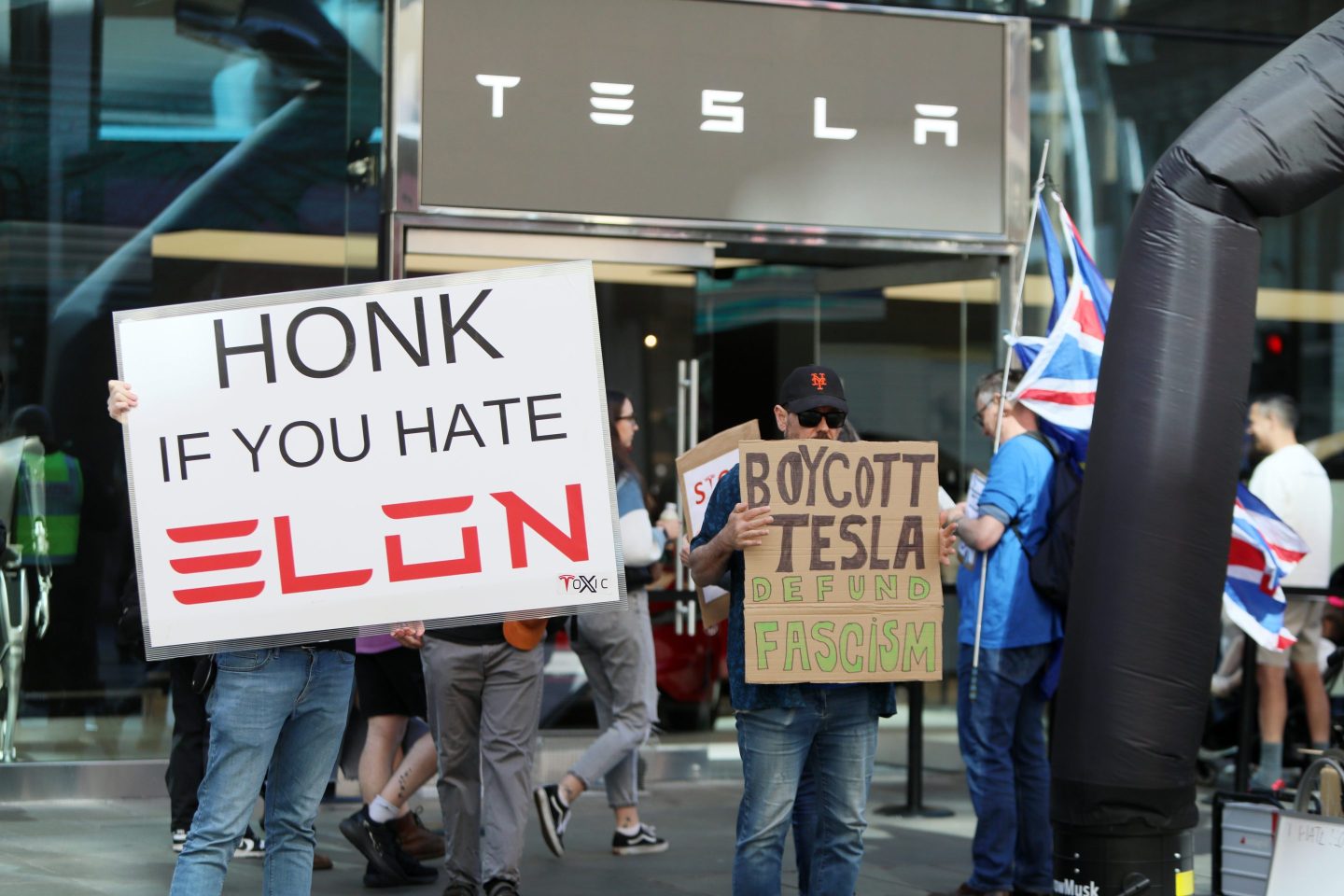
Demonstrators rally against Tesla CEO Elon Musk, US President Donald Trump and their recent policies outside a Tesla showroom on April 05, 2025 in London, England.
Elon Musk's divisive politics means the demand destruction at Tesla is real, not imagined, warned Wedbush analyst Dan Ives.Alishia Abodunde—Getty Images
  • Wedbush Securities analyst Dan Ives lowered his Tesla price target to $315 per share, citing a steep revision in his delivery estimatesthrough 2030 due to Elon Musk’s politics. Ives had hiked it in late January to $550 just before the stock suffered a market rout. “The demand destruction for Tesla and brand damage is real,” he wrote.

Roughly a month ago, Wedbush Securities analyst Dan Ives warned Tesla CEO Elon Musk that patience among his shareholders was “wearing very thin.” 

Recommended Video

It now looks as if it has finally snapped, after Wall Street’s most reliable Tesla bull slashed his price target nearly in half, blaming the polarizing CEO for poisoning the well. Moving forward, he said, EV sales for the brand that once hit breakneck speeds will only crawl ahead with percentage gains in the single digits as a result.

“The demand destruction for Tesla and brand damage is real,” Ives wrote, “and has morphed into something much more concerning over the past few months.”

By cutting his price target to just $315 from $550, the Wedbush analyst broke ranks from many Tesla bulls who largely view Musk’s politics as a wash—as in, Musk is losing no more customers on the left than he is gaining from the right.

Ives not only disagreed with that, he said the tariffs risked spreading the problems from Europe and the U.S. farther East, explaining he was much more worried about Musk’s association with Trump in terms of China. 

Whereas his recent price target changes appeared to be driven by sentiment and conviction, Ives this time erased entire assumptions underpinning the fundamental earnings drivers.

He justified the new $315 target with a steep downward revision of his estimates for Tesla vehicle deliveries for 2025 all the way through to 2030, reducing them by an average of more than a fifth. 

Sharp downward revision of delivery estimates through 2030

Ives now predicts EV sales for the brand should increase at an annual pace of roughly 8% from next year onward—down from a previous rate of approximately 15%. 

“We now estimate Tesla has lost/destroyed at least 10% of its future customer base globally based on self created brand issues and this could be a conservative estimate,” Ives wrote. “In Europe, this number could be 20% or higher…all self-inflicted by Musk.”

What that means in practice is deliveries of just 1.70 million vehicles this year, a 5% annual drop over 2024, rising to 2.47 million at the end of the decade. For comparison, his estimates were at 2.19 million and 4.54 million, respectively, only five months ago.

Previously Ives had calmed investors by arguing Musk’s influence with Trump would likely grant him a hefty say in the China tariffs the president was planning. 

These hopes were dashed last week following news that import duties on China would skyrocket to 54% from a previous 20%, starting April 9. 

China in return slapped a reciprocal tariff of 34% to match the administration’s move, setting up a trade war between the world’s two superpowers.

Now Ives fears that Chinese buyers, who previously cared little whether Musk was pushing authoritarianism in the West, could turn their backs on the Tesla CEO because of his close relationship with the U.S. President.

“The backlash from Trump tariff policies in China and Musk’s association will be hard to [overstate] and this will further drive Chinese consumers to buy domestic, such as BYD, Nio, Xpeng and others,” Ives wrote.

Ives had hiked his price target three times since Trump’s election

The Wedbush analyst had picked the worst possible time to become bullish. In mid-December, he hiked his price target to $515, just three days before the stock peaked at its record price of $488 a share. 

Ives then doubled down on his optimism, hiking once more to $550 two days after Trump took office. By that point the stock’s steady declines over the previous four weeks were about to turn into a rout, as Musk’s DOGE efforts sparked outrage across the country.

Finally, after Tesla shares fell another 37% to hit $263, Ives felt investors needed a “table pounder” like Wedbush to remind them of the value they were missing out on and added the stock to its Best Ideas List. In total Ives had hiked his price target three times since the election from just $300 in early November.

Instead the mixture of Tesla’s Q1 car sales—the lowest in nearly three years—and the uncertainty around tariffs has continued to pressure the stock. Tesla shares are expected to open some 5% lower when trading begins Monday.

“Tesla has unfortunately become a political symbol because of Musk and this is a very bad thing for the future of this technology stalwart,” he said. 

Fortune Brainstorm AI returns to San Francisco Dec. 8–9 to convene the smartest people we know—technologists, entrepreneurs, Fortune Global 500 executives, investors, policymakers, and the brilliant minds in between—to explore and interrogate the most pressing questions about AI at another pivotal moment. Register here.
About the Author
Christiaan Hetzner
By Christiaan HetznerSenior Reporter
Instagram iconLinkedIn iconTwitter icon

Christiaan Hetzner is a former writer for Fortune, where he covered Europe’s changing business landscape.

See full bioRight Arrow Button Icon

Latest in

AIMeta
It’s ‘kind of jarring’: AI labs like Meta, Deepseek, and Xai earned some of the worst grades possible on an existential safety index
By Patrick Kulp and Tech BrewDecember 5, 2025
3 hours ago
RetailConsumer Spending
U.S. consumers are so financially strained they put more than $1 billion on buy-now, pay later services during Black Friday and Cyber Monday
By Jeena Sharma and Retail BrewDecember 5, 2025
4 hours ago
Elon Musk
Big TechSpaceX
Musk’s SpaceX discusses record valuation, IPO as soon as 2026
By Edward Ludlow, Loren Grush, Lizette Chapman, Eric Johnson and BloombergDecember 5, 2025
4 hours ago
data center
EnvironmentData centers
The rise of AI reasoning models comes with a big energy tradeoff
By Rachel Metz, Dina Bass and BloombergDecember 5, 2025
4 hours ago
netflix
Arts & EntertainmentAntitrust
Hollywood writers say Warner takeover ‘must be blocked’
By Thomas Buckley and BloombergDecember 5, 2025
4 hours ago
Personal FinanceLoans
5 ways to use a home equity line of credit (HELOC)
By Joseph HostetlerDecember 5, 2025
4 hours ago

Most Popular

placeholder alt text
Economy
Two months into the new fiscal year and the U.S. government is already spending more than $10 billion a week servicing national debt
By Eleanor PringleDecember 4, 2025
2 days ago
placeholder alt text
Success
‘Godfather of AI’ says Bill Gates and Elon Musk are right about the future of work—but he predicts mass unemployment is on its way
By Preston ForeDecember 4, 2025
1 day ago
placeholder alt text
Success
Nearly 4 million new manufacturing jobs are coming to America as boomers retire—but it's the one trade job Gen Z doesn't want
By Emma BurleighDecember 4, 2025
1 day ago
placeholder alt text
Success
Nvidia CEO Jensen Huang admits he works 7 days a week, including holidays, in a constant 'state of anxiety' out of fear of going bankrupt
By Jessica CoacciDecember 4, 2025
1 day ago
placeholder alt text
Real Estate
‘There is no Mamdani effect’: Manhattan luxury home sales surge after mayoral election, undercutting predictions of doom and escape to Florida
By Sasha RogelbergDecember 4, 2025
1 day ago
placeholder alt text
Economy
Tariffs and the $38 trillion national debt: Kevin Hassett sees ’big reductions’ in deficit while Scott Bessent sees a ‘shrinking ice cube’
By Nick LichtenbergDecember 4, 2025
1 day ago
Rankings
  • 100 Best Companies
  • Fortune 500
  • Global 500
  • Fortune 500 Europe
  • Most Powerful Women
  • Future 50
  • World’s Most Admired Companies
  • See All Rankings
Sections
  • Finance
  • Leadership
  • Success
  • Tech
  • Asia
  • Europe
  • Environment
  • Fortune Crypto
  • Health
  • Retail
  • Lifestyle
  • Politics
  • Newsletters
  • Magazine
  • Features
  • Commentary
  • Mpw
  • CEO Initiative
  • Conferences
  • Personal Finance
  • Education
Customer Support
  • Frequently Asked Questions
  • Customer Service Portal
  • Privacy Policy
  • Terms Of Use
  • Single Issues For Purchase
  • International Print
Commercial Services
  • Advertising
  • Fortune Brand Studio
  • Fortune Analytics
  • Fortune Conferences
  • Business Development
About Us
  • About Us
  • Editorial Calendar
  • Press Center
  • Work At Fortune
  • Diversity And Inclusion
  • Terms And Conditions
  • Site Map

© 2025 Fortune Media IP Limited. All Rights Reserved. Use of this site constitutes acceptance of our Terms of Use and Privacy Policy | CA Notice at Collection and Privacy Notice | Do Not Sell/Share My Personal Information
FORTUNE is a trademark of Fortune Media IP Limited, registered in the U.S. and other countries. FORTUNE may receive compensation for some links to products and services on this website. Offers may be subject to change without notice.