Hello and welcome to Eye on AI. In today’s edition…How a new prediction model could improve wildfire management and response; Trump tariffs are “worse than the worst case scenario” for tech investors; AI executive shakeups hit Google and Meta; and AI therapy chatbots might actually work.
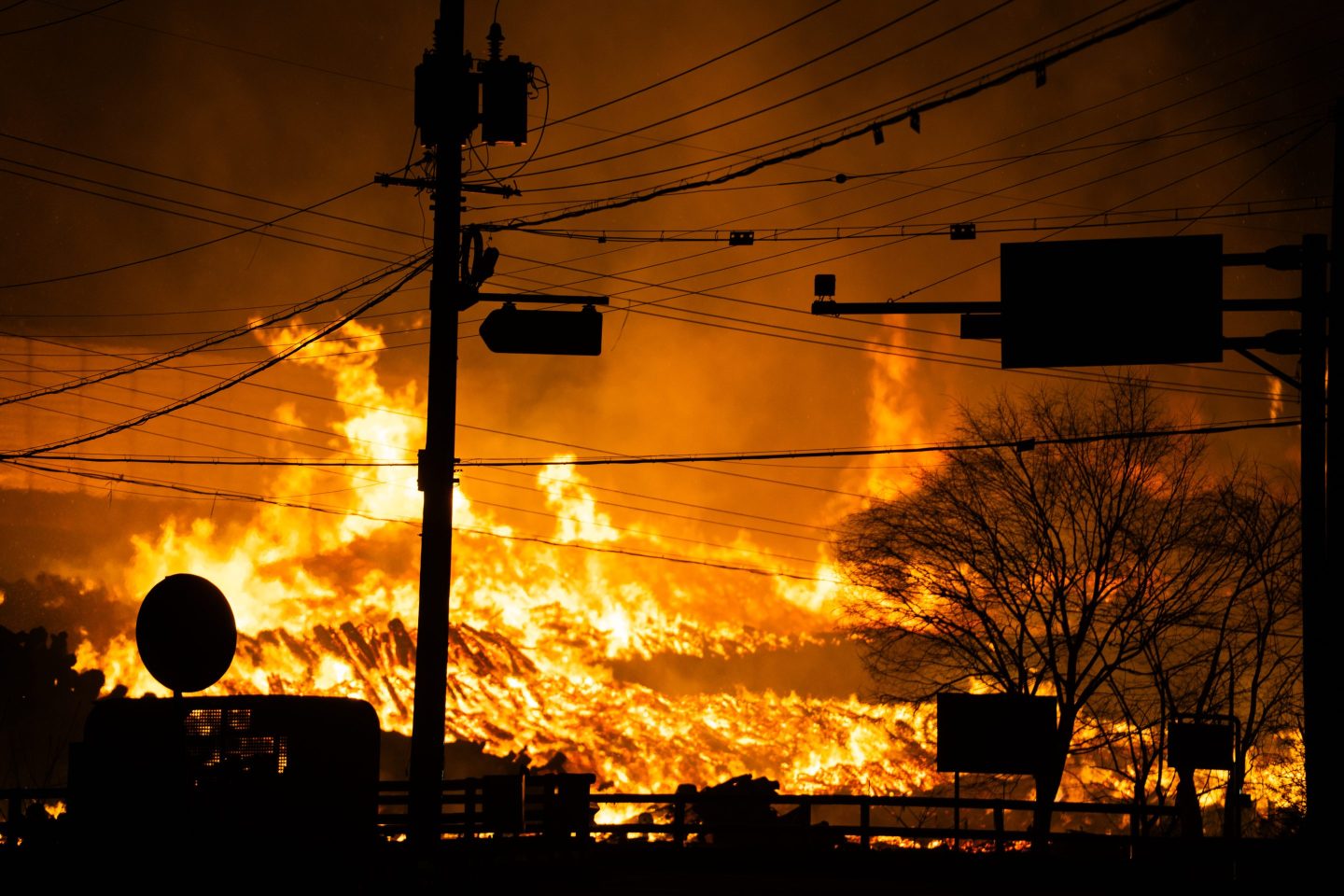
Record-setting wildfires have become the norm over the last few years, with climate change playing a pivotal role in increasing both the frequency and intensity of fires. Today’s forest fires burn nearly six million more hectares of trees compared to two decades ago, and the issue is only expected to worsen with forested regions in the northern hemisphere warming at faster rates compared to the rest of the planet, according to data from The World Resources Institute.
So, unsurprisingly, scientists are seeing how they can leverage AI models to better understand and control the crisis. This week, researchers from the European Centre for Medium-Range Weather Forecasts (ECMWF) unveiled a new machine learning model called Probability of Fire (PoF) that outperforms traditional models designed to predict wildfire events. While machine learning algorithms make it possible, the researchers tell me the key to this model’s success is all about the data—yet another piece of evidence that access to high-quality datasets is critical if AI is to contribute to breakthrough scientific research.
The model
Previous predictive models considered combinations of heat and dryness to determine fire danger ratings. This method, however, failed to take into account some of the most important factors that influence wildfires, such as the amount of vegetation that could serve as fuel. This resulted in many false positives for fire danger, for example, flagging risk in vast desert areas that don’t actually experience fires because they lack the vegetation needed for a fire to start and spread.
The new model from ECMWF integrates more information, tapping datasets on other factors including observed fire activity, satellite data on the amount of vegetation that could act as fuel, possible ignition causes (like lightning forecasts), population, and road density. It also considers where fires have happened in the past, not just where there’s hot temperatures and dryness.
“PoF represents a shift away from traditional models that focus on fire danger,” said ECMWF researchers Francesca Di Giuseppe and Joe McNorton, who authored the paper published in Nature Communications. “By focusing on satellite observed fire activity rather than just potential conditions, we more accurately predict where fires are likely to occur.”
Data > everything else
Aside from just developing a more effective model, the researchers sought to understand the importance of model complexity versus the importance of the data. So they created three models, each with increasing complexity, and gave them varied combinations of data. The mid-complexity model performed the best, and overall, the results showed serious degradation in prediction quality whenever one or more datasets was omitted.
“The improvement achieved by incorporating additional data into the training process outweighs the gains obtained from transitioning from a medium-complexity to a high-complexity architecture,” reads the paper.
To improve fire prediction even further, Di Giuseppe and McNorton said they’d want to be able to incorporate high-resolution, real-time satellite data on vegetation composition and moisture. Additionally, more novel data on human practices like agricultural burning would also enhance the model’s ability to predict fires and their spread, improving overall risk forecasting. Lastly, they said improved weather forecasting models—such as those recently created by Google DeepMind, as well as ECMWF’s own system—have the potential to further boost fire prediction.
Aiding the fight
Having a better handle on the risk of wildfires can help us to prevent them, with targeted strategies like public warnings and access restrictions to certain areas. The better modeling can also help with emergency response once a wildfire has started. In the long term, systems like PoF could also improve land management strategies and ecosystem health by aiding policy and conservation efforts in fire-prone areas.
Fire risk is regional, with small agencies needing to understand the current conditions and risks in their area. That’s one reason the most complex model isn’t always best.
“One of the key strengths of our model is that it has been designed to be both cost-effective and user-friendly. We wanted to make sure that it could be easily accessed and used by practitioners and centers that may not have large resources at their disposal,” Di Giuseppe and McNorton said. “By keeping the model simple to implement and affordable, we hope it can be widely adopted, enabling better wildfire risk management in areas where resources are limited.”
Now, just one more thing before we get to the rest of the news. Today’s newsletter will sadly be my last. It’s been nothing but a joy breaking down the most important stories unfolding in and around AI for you every week. Eye on AI will still be in your inboxes every Tuesday and Thursday, written by Jeremy Kahn, Sharon Goldman, and the Fortune Tech team. Thanks so much for reading!
Sage Lazzaro
sage.lazzaro@consultant.fortune.com
sagelazzaro.com
AI IN THE NEWS
Trump’s tariffs send Big AI stocks tumbling. Nvidia, Microsoft, Alphabet, Meta, and Amazon saw their share prices dip last night in after hours trading after U.S. President Donald Trump announced new tariffs between 10% and 49% on imported goods. And those stocks continued their slides during trading today. Nvidia and Apple saw some of the biggest drops, declining more than 6% and more than 8% respectively. Both companies are heavily dependent on components imported from Asian countries and could be the most severely impacted. Analysts described the tariffs as “worse than the worst case scenario” for tech investors, according to The Hill.
Google shakes up its AI leadership. The company is replacing Sissie Hsiao, the leader of its consumer AI products group who led Google’s AI chatbot effort, originally dubbed Bard and now called Gemini. In a memo to staff, Google DeepMind CEO Demis Hassabis said Josh Woodward, who leads Google Labs and oversaw the launch of NotebookLM, will replace Hsiao as head of consumer AI products, while also still running Google Labs. Hsiao has been at Google for 19 years and said she plans to take on a new role at the company after stepping away for a “short break.” You can read more from Semafor.
Meta’s head of AI research announces her departure. Meta’s AI leadership is also changing, with the company’s VP of AI research Joelle Pineau announcing her departure in a LinkedIn post. Pineau was one of the company’s top AI researchers and helped oversee its most influential AI products including its family of Llama AI models and PyTorch, a popular software for AI developers. Pineau did not give a reason for her departure but said her last day will be May 30. Her departure comes at a crucial moment for Meta as the company doubles down on prioritizing AI. You can read more from CNBC.
Anthropic rolls out “Claude for Education” model designed specifically for higher education. The model will guide students to reason through their requests as opposed to providing instant answers. “Claude will not just write an essay for you,” Anthropic’s president Daniela Amodei told Fortune. “Instead, it will say, how would you approach this problem, or where are you confused? Can I help walk you through with some example cases?” The company is initially rolling out the product to just three universities—Northeastern University, the London School of Economics, and Champlain College—so it can test it before scaling.
FORTUNE ON AI
Why OpenAI caved to open-source on the same day as its $300 billion flex (Hint: It’s not just about DeepSeek) —by Sharon Goldman
Wharton is set to offer an MBA major in AI—and that has implications for CFOs —by Sheryl Estrada
No one can clearly define an AI agent. LinkedIn’s engineering boss says that’s okay —by John Kell
AI CALENDAR
April 9-11: Google Cloud Next, Las Vegas
April 24-28: International Conference on Learning Representations (ICLR), Singapore
May 6-7: Fortune Brainstorm AI London. Apply to attend here.
May 20-21: Google IO, Mountain View, Calif.
July 13-19: International Conference on Machine Learning (ICML), Vancouver
July 22-23: Fortune Brainstorm AI Singapore. Apply to attend here.
EYE ON AI NUMBERS
51%
That’s how much patients with depression saw their symptoms reduced after eight weeks of talking to an AI therapy chatbot, according to the first clinical trial of the technology, published last week in NEJM AI, a journal by the New England Journal of Medicine. Additionally, those with anxiety experienced a 31% reduction in symptoms, and those at risk for eating disorders saw a 19% reduction in concerns about body image and weight, based on self-reported feedback from the participants.
The results are promising and put success on par with human therapists, but a lot more research is still needed. For example, we still don’t know exactly how these chatbots work. Researchers should also directly compare the use of therapy chatbots to patients’ success and experience with human therapists, rather than using no therapy as the only control. It’d also be interesting to look at what happens when the two are combined.
While there’s already a growing field of startups aiming to use AI to offer mental health services—such as Woebot Health, Lyra Health, and Kintsugi—researchers and psychiatry experts tell MIT Technology Review there are risks and limitations to using chatbots for therapy instead of human professionals. For one, if the chatbot says the wrong things it could cause real harm. There’s also the fact that the hallmarks of a good therapy relationship include shared goals and collaboration, which is hard to replicate with software.