• Home
  • Latest
  • Fortune 500
  • Finance
  • Tech
  • Leadership
  • Lifestyle
  • Rankings
  • Multimedia
Commentary

Trump is knowingly steering the economy off the cliff with tariffs

By
Jeffrey Sonnenfeld
Jeffrey Sonnenfeld
,
Steven Tian
Steven Tian
, and
Stephen Henriques
Stephen Henriques
Down Arrow Button Icon
By
Jeffrey Sonnenfeld
Jeffrey Sonnenfeld
,
Steven Tian
Steven Tian
, and
Stephen Henriques
Stephen Henriques
Down Arrow Button Icon
March 31, 2025, 3:19 PM ET
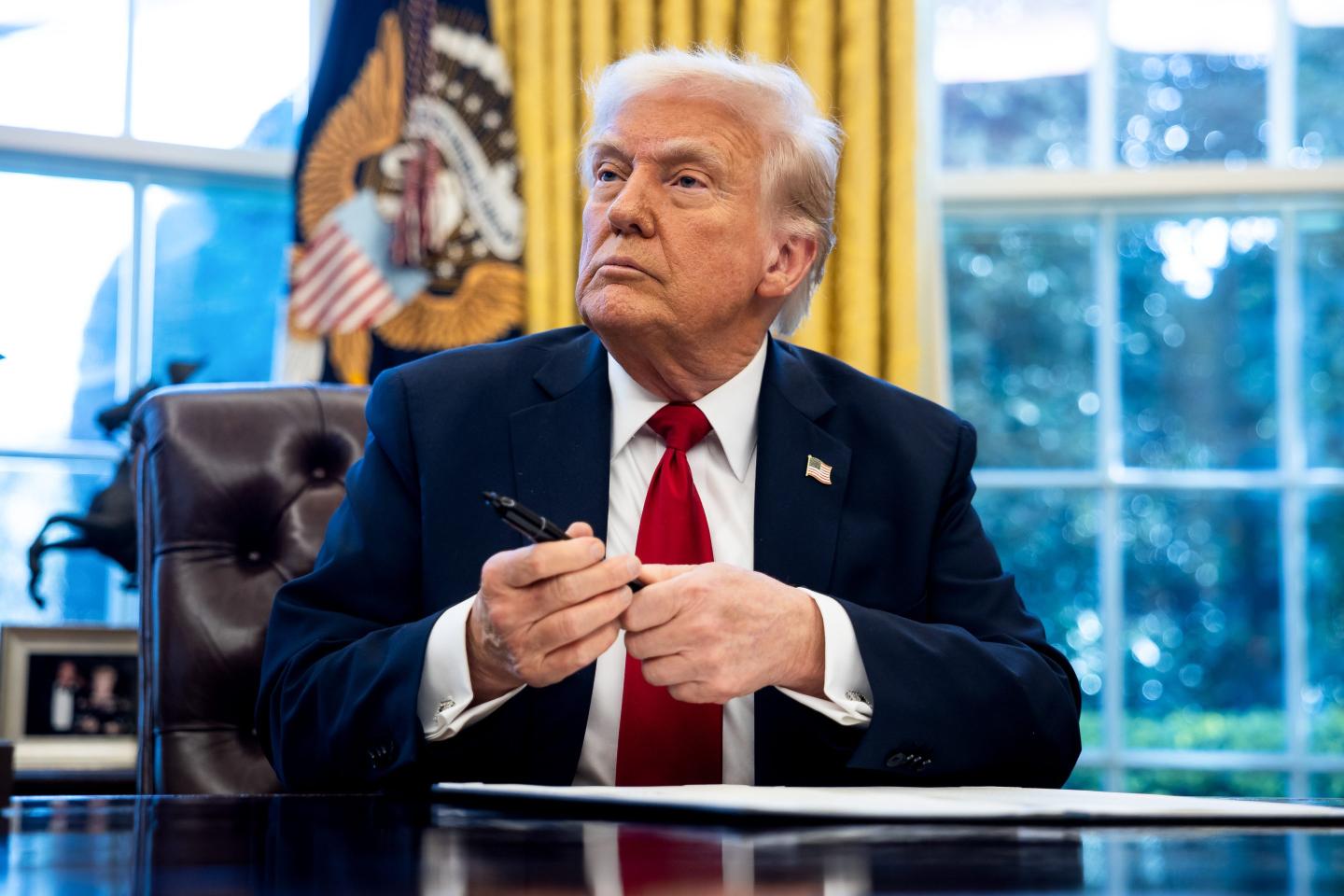
Last week Trump said he will be implementing a 25% tariff on auto imports, expanding a trade war.
Last week Trump said he will be implementing a 25% tariff on auto imports, expanding a trade war. Francis Chung/Politico/Bloomberg via Getty Images

Over the weekend, Donald Trump’s reassurance of a more generous approach to tariffs was reversed again, apparently returning to draconian across-the-board 20% tariffs. The president’s imminent Rose Garden “Liberation Day” announcement of universal tariffs on everything coming into the U.S. from everyone—accompanied by the Trump-driven 10% decline in the stock market over the last month—is just the latest example of how Trump’s capricious tariff tantrums are steering the U.S. economy straight off the cliff. Given the near unanimous chorus of business leaders and economists, one must wonder what motivates Trump’s destructive decrees. As Trump himself confessed this weekend on NBC, “I couldn’t care less if car prices go up!” 

The problem is not tariffs—the problem is Donald Trump, plain and simple. Per our Yale CEO Caucus survey results, 90% of CEOs actually support tariffs, when they are used strategically and selectively. These business leaders support the use of selective tariffs to rectify genuine trade imbalances and constrain foreign dumping into the U.S., undermining U.S. producers in sectors such as steel.

But these worthy goals often seem to be subjugated to Trump’s personality-driven vendettas, such as punishing longtime nemesis Justin Trudeau; and even more importantly, Trump’s idiosyncratic, capricious rollout of tariffs has made it all but impossible for companies to invest at all, hampering Trump’s own stated goal of bringing investment and jobs back to the U.S.

Already, there is a confusing array of 12,500 tariff categories across 200 trading partners. We tallied up Trump’s tariff pronouncements over the last two months and found no less than a head-spinning 107 instances of paradoxical flip-flops on tariff policy, often with same-day reversals. That does not even account for often contradictory guidance from Trump’s deputies, which are then subsequently overruled by Trump himself.
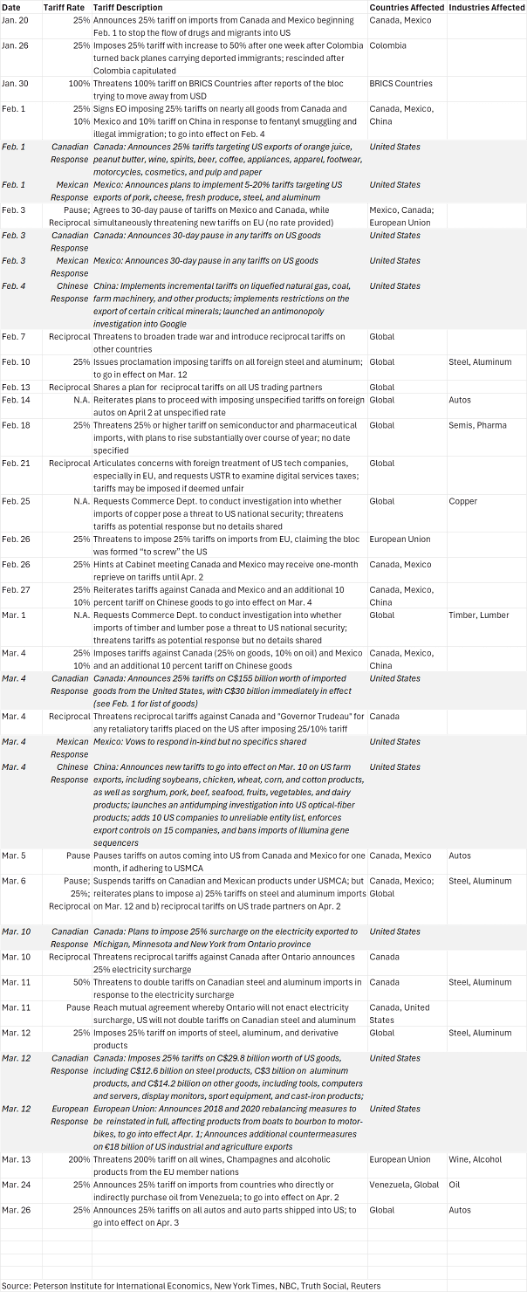
Businesses need predictability and stability; no company can authorize billions in capital spending to build new plants or hire new workers when trade policy changes not day by day, not hour by hour, but in some cases, literally minute by minute. During our Yale CEO Caucus this month, CEOs groaned and cringed each time CNBC’s Eamon Javers read off a new tariff policy reversal, with seven flip-flops over our three-hour event.

On March 11, JPMorgan Chase CEO Jamie Dimon and Yale Chief Executive Leadership Institute founder and president Jeffrey Sonnenfeld discussed the strategic opportunities and challenges of Trump 2.0.
Donovan Marks

Trump’s defenders argue this is all part of his “art of the deal”—to punch counterparties in the face so hard that they are knocked off balance and are all but begging for a deal. But the reality is, Trump is getting snookered in these deals, as companies merely repackage existing and preplanned capex spending into gauzy, headline-drawing “announcements” of “new investments” in the U.S. The veneer of glitz and glamour of fawning Oval Office press conferences announcing these new investments hides a much seamier reality, as much-ballyhooed new “investments” such as Foxconn’s planned $10 billion electronics factory in Wisconsin turn into abandoned shadows and idled plants. Meanwhile, foreign leaders and companies offer token concessions with little genuine benefit to the U.S., while racing to evade tariffs by rerouting supply chains through neutral countries, brazenly and openly defying Trump while paying lip service to his whims. That is why 90% of CEOs polled at our Yale CEO Caucus said that Trump’s tariffs are backfiring on the U.S.

These CEOs, like everyone else, are looking at ample data pointing to the widespread havoc wrought by Trump’s tariff tantrums. Not only have Trump’s botched tariff tantrums helped chop about $7 trillion in value off the stock market since his inauguration—enough to fund the government for an entire year—but the costs are being felt in the real economy. Far from bringing manufacturing and jobs back to the U.S., Trump is killing American manufacturing, hurting U.S. workers, and bringing the entire U.S. economy down with him. Inflation expectations have jumped to 32-year highs; consumer confidence has plunged 25% across both the University of Michigan and Conference Board surveys as consumer spending falls the most in five years; NFIB Small Business confidence has plunged 50%; the labor market is deteriorating as the number of new layoffs quadrupled over the last three months; capital spending and investments have come to a standstill; and GDP growth forecasts have come down by 1%—a head-spinning reversal of economic fortune as the initial euphoria of Trump’s pledges of tax cuts and deregulation morphed into the Frankenstein monster of all tariffs, all the time.

Of course, many business leaders wonder what motivates Trump’s destructive tariff tantrums. On one hand, Trump has obsessed over tariffs since at least the 1980s; and he has long, reductionistically viewed the U.S. balance of trade as if he were still running the Trump Organization, which tries to sell more than it buys every year. But the sheer, avoidable, intentional chaos of Trump’s tariff rollout, and his willingness to ignore significant stock market drawdowns, suggest there may be other explanatory factors. Some CEOs have privately suggested that Trump may be trying to induce a recession early in his term to “clear the deck” well before midterm elections—though that assumes a greater facility for long-term strategic foresight than is usually associated with Trump. More likely, perhaps Trump has no plan and is just making things up on the fly, with arbitrary megalomaniacal impulses unconstrained by yes-men staff. 

In Trump’s tantrums, psychoanalysts might find strong resemblance to what Sigmund Freud called the “death drive” pathology of entrepreneurs, or what psychiatrists term the self-destructive impulse—akin to a child on the beach who builds a beautiful castle and kicks it down.

Forty-two years ago, Abraham Zaleznik, a psychoanalyst management scholar at the Harvard Business School, explained that many times, such entrepreneurial leaders as Trump and Musk are driven by an ultimately self-destructive megalomania, rooted in a bad relationship with a parent who disparaged them but is no longer around to be proven wrong. Zaleznik stated, “In their climb to the top, they have certain fantasies having to do with creating a new world. There is a search for restitution—to remake the world, remake their childhood, remake a relationship with a parent. They fall prey to the Midas theory. Everything they touch will turn to gold, and if it doesn’t they go bonkers. I think if we want to understand the entrepreneur we should look at the juvenile delinquent. I think there are a lot of similarities. They both have an under-developed super-ego. And so they don’t understand right from wrong.”

Trump’s “Liberation Day” has turned into a nightmare for U.S. businesses. The real liberation the U.S. economy needs is a more orderly, strategic approach to tariffs, liberated from Trump’s idiosyncratic whims. 

Jeffrey Sonnenfeld is the Lester Crown Professor in Management Practice and president and founder of the Yale Chief Executive Leadership Institute. Steven Tian is the director of research at the Yale Chief Executive Leadership Institute. Stephen Henriques is a senior research fellow at the Yale Chief Executive Leadership Institute and a former McKinsey & Co. consultant. 

The opinions expressed in Fortune.com commentary pieces are solely the views of their authors and do not necessarily reflect the opinions and beliefs of Fortune.

Read more:

  • Trump tariffs: Stealing from the China playbook—to boost car making in America
  • Trump’s tariffs program is based on flawed assumptions about the trade deficit
  • Ray Dalio fears ‘something worse than a recession.’ If anything his fears are understated
  • Tariffs won’t make America great again: Export-Import Bank’s former chairman and president
Join us at the Fortune Workplace Innovation Summit May 19–20, 2026, in Atlanta. The next era of workplace innovation is here—and the old playbook is being rewritten. At this exclusive, high-energy event, the world’s most innovative leaders will convene to explore how AI, humanity, and strategy converge to redefine, again, the future of work. Register now.
About the Authors
By Jeffrey Sonnenfeld

Jeffrey Sonnenfeld is the Lester Crown Professor in Management Practice and Senior Associate Dean at Yale School of Management.

See full bioRight Arrow Button Icon
By Steven Tian

Steven Tian is the director of research at the Yale Chief Executive Leadership Institute.

See full bioRight Arrow Button Icon
By Stephen Henriques
See full bioRight Arrow Button Icon

Latest in Commentary

Finance
Lorem ipsum dolor sit amet, consectetur adipiscing elit, sed do eiusmod tempor incididunt ut labore et dolore magna aliqua. Ut enim ad minim veniam
By Fortune Editors
October 20, 2025
Finance
Lorem ipsum dolor sit amet, consectetur adipiscing elit, sed do eiusmod tempor incididunt ut labore et dolore magna aliqua. Ut enim ad minim veniam
By Fortune Editors
October 20, 2025
Finance
Lorem ipsum dolor sit amet, consectetur adipiscing elit, sed do eiusmod tempor incididunt ut labore et dolore magna aliqua. Ut enim ad minim veniam
By Fortune Editors
October 20, 2025
Finance
Lorem ipsum dolor sit amet, consectetur adipiscing elit, sed do eiusmod tempor incididunt ut labore et dolore magna aliqua. Ut enim ad minim veniam
By Fortune Editors
October 20, 2025
Finance
Lorem ipsum dolor sit amet, consectetur adipiscing elit, sed do eiusmod tempor incididunt ut labore et dolore magna aliqua. Ut enim ad minim veniam
By Fortune Editors
October 20, 2025
Finance
Lorem ipsum dolor sit amet, consectetur adipiscing elit, sed do eiusmod tempor incididunt ut labore et dolore magna aliqua. Ut enim ad minim veniam
By Fortune Editors
October 20, 2025

Most Popular

Finance
Lorem ipsum dolor sit amet, consectetur adipiscing elit, sed do eiusmod tempor incididunt ut labore et dolore magna aliqua. Ut enim ad minim veniam
By Fortune Editors
October 20, 2025
Finance
Lorem ipsum dolor sit amet, consectetur adipiscing elit, sed do eiusmod tempor incididunt ut labore et dolore magna aliqua. Ut enim ad minim veniam
By Fortune Editors
October 20, 2025
Finance
Lorem ipsum dolor sit amet, consectetur adipiscing elit, sed do eiusmod tempor incididunt ut labore et dolore magna aliqua. Ut enim ad minim veniam
By Fortune Editors
October 20, 2025
Finance
Lorem ipsum dolor sit amet, consectetur adipiscing elit, sed do eiusmod tempor incididunt ut labore et dolore magna aliqua. Ut enim ad minim veniam
By Fortune Editors
October 20, 2025
Finance
Lorem ipsum dolor sit amet, consectetur adipiscing elit, sed do eiusmod tempor incididunt ut labore et dolore magna aliqua. Ut enim ad minim veniam
By Fortune Editors
October 20, 2025
Finance
Lorem ipsum dolor sit amet, consectetur adipiscing elit, sed do eiusmod tempor incididunt ut labore et dolore magna aliqua. Ut enim ad minim veniam
By Fortune Editors
October 20, 2025
Fortune Secondary Logo
Rankings
  • 100 Best Companies
  • Fortune 500
  • Global 500
  • Fortune 500 Europe
  • Most Powerful Women
  • World's Most Admired Companies
  • See All Rankings
  • Lists Calendar
Sections
  • Finance
  • Fortune Crypto
  • Features
  • Leadership
  • Health
  • Commentary
  • Success
  • Retail
  • Mpw
  • Tech
  • Lifestyle
  • CEO Initiative
  • Asia
  • Politics
  • Conferences
  • Europe
  • Newsletters
  • Personal Finance
  • Environment
  • Magazine
  • Education
Customer Support
  • Frequently Asked Questions
  • Customer Service Portal
  • Privacy Policy
  • Terms Of Use
  • Single Issues For Purchase
  • International Print
Commercial Services
  • Advertising
  • Fortune Brand Studio
  • Fortune Analytics
  • Fortune Conferences
  • Business Development
  • Group Subscriptions
About Us
  • About Us
  • Press Center
  • Work At Fortune
  • Terms And Conditions
  • Site Map
  • About Us
  • Press Center
  • Work At Fortune
  • Terms And Conditions
  • Site Map
  • Facebook icon
  • Twitter icon
  • LinkedIn icon
  • Instagram icon
  • Pinterest icon

Latest in Commentary

hegseth
CommentaryMilitary
America shot its arsenal empty in 2 wars. Now it needs Beijing’s permission to reload
By Steve H. Hanke and Jeffrey WengApril 30, 2026
59 minutes ago
Duncan Tait, CEO of Inchcape
Europecar manufacturing
“Competition is good for the industry”. Inchcape CEO’s case for optimism in automotive’s next chapter
By Duncan TaitApril 30, 2026
4 hours ago
agentic
CommentaryAI agents
Why your data infrastructure — not your AI model — will determine whether Agentic AI scales
By Jeffrey Sonnenfeld, Stephen Henriques, Catherine Dai and Zander JeinthanuttkanontApril 30, 2026
7 hours ago
hoskins
Commentaryoffices
Gensler Co-Chair: Hot-desking was supposed to save money. It may be costing you your culture
By Diane HoskinsApril 30, 2026
8 hours ago
tillis
CommentaryCongress
Thom Tillis: Free markets built American prosperity. Government intervention puts it at risk
By Thom Tillis and John StanfordApril 30, 2026
10 hours ago
iran
CommentaryIran
The Strait of Hormuz is a data problem, not just a military one
By Erik Bethel and Ami DanielApril 30, 2026
10 hours ago

Most Popular

Apple cofounder Ronald Wayne—whose stake would be worth up to $400 billion had he not sold it in 1976—says that at 91, he has no regrets
Success
Apple cofounder Ronald Wayne—whose stake would be worth up to $400 billion had he not sold it in 1976—says that at 91, he has no regrets
By Preston ForeApril 27, 2026
3 days ago
‘They left me no choice’: Powell isn’t going anywhere—blocking Trump from another Fed appointee
Banking
‘They left me no choice’: Powell isn’t going anywhere—blocking Trump from another Fed appointee
By Eva RoytburgApril 29, 2026
24 hours ago
Jamie Dimon gets candid about national debt: ‘There will be a bond crisis, and then we’ll have to deal with it’
Economy
Jamie Dimon gets candid about national debt: ‘There will be a bond crisis, and then we’ll have to deal with it’
By Eleanor PringleApril 29, 2026
1 day ago
Google Cloud revenue is now 18% of Alphabet's business. Is this the beginning of the end of Google's search identity?
Big Tech
Google Cloud revenue is now 18% of Alphabet's business. Is this the beginning of the end of Google's search identity?
By Alexei OreskovicApril 29, 2026
17 hours ago
‘The cost of compute is far beyond the costs of the employees’: Nvidia executive says right now AI is more expensive than paying human workers
AI
‘The cost of compute is far beyond the costs of the employees’: Nvidia executive says right now AI is more expensive than paying human workers
By Sasha RogelbergApril 28, 2026
2 days ago
Elon Musk says saving for retirement is irrelevant because AI is going to create a world of abundance: 'It won't matter'
Future of Work
Elon Musk says saving for retirement is irrelevant because AI is going to create a world of abundance: 'It won't matter'
By Marco Quiroz-GutierrezApril 26, 2026
4 days ago

© 2026 Fortune Media IP Limited. All Rights Reserved. Use of this site constitutes acceptance of our Terms of Use and Privacy Policy | CA Notice at Collection and Privacy Notice | Do Not Sell/Share My Personal Information
FORTUNE is a trademark of Fortune Media IP Limited, registered in the U.S. and other countries. FORTUNE may receive compensation for some links to products and services on this website. Offers may be subject to change without notice.