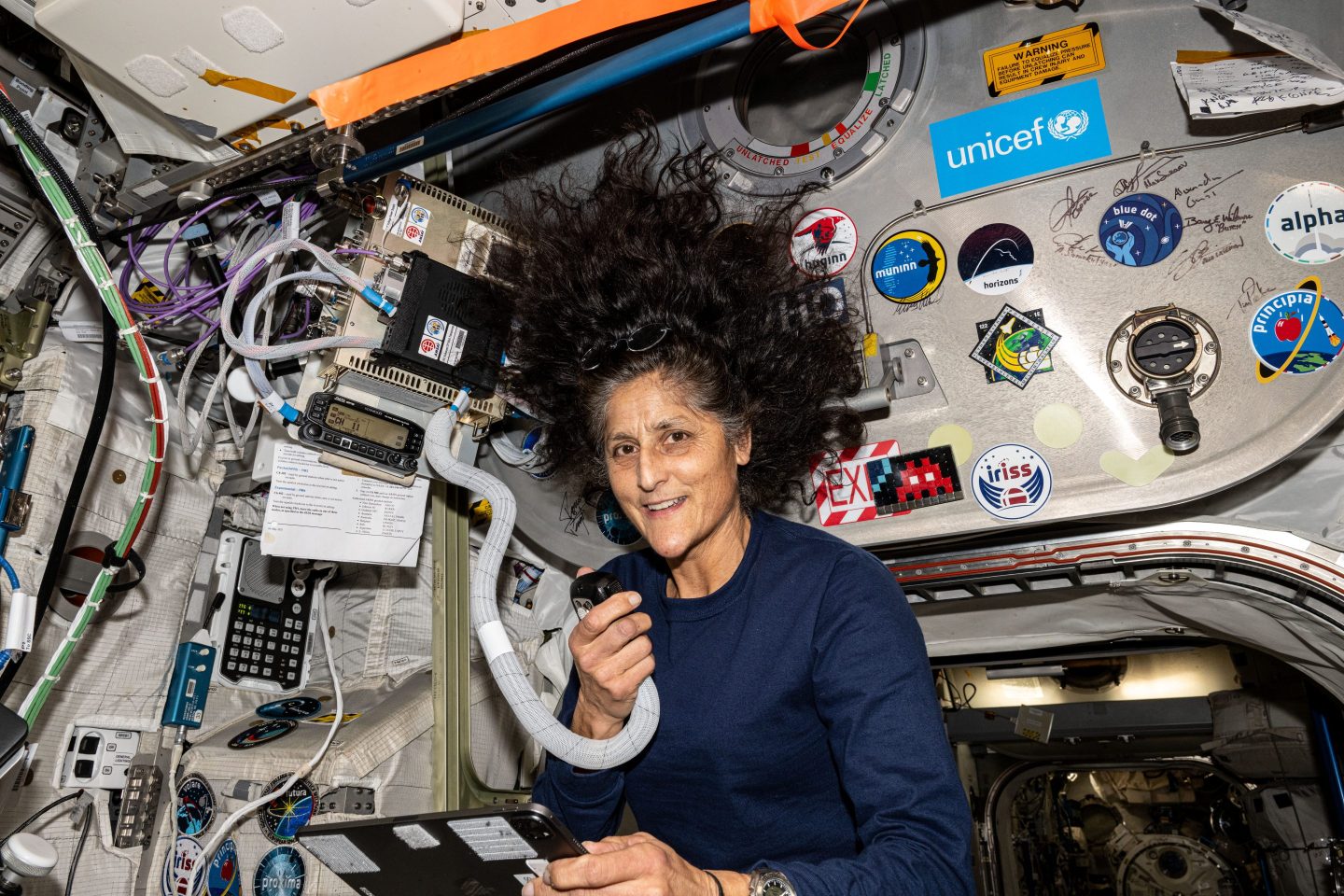
For NASA’s Sunita “Suni” Williams, a scheduled eight-day trip to the International Space Station last summer has instead become a nine-month work assignment.
Williams, 59, and fellow astronaut Butch Wilmore initially remained at the ISS last June after the Boeing Starliner craft they were aboard malfunctioned. Officials ultimately decided to return the Starliner to Earth uncrewed last September, while William and Wilmore, now fully integrated into the crew of Expedition 72 at the ISS, stayed in space.
A veteran of two previous space missions, Williams has served as the station’s commander since September. She and Wilmore were scheduled to return to Earth aboard a SpaceX Dragon capsule Tuesday at about 6pm, after departing the ISS early Tuesday morning. A replacement crew arrived at the space station over the weekend, following a scrubbed launch attempt by NASA and SpaceX last week due to a ground system issue at the launch pad.
By the time of their scheduled landing, Williams and Wilmore’s mission will clock in at nearly 290 days, one of the longer assignments in our history of space travel. Once on terra firma, though, Suni Williams likely will be thinking of space again. And she appears certain of the next move by the U.S. in that regard: a trip back to the future.
“The moon to Mars—that’s our outlook,” Williams says.
In an extensive interview with Fortune months before her mission began, Williams expanded on that idea—and the short- and longer-term outlook for space travel.
This interview has been edited for length and clarity.
Fortune: First of all, why space, and why now?
Suni Williams: It’s just what the human body does—it explores, among other things. We all have curiosity; we’re born with it. Maybe some of that gets pushed down a little bit by society and things going on around us, but we’re all curious and we want to explore. As a nation, this is one of those things that gives people hope and understanding about things that are bigger than themselves.
What is out there that we still want to know about?
I think we want to know where our place in the universe is. When you’re here on Earth, you’re driving around thinking things like, “I’ve got to get to work. I’ve got to get in line at Dunkin’ Donuts or Starbucks.” We’re pretty myopically focused on the here and now. When you go out into space, and you actually see that this is just the little island that we all live on, it becomes more philosophical: What is our purpose here? What happened to our planet, and what is happening to our planet now?
That’s where Mars comes in to play?
If we went there, we might get some insights on what’s going to happen eventually here. How we keep our planet viable, and all of those other questions, may be answered when we just start to think and expand our horizon a little bit more by going to space.
And that starts with going back to the moon?
I don’t know how we’re going to go to Mars, and I don’t think anybody really knows exactly. But in the process of actually trying to get back to the moon sustainably and (then) onto Mars, I’d say we are going to learn something. We’re going to learn a lot about how to do things physically—engineering—but we’re also going to learn about us as human beings and how we tackle problems, and how we face problems in the future with other countries and cultures as we start to leave.
So what does that look like?
The moon to Mars—that’s our outlook. We want to go back to the moon sustainably, which means we need to have a lander presence there. We need to probably have a space station—we’re designing Gateway as a jumping-off point to get to the moon and off the moon, where we do science experiments, where we could build something on the moon sustainably. It seems a little bit like science fiction, a little bit crazy when we think about landers and spacecraft and all that stuff. But when I first got to the NASA building, the International Space Station seemed like it was crazy idea, too. We’ve done that. I don’t put anything past the human mind to be able to do.
When will we have a station on the moon, and then on Mars?
It’s not a quick thing. I think in this decade we will be having people on the moon, and I think the idea would be that as soon as we can get it going, we would want to start having some type of presence on the moon sustainably. As soon as we put people there, we’ll understand how hard it is to do it. Remember, we’re not going to the same place that we did for the Apollo program. It’s a little bit trickier. We’re at the pole, so it’s a different orbit. It’s a different environment.
That will get us ready. Some of the people who are building rockets that might go to some of these places, they are leaving them out in the environment, not necessarily a clean room, so that they can understand what a terrible environment would do to them. People are already thinking about leaving stuff on the moon for a little while and then trying to get it off of the moon. We’re already in the baby steps of understanding how this process is going to work.
Going to the moon would be a common occurrence?
Our idea is to be able to take people regularly to the moon and build our space station there. It’d be the practice ground for how we’re going to then understand how we could take people to Mars…We’ve gotten comfortable with going to low earth orbit (like the ISS). We know how to do it. It’s rockets. It’s dangerous, but we know how to do it. Let’s let companies be able to do that on a regular basis, and we can take the next step of exploration.
Speaking of companies, there’s been explosive growth in the private sector of space travel and production. Does that factor in to all this?
We got a taste of it here at NASA with space tourism, as the Russians were bringing some tourists up to the International Space Station. We embraced it and got on with it, and we started to understand that there’s an avenue here for commercialism. We were then contracting for commercial space supply, and then looking at commercial crew options for the International Space Station. So all of that sort of started to crack open around in the 2000’s, and it has really accelerated in the last decade.
Is there a benefit to the public?
Folks have recognized that this is an interesting way to get things to space, a little bit cheaper for the tax dollar, potentially. But the bigger and better thought is, let’s let these people design the spacecraft the way they want to. Let their creativity guide the way. They could do something and not perhaps be hindered by the way we’ve always done it, because times are changing. So there have been advances in manufacturing processes, 3D printing of metals on a large scale, friction stir welding, other types of processes like that.
And computing power as well?
It’s crazy how much computing power can be in a phone, for example—much more than the computers on the space shuttle. All these types of technological advancements, materials, chemicals, new ideas of using fuels for rocket engines—that’s all sort of been opened up as we’ve opened up to the commercial side. It’s like, let’s let people be creative and try to do this better and smarter. Of course, it’s expensive. The U.S. government has helped some of these companies along the way by rewarding contracts.
What are the main sectors where we might see future growth with regard to space exploration?
Rockets, of course. But also materials, suits, landers. If you’re going to put a human someplace, every aspect of that person going there for a long period of time needs to be adapted. So it’s food, it’s exercise, it’s clothing, some of these little basic things. We have to come up with creative ways to do all of that. Whenever I’m talking to any kids and they’re thinking about what they want to do as a career, I say, ‘You can do anything and be in the space business.’ You do not have to be an astronaut, an engineer or a doctor.
There is still so much we don’t know.
We’ve been able to come back (from space) and be okay. But you want to see how people are going to do when they live in space for a long period of time. The moon’s not that far, but that mission would be a couple of weeks long. They’ll be in microgravity the whole time. As we go further than that—going to Mars is going to be a long trip. Being on Mars is going to be a while, and it’s not going to be Earth gravity. So we have to learn. We have to figure it out.