A U.K. startup aiming to use AI to discover new chemicals and materials has signed up two “godfathers of AI,” as well as a leading AI policy advisor and a renowned materials science researcher, as advisors. It has also quietly hired a clutch of AI talent away from Google and its sister companies.
CuspAI, which was founded last year and is based in Cambridge, England, has appointed both Geoffrey Hinton, the former Google AI researcher who shared a Nobel Prize in Physics last year for his pioneering work on artificial neural networks, and Yann LeCun, another AI luminary who serves as the chief AI scientist at Meta, to its scientific advisory board.
LeCun was once Hinton’s post-doctoral student at the University of Toronto and both scientists are widely regarded as “godfathers” in the field of AI, having developed some of the basic algorithmic methods that lie behind the current AI boom. They were also co-recipients of the 2018 Turing Award (considered the equivalent of the Nobel Prize for computer science).
LeCun said he was excited to help CuspAI as it tries to discover new materials that can help advance environmental sustainability, including chemicals that can help with carbon capture and storage, water purification, and create better performing batteries and more energy-efficicent computer chips. “The application of machine learning and modern AI to material science is one of the most promising approaches to addressing the biggest challenges faced by humanity,” he said in a statement provided to Fortune. “CuspAI’s combination of frontier AI and materials expertise is exactly what’s needed to tackle these challenges.”
In addition to Hinton and LeCun, CuspAI has appointed as a scientific advisor Kristin Persson, a materials science researcher University of California Berkeley who was last year named a Distinguished Science Fellow by the U.S. Department of Energy. She leads the Materials Project, a multinational effort to use machine learning to discover all the properties of inorganic materials and make the data, as well as the underlying algorithms used to perform the analysis, publicly-available. The company also appointed Verity Harding, a former Google DeepMind head of public policy who is now the director of the AI and Geopolitics Project at the University of Cambridge, to its advisory board.
Hinton’s advisory position was announced in June. The other appointments have not been reported previously. But the company has said it had partnered with Meta’s Fundamental AI Research (FAIR) arm and the Georgia Institute of Technology on a research project around materials for capturing carbon dioxide from the air called OpenDAC.
Besides Harding’s addition to the scientific advisory board, CuspAI has hired at least other two former Google DeepMind staffers: Sina Samangooei, who was a senior research engineer at the Google AI lab, working on its Gemini AI models among other projects, is now a member of CuspAI’s technical staff, and Hannah Openshaw, who had had been the program lead for DeepMind’s “Multi-World Agent team,” who is now a technical program manager at CuspAI. The company has also hired Alessandro de Maria, who was the first employee at the DeepMind spinout Isomorphic Labs, which has been working on AI for drug discovery. He is now CuspAI’s VP of Platform engineering. The company’s new chief strategy officer, Markus Hoffmann, is also ex-Google, having formerly led global partnerships for Google’s Quantum AI.
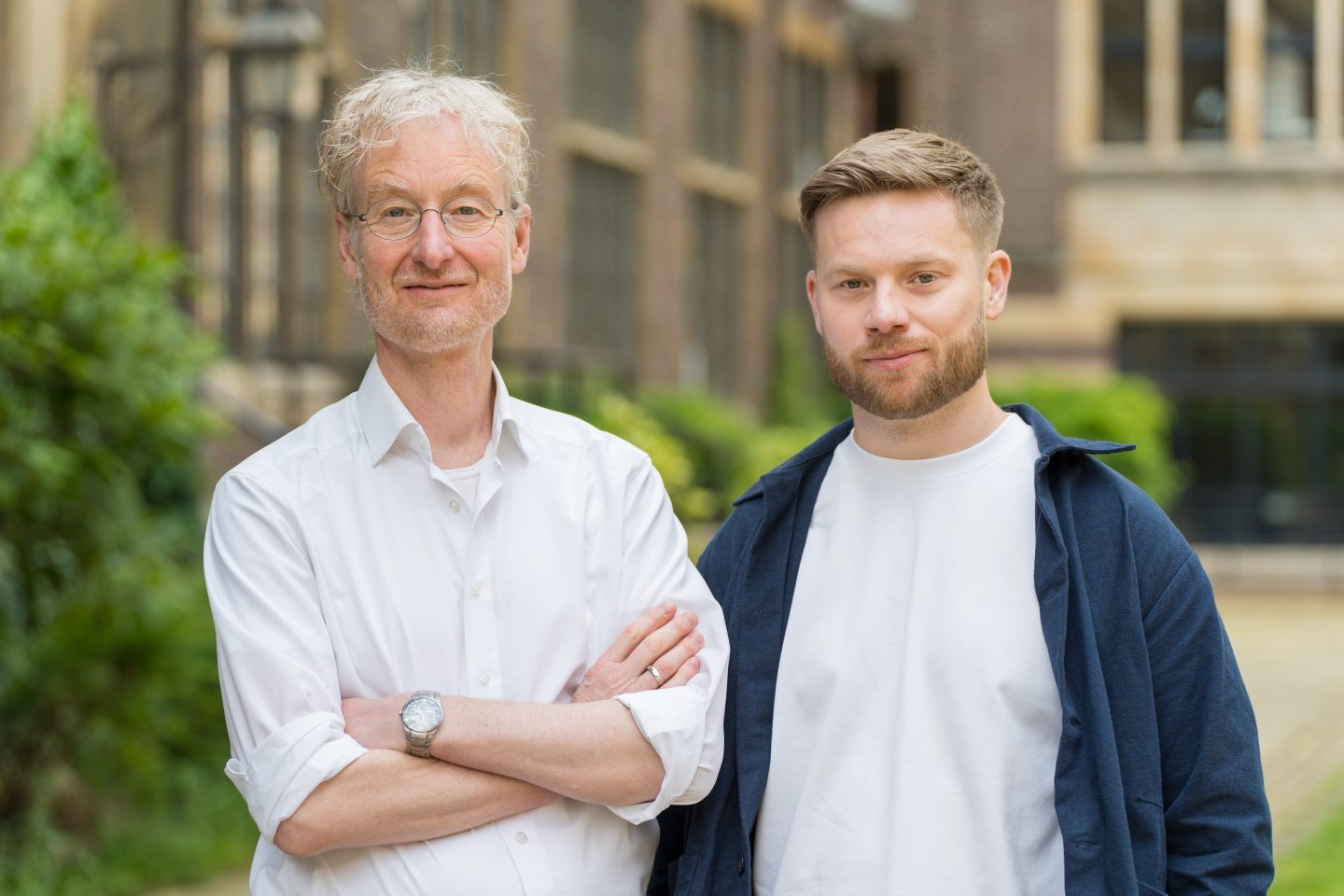
Chad Edwards, CuspAI’s cofounder and CEO, says that the company’s mission around using AI to advance fundamental science, especially in areas that will improve sustainability, has been a big draw in helping the company attract top AI talent. He also says that once people see other top researchers joining the startup, it has a “snowball effect” that attracts yet more talent. Edwards himself had been working strategic partnerships for quantum computing company Quantinuum before deciding that AI could have a more immediate impact on material discovery and opting to start CuspAI.
He joined forces with Max Welling, his cofounder and CuspAI’s chief technology officer. Welling is a physicist who has worked on applying AI to scientific problems both as a professor at the University of Amsterdam and also as a vice president and distinguished scientist at Microsoft and, before that, a vice president of technologies at Qualcomm. Welling said he found there was often too much bureaucracy and what he called “viscosity” at large companies and that he wanted to try creating a startup devoted only to creating new materials with AI.
Chemical ‘recipes’ for new materials
CuspAI’s vision is to build AI “foundation models” that would function much like today’s large language models, but for chemistry, Welling said. Eventually, the company wants to build a model that would allow a researcher to specify, in plain English, the properties of the material they want to create and have the model spit out a chemical recipe for creating a material with exactly those properties.
The company is making progress toward that vision, although it currently uses an ensemble of models that can optimize different aspects of a potential material, and is working on building a central AI agent that can coordinate the work of the other models, Welling said.
Among the models the company is trying to develop is one that would understand how easy it will be for a chemical company to actually manufacture a given material. In the past, some chemists have criticized AI-based efforts to create new materials—such as Google DeepMind’s Graph Networks for Materials Exploration (GNoME) AI model, which it used in 2023 to produce the formula for 380,000 stable new materials, and Microsoft’s Quantum team which used AI to find 32 million novel inorganic compounds for possible batteries—as producing candidates that would be too difficult or expensive to mass produce.
CuspAI has designed its first set novel materials, which are now being prototyped and tested by an unnamed speciality chemicals company with which it has partnered, the company said.
The company’s business model revolves around finding commercial partners to produce and test the compounds its AI models suggest, with the company retaining a portion of the IP rights in the material so that it will earn licensing and royalty revenue from the eventual sales of that substance. The company hopes to assemble a portfolio of different chemicals which will provide a steady stream of royalty revenue, Welling said.
The company—which now has offices in Cambridge, Edinburgh, Amsterdam, and Berlin—announced a $30 million seed venture capital funding round in June last year, led by London-based Hoxton Ventures, with significant participation from Basic Set Ventures and Lightspeed Venture Partners.
Correction, March 5: A previous version of this story misstated the stage of funding CuspAI raised in June. It was the company’s seed round. It also misspelled the last name of University of California at Berkeley materials science researcher Kristin Persson.