• Home
  • Latest
  • Fortune 500
  • Finance
  • Tech
  • Leadership
  • Lifestyle
  • Rankings
  • Multimedia
FinanceBanks

A former JPMorgan employee has accused the bank of obscuring the true size of its trading business to evade capital requirements

By
Greg McKenna
Greg McKenna
News Fellow
Down Arrow Button Icon
By
Greg McKenna
Greg McKenna
News Fellow
Down Arrow Button Icon
February 28, 2025, 5:21 AM ET
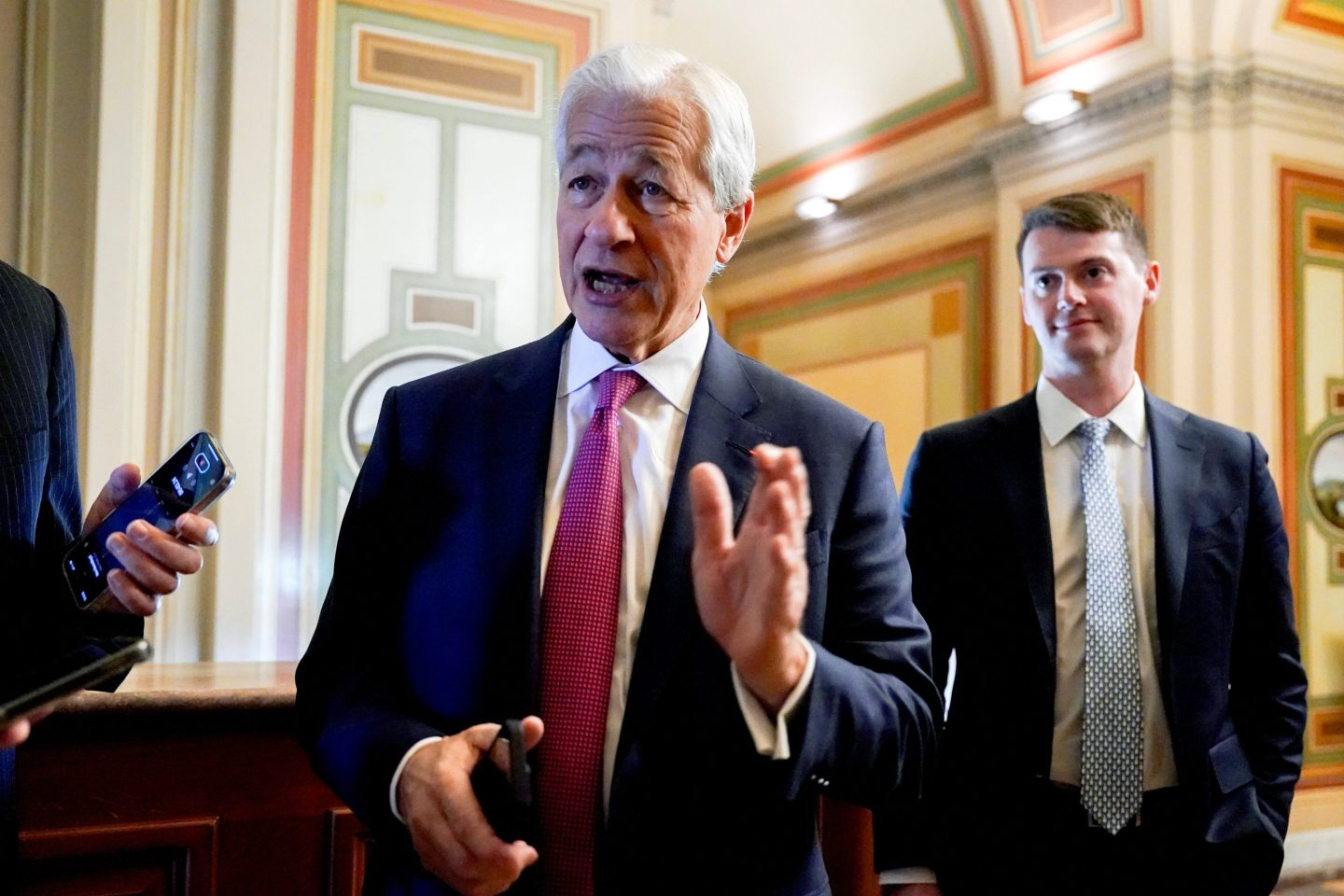
Jamie Dimon lifts his left hand up as he talks to reporters in the U.S. Capitol.
JPMorgan Chase CEO Jamie Dimon Al Drago—Bloomberg via Getty Images
  • The world’s most important central banks helped develop common standards to regulate JPMorgan Chase and other financial institutions critical to the health of the global economy. However, if the Fed is allowing U.S. banks to flout some of those norms, experts told Fortune, other countries have little incentive not to let their big lenders do the same. 

It turns out JPMorgan might not want to boast about the size of its book. In fact, a whistleblower has alleged the world’s largest bank, along with several of its peers, has deliberately underreported the scale of its trading activity to minimize capital requirements the industry has long argued are onerous. JPMorgan, for its part, has called allegations it is evading capital requirements completely “false.”

Recommended Video

The requirements at issue are aimed at ensuring banks can survive if they sustain heavy losses, and they were tightened in the aftermath of the 2008 financial crisis. Regulators from around the world developed what is known as Basel III, or common standards to safeguard the health of so-called “globally systemic banks”—many of which required controversial government bailouts to avoid economic catastrophe. But if the Federal Reserve is allowing JPMorgan and other competitors to defy some of those norms, experts in corporate finance and administrative law told Fortune, other countries have little incentive not to let their banks follow suit.

“It kind of diminishes the meaning of the rules and the extent to which people are going to take them seriously going forward,” said Itay Goldstein, who chairs the finance department at the University of Pennsylvania’s Wharton School.

The Bureau of Investigative Journalism broke the allegations in January, citing a former JPMorgan employee who said the bank was improperly reporting its long and short positions in certain securities, obscuring the true size of its trading business. The publication also quoted another banker familiar with the matter, who said the Federal Reserve has given tacit approval for other U.S. banks to do the same.

JPMorgan, meanwhile, has been adamant that it is following the law and referred Fortune to its previous statements on the matter.

“We are confident in our methodology, which is fully transparent to our regulators,” the bank said. “We comply with all capital regulations, and claims suggesting otherwise are false.”

The Federal Reserve, meanwhile, declined to comment. The central bank previously told the Bureau that American lenders are subject to higher capital requirements than their international counterparts but did not directly address the allegations.

The Fed treats its supervisory relationship with banks as confidential, said David Zaring, a professor of legal studies and business ethics at Wharton, to avoid exposing lenders’ sensitive information to competitors and trading counterparties.

“Totally makes sense to me,” he added, “but it means that you often aren’t really sure what they’re looking at when they tell you, ‘We’re comfortable with this bank’s derivative book of business and how [the bank is] accounting for it.’”

What is netting, and why does it affect capital requirements?

Netting refers to the process of consolidating and offsetting multiple financial obligations to reduce overall risk. Rules around netting are relevant because the size of a bank’s balance sheet and the risk profile of the investments it contains helps regulators determine how much of a lender’s assets should be financed by equity that can sustain losses.

“Once the equity is wiped out, there’s nothing to absorb the loss,” Goldstein said. What’s left, he added, “is going to fall on the debt holders or the government.”

That’s why several banks are deemed “too big to fail,” a term that gained in popularity after the U.S. government spent $700 billion to save Wall Street banks and other financial institutions critical to the nation’s economy. All of America’s largest banks are subject to a minimum 4.5% capital requirement, with additional buffers mandated based on the Fed’s stress tests of bank balance sheets. Then, finally, there’s a capital surcharge for banks deemed to be “globally systemic,” termed G-SIBs.

JPMorgan sits alone atop the list, subject to an additional 50 basis point requirement compared to its closest peers, Citigroup and HSBC. The Bureau’s reporting suggested the G-SIB surcharge would be higher, however, if the Fed enforced international standards to which the central bank previously agreed.

As Goldstein explained, there is often a strong economic rationale to netting, or allowing long and short positions in the same security to offset each other. In a simplified example, if a long is equivalent to a short, they cancel each other out on the balance sheet.

“It is as if you don’t hold anything,” Goldstein said.

But there are several reasons why regulators might want to see the whole gross position, or the longs added to the shorts, Goldstein said. On one side of the trade, for instance, there might be a higher possibility that the other party could default on its obligations.

That’s why the Basel Committee on Banking Supervision instructs G-SIB’s not to net longs and shorts for securities that, “if sold quickly during periods of severe market stress, are more likely to incur larger fire-sale discounts or haircuts to compensate for high market risk.” Each country’s central bank, however, is ultimately responsible for enacting this standard.

Banks have been very successful at pushing back on the Fed’s efforts to fully implement Basel III. The Fed scrapped its initial proposal last year, which would have raised capital requirements by 19%, and vice chair of supervision Michael Barr later stepped down to let President Donald Trump make his own pick for the role.

“The idea of entering into an international agreement in the current administration, even an informal one, is pretty unpopular,” Zaring said.

In other words, cooperation among the Fed and foreign regulators may be undermined by several factors. Just add this issue about netting to the list.
Join us at the Fortune Workplace Innovation Summit May 19–20, 2026, in Atlanta. The next era of workplace innovation is here—and the old playbook is being rewritten. At this exclusive, high-energy event, the world’s most innovative leaders will convene to explore how AI, humanity, and strategy converge to redefine, again, the future of work. Register now.
About the Author
By Greg McKennaNews Fellow
LinkedIn icon

Greg McKenna is a news fellow at Fortune.

See full bioRight Arrow Button Icon

Latest in Finance

Finance
Lorem ipsum dolor sit amet, consectetur adipiscing elit, sed do eiusmod tempor incididunt ut labore et dolore magna aliqua. Ut enim ad minim veniam
By Fortune Editors
October 20, 2025
Finance
Lorem ipsum dolor sit amet, consectetur adipiscing elit, sed do eiusmod tempor incididunt ut labore et dolore magna aliqua. Ut enim ad minim veniam
By Fortune Editors
October 20, 2025
Finance
Lorem ipsum dolor sit amet, consectetur adipiscing elit, sed do eiusmod tempor incididunt ut labore et dolore magna aliqua. Ut enim ad minim veniam
By Fortune Editors
October 20, 2025
Finance
Lorem ipsum dolor sit amet, consectetur adipiscing elit, sed do eiusmod tempor incididunt ut labore et dolore magna aliqua. Ut enim ad minim veniam
By Fortune Editors
October 20, 2025
Finance
Lorem ipsum dolor sit amet, consectetur adipiscing elit, sed do eiusmod tempor incididunt ut labore et dolore magna aliqua. Ut enim ad minim veniam
By Fortune Editors
October 20, 2025
Finance
Lorem ipsum dolor sit amet, consectetur adipiscing elit, sed do eiusmod tempor incididunt ut labore et dolore magna aliqua. Ut enim ad minim veniam
By Fortune Editors
October 20, 2025

Most Popular

Finance
Lorem ipsum dolor sit amet, consectetur adipiscing elit, sed do eiusmod tempor incididunt ut labore et dolore magna aliqua. Ut enim ad minim veniam
By Fortune Editors
October 20, 2025
Finance
Lorem ipsum dolor sit amet, consectetur adipiscing elit, sed do eiusmod tempor incididunt ut labore et dolore magna aliqua. Ut enim ad minim veniam
By Fortune Editors
October 20, 2025
Finance
Lorem ipsum dolor sit amet, consectetur adipiscing elit, sed do eiusmod tempor incididunt ut labore et dolore magna aliqua. Ut enim ad minim veniam
By Fortune Editors
October 20, 2025
Finance
Lorem ipsum dolor sit amet, consectetur adipiscing elit, sed do eiusmod tempor incididunt ut labore et dolore magna aliqua. Ut enim ad minim veniam
By Fortune Editors
October 20, 2025
Finance
Lorem ipsum dolor sit amet, consectetur adipiscing elit, sed do eiusmod tempor incididunt ut labore et dolore magna aliqua. Ut enim ad minim veniam
By Fortune Editors
October 20, 2025
Finance
Lorem ipsum dolor sit amet, consectetur adipiscing elit, sed do eiusmod tempor incididunt ut labore et dolore magna aliqua. Ut enim ad minim veniam
By Fortune Editors
October 20, 2025
Rankings
  • 100 Best Companies
  • Fortune 500
  • Global 500
  • Fortune 500 Europe
  • Most Powerful Women
  • Future 50
  • World’s Most Admired Companies
  • See All Rankings
Sections
  • Finance
  • Leadership
  • Success
  • Tech
  • Asia
  • Europe
  • Environment
  • Fortune Crypto
  • Health
  • Retail
  • Lifestyle
  • Politics
  • Newsletters
  • Magazine
  • Features
  • Commentary
  • Mpw
  • CEO Initiative
  • Conferences
  • Personal Finance
  • Education
Customer Support
  • Frequently Asked Questions
  • Customer Service Portal
  • Privacy Policy
  • Terms Of Use
  • Single Issues For Purchase
  • International Print
Commercial Services
  • Advertising
  • Fortune Brand Studio
  • Fortune Analytics
  • Fortune Conferences
  • Business Development
About Us
  • About Us
  • Editorial Calendar
  • Press Center
  • Work At Fortune
  • Diversity And Inclusion
  • Terms And Conditions
  • Site Map
  • Facebook icon
  • Twitter icon
  • LinkedIn icon
  • Instagram icon
  • Pinterest icon

Latest in Finance

President Donald Trump pictured in front of a waving American flag.
EconomyU.S. economy
Trump’s immigration curbs will help take 2.4 million people out of the workforce, but he’s betting AI can pick up the slack
By Tristan BoveFebruary 11, 2026
37 minutes ago
Lemley and Kauf pose for photos while holding their skis and American flags.
Personal FinanceOlympics
Every U.S. Olympian was promised a $200,000 payout, but how much they actually keep depends on where they live
By Jacqueline MunisFebruary 11, 2026
42 minutes ago
hegseth
PoliticsAviation
Pete Hegseth’s plan to test anti-cartel lasers shut down the El Paso airport for a full day, sources say
By Seung Min Kim, Ben Finley, Mary Clare Jalonick, Morgan Lee, Josh Funk and The Associated PressFebruary 11, 2026
45 minutes ago
jobs
EconomyJobs
Turns out the U.S. economy didn’t create half a million jobs last year. It was just 181,000
By Paul Wiseman and The Associated PressFebruary 11, 2026
50 minutes ago
TrumpRx
CommentaryPharmaceutical Industry
TrumpRx is here and it helps, though a bit less than advertised
By Jeffrey Sonnenfeld, Stephen Henriques, Ferron Chen, Asuka Koda and Vanessa McLennanFebruary 11, 2026
55 minutes ago
A member of the Kurdish security forces guards an oil refinery on the outskirts of Mosul, Iraq, in June 2014.
EnergyBig Oil
Big Oil embraces global exploration again as Chevron returns to Libya
By Jordan BlumFebruary 11, 2026
1 hour ago

Most Popular

placeholder alt text
Economy
America borrowed $43.5 billion a week in the first four months of the fiscal year, with debt interest on track to be over $1 trillion for 2026
By Eleanor PringleFebruary 10, 2026
1 day ago
placeholder alt text
Economy
It turns out that Joe Biden really did crush Americans' dreams for the future. Just look at how the vibe changed 5 years ago
By Jake AngeloFebruary 10, 2026
1 day ago
placeholder alt text
C-Suite
Meet Jody Allen, the billionaire owner of the Seattle Seahawks, who plans to sell the team and donate the proceeds to charity
By Jake AngeloFebruary 9, 2026
2 days ago
placeholder alt text
AI
As billionaires bail, Mark Zuckerberg doubles down on California with $50 million donation
By Sydney LakeFebruary 9, 2026
2 days ago
placeholder alt text
Economy
China might be beginning to back away from U.S. debt as investors get nervous about overexposure to American assets
By Eleanor PringleFebruary 9, 2026
2 days ago
placeholder alt text
Commentary
Something big is happening in AI — and most people will be blindsided
By Matt ShumerFebruary 11, 2026
8 hours ago

© 2026 Fortune Media IP Limited. All Rights Reserved. Use of this site constitutes acceptance of our Terms of Use and Privacy Policy | CA Notice at Collection and Privacy Notice | Do Not Sell/Share My Personal Information
FORTUNE is a trademark of Fortune Media IP Limited, registered in the U.S. and other countries. FORTUNE may receive compensation for some links to products and services on this website. Offers may be subject to change without notice.