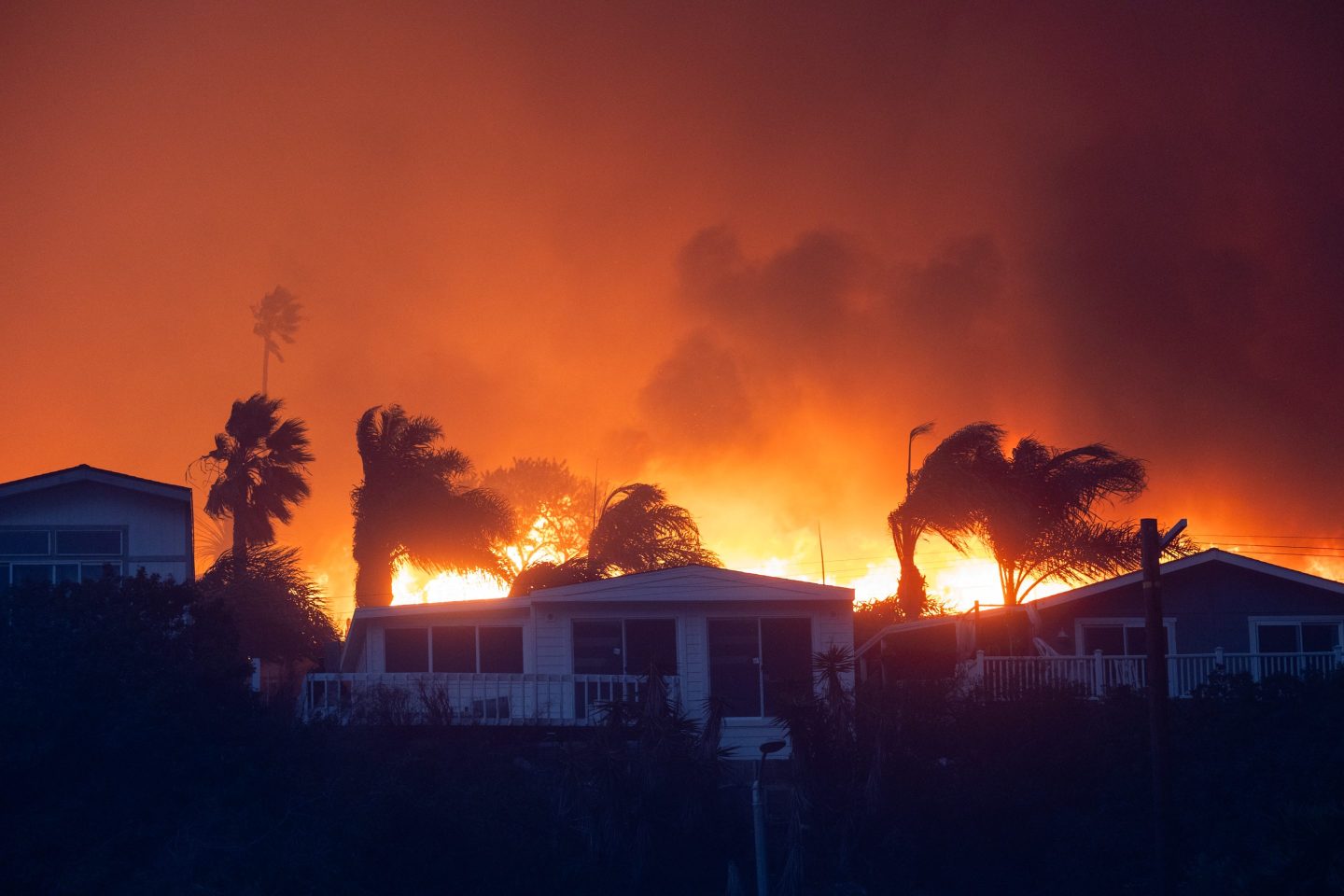
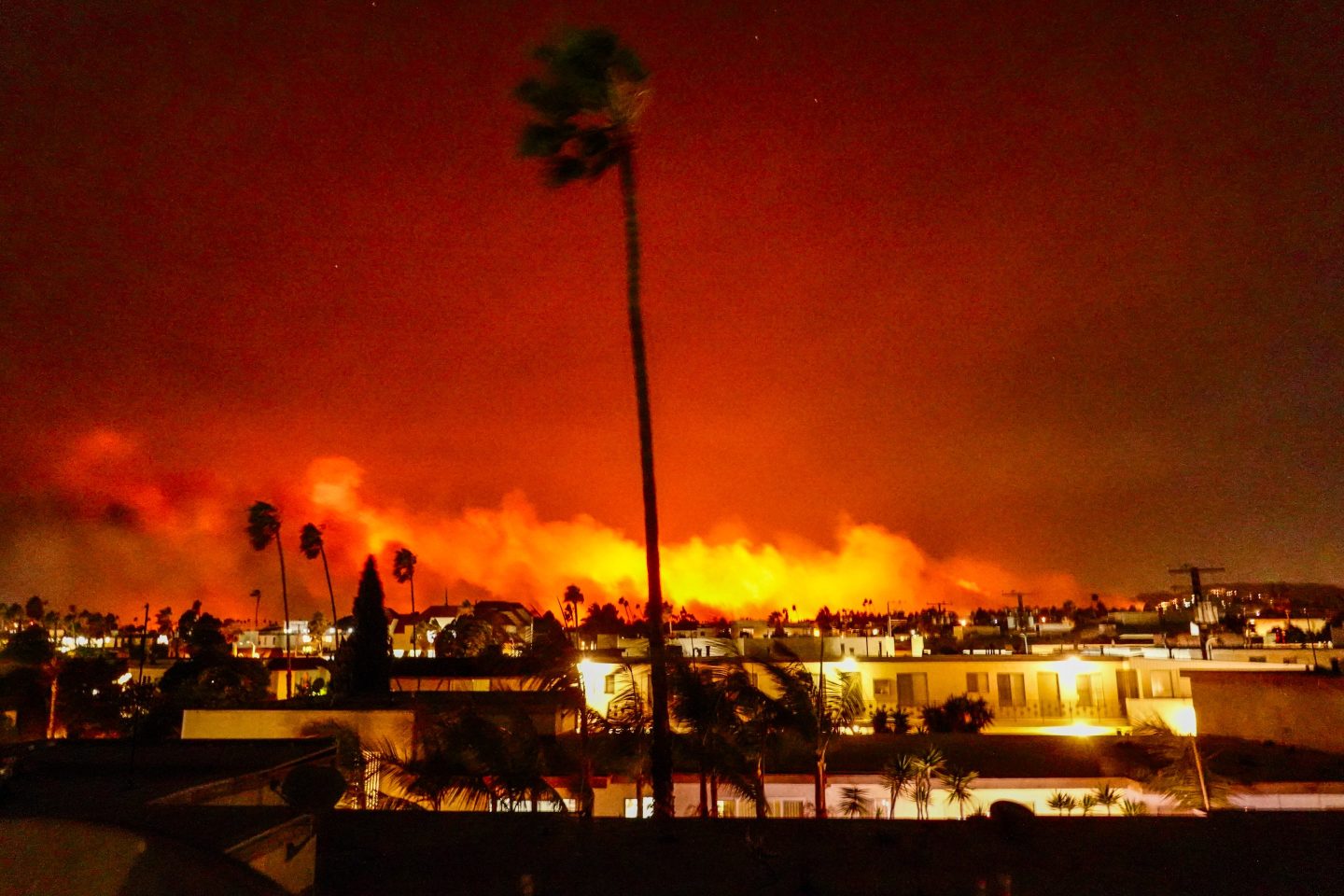
The fires scorched parts of Los Angeles more than a month ago, and with the smoke clear, a devastating domino effect has come into even sharper relief.
It’s a vicious cycle. California does not have enough homes for its population, so home prices and rents have ballooned, far exceeding the rest of the country. The typical California home price is more than double the national average of $355,000; rent is 38% higher, too. Millions of homes are in places prone to disaster, throwing the insurance industry in disarray. The wildfires intensified an already dire housing crisis, and the storm of challenges could alter the real estate landscape for years to come.
“We have fires every month of the year now,” said Char Miller, a professor of environmental history, policy, and analysis at Pomona College. The Southern California fire season used to be in the fall, then rain would come. But the rain isn’t coming and the wind is growing more intense, he said. There was no stopping the Palisades and Eaton fires once they started. Still, “this pattern of building to burn is essentially a century old,” Miller said.
It’s a moment of truth for the Golden State. Bearing the risk, do people just rebuild in an area prone to wildfires? Or is it finally time to change the way the state not only responds to disasters but develops homes, neighborhoods, and communities?
“Disaster amnesia,” is the diagnosis Richard Kent Green, director and chair of the University of Southern California Lusk Center for Real Estate, once heard someone call it. The phenomenon refers to people and their societies forgetting or even minimizing the risk and impact of disasters over time, to the point that they are less prepared when it happens again. After Hurricane Katrina in 2005 decimated New Orleans, displaced a million people and claimed nearly 2,000 lives, there was substantial investment in flood protection, but similar failures in disaster preparedness were seen in later storms.
Where civilization meets shrubland and the Santa Ana winds
Wildland urban interface development is understood to be a leading cause of wildfires. The term refers to the breaching of the boundary between undeveloped wildland and human development: housing. Since the 1990s, California has seen the greatest scale of wildland urban interface expansion in the country. Almost 1.5 million new homes were built in these areas in the last 30 years, a paper by four University of California, Santa Cruz researchers revealed.
The paper, titled: “Relational geographies of urban unsustainability: The entanglement of California’s housing crisis with WUI growth and climate change,” argues the rapid expansion of these transition zones are connected to the absence of affordable housing that has pushed people to exurbs. More than one out of every three California households is located in a wildland urban interface at this moment.
“When you prohibit housing to be as dense as a metropolitan area needs it, kind of close to the city where there is no fire risk whatsoever, you push that housing farther and farther out into areas that are more prone to wildfire risk,” said Michael Lens, a professor of urban planning and public policy at University of California, Los Angeles. “So those two mistakes are kind of two sides of the same coin.”
A desire for single-family homes has driven the state’s housing crisis, but why we’ve built in areas where there is wildfire risk is because that risk has been underestimated.
Blame it on land-use regulation and local governments that are influenced by residents who don’t want denser housing in their neighborhoods, but for decades the Golden State has not built enough homes. Whether it be conditional-use permitting, discretionary approval, or the California Environmental Quality Act, policy failure and regulatory overload has stymied development. California needs to build 180,000 homes per year, and yet fewer than 80,000 homes are built each year. That is one dilemma. The other: insurance woes.
Property insurers are either capping the number of policies they write in the state, refusing to write new policies altogether, raising rates, or fleeing. Since 2022, seven of the top 12 insurance companies have paused or restricted new business despite rate increases. In some situations they cannot justify doing business in California because of the fire risk that has always existed and is worsening. Thousands of homes in Los Angeles were dropped by their insurers before the Palisades and Eaton fires.
The recent wildfires that swept through neighborhoods in Pacific Palisades and Altadena wiped out more than 16,000 structures in Los Angeles alone. Redfin data found roughly one of every six homes within the perimeters of the Palisades and Eaton fires have been destroyed, damaged, or made inaccessible as of January 22. That’s a total of 14,960 homes, and of those, 12,941 were destroyed. In all of Los Angeles County, 0.4% of all homes were destroyed or damaged, the analysis revealed. Most were single-family homes, and according to a separate analysis, only 6,000 single-family permits are granted each year in Los Angeles County.
Home prices, rents, and insurance costs are all expected to surge in the aftermath of the loss of homes. It was already costly, plus interest rates are still higher than what people are accustomed to. Redfin chief executive Glenn Kelman called it “a bit of a triple threat that we’ve never seen before,” in an earlier interview. Then there’s talk of rebuilding in the very neighborhoods that burned down.
California Governor Gavin Newsom and Los Angeles Mayor Karen Bass cut the metaphorical red tape so people could rebuild their homes. Christopher Elmendorf, a professor at University of California, Davis whose work concentrates on land-use and housing law, said that what the two elected officials have done thus far are “total stopgap measures.”
Newsom suspended permitting requirements and reviews based on the California Environmental Quality Act and Coastal Act, and instructed the Coastal Commission not to interfere with his order. But “there’s been no suspension of environmental or coastal commission review for building more housing in safe places, which is what needs to happen,” Elmendorf explained. Basically, everything Newsom has done so far is to rebuild things almost exactly as they were before the fires—not to increase supply or develop elsewhere. People might be rebuilding just to burn again.
A little more imagination would be great, said Green. More than three years ago a bill went into effect that permits building up to four units on what was one single-family parcel, but the process of making it actually happen isn’t always so easy. California officials could cut the red tape for that on an occasion such as this.
But mild expediting might be the best we can hope for, Lens said. It isn’t only on the government: labor shortages and expensive material costs are an issue, too, and tariffs might only make conditions unfavorable. Oh and of course the not-in-my-backyard crowd doesn’t help.
Either way, the Bass-Newsom duo hasn’t necessarily shown an interest in remaking an affordable California in the past, Elmendorf explained. He pointed to an executive order Bass signed that only applied to 100% affordable housing projects. It was a hard sell for developers and was still scaled back after criticism. Newsom “hasn’t been an obstacle but he hasn’t been a leader either beyond his rhetoric,” Elmendorf said.
Newsom hasn’t gone head to head with neighborhood groups that oppose new development. Post-fires, those groups will still be there, Elmendorf said. “The question is whether legislators become more willing to incite or bear the ire of those groups because they see a problem that is so important that they’re either willing to take political risks or maybe they think there will actually be a political payoff,” he suggested.
People need insurance to rebuild, too—you typically can’t get a mortgage without fire insurance. No one knows yet how much insurance will cover, or if the government will help those who had no coverage at all. Others were insured through the bare-boned, last resort, state-backed FAIR Plan, and regulators just said they would allow the FAIR Plan to collect $1 billion from private insurers operating in California. But “if the state assesses insurers, I bet almost all those insurers are just going to pull out,” Elmendorf said.
Unless the state changes its insurance policies and lets insurers charge rates that offset the challenges and losses to their balance sheets, things won’t get better. Voters passed Proposition 103 decades ago to protect consumers from arbitrary insurance rates and ensure that insurance is affordable for all Californians—but because it regulates insurance rates, it has basically suppressed premiums in risky areas.
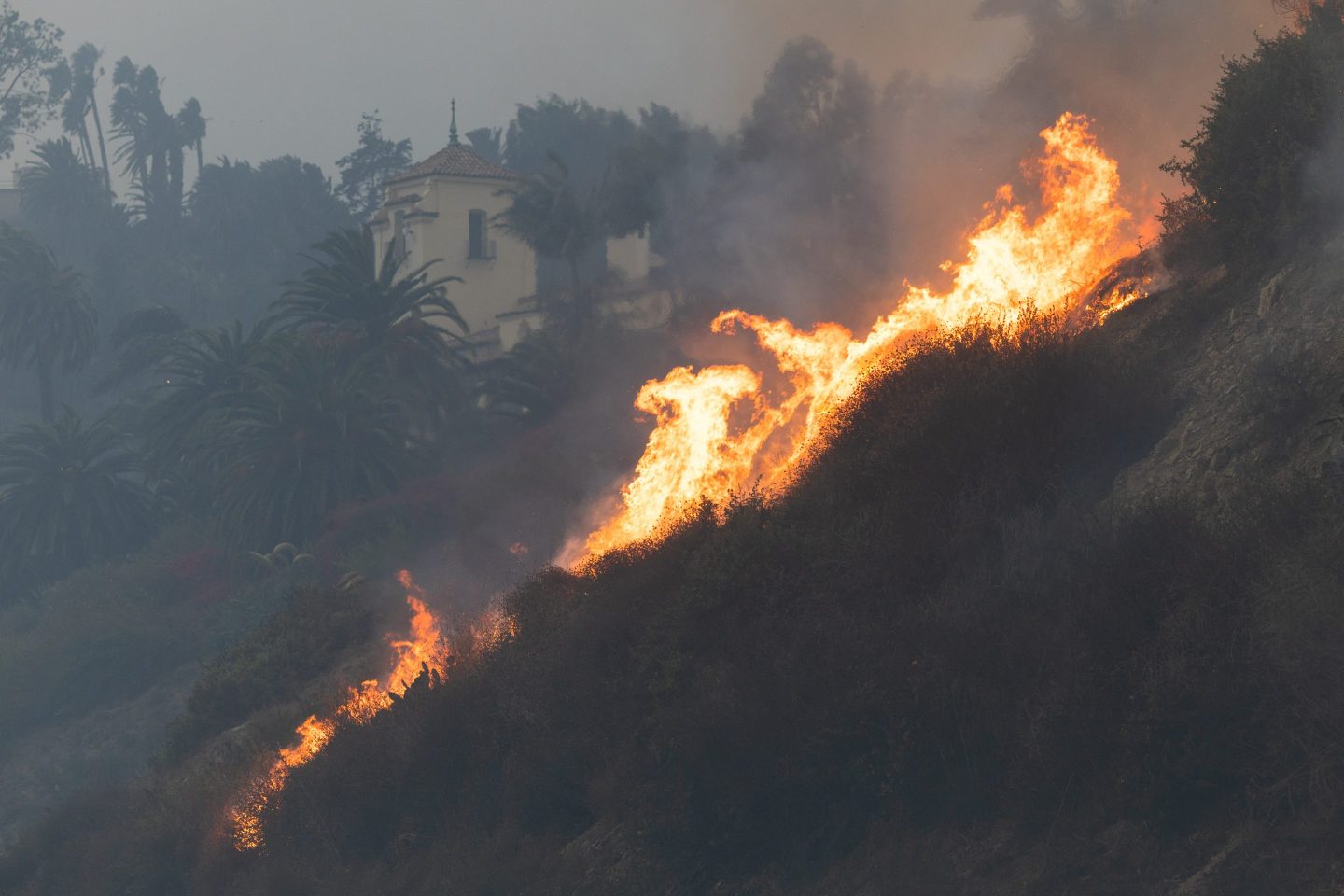
People are aware of the threat, but to tell them they can’t rebuild after losing everything would be awful. Nonetheless, in an ideal world, we wouldn’t rebuild in neighborhoods that burned to the ground, Miller said. “We spend billions of dollars to fight fire, we spend billions more to reconstruct afterwards. What if we took some of that money,” he said, “and went to people who would be willing to sell?” At the moment, the preliminary estimate for the total damage and economic loss is between $250 billion and $275 billion. “What if you had $270 billion to buy people out? You could buy a lot of willing sellers, I would think,” he said.
Elected officials should be obligated to pursue policies that help people live, not push them into places that everyone knows will burn, Miller said. After Hurricane Harvey in 2017, Texas came up with a similar plan, but home prices in California are much higher. But more likely than not, a rebuild will occur.
Some Palisades residents will want to recreate what was there: The beautiful homes up in a hill on the coast. One resident who lost his home told me he had already called a builder days after. It will probably take longer than a year for the Pacific Palisades to return to its former glory because of all the toxins in the air and ground, Miller explained. Still, for Miller, the latest bout of fires are a smoke signal for climate change and a wake-up call for those who call those places home. But the pattern from most natural disasters is a bailout of the people who suffered, and they rebuild, and the disaster happens again, Elmendorf said.