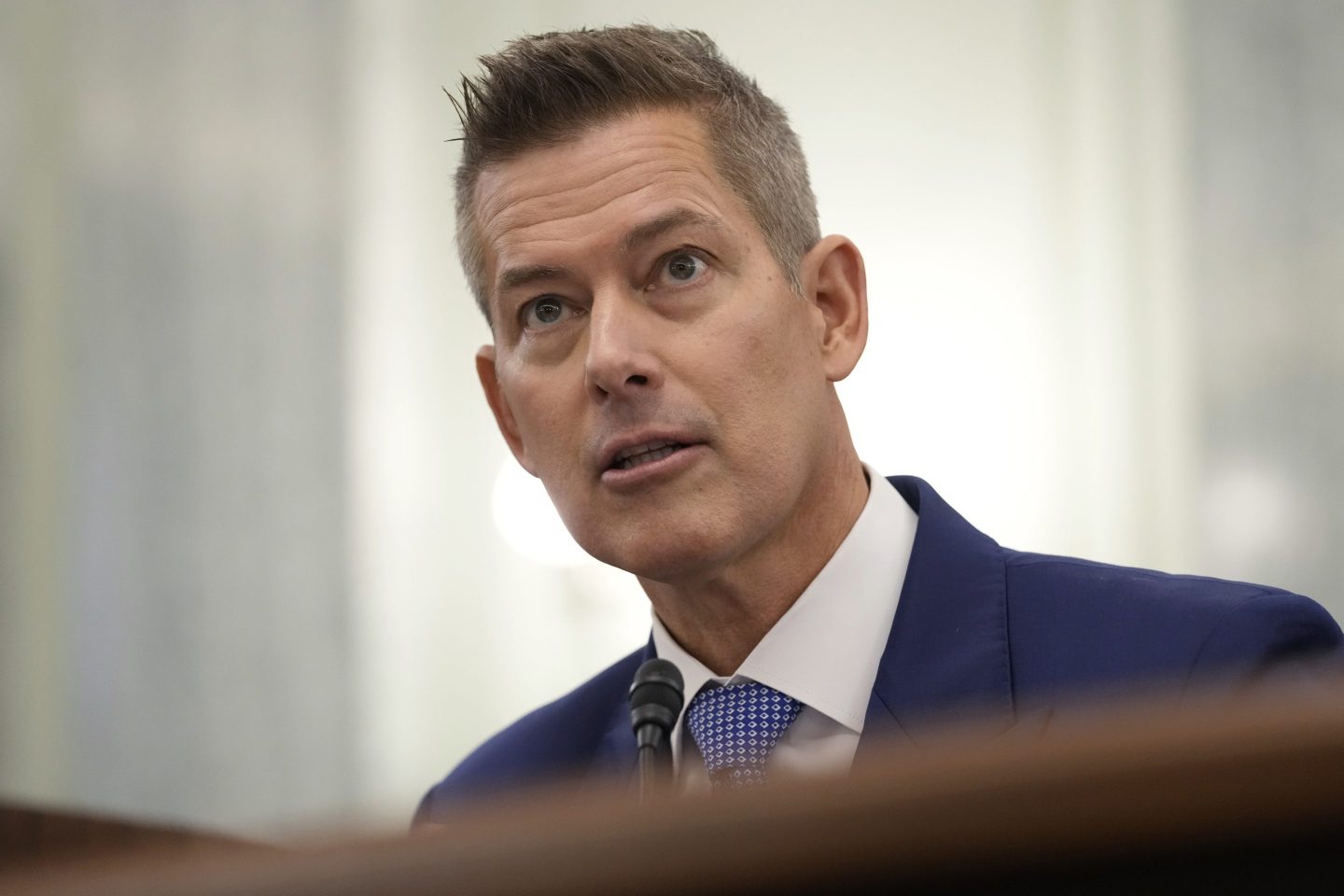
Shortly after he was confirmed as President Donald Trump’s transportation secretary, Sean Duffy circulated a memo that instructed his department to prioritize families by, among other things, giving preference to communities with marriage and birth rates higher than the national average when awarding grants.
Connecticut Democratic Sen. Richard Blumenthal called the directive last week “deeply frightening,” and Washington Democratic Sen. Patty Murray called it “disturbingly dystopian.”
The memo also calls for prohibiting governments that get Department of Transportation funds from imposing vaccine and mask mandates, and requiring their cooperation with the administration’s immigration enforcement efforts.
With hundreds of billions of dollars in transportation money still unspent from the 2021 bipartisan infrastructure law, such changes could be a boon for projects in Republican-majority states, which on average have higher fertility rates than those leaning Democratic.
States controlled by Democrats were generally more receptive to mask and vaccine rules to combat the COVID-19 pandemic and have been more resistant to Trump’s immigration raids.
More births for more roads?
All administrations set their own rules for choosing which transportation projects to prioritize. But some of Duffy’s directives were received as highly unusual.
“Distributing transportation funding based marriage and birth rates is bizarre and a little creepy,” said Kevin DeGood, senior director of infrastructure and housing policy at the left-leaning Center for American Progress. “States and regions with aging populations tend, on average, to have lower birth rates … Are they somehow not deserving of transportation investment?”
According to the latest figures from the Centers for Disease Control and Prevention in 2022, the 14 states with the highest fertility rates backed Trump in the November election while the bottom 11 plus the District of Columbia supported Democrat Kamala Harris. Marriage rates tend to skew higher for red states too, but by a smaller margin.
Vice President JD Vance has long expressed concern about declining birth rates, citing national economic needs as well as the inherent value of children.
Tennessee Republican Sen. Marsha Blackburn raised the idea of tying transportation funding to population growth during Duffy’s confirmation hearing.
“People are leaving some of these blue states and coming to places like Tennessee,” she said. “And this means that we need to look at where those federal highway dollars are spent and placing them in areas with growing needs rather than areas that are losing population.”
Sarah Hayford, sociology professor and director of the Institute for Population Research at Ohio State University, said she had never heard of birth rates being used to set funding priorities.
“I was a little surprised,” she said. “Often the policy around birth rates is trying to address challenges or barriers to people not having children. This seems more focused on rewarding people for already having children.”
The U.S. birth rate has been declining since 2007, which Hayford attributes in part to economic uncertainty during the Great Recession. She said research has tied higher birth rates to areas with lower education.
Longstanding transportation policy already considers where kids live, said Beth Jarosz, senior program director at the nonpartisan and nonprofit Population Reference Bureau.
“If what you’re trying to do is support families, birth rates aren’t necessarily the best way to do that,” she said, pointing out that many growing families move to new communities when they find their homes are too small.
The Department of Transportation has not responded to questions about the memo.
So far, lawmakers and advocates are unaware of birth and marriage rates being linked to non-transportation grants.
Blue states push back
Blumenthal said the transportation secretary’s focus on birth and marriage rates was “reminiscent of what you might see in the People’s Republic of China.”
“On its face, it’s social engineering. But clearly and indisputably, it is a dagger aimed at blue states,” he said. “It is patently discriminatory if you look at the numbers. This criteria was designed to punish blue states and coerce states to change their lawful policy on tolls, vaccines and immigration.”
U.S. Rep. Kweisi Mfume, a Maryland Democrat, said he feared Duffy’s directives would harm some grants already announced — including $85 million awarded to Baltimore in the final weeks of the Biden administration to transform a blighted stretch of U.S. 40 known as the “highway to nowhere.”
“If it’s an effort to reward red states, he ought to just go ahead and say that,” Mfume said. “Otherwise, there will be a lot of challenges by states and advocacy organizations all over the country who have no choice but to fight back, and that fight will become a legal one.”
Yet Jarosz said the policy’s political intentions are unclear, noting communities like San Diego and Sacramento in California are above the national average in terms of birth rates, while certain rural areas of the country are below.
Is this even legal?
Legal experts say it is too early to know whether anything in Duffy’s memo could be struck down by the courts.
Although it is difficult to make a legal argument for funding equality based on political affiliation, federal law does protect against discrimination over such things as race, sex, and disabilities.
Joel Roberson, who handles transportation and infrastructure cases at the Washington, D.C., law firm Holland & Knight, said administrations have widespread authority to set their own criteria for awarding money. However, communities denied funding could file a lawsuit arguing they endured an illegal “disparate impact.”
As for whether Trump could redirect transportation grants awarded under Biden, Roberson said it largely depends on the status of the project and whether Congress has already appropriated the funding.
State transportation officials have expressed confidence that the new guidelines won’t impact the federal funds states use to set their own transportation priorities and build roads. But many other grants are awarded at the discretion of the administration in power.
Less clear is the status of some already approved discretionary grants, such as an agreement signed just before former President Joe Biden left office committing $1.9 billion toward a nearly $5.7 billion project to add four new L stations in South Side Chicago.
Blumenthal, a former state attorney general and federal prosecutor, said Duffy’s edict created “uncertainty and confusion” and pointed out it doesn’t carry any legal weight like statutes and regulations do. He predicted courts would ultimately reject the policy.
“Anybody can write a memo,” Blumenthal said.