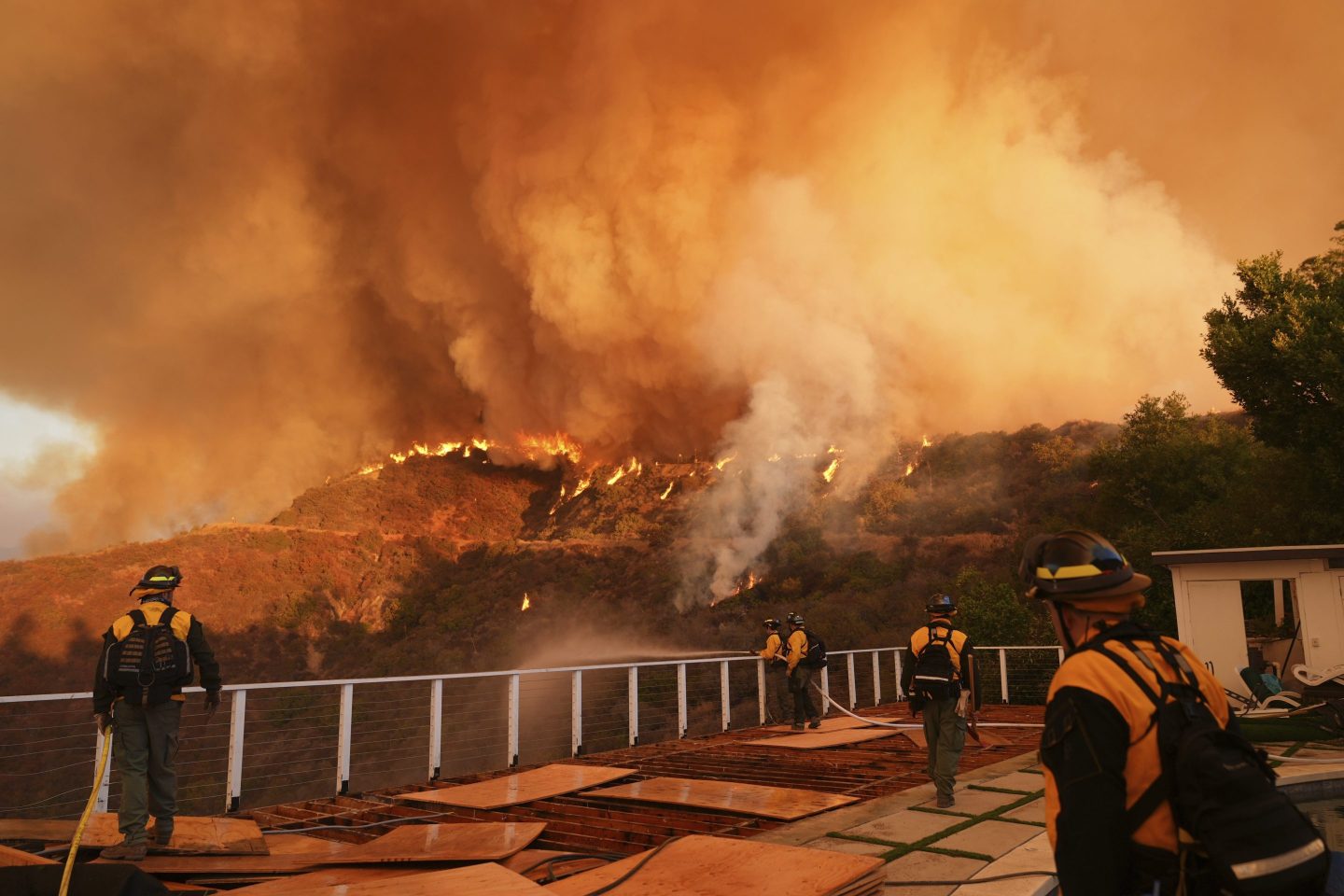
Human-caused climate change increased the likelihood and intensity of the hot, dry and windy conditions that fanned the flames of the recent devastating Southern California wildfires, a scientific study found.
But the myriad of causes that go into the still smoldering fires are complex, so the level of global warming’s fingerprints on weeks of burning appears relatively small compared to previous studies of killer heat waves, floods and droughts by the international team at World Weather Attribution. Tuesday’s report, too rapid for peer-review yet, found global warming boosted the likelihood of high fire weather conditions in this month’s fires by 35% and its intensity by 6%.
Once-in-a-decade super strong Santa Ana winds, a dry autumn that followed two very wet years that caused rapid growth in flammable chapparal and grass, hot weather, dry air and vulnerable houses in fire-prone areas all were factors in the fast-moving fires that destroyed thousands of homes and killed at least 29 people, study authors said. But the climate attribution team was only able to quantify issues that dealt with the fire weather index, which are the meteorological conditions that add up to fire danger.
The fire weather index — which includes measurements of past rainfall, humidity and wind speed — is where the team looked and found markers of climate change that they could quantify.
The team used observations of past weather and computer simulations that compared what happened this month to a what-if world without the 1.3 degrees Celsius (2.3 degrees Celsius) of human-caused climate change that Earth has had since industrial times. That allowed them to come up with a calculation for warming’s contribution to the disaster. It’s a method that the National Academy of Sciences says is valid. Even though these rapid studies aren’t yet peer-reviewed, nearly all of them are published later in peer-reviewed journals without significant changes, said World Weather Attribution co-lead scientist Friederike Otto.
“The number (35%) doesn’t sound like much” because unlike dozens of its past studies, the team looked at a small area and a complex meteorological measurement in the fire weather index that would generally mean there would be large uncertainties, said Otto, a climate scientist at Imperial College London. But in this case the climate change fingerprint is big enough that it stands out, she said.
Those conditions are part of what makes California attractive to 25 million residents, said study co-author John Abatzoglou, a climate and fire scientist at the University of California Merced.
Southern California has “some of the best climate, best weather on the planet — except when you get a combination of conditions that occurred here,” Abatzoglou said. “You get the trifecta of dry windy and warm conditions. Those three things, in combination with dry fuels and ignitions, are the perfect recipe for fire disasters.”
Abatzoglou said it’s like a bunch of switches — dryness, fuels, high temperatures, wind and ignition — that all need to be turned on “for conditions to really take off.” Think of it as switches for a light bulb to illuminate — “and so you can think about the artificial warming due to human-caused climate change making the light brighter,” added co-author Park Williams, a UCLA fire and climate scientist.
The study also found California’s dry season has increased by 23 days and the lack of rain in October, November and December was more than twice as likely now than in pre-industrial times, but because of limitations on the data, researchers couldn’t statistically pinpoint these to both climate change and the specific fires this month, Otto said. But she said “the rains are decreasing — that is because of human-induced climate change.”
Then add in strong winds to whip and spread flames.
Mike Flannigan, a Canadian fire scientist who wasn’t part of the research, said one key to him is the fire season extending longer and “increasing the chance a fire will start during peak Santa Ana winds.”
The research couldn’t specifically quantify how much, if any, climate change affected the Santa Ana winds.
Craig Clements, a climate scientist and director of wildfire study at San Jose State University, said the rapid study makes sense and fits with past research about other fires.
“It’s hard to attribute climate change to every fire event as many do,” said Clements, who wasn’t part of the research. “If we can state with confidence that the drought is caused by climate change then that is the fingerprint.”
If the world warms another 1.3 degrees Celsius from now, the study said people should expect the type of weather conditions that led to these fires to happen another 35% more often.
Otto said this is not an issue of politics, but science.
“It’s not something where you can say that this was because California did something very wrong. They did a lot of things right. They did some things that they could do better,” Otto said. “But what makes these ever more dangerous, these fires, and what is something that the government of California alone can definitely not do anything about is human-induced climate change. And drill, baby drill will make this much, much worse.”