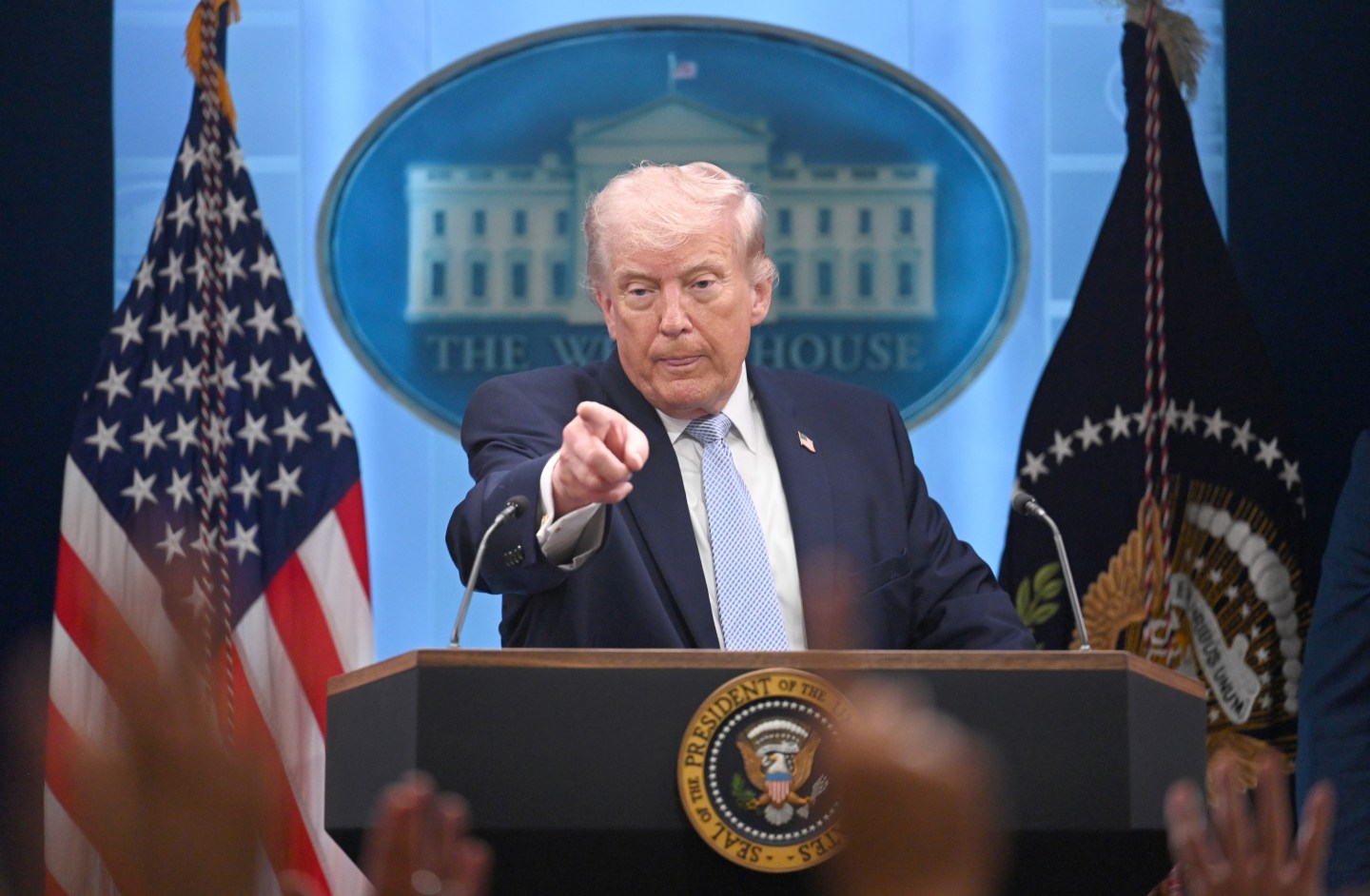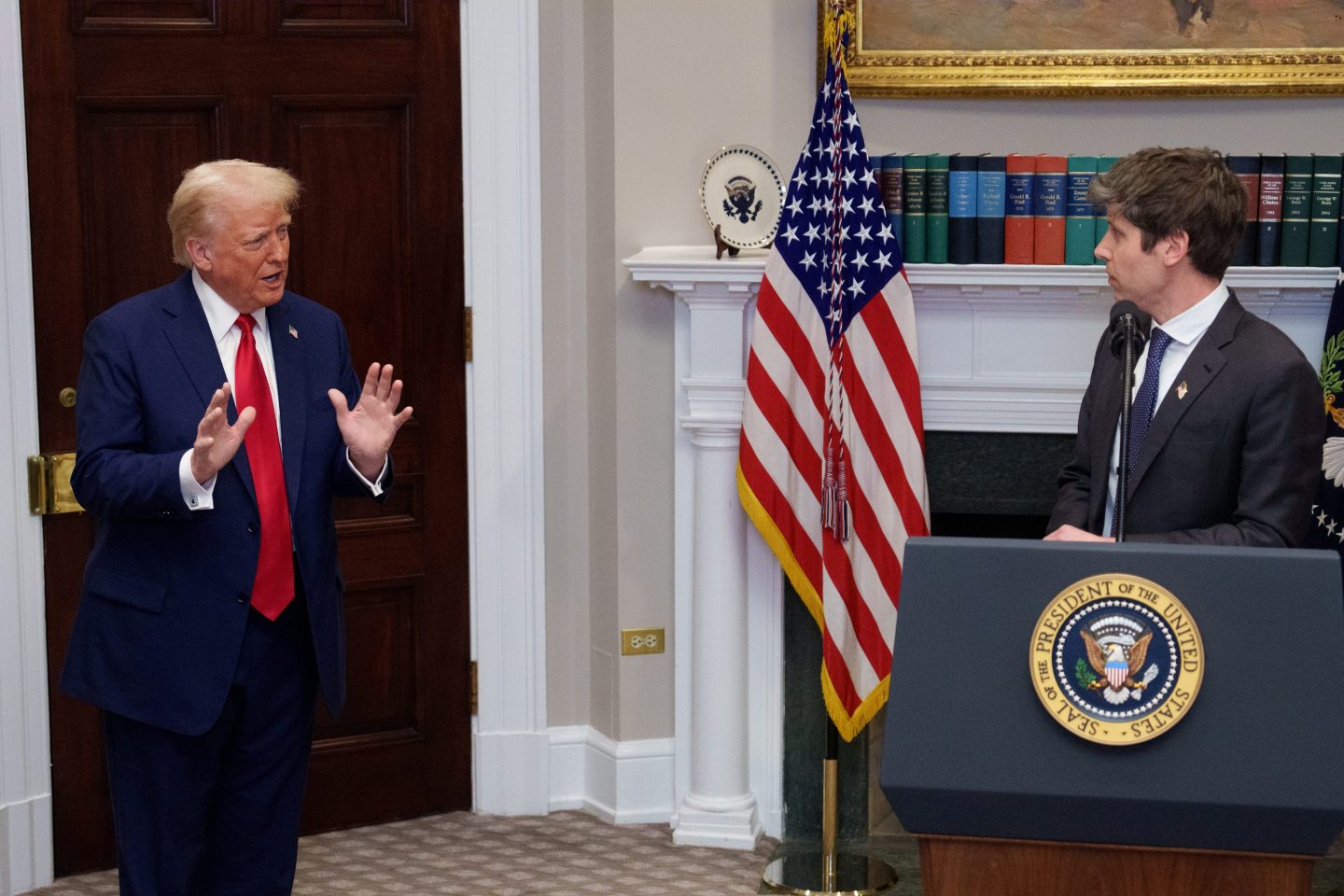
President Donald Trump and the leaders of OpenAI, SoftBank and Oracle yesterday announced an enormous new AI initiative called Stargate, involving a planned $500 billion build-out of AI data centers in the U.S.
It’s a huge move that comes with an up-front investment of $100 billion by OpenAI, SoftBank, Oracle, and the Emirati AI investor MGX. If it comes to fruition, it has the potential to keep the U.S. at the forefront of the AI scene. (It also has the potential, according to Trump, to create 100,000 new jobs—though many if not most will likely be temporary ones, associated with the construction of the data centers.)
But the Stargate announcement also provides crucial insights into tech CEOs’ scramble for influence in the second Trump White House.
Sam’s in the house
The first big takeaway is that OpenAI CEO Sam Altman is anything but out in the cold. Altman and Elon Musk were once close, with the two teaming up to help create OpenAI back in late 2015, but they have since developed an acrimonious rivalry. Given Musk’s close proximity to Trump — he bankrolled the president’s campaign and is leading his so-called Department of Government Efficiency — there had been concerns that Musk would use that relationship to favor his own xAI operation and possibly to disadvantage OpenAI.
Altman himself addressed those fears last month, saying: “It would be profoundly un-American to use political power, to the degree that Elon has it, to hurt your competitors and advantage your own businesses.” He added that “people” would not tolerate such a move, and he did not “think Elon would do it.”
The OpenAI CEO went on to donate $1 million to Trump’s inaugural fund, and to attend the inauguration on Monday — though he was not seated next to Musk and other Big Tech leaders, such as Amazon founder Jeff Bezos and Meta CEO Mark Zuckerberg, on the stage behind the returning president. OpenAI also disclosed on Tuesday that it spent seven times as much on lobbying last year as it did in 2023, with a particular acceleration in the last quarter.
And now OpenAI is the prime beneficiary of the Trump-endorsed Stargate project. “I think this will be the most important project of this era,” Altman said at the project’s announcement, which he announced from the White House, with Trump looking on. “We wouldn’t be able to do this without you, Mr. President.”
Musk is fuming. The investors “don’t actually have the money,” he sniped on his X account. “SoftBank has well under $10B secured. I have that on good authority.”
SoftBank declined to officially comment on that claim, but Altman struck back with his own tweet on Wednesday. “Wrong, as you surely know,” he wrote. “Want to come visit the first site already under way? This is great for the country. I realize what is great for the country isn’t always what’s optimal for your companies, but in your new role I hope you’ll mostly put [America] first.”
Microsoft’s changing role
It is not entirely clear what role Trump and his team — officially in power for just two days, though they have been exerting huge influence since the election — actually played in assembling the Stargate initiative.
Oracle executive chairman Larry Ellison is likely to have been a key player. He is a longstanding ally of Trump’s (the president just said he was open to the idea of Musk or Ellison buying TikTok) and also an established OpenAI partner.
Seven months ago, the companies announced a big deal that sees OpenAI’s workloads run on Microsoft’s Azure AI cloud platform, on Oracle’s data-center infrastructure. This was framed as a way to allow OpenAI to keep building larger and larger AI models — which required more specialized computer chips than Microsoft was apparently willing or able to provide — as well as to “extend” Azure beyond Microsoft’s own extensive cloud infrastructure. (Azure currently holds 20% of the cloud market, according to recent data from Synergy Research Group. Oracle has just 3%.)
Stargate essentially builds on that deal, with government support and $100 billion thrown into the mix. “We are thrilled to continue our strategic partnership with OpenAI and to partner on Stargate,” Microsoft said in a Tuesday blog post.
Warm words aside, it is clear that the once-tight bond between OpenAI and Microsoft, which has invested some $13 billion in the smaller company, continues to loosen. (This drifting apart has been apparent since early last year, but has progressed since then. According to a recent Reuters report, Microsoft is working on powering its Copilot AI product with a diverse range of models, not just those from OpenAI.)
Microsoft still has the exclusive right to provide access to OpenAI’s application programming interface (API), meaning the gate between OpenAI and the developers who tap into its technology has to run on Azure. However, until recently it also had exclusivity on the provision of new physical infrastructural capacity for OpenAI — an issue that was central to Google’s reported request last month that the U.S. government break up the Microsoft-OpenAI deal.
As Microsoft made clear in its post yesterday, this element of its OpenAI deal has now been modified to give Microsoft the right of first refusal on the deployment of new capacity for OpenAI. With Oracle being the one to roll out that capacity in Stargate, it would appear that Microsoft passed in this case. Indeed, the Stargate announcement lists Microsoft only as a technology partner, and not a funder of the new project. The Information reported last April that Microsoft was in talks to spend $100 billion on an OpenAI supercomputing cluster called Stargate.
That said, Microsoft has just let it slip that, separate from its involvement in Stargate, it plans to invest a whopping $80 billion into AI, including infrastructure, in this fiscal year alone.
Building on Biden
The Stargate announcement gives great optics to Trump, who made big infrastructure promises in his first term that ended up in disappointment. While Altman credited the Trump Administration with playing a crucial role in the bringing the project to fruition, his predecessor may have smoothed the way.
One of President Biden’s last acts was an executive order directing federal agencies to quickly identify federal lands that can be used for new “frontier” AI data centers. The order comes with environmental strings attached — data-center developers will have to bring online either zero-carbon energy sources (i.e. renewables or nuclear) or low-carbon sources (fossil-fuel plants with effective carbon-capture technology) to power the facilities. At least five “priority geothermal zones” will come with expedited permitting, to encourage the use of that form of clean energy.
Trump, who is no fan of clean energy, rescinded Biden’s order on AI safety as soon as he took office. But, so far, he has not rescinded Biden’s AI infrastructure order.
Stargate could do much to shore up the U.S.’s traditional lead in AI, if it plays out as planned, and if it continues to be the case that ever-increasing amounts of computing horsepower are needed to create the most cutting-edge AI models. (This latter point is not a sure thing, as indicated by the relatively low computational requirements of Deepseek, a high-performing new model coming out of China.)
The rest of the world would certainly struggle to match a $500 billion project such as this, particularly when another late Biden move capped exports of U.S. AI chips to all but 18 countries.
“The Stargate project is an unequivocal claim by the U.S. to leadership in the field of artificial intelligence. This must be a wake-up call for Germany and Europe,” Verena Pausder, CEO of the German Startup Association, said. “The funding gap with the U.S. is huge. Germany and Europe must get going — because the U.S. is already sprinting.”
Thomas Regnier, a spokesperson for the European Commission, declined to comment directly on the Stargate announcement, but noted that the EU is setting up seven “AI factories” and providing funding for the sector. “This will generate an additional overall public and private investment of around €4 billion ($4.2 billion) until 2027,” he said.
“The U.S. is one of our closest partners,” said Regnier. “No other economies in the world are as integrated as we are. We already cooperate well on different aspects of AI, and we are ready to engage and discuss common interests with the new administration.”
Update: This article was updated to include Regnier’s comment and Altman’s tweet, and to note previous reporting around Microsoft, OpenAI and Stargate.