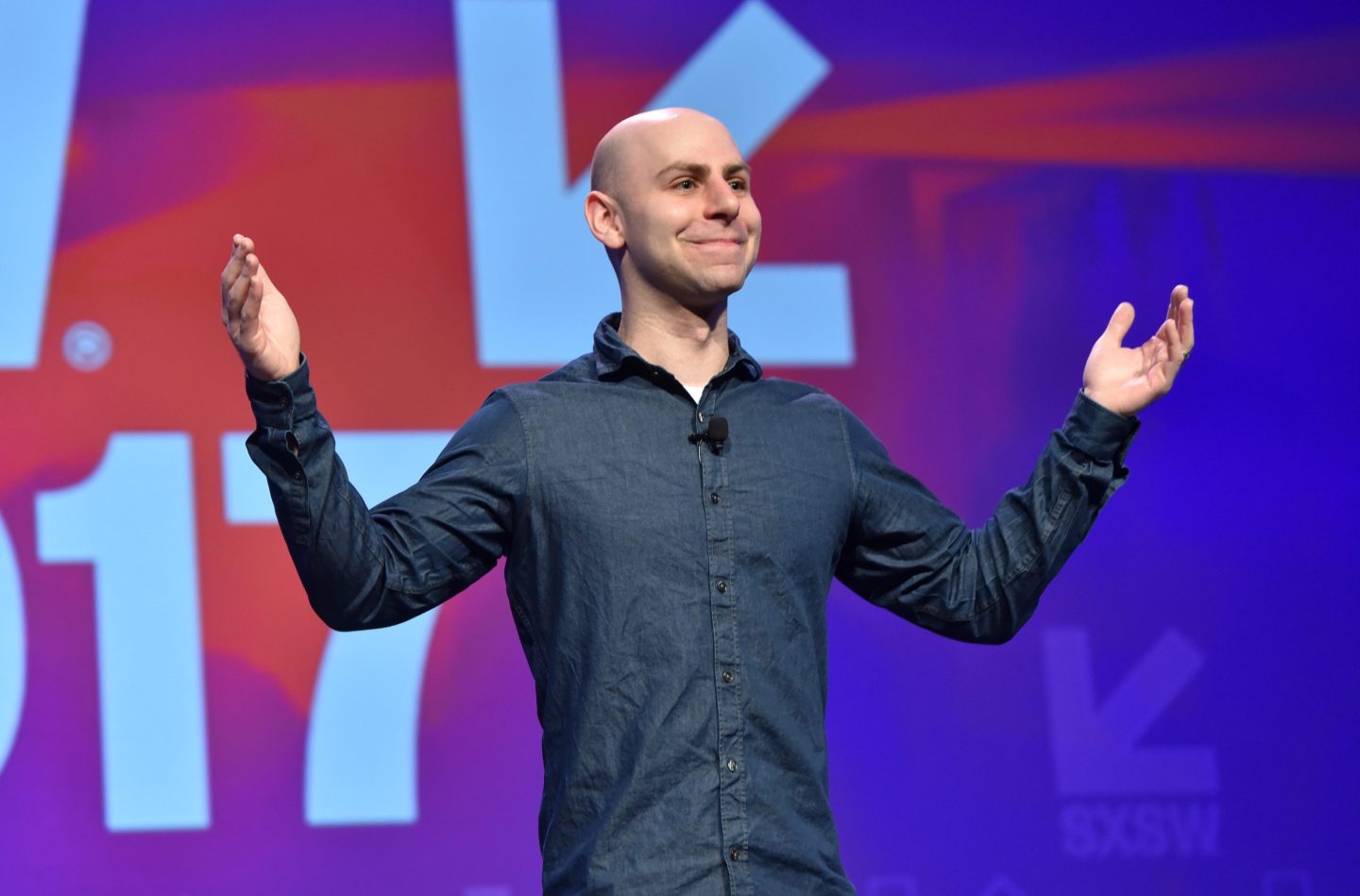
If there’s a patron saint of modern workplace psychology, it might be Adam Grant.
He’s a leading voice on organizational psychology and everything from parenting to how to unlock your hidden potential. A Wharton professor as well as an author and podcaster, he’s probably best known for his 2021 New York Times article on languishing, or a “meh” state of mental health epitomized by feeling of emptiness; it was the publication’s most-read piece that year.
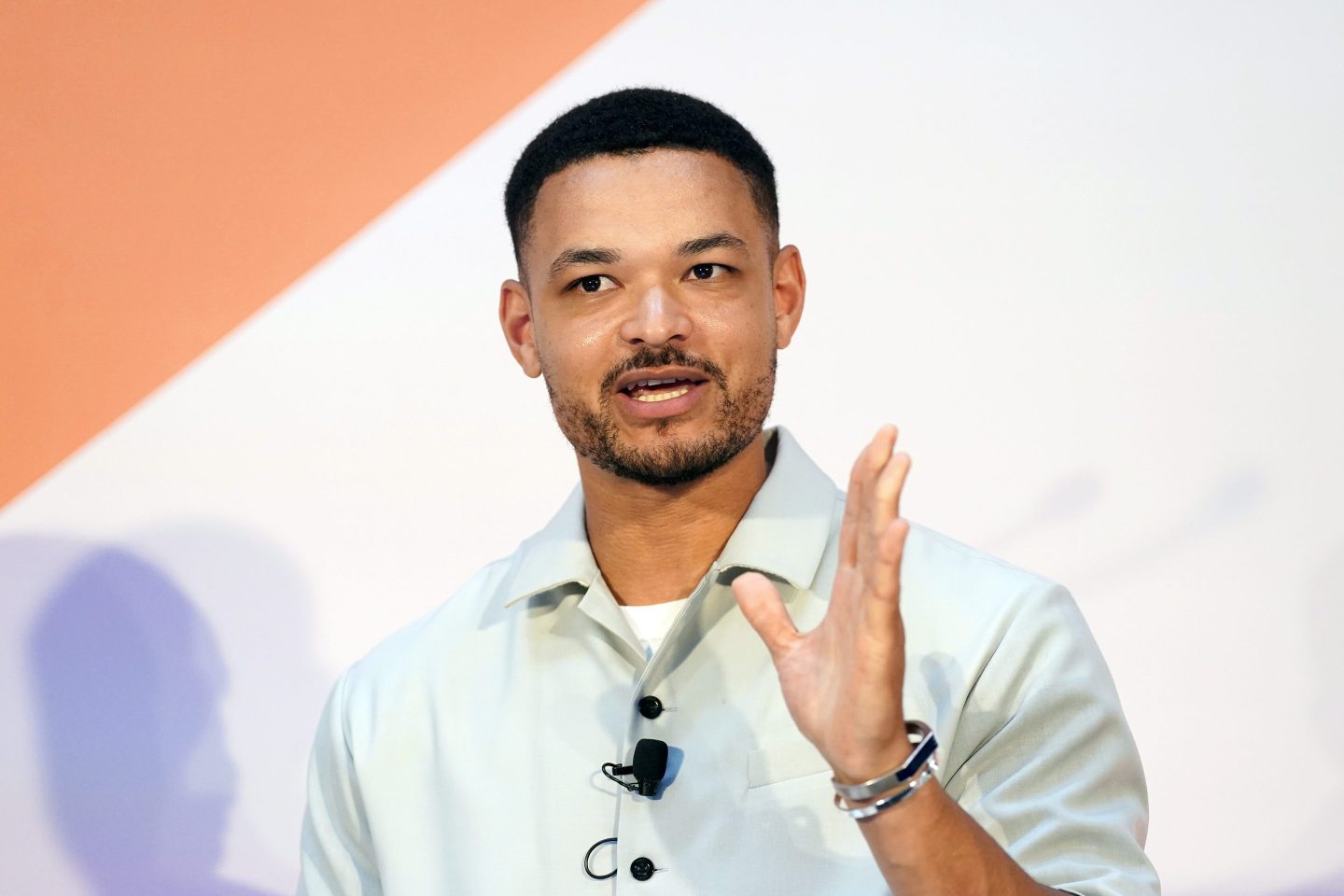
Today, employer review site Glassdoor announced that Adam Grant, organizational psychologist and New York Times bestselling author, is joining the company as its first-ever chief worklife expert. His role will involve leveraging the company’s data, including reviews, salaries, and community insights, to address critical issues like burnout, career growth, and of course, workplace well-being. He kicked off his tenure with a blog post about career pivots.
Fortune sat down with Grant to hear more about what he thinks about the current jobs landscape, what makes a great boss, and his predictions for 2025’s biggest work trends. This interview has been edited and condensed for clarity.
Fortune: A whole bunch of new job seekers are going to be sending out applications this month, and this week especially. What’s your advice for them?
Adam Grant: I think that we used to live in a world where people got hired based on ability, and increasingly what employers are looking for is agility. So I think the more that you can showcase your willingness to adapt, to change, your effectiveness in learning, in taking on new challenges, that’s great. And it’s a pretty effective way to stand out in a massively turbulent and increasingly rapidly-changing world.
We’re seeing data that hiring managers basically just want to bypass hiring new graduates altogether. What’s your advice for new grads entering the workforce?
I’ve been advising on this for a long time, in part because my students have to face it every year, and one thing I’ve suggested to them is to try to leverage their lack of experience as an asset, as opposed to seeing it as a liability. So what does that look like? It may look like giving feedback to an organization on how their culture is seen from the outside, or what their brand image is in the eyes of young consumers, and trying to take the fact that they’re not yet insiders drinking the Kool Aid. I think that’s a chance to showcase your initiative. It’s a way to demonstrate your creativity, and it also doesn’t then have to be linked to your prior education. What you’re demonstrating is that you have a point of view that can add value to them and maybe help them identify and then manage some blind spots.
A big new area of focus for the corporate world is a shift from bosses as taskmasters to bosses as coaches. What does it take to be a great boss right now?
I think that shift is, frankly, long overdue. A lot of bosses historically have been cheerleaders and critics. Cheerleaders are basically giving every employee top ratings and just celebrating and applauding the best version of each employee. Critics do the opposite. They are identifying and then attacking the worst version of each of their employees, doubting everyone’s motivation, questioning their intentions and their loyalty. And I think neither of those does a real service to people.
I think that what great coaches do is recognize their employees’ hidden potential, and then try to help them become a better version of themselves. So what does that look like?
I published some research with Amy Wrzesniewski and Justin Berg where we studied a range of jobs and also a whole group of employees at a Fortune 500 tech company. And what we showed is that the great managers were not just coaching employees to develop their skills, they were also giving employees latitude to reimagine their own jobs. Many organizations treat job descriptions as fixed, and they’re not. All of our jobs are flexible. We have discretion over what tasks we spend time on and who we interact with. And when people were given a little bit of latitude to actually think about evolving what they did every day and not just what skills they had, six months later, they were happier at work without any cost to their performance.
It seems like emotional intelligence is the new must-have skill in the corporate world. Are you seeing that shift, how can people work on that or measure that?
The jury is out on that one, actually. My reading of the evidence is that emotional intelligence has always been a useful skill, and we’re just talking about it more now, and also lumping a lot of things under that umbrella that may or may not belong there.
In psychology, emotional intelligence is defined and measured as the ability to use emotions effectively. And that breaks down into, at least in my view and in the data that I collected personally, two major sets of skills. One has to do with emotional understanding and perception. So can you recognize what you’re feeling? Can you make sense of what other people are feeling? And the other is about emotion regulation and management. When you’re in a bad mood, can you prevent that from interfering with your performance, and not spill over to make your colleagues miserable? Are you good at getting other people fired up or helping them calm down when they’re stressed?
From studying this, I found that the latter set of skills is more important than the former. So it’s great to know what you and others are feeling. Not a lot you can do with that if you don’t have the capacity to regulate. So I think that there may be a growing premium on emotion regulation skills.
My hunch is—and I’ve not seen any evidence for this, I’m guessing and this is a low confidence prediction—that if you think about all the ways that work has become more stressful–from people having more precarity in their jobs, as opposed to what used to feel like lifetime employment at a given organization, to all of the external events in the world that are destabilizing jobs, from a pandemic to AI–I think that there’s probably more emotion that’s sometimes just below the surface and spilling out at work. And so it would not surprise me if those skills are becoming more valuable.
We’re seeing a very strange labor market right now: People want jobs, and hiring managers want workers, but it doesn’t really seem to be working out for them. Is there a skills mismatch at work? What’s at play here?
There was a meta analysis—a study of studies—a few years ago, accumulating every study that’s ever looked at the relationship between how much time have you spent on the job and your performance in that job, and the relationship is so tiny that it’s not meaningfully different from zero in the vast majority of jobs. Why is experience not the advantage that we thought it was? Largely because the amount of time somebody has spent doing a role is a really poor proxy for their expertise in doing that role.
To the point I made earlier about agility, there’s an opportunity here that many employers are overlooking, which is that it doesn’t really matter what I know or what I can do today— what you [as a hiring manager] want is to invest in someone who’s going to build knowledge and skill for tomorrow.
What are the three biggest work trends that you’re noticing right now, and what do you expect from 2025
If only I had a crystal ball!
From the work we’ve already started doing at Glassdoor, the first trend that looms large is career pivots. People, historically, have often taken a new year as a chance for a fresh start. But post Great Resignation, we’re in a moment where people are both willing and able to rethink their careers in ways that they didn’t before. The fact that there are lots of remote jobs means that there are lots more possibilities available to you outside of the place where you happen to live. The fact that you can vet what employers are like by taking a tour through what their Glassdoor reviews look like. That opens up opportunities and ideas for people that they weren’t considering before. And so I guess this is a continuation of a trend that’s been happening for a long time around career mobility increasing, but I think it’s also an acceleration of that trend where people are excited to reinvent themselves. A lot of people are tired of working for abusive bosses, miserable jobs and toxic cultures. I think 2025 may well be the year where many people say “I’ve had enough. I’m taking my career into my own hands.”
I think a second trend that I’m seeing is there is a growing expectation among Gen Z, let’s just say Gen Z, writ large, that they’re going to have a voice in how their organization is run. And there is a fair amount of backlash from executives around that saying, “Who are you, 22 year-old? it’s not your place to dictate our vision and corporate strategy.” And I think there’s been a tug-of-war going on for a while on that, and I think that the leaders who succeed in managing that dynamic are the ones who manage to convey to their people that they have a say, but that doesn’t mean they’re always going to get their way. That’s a set of skills that a lot of leaders are going to need to invest in, around explaining the rationales for why an idea was not adopted, while still allowing people to feel that they did have a voice. And that’s going to be a tight-rope walk.
And a third trend, if I were going to place a bet, is that people—particularly job seekers—are going to start to place more of a premium on community at work. We know that there’s something of a loneliness epidemic going on. We know that the traditional institutions that used to provide community, whether it’s neighborhoods or places of worship or bowling leagues, they’re kind of gone, or at least much less popular than they once were. And so for community and friendship outside of your family, the workplace is the place that’s left. I’m guessing we’re going to see more organizations making the case of, “Hey, this is a place where you can belong, you can make friends, you can feel part of a team.” And they’ll do that because it’s a great way to attract applicants, but also because it’s a way to get people into the office, which has been a struggle as well.