When Bernard Jones Jr. and his wife, Doris, built their dream home, they didn’t hold back. A grotto swimming pool with a waterfall for hot summer days. A home theater for cozy winter nights. A fruit orchard to harvest in fall. And a vast underground bunker in case disaster strikes.
“The world’s not becoming a safer place,” he said. “We wanted to be prepared.”
Under a nondescript metal hatch near the private basketball court, there’s a hidden staircase that leads down into rooms with beds for about 25 people, bathrooms and two kitchens, all backed by a self-sufficient energy source.
With water, electricity, clean air and food, they felt ready for any disaster, even a nuclear blast, at their bucolic home in California’s Inland Empire.
“If there was a nuclear strike, would you rather go into the living room or go into a bunker? If you had one, you’d go there too,” said Jones, who said he reluctantly sold the home two years ago.
Global security leaders are warning nuclear threats are growing as weapons spending surged to $91.4 billion last year. At the same time, private bunker sales are on the rise globally, from small metal boxes to crawl inside of to extravagant underground mansions.
Critics warn these bunkers create a false perception that a nuclear war is survivable. They argue that people planning to live through an atomic blast aren’t focusing on the real and current dangers posed by nuclear threats, and the critical need to stop the proliferation of weapons of mass destruction.
Meanwhile, government disaster experts say bunkers aren’t necessary. A Federal Emergency Management Agency 100-page guidance on responding to a nuclear detonation focuses on having the public get inside and stay inside, ideally in a basement and away from outside walls for at least a day. Those existing spaces can provide protection from radioactive fallout, says FEMA.
But increasingly, buyers say bunkers offer a sense of security. The market for U.S. bomb and fallout shelters is forecast to grow from $137 million last year to $175 million by 2030, according to a market research report from BlueWeave Consulting. The report says major growth factors include “the rising threat of nuclear or terrorist attacks or civil unrest.”
Building bunkers
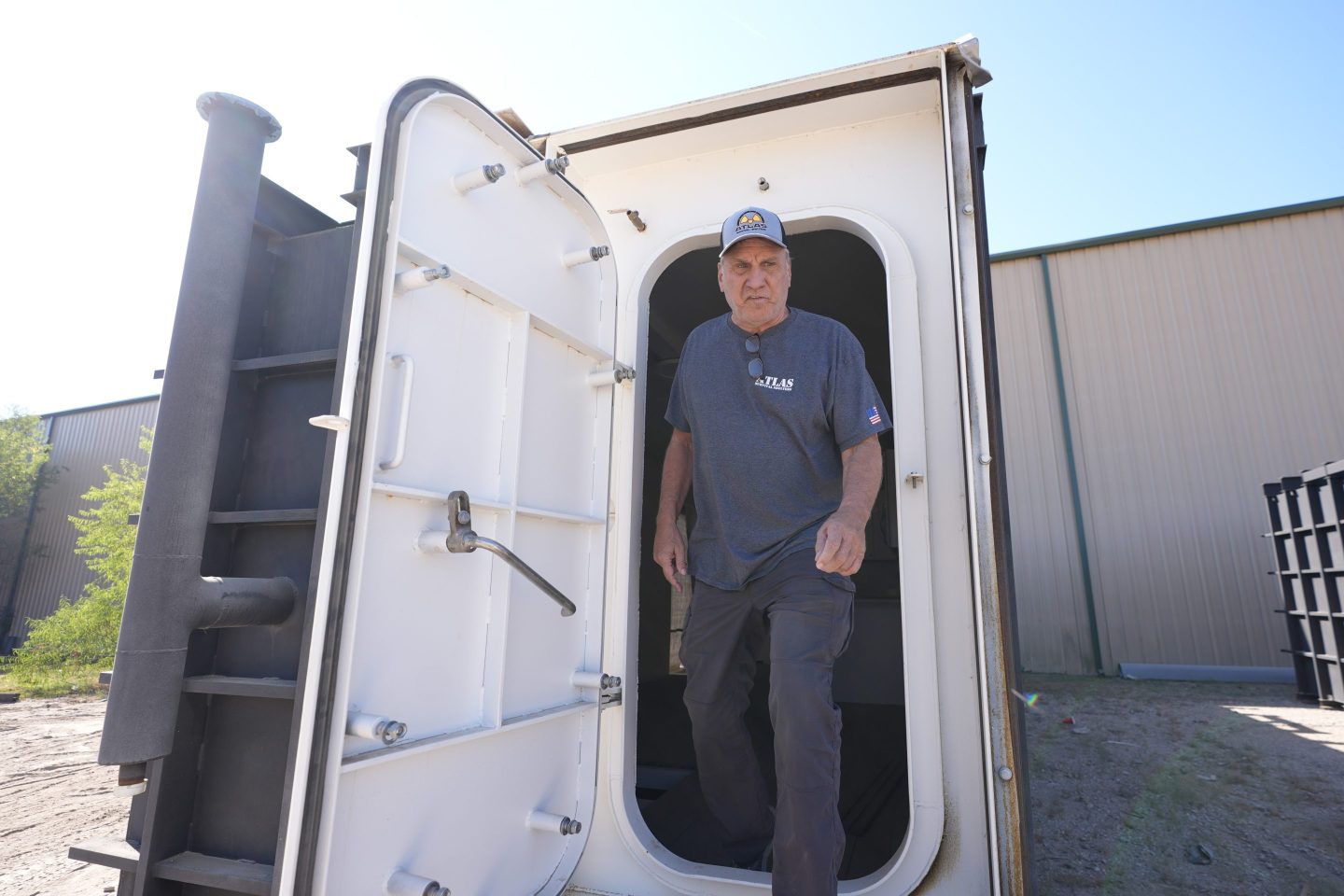
“People are uneasy and they want a safe place to put their family. And they have this attitude that it’s better to have it and not need it then to need it and not have it,” said Atlas Survival Shelters CEO Ron Hubbard, amid showers of sparks and the loud buzz of welding at his bunker factory, which he says is the world’s largest, in Sulphur Springs, Texas.
Hubbard said COVID lockdowns, Russia’s invasion of Ukraine and the outbreak of the Israel-Hamas war have driven sales.
On Nov. 21, in the hours after Russia’s first-ever use of an experimental, hypersonic ballistic missile to attack Ukraine, Hubbard said his phone rang nonstop.
Four callers ended up buying bunkers in one day, he said, and more ended up ordering doors and other parts for shelters they were already building.
Hubbard said his bunkers are built for all disasters.
“They’re good for anything from a tornado to a hurricane to nuclear fallout, to a pandemic to even a volcano erupting,” he said, sweeping his arms toward a massive warehouse where more than 50 different bunkers were under construction.
A loaded shotgun at arm’s length and metal mesh window shields to block Molotov cocktails nearby, Hubbard said he started his company after building his own bunker about 10 years ago. He says callers ask about prices — $20,000 to multimillions, averaging $500,000 — and installations — they can go just about anywhere. He said most days he sells at least one bunker.
Under Hubbard’s doomsday scenario, global tensions could lead to World War III, a situation he is prepared to live through.
“The good news about nuclear warfare,” he said, “if there ever was any, that it’s very survivable if you’re not killed in the initial blast.”
He’s not wrong, say U.S. government disaster preparedness experts.
“You want to go to your most robust building”
“Look, this fallout exposure is entirely preventable because it is something that happens after the detonation,” said Brooke Buddemeier a radiation safety specialist at Lawrence Livermore National Laboratory, where the U.S. government designs nuclear weapons. Buddemeier and his colleagues are tasked with evaluating what could happen after an attack and how best to survive. “There’s going to be a fairly obvious nuclear explosion event, a large cloud. So just getting inside, away from where those particles fall, can keep you and your family safe.”
Buddemeier and others in the U.S. government are trying to get Americans — who decades ago hid under desks during nuclear attack drills — educated about how to respond.
After a deadly and deafening blast, a bright flash and a mushroom cloud, it will take about 15 minutes for the radioactive fallout to arrive for those a mile or more away from ground zero, said Michael Dillon, a scientist at Lawrence Livermore National Laboratory.
“It’s going to literally be sand falling on your head, and you’re going to want to get out of that situation. You want to go to your most robust building,” he said. In their models, they estimate people may need to stay inside for a day or two before evacuating.
The government’s efforts to educate the public were reinvigorated after a false alarm missile alert in Hawaii in 2018 caused widespread panic.
The emergency alert, which was sent to cellphones statewide just before 8:10 a.m., said: “BALLISTIC MISSILE THREAT INBOUND TO HAWAII. SEEK IMMEDIATE SHELTER. THIS IS NOT A DRILL.”
For the next 40 minutes there were traffic jams, workers running into and out of buildings, families huddling in their bathrooms, students gathering in gyms, drivers blocking tunnels, all in an attempt to seek shelter, without any clear idea of what “seek immediate shelter” actually meant.
Today the federal government offers a guide to prepare citizens for a nuclear attack that advises people to find a basement or the center of a large building and stay there, possibly for a few days, until they get word about where to go next.
“Gently brush your pet’s coat to remove any fallout particles” it says, adding that the 15-minute delay between bomb and fallout allows “enough time for you to be able to prevent significant radiation exposure.”
Jeffrey Schlegelmilch, who directs the FEMA-backed National Center for Disaster Preparedness at Columbia University, said “the scenarios of a nuclear detonation are not all or nothing.”
If a small number of weapons detonate rather than all-out war, he said, sheltering inside a large building to avoid the fallout could save lives.
“Underground bunkers aren’t going to protect people”
Nonproliferation advocates bristle at the bunkers, shelters or any suggestion that a nuclear war is survivable.
“Bunkers are, in fact, not a tool to survive a nuclear war, but a tool to allow a population to psychologically endure the possibility of a nuclear war,” said Alicia Sanders-Zakre at the International Campaign to Abolish Nuclear Weapons.
Sanders-Zakre called radiation the “uniquely horrific aspect of nuclear weapons,” and noted that even surviving the fallout doesn’t prevent long-lasting, intergenerational health crises. “Ultimately, the only solution to protect populations from nuclear war is to eliminate nuclear weapons.”
Researcher Sam Lair at the James Martin Center for Nonproliferation Studies says U.S. leaders stopped talking about bunkers decades ago.
“The political costs incurred by causing people to think about shelters again is not worth it to leaders because it forces people to think about what they would do after nuclear war,” he said. “That’s something that very, very few people want to think about. This makes people feel vulnerable.”
Lair said building bunkers seems futile, even if they work in the short term.
“Even if a nuclear exchange is perhaps more survivable than many people think, I think the aftermath will be uglier than many people think as well,” he said. “The fundamental wrenching that it would do to our way of life would be profound.”
That’s been a serious concern of Massachusetts Congressman James McGovern for almost 50 years.
“If we ever get to a point where there’s all out nuclear war, underground bunkers aren’t going to protect people,” he said. “Instead, we ought to be investing our resources and our energy trying to talk about a nuclear weapons freeze, initially.”
Next, he said, “we should work for the day when we get rid of all nuclear weapons.”
Year after year he introduces legislation pushing for nonproliferation, but looking out his office window at the Capitol, he said he’s disappointed by the lack of debate over what will be a $1 trillion expenditure to build and modernize the U.S. arsenal.
“The stakes, if a nuclear weapon is ever used, is that millions and millions and millions of people will die. It really is shocking that we have world leaders who talk casually about utilizing nuclear weapons. I mean, it would be catastrophic, not just for those that are involved in an exchange of nuclear weapons, but for the entire world.”
McGovern pushed back against FEMA’s efforts to prepare the public for a nuclear attack by advising people to take shelter.
“What a stupid thing to say that we all just need to know where to hide and where to avoid the most impacts of nuclear radiation. I mean, really, that’s chilling when you hear people try to rationalize nuclear war that way,” he said.
Nuclear war was far from a couple’s mind when they went house-hunting in Southern California a few years ago. They wanted a home to settle down and raise their family, and they needed extra garage space. They spotted an online ad for a home with at least eight parking spots. On the basketball court, there was a metal hatch. Beneath it was a bunker.
This was Jones’ former home, which Jones said he put up for sale for family reasons.
The husband, who spoke on condition of anonymity because of concerns about his family’s privacy, went ahead and bought Jones’ home, bunker and all. They aren’t particularly worried about nuclear war, and haven’t spent a night in the bunker, but they have stored food and medical supplies down there.
“We have told some of our friends, if something goes crazy and gets bad, get over here as fast as possible,” the husband said. “It does provide a sense of security.”