• Home
  • News
  • Fortune 500
  • Tech
  • Finance
  • Leadership
  • Lifestyle
  • Rankings
  • Multimedia
EnvironmentHurricanes

Climate change has made hurricane winds 18 mph stronger since 2019, study says

By
Seth Borenstein
Seth Borenstein
and
The Associated Press
Down Arrow Button Icon
By
Seth Borenstein
Seth Borenstein
and
The Associated Press
Down Arrow Button Icon
November 20, 2024, 8:01 AM ET
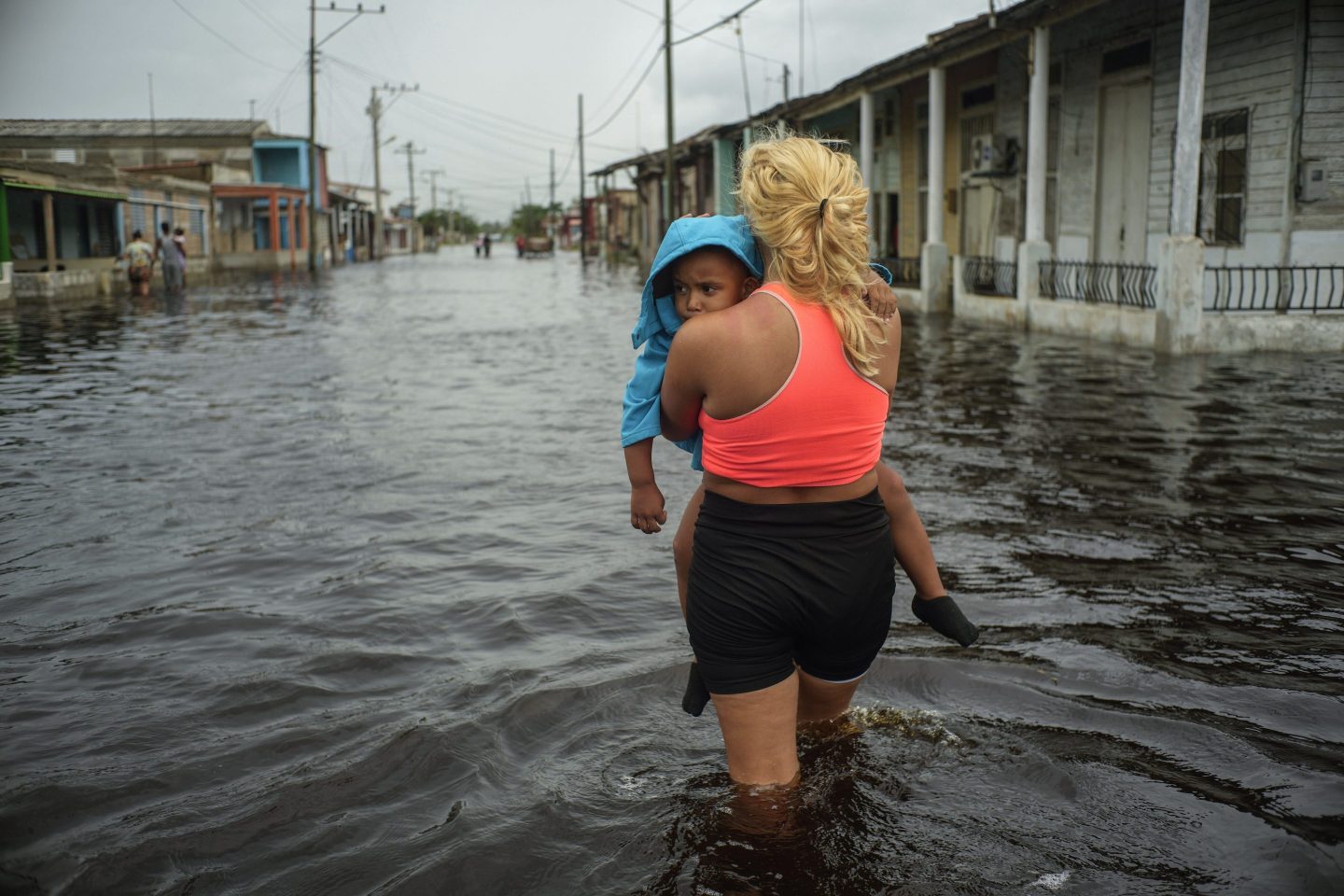
A woman carries a child as she wades through a street flooded in the passing of Hurricane Helene, in Batabano, Mayabeque province, Cuba, Sept. 26, 2024.
A woman carries a child as she wades through a street flooded in the passing of Hurricane Helene, in Batabano, Mayabeque province, Cuba, Sept. 26, 2024. Ramon Espinosa—AP

Human-caused climate change made Atlantic hurricanes about 18 miles per hour (29 kilometers per hour) stronger in the last six years, a new scientific study found Wednesday.

Recommended Video

For most of the storms — 40 of them — the extra oomph from warmer oceans made the storms jump an entire hurricane category, according to the study published in the journal, Environmental Research: Climate. A Category 5 storm causes more than 400 times the damage of a minimal Category 1 hurricane, more than 140 times the damage of a minimal Category 3 hurricane and more than five times the damage of a minimal Category 4 storm, according to the National Oceanic and Atmospheric Administration

For three storms, including this month’s Rafael, the climate change factor goosed wind speed so much that the winds increased by two storm categories.

This isn’t about more storms, but increasing power from the worst ones, authors said.

“We know that the intensity of these storms is causing a lot more catastrophic damage in general,” lead study author Daniel Gifford, a climate scientist at Climate Central, which does research on global warming. “Damages do scale (up) with the intensity.”

The effect was especially noticeable in stronger storms, including those that made it to the top of the Saffir-Simpson scale of storm intensity: Category Five, study authors said. The study looked at 2019 to 2023, but the authors then did a quick addition for the named storms this year, all of which had a bump up due to climate change.

“We had two Category Five storms here in 2024,” Gifford said. “Our analysis shows that we would have had zero Category Five storms without human-caused climate change.”

This year’s three most devastating storms — Beryl, Helene and Milton — increased by 18 mph (29 kph), 16 mph (26 kph) and 24 mph (39 mph) respectively because of climate change, the authors said. A different study by World Weather Attribution had deadly Helene’s wind speed increase by about 13 mph, which is close, said Imperial College of London climate scientist Friederike Otto, who coordinates the WWA team and praised the Climate Central work.

“It absolutely makes sense from a fundamental standpoint that what’s going on is we’ve added more energy to the system,” National Oceanic and Atmospheric Administration chief Rick Spinrad said at United Nations climate talks in Baku, Azerbaijan. “The change is going to manifest in terms of what we’re already seeing. You look at Hurricane Helene which was massive, 500 miles across. We’re going to see changes in terms of the velocity of these storms. We’re going to see changes in terms of Hurricane Milton spawning so many tornadoes.”

Since 2019, eight storms — 2019’s Humberto, 2020’s Zeta, 2021’s Sam and Larry, 2022’s Earl, 2023’s Franklin and 2024’s Isaac and Rafael — increased by at least 25 mph (40 kph) in wind speed. Humberto and Zeta gained the most: 31 miles per hour (50 kph).

In 85% of the storms studied in the last six years, the authors saw a fingerprint of climate change in storm strength, Gifford said.

Warm water is the main fuel of hurricanes. The warmer the Atlantic, Caribbean and Gulf of Mexico get, the more potential energy goes into storms. Other factors — such as high level crosswinds and dry air — can act to weaken hurricanes.

The waters in the hurricane area have increased by 2 to 3 degrees Fahrenheit (1.1 to 1.6 Celsius) in general and as much as 4 degrees (2.2 C) due to climate change, Gifford said. They know this because Climate Central has used scientifically accepted techniques to regularly track how much warmer oceans are because of the burning of coal, oil and natural gas.

That technique basically uses computer simulations to create a fictional world with no human-caused warming and then compares it to current reality, with the difference being caused by greenhouse gases. They account for other factors, such as the lessening amount of sulfate pollution from marine shipping which had been counteracting a bit of the warming before the skies cleared up more.

To go from warmer waters to stronger storms, the authors looked at a calculation called potential intensity, which is essentially the speed limit for any given storm based on the environmental conditions around it, Gifford said.

MIT hurricane expert and meteorology professor Kerry Emanuel, who pioneered potential intensity measurements, wasn’t part of the study but said it makes sense. It shows the increase in storm strength that he predicted would happen 37 years ago, he said.

Past studies have shown that climate change has made hurricanes intensify quicker, and slower moving, which causes even more rain to be dumped.
Fortune Brainstorm AI returns to San Francisco Dec. 8–9 to convene the smartest people we know—technologists, entrepreneurs, Fortune Global 500 executives, investors, policymakers, and the brilliant minds in between—to explore and interrogate the most pressing questions about AI at another pivotal moment. Register here.
About the Authors
By Seth Borenstein
See full bioRight Arrow Button Icon
By The Associated Press
See full bioRight Arrow Button Icon

Latest in Environment

coal
EnvironmentCoal
‘You have an entire culture, an entire community that is also having that same crisis’: Colorado coal town looks anxiously to the future
By Brittany Peterson, Jennifer McDermott and The Associated PressDecember 6, 2025
8 hours ago
data center
EnvironmentData centers
The rise of AI reasoning models comes with a big energy tradeoff
By Rachel Metz, Dina Bass and BloombergDecember 5, 2025
1 day ago
Jaguar
EnvironmentArizona
‘This species is recovering’: Jaguar spotted in Arizona, far from Central and South American core
By Susan Montoya Bryan and The Associated PressDecember 5, 2025
1 day ago
Steve Jobs holds up the first iPod Nano
Big TechApple
Apple is experiencing its biggest leadership shake-up since Steve Jobs died, with over half a dozen key executives headed for the exits
By Dave SmithDecember 5, 2025
1 day ago
Paul Atkins
CommentaryCorporate Governance
Turning public companies into private companies: the SEC’s retreat from transparency and accountability
By Andrew BeharDecember 5, 2025
1 day ago
Four years ago, BKV started buying up the two Temple power plants in Texas—located between Austin and Dallas—which now total 1.5 gigawatts of electricity generation capacity—enough to power more than 1.1 million homes, or a major data center campus. There is room to expand.
Energypower
How a Texas gas producer plans to exploit the ‘megatrend’ of power plants for AI hyperscalers
By Jordan BlumDecember 5, 2025
2 days ago

Most Popular

placeholder alt text
Big Tech
Mark Zuckerberg rebranded Facebook for the metaverse. Four years and $70 billion in losses later, he’s moving on
By Eva RoytburgDecember 5, 2025
1 day ago
placeholder alt text
Economy
Two months into the new fiscal year and the U.S. government is already spending more than $10 billion a week servicing national debt
By Eleanor PringleDecember 4, 2025
3 days ago
placeholder alt text
Success
Nvidia CEO Jensen Huang admits he works 7 days a week, including holidays, in a constant 'state of anxiety' out of fear of going bankrupt
By Jessica CoacciDecember 4, 2025
2 days ago
placeholder alt text
Success
‘Godfather of AI’ says Bill Gates and Elon Musk are right about the future of work—but he predicts mass unemployment is on its way
By Preston ForeDecember 4, 2025
2 days ago
placeholder alt text
AI
Nvidia CEO says data centers take about 3 years to construct in the U.S., while in China 'they can build a hospital in a weekend'
By Nino PaoliDecember 6, 2025
6 hours ago
placeholder alt text
Asia
Despite their ‘no limits’ friendship, Russia is paying a nearly 90% markup on sanctioned goods from China—compared with 9% from other countries
By Jason MaNovember 29, 2025
7 days ago
Rankings
  • 100 Best Companies
  • Fortune 500
  • Global 500
  • Fortune 500 Europe
  • Most Powerful Women
  • Future 50
  • World’s Most Admired Companies
  • See All Rankings
Sections
  • Finance
  • Leadership
  • Success
  • Tech
  • Asia
  • Europe
  • Environment
  • Fortune Crypto
  • Health
  • Retail
  • Lifestyle
  • Politics
  • Newsletters
  • Magazine
  • Features
  • Commentary
  • Mpw
  • CEO Initiative
  • Conferences
  • Personal Finance
  • Education
Customer Support
  • Frequently Asked Questions
  • Customer Service Portal
  • Privacy Policy
  • Terms Of Use
  • Single Issues For Purchase
  • International Print
Commercial Services
  • Advertising
  • Fortune Brand Studio
  • Fortune Analytics
  • Fortune Conferences
  • Business Development
About Us
  • About Us
  • Editorial Calendar
  • Press Center
  • Work At Fortune
  • Diversity And Inclusion
  • Terms And Conditions
  • Site Map

© 2025 Fortune Media IP Limited. All Rights Reserved. Use of this site constitutes acceptance of our Terms of Use and Privacy Policy | CA Notice at Collection and Privacy Notice | Do Not Sell/Share My Personal Information
FORTUNE is a trademark of Fortune Media IP Limited, registered in the U.S. and other countries. FORTUNE may receive compensation for some links to products and services on this website. Offers may be subject to change without notice.