• Home
  • Latest
  • Fortune 500
  • Finance
  • Tech
  • Leadership
  • Lifestyle
  • Rankings
  • Multimedia
LeadershipBusiness

Tom Brady schooled an auditorium full of CEOs on how to unlock greatness, even if you’re not a natural star

Geoff Colvin
By
Geoff Colvin
Geoff Colvin
Senior Editor-at-Large
Down Arrow Button Icon
Geoff Colvin
By
Geoff Colvin
Geoff Colvin
Senior Editor-at-Large
Down Arrow Button Icon
November 16, 2024, 5:00 AM ET
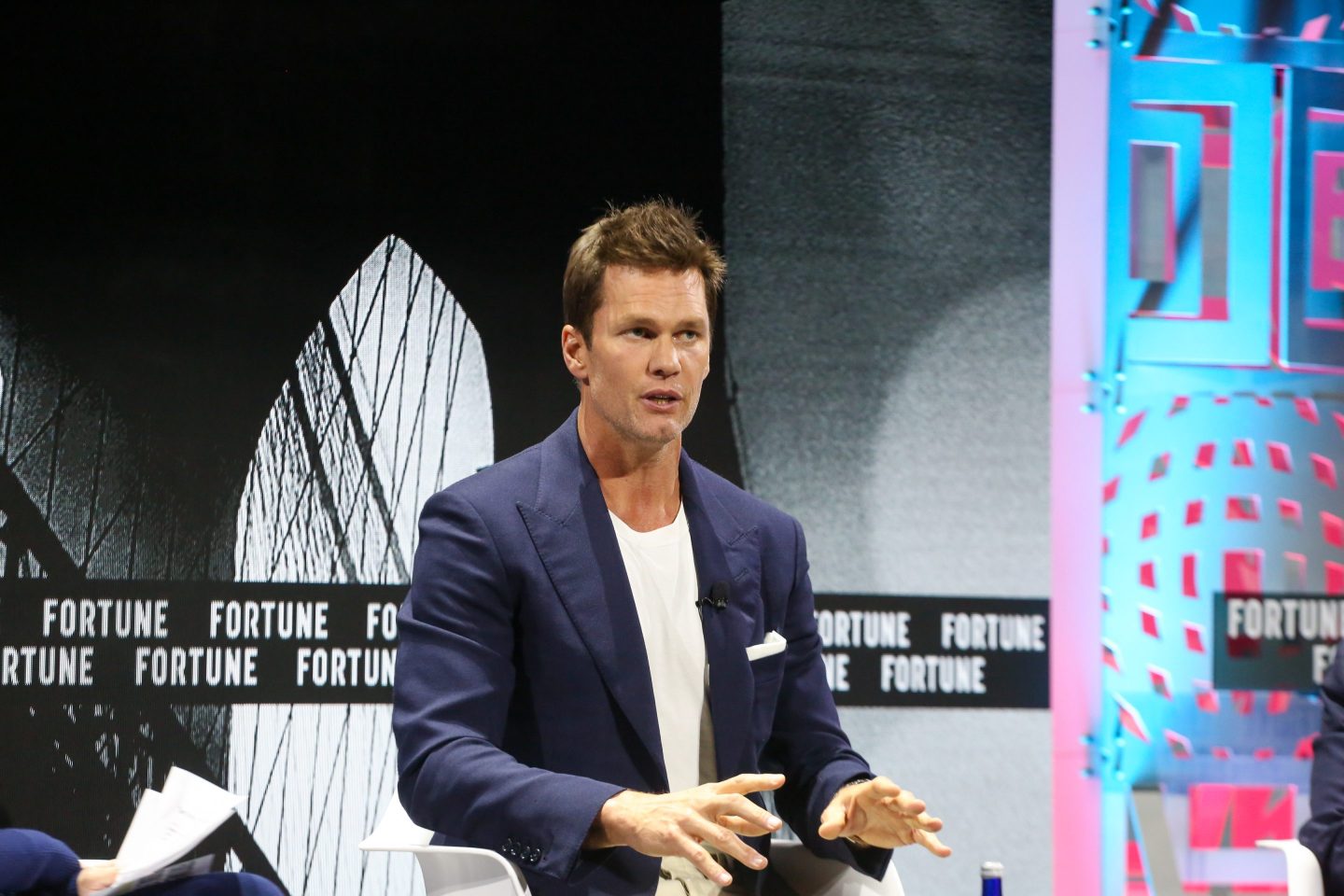
Fortune Global Forum 2024 Tuesday, November 12, 2024 New York, NY 2:25–2:55 PM TRUST AND TEAMWORK: A CEO PLAYBOOK In this exclusive closing conversation, football legend Tom Brady and Harvard Business School professor and leadership expert, Nitin Nohria, will discuss a key set of principles that business leaders can apply to help teams work together toward common goals–from creating a “culture of 100% effort” to recognizing unsung heroes and identifying motivational levers. As business leaders themselves, they also have unique insights on the trends that are shaping the world of business (and sports) today. Whether on the field or factory floor, in the classroom or the office, they’ll share why trust and teamwork is the secret to winning the game. Tom Brady, Seven-Time World Champion and Entrepreneur Nitin Nohria, Executive Chairman, Thrive Capital In conversation with: Alyson Shontell, Fortune Photograph by Rebecca Greenfield for Fortune
Tom Brady speaks at Fortune Global Forum in New York on Tuesday November 12.Rebecca Greenfield for Fortune

Tom Brady was speaking to some 200 CEOs, telling them how he became football’s greatest quarterback of all time. He was at the recent Fortune Global Forum in New York City, but he made only fleeting connections between his career and the CEOs’ jobs. That was clearly fine with the CEOs. He’s a football god with a great story to tell, and just hearing it was a thrill.

Recommended Video

Still, let’s hope the CEOs listened carefully. Whether they knew it or not, Brady’s story of a football career was a detailed tutorial on great performance at a CEO’s job. Decades of research have produced a prescription for excellent performance in any domain, and Brady’s life-long football experience matched that prescription exactly. While everyone’s story is unique, the factors that built Brady’s skills over several years are not. Research has shown that those same factors are the key to world-class performance broadly. It isn’t quick or easy; there is no magic. But what worked for Brady really does work for all of us in all we do.

The essence of his story is that he wasn’t a child prodigy quarterback, not a natural star—just the opposite. Review his journey to greatness and see if you notice a pattern:

· In high school “I was the backup quarterback on a freshman football team that didn’t win a game,” he said. “We sucked so bad, and they still wouldn’t put me on the field.” He became the starter as a sophomore because the previous starter decided he’d rather play basketball. Crucially, Brady “consulted a mentor of mine who taught me how to throw the football. Every single summer I’d go to his camp. I would continue to work on mechanics and techniques on my own.”

· He became good enough for the University of Michigan to recruit him, but as a freshman he was the team’s seventh-ranked quarterback. By the end of the year he had moved up to fourth. In the next year he worked his way up to third, then second. Through the year after that he remained the backup. In his fourth year he had to compete with a new recruit to become the starter, and he won that competition. Yet in his fifth year he again had to compete with another quarterback, finally becoming the starter in the season’s second half. In his thrilling final college game his team beat Alabama, coming back from two 14-point deficits.

· “Everyone must see now, at this point, I’m going to be a great NFL quarterback,” he recalled. “Nope. No way.” In the NFL draft he was the 199th pick, going to the New England Patriots, which he joined as the fourth-ranked quarterback. In his first year he worked his way up to third, in the next year up to second. Then the starting quarterback was badly injured and out for the season. Brady went in as the starter, “and I never went off the field after that.” At age 24, after ten years of intensive fighting his way up, he remained the starting quarterback for 19 seasons with the Patriots and three seasons with the Tampa Bay Buccaneers, winning a record seven Super Bowls and becoming the undisputed GOAT, the greatest of all time.

Brady was doing what the researchers call deliberate practice. It’s specifically defined and not practice as most of us conceive it. Its central feature is that it continually pushes you just beyond, but not way beyond, your current limits. You can’t improve if you practice only what you can already do, and you’re simply lost if you reach too far. As you improve, your practice must change, so you’re always forcing yourself to do what you can’t quite do. That’s what Brady was doing as he steadily climbed the multi-step ladder from backup high school quarterback to starting NFL quarterback to the greatest NFL quarterback.

Deliberate practice requires other elements as well. It must be repeated a lot, which eventually alters your brain, and you must receive continuous feedback. Brady met those requirements in high school with the mentor who taught him how to throw and then with high-level coaches at Michigan and in the NFL.

One more thing about deliberate practice: It isn’t fun. Hank Haney, Tiger Woods’s coach for several years, says Tiger was an example of deliberate practice, which Haney calls “the most difficult and highest level of practice because it requires painstaking focus on weaknesses…. The great improvers are willing to get uncomfortable and make the mental and physical effort to correct a flaw.” Brady was given ideal circumstances for deliberate practice, but he couldn’t have become great without a powerful inner drive that he had to find deep in himself.

Deliberate practice can even build leadership, though not in a way people might imagine. Brady’s team leadership was as important in his career as his own performance. His Patriots teammates elected him team captain for 18 seasons, and he was co-captain for two seasons with the Buccaneers. The reason goes to the essence of deliberate practice, the imperative of making oneself uncomfortable. “I played with a lot of athletes, and part of my role as a leader was to make these guys feel uncomfortable,” he said. “As great as they were, I was always focused on making sure they were working harder than they ever thought they could work.”

That’s the message Brady wanted those 200 CEOs to remember. “Hopefully you find people you love to work with, you push each other to succeed, you push each other outside your comfort zone,” he told them. “It’s okay to feel uncomfortable. Unless we stress our mind, it doesn’t grow.”


Join us at the Fortune Workplace Innovation Summit May 19–20, 2026, in Atlanta. The next era of workplace innovation is here—and the old playbook is being rewritten. At this exclusive, high-energy event, the world’s most innovative leaders will convene to explore how AI, humanity, and strategy converge to redefine, again, the future of work. Register now.
About the Author
Geoff Colvin
By Geoff ColvinSenior Editor-at-Large
LinkedIn iconTwitter icon

Geoff Colvin is a senior editor-at-large at Fortune, covering leadership, globalization, wealth creation, the infotech revolution, and related issues.

See full bioRight Arrow Button Icon

Latest in Leadership

HealthCommentary
Nicotine pouches offer huge promise—so long as the U.S. doesn’t repeat its mistake with vaping
By Max CunninghamDecember 14, 2025
18 hours ago
Thompson
C-SuiteMedia
Atlantic CEO Nick Thompson on how he learned to ‘just keep moving forward’ after his famous firing at 22
By Nick LichtenbergDecember 14, 2025
19 hours ago
Chess master and co-founder of Chess.com, Danny Rensch
SuccessEntrepreneurs
Chess.com cofounder says it took a pinch of delusion to bring the traditional game online—and it’s a ‘requirement for every successful entrepreneur’
By Emma BurleighDecember 14, 2025
21 hours ago
JPMorganChase CEO Jamie Dimon says AI will eliminate jobs—and that soft skills will be more important than ever.
Future of WorkTech
Jamie Dimon says soft skills like emotional intelligence and communication are vital as AI eliminates roles
By Nino PaoliDecember 14, 2025
23 hours ago
Nicholas Thompson
C-SuiteBook Excerpt
I took over one of the most prestigious media firms while training for an ultramarathon. Here’s what I learned becoming CEO of The Atlantic
By Nicholas ThompsonDecember 13, 2025
2 days ago
Lauren Antonoff
SuccessCareers
Once a college dropout, this CEO went back to school at 52—but she still says the Gen Zers who will succeed are those who ‘forge their own path’
By Preston ForeDecember 13, 2025
2 days ago

Most Popular

placeholder alt text
Success
40% of Stanford undergrads receive disability accommodations—but it’s become a college-wide phenomenon as Gen Z try to succeed in the current climate
By Preston ForeDecember 12, 2025
3 days ago
placeholder alt text
Success
Apple cofounder Ronald Wayne sold his 10% stake for $800 in 1976—today it’d be worth up to $400 billion
By Preston ForeDecember 12, 2025
3 days ago
placeholder alt text
Uncategorized
Transforming customer support through intelligent AI operations
By Lauren ChomiukNovember 26, 2025
18 days ago
placeholder alt text
Economy
More financially distressed farmers are expected to lose their property soon as loan repayments and incomes continue to falter
By Jason MaDecember 13, 2025
1 day ago
placeholder alt text
Energy
Everything the Trump administration is doing in Venezuela involves oil and regime change—even if the White House won’t admit it
By Jordan BlumDecember 14, 2025
20 hours ago
placeholder alt text
Economy
Tariffs are taxes and they were used to finance the federal government until the 1913 income tax. A top economist breaks it down
By Kent JonesDecember 12, 2025
3 days ago
Rankings
  • 100 Best Companies
  • Fortune 500
  • Global 500
  • Fortune 500 Europe
  • Most Powerful Women
  • Future 50
  • World’s Most Admired Companies
  • See All Rankings
Sections
  • Finance
  • Leadership
  • Success
  • Tech
  • Asia
  • Europe
  • Environment
  • Fortune Crypto
  • Health
  • Retail
  • Lifestyle
  • Politics
  • Newsletters
  • Magazine
  • Features
  • Commentary
  • Mpw
  • CEO Initiative
  • Conferences
  • Personal Finance
  • Education
Customer Support
  • Frequently Asked Questions
  • Customer Service Portal
  • Privacy Policy
  • Terms Of Use
  • Single Issues For Purchase
  • International Print
Commercial Services
  • Advertising
  • Fortune Brand Studio
  • Fortune Analytics
  • Fortune Conferences
  • Business Development
About Us
  • About Us
  • Editorial Calendar
  • Press Center
  • Work At Fortune
  • Diversity And Inclusion
  • Terms And Conditions
  • Site Map

© 2025 Fortune Media IP Limited. All Rights Reserved. Use of this site constitutes acceptance of our Terms of Use and Privacy Policy | CA Notice at Collection and Privacy Notice | Do Not Sell/Share My Personal Information
FORTUNE is a trademark of Fortune Media IP Limited, registered in the U.S. and other countries. FORTUNE may receive compensation for some links to products and services on this website. Offers may be subject to change without notice.