JP Morgan Chase CEO Jamie Dimon attended a ribbon-cutting ceremony this fall for the opening of a new kind of branch in the Brooklyn neighborhood of Bedford-Stuyvesant. Though the most successful banker in America doesn’t attend many branch openings, Dimon made a point to stop by this one as part of JP Morgan’s broader push to help those in lower income neighborhoods build wealth.
Banks have long been obliged by federal law to open locations in low-income neighborhoods. But these branches, called community centers, take a more hands-on approach, teaching residents how to build credit, take out loans and become the kinds of customers that help the bank turn a profit. If not for the sounds of ATMs dinging in the background, the branches’ auditorium-style classes would feel more like startup incubators than banks.
‘They’re bringing their assets’
There’s now 19 of these community center branches in low-income neighborhoods around the country, including one in Crenshaw, L.A., the south side of Chicago, and Detroit—and JP Morgan plans to open a hundred more in the coming years. Meanwhile, just down the street from the Harlem location where JP Morgan opened its first community center in 2019, Wells Fargo has opened a nearly identical financial outlet, and each of the three largest banks in America now has similar endeavors in place.
At stake is more than just the financial well-being of the six million American households the FDIC estimates have no access to a bank account, but the billions of dollars generated by venture backed startups and payday lenders that many view as predatory.
Diedra Porché, 55, JPMorgan Chase’s national head of community and business development, says helping educate the unbanked is just good business. “What we’ve seen is that with the right financial information workshops, with a branch, candidly, that people want to come into and feel welcome at, they’re bringing their assets, and others are too. What you end up with is a profitable branch and a profitable model.”
Refining the model
Long before the first Chase community center opened, the bank sent a team of bankers into Harlem to try to learn why so many people walked right past the 12 branches that were already there. The problem, they learned, started at the doors, where many Harlem residents literally didn’t feel welcome. The new branches are emblazoned with the name of each community beside the Chase branding, designed by local architects, and decorated with local artwork.
At the Harlem branch, the doors of the giant steel-reinforced concrete safe have been permanently opened to the public. Nestled between a wood panel wall that once adorned the Harlem home of jazz legend Billy Holiday and a wall of hundreds of decommissioned safety deposit boxes is a board room table open to the public, and built from the reclaimed wood of Harlem bowling alleys. In October, real estate broker Sandy Edry, 56, spoke about how he grew his Harlem real estate agency, The Edry Team, to sell $75 million worth of real estate annually.
“In a city as big as New York,” Edry says, “it’s very easy to forget that we live in neighborhoods where people still have a lot of the same values and are looking for opportunities.”
The model is working, according to a JPMorgan report. While 30% of JPMorgan branches are in low-income areas, checking account openings at community center branches were 16% higher than regular branches. Personal savings at community center branches grew 73% more than at traditional branches. Since the community center branch model launched in 2019, according to an investor report, the emerging market segment in which community centers sit, has been JPMorgan’s fastest growing area, and is expected to break even in four years.
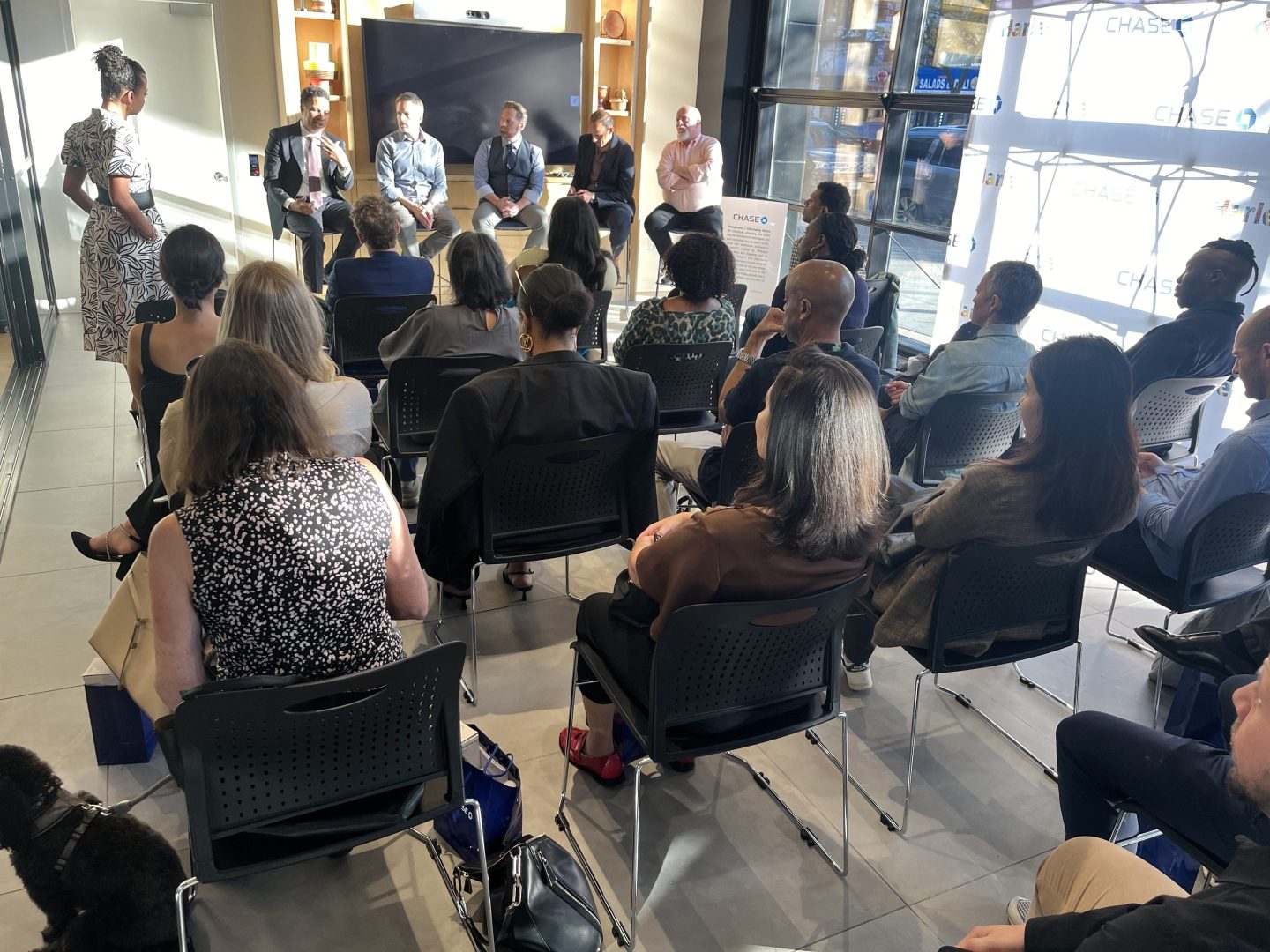
A short walk from the Harlem location, in April 2022, Wells Fargo opened the first of its own version of a community center bank, called a Hope Inside Center, that offers free one-on-one financial guidance to locals. In partnership with the non-profit Operation Hope, Wells Fargo plans to have 50 such branches by 2026. Bank of America has 420 Hope Inside Centers, and on average, locals improved their FICO scores by 21 points, increased their yearly savings by $4,313 and reduced their annual debt by $837, according to a statement.
The more hands-on approach appears to be working. The FDIC last year reported that a record of 96% of American houses now have access to banking services. The Washington DC-based non-profit, Bank Policy Institute, chaired by Jamie Dimon, reported that when adjusted for population distribution the 14 largest banks in America actually opened more branches in low- to middle-income neighborhoods than in middle to upper income areas. BPI’s head of research, Francisco Covas, says so-called banking deserts where residents don’t have access to a bank, are a “mirage.”
Oases in the desert?
Not everyone is convinced, however, that community banks are what they’re cracked up to be. Jesse Van Tol is CEO of the National Community Reinvestment Coalition, which researches wealth in America. In February 2022 the NCRC published a report in the wake of the Great Recession showing that banks merging with other banks and closing down redundant branches had reduced the number of branches in low-to-middle income areas.
Though the BPI and others have long argued that bank mergers free up cash to invest in technology that lowers the cost of banking, Van Tol says low-to-moderate income areas are especially hard hit by bank closures and the technology intended to replace brick-and-mortar branches leaves little recourse for customers with more complex banking needs. “Banks may have cracked the code on profitability,” says Van Tol. “But you’d have to be nuts to believe that banking deserts don’t exist.”
The absence of banks in many of these neighbohood has proven a tempting business opportunity for many an innovator and huckster. Since 2014, financial technology startups have raised $593 billion to take on traditional financial firms, according to Crunchbase data, and Banking-as-a-Service (BaaS) startups specifically targeting banks have raised $3.7 billion. Predatory payday lenders that can charge more than 400% APR, are on track to generate $6.8 billion by 2030, predicts Horizon Grand View Research.
Banks figuring out how to safely serve those people profitably—or teach them how to build their credit—would undercut many of those business models.
Ironically, the secret to JPMorgan Chase’s success might not be repeatable. Though Porché declined to share Chase customer acquisition costs, she says it’s JPMorgan’s size that helps make serving low-income areas profitable. The bank, with 4,700 locations around the world, is the product of dozens of mergers and acquisitions, including most prominently Chase Manhattan Bank, in 2000, and most recently, First Republic, in 2024. And it’s only getting bigger. In February the bank announced a “multi-billion dollar” investment to build more than 500 branches and renovate 1,700 over the next three years.
“We have scale and size on our side, and so the fact that we do have this vast distribution is key,” says Porché. “Our capital is patient. We can make this investment and build trust, and hopefully earn your trust so that you’ll be a customer for life.”