American voters are approaching the presidential election with deep unease about what could follow, including the potential for political violence, attempts to overturn the election results and its broader implications for democracy, according to a new poll.
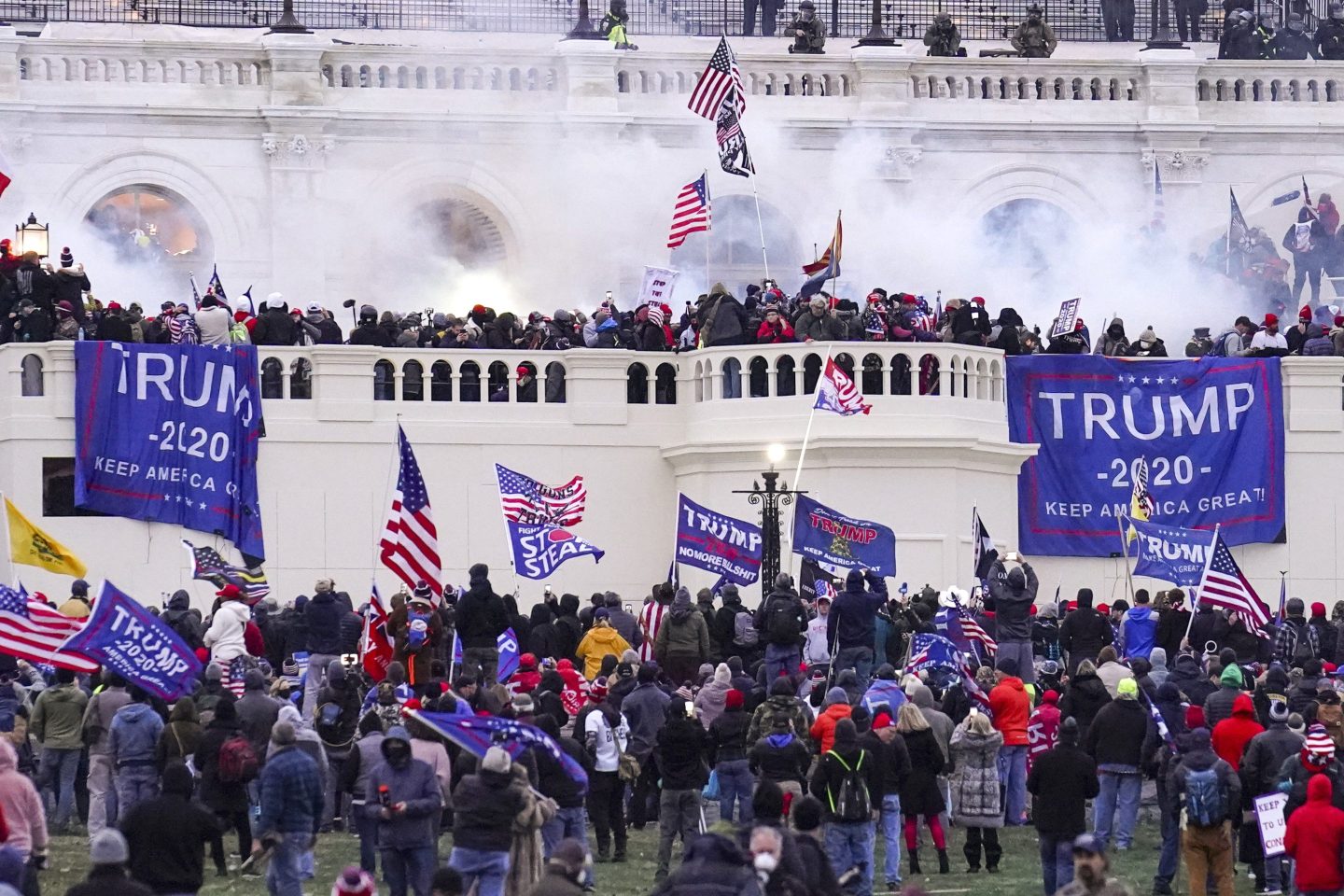
The findings of the survey, conducted by The Associated Press-NORC Center for Public Affairs Research, speak to persistent concerns about the fragility of the world’s oldest democracy, nearly four years after former President Donald Trump’s refusal to accept the 2020 election results inspired a mob of his supporters to storm the U.S. Capitol in a violent attempt to stop the peaceful transfer of power.
About 4 in 10 registered voters say they are “extremely” or “very” concerned about violent attempts to overturn the results after the November election. A similar share is worried about legal efforts to do so. And about 1 in 3 voters say they are “extremely” or “very” concerned about attempts by local or state election officials to stop the results from being finalized.
Relatively few voters — about one-third or less — are “not very” or “not at all” concerned about any of that happening.
Trump has continued to lie about fraud costing him reelection four years ago and is again forecasting that he can lose this time only if the election is rigged against him, a strategy he has deployed since his first run for office. His allies and the Republican National Committee, which he reshaped, have filed lawsuits around the country that are a potential prelude to post-election legal challenges should he lose.
“I thought after Jan. 6 of 2021, the GOP would have the sense to reject him as a candidate,” Aostara Kaye, of Downey, California, said of Trump. “And since they didn’t, I think it just emboldened him to think he can do anything, and they will still stick with him.”
Many voters think Trump won’t concede if he loses
Trump’s wide-ranging attempts to reject the will of the voters and remain in power after his 2020 loss have led to concerns that he will again fail to concede should he lose to Vice President Kamala Harris.
Nearly 9 in 10 voters said the loser of the presidential election is obligated to concede once every state has finished counting its votes and legal challenges are resolved, including about 8 in 10 Republicans. But only about one-third of voters expect Trump to accept the results and concede if he loses.
Democrats and Republicans have widely divergent views on the matter: About two-thirds of Republican voters think Trump would concede, compared to only about 1 in 10 Democrats.
The same concern does not apply to Harris. Nearly 8 in 10 voters said Harris will accept the results and concede if she loses the election, including a solid majority of Republican voters.
Democrats and Republicans divided on who would weaken democracy
Members of both parties have broad concerns about how American democracy might fare depending on the outcome of the November election.
Overall, about half of voters believe Trump would weaken democracy in the U.S. “a lot” or “somewhat” if he wins, while about 4 in 10 said the same of Harris.
Not surprisingly, Americans were deeply divided along ideological lines. About 8 in 10 Republicans said another term for Trump would strengthen democracy “a lot” or “somewhat,” while a similar share of Democrats said the same of a Harris presidency.
About 9 in 10 voters in each party said the opposing party’s candidate would be likely to weaken democracy at least “somewhat” if elected.
Kaye, a retired health care system worker, called Trump an “existential threat to the Constitution.” One prospect she said frightens her is that if Trump wins, he likely will not have the guardrails in his new administration that were in place in the last one.
Republican voter Debra Apodaca, 60, from Tucson, Arizona, said it’s Harris who is a greater threat to democracy. She said President Joe Biden’s administration has placed too great a priority on foreign aid and shown a lack of concern for its own people.
“Our tax dollars, we’re just sending it everywhere. It’s not staying here. Why aren’t we taking care of America?” she said. “Why should we pay taxes if we’re just sending it away?”
That lack of concern also includes the border, she said, adding that a Harris win would be “the end to the Border Patrol.”
The January 6th attack on the Capitol is a dividing line
Part of what divides voters on their views of American democracy is the Jan. 6 attack on the U.S. Capitol and who is to blame. Democrats and independents are much more likely than Republican voters to place “a great deal” or “quite a bit” of responsibility on Trump.
Susan Ohde, an independent voter from Chicago and a retiree from the financial sector, said she’s concerned that “crazy people will buy the misinformation that they’re given,” leading to another such attack.
Giovanna Elizabeth Minardi of Yucaipa, California, said other issues are more important in this year’s election. She said her chief concern is the economy and feels that high prices, especially in her home state, are chasing off businesses and creating a dependency on government. It’s a dependency Harris wants to continue, said Minardi, a children and family services advocate.
Views about the Jan. 6 attack are not the only ones where voters split along ideological lines. Following Trump’s lead, a majority of Republicans maintain that Biden was not legitimately elected. Nearly all Democrats and about 7 in 10 independents believe Biden was legitimately elected.
Other aspects of the political system are divisive too
This year’s presidential campaign has highlighted one aspect of the American political system that some believe is undemocratic — the use of the Electoral College to elect the president rather than the popular vote. Trump and Harris have concentrated their campaign events and advertising in seven battleground states that represent just 18% of the country’s population.
About half of voters think the possibility that a candidate could become president by winning the Electoral College but losing the popular vote is a “major problem” in U.S. elections. As with many other issues, the question also reveals a partisan divide: About two-thirds of Democrats say the potential for an Electoral College-popular vote split is a major problem, compared to about one-third of Republicans.
Debra Christensen, 54, a home health nurse and Democrat from Watertown, Wisconsin, is opposed to the Electoral College that could give Trump the White House even if he loses the popular vote for the third time.
“In this day and age with technology what it is, why can’t we have one person one vote?” she said.
The poll of 1,072 adults was conducted Oct. 11-14, 2024, using a sample drawn from NORC’s probability-based AmeriSpeak Panel, which is designed to be representative of the U.S. population. The margin of sampling error for registered voters is plus or minus 4.2 percentage points.