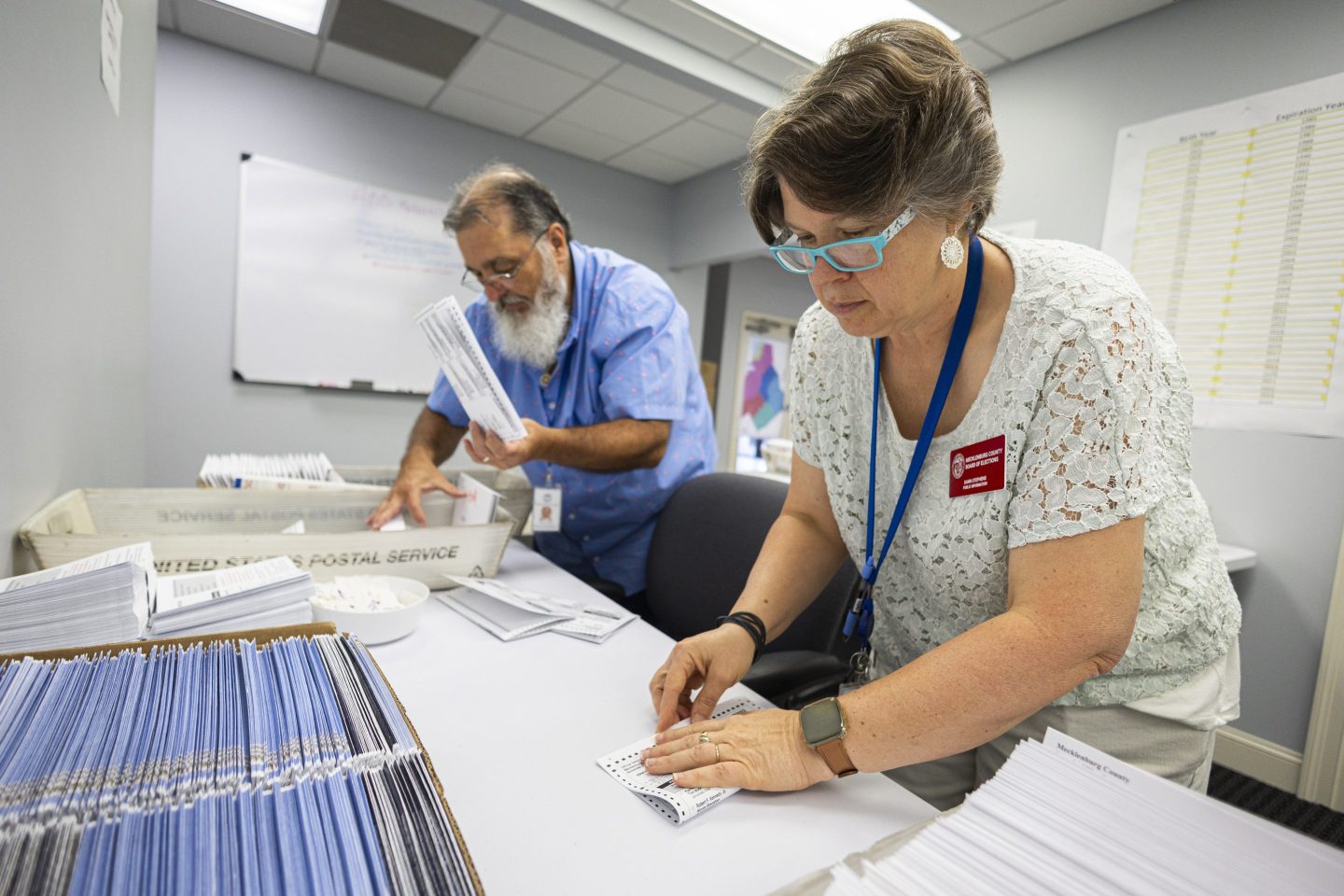
The latest method of voting to fall into the political crosshairs is the way overseas voters — including members of the military stationed abroad — cast their ballots.
The process is governed by federal law and implemented by states. In recent weeks, Republicans have been challenging how states handle these voters, something former President Donald Trump didn’t do in 2020 when he and his allies challenged his loss in court.
But things have changed, with just a month before Election Day and a tight race between Trump and Vice President Kamala Harris. It’s part of a broader legal strategy by Republicans to position themselves for post-election challenges should Trump lose.
Ballots already have been sent to overseas and military voters under a federally mandated deadline. Trump and his Republican allies contend these ballots could be part of an elaborate scheme to steal the election from him, a claim for which there is no evidence. Their challenge comes as the voters who receive the ballots are increasingly from groups that are presumed to be Democratic.
Here’s a look at the issues involved and what’s driving the claims.
Who are these voters?
Congress passed a law in 1986 that was signed by then-President Ronald Reagan requiring states to allow certain groups of citizens to register and vote absentee in federal elections. Known as the Uniformed and Overseas Citizens Absentee Voting Act, or UOCAVA, it applies to military members, their family and U.S. citizens living outside the country.
In 2020, states sent more than 1.2 million ballots to military and overseas voters. Of those, more than 900,000 were returned and nearly 890,000 were counted, according to data collected by the U.S. Election Assistance Commission.
Before 2016, military members and eligible family members represented most of these voters, according to the commission. But that has shifted slightly. In 2020, overseas citizens accounted for 57.4% of the registered voters. Overall, 40% of all military and overseas ballots were cast in three states: California, Florida and Washington.
That shift explains why Trump and other Republicans may be turning on the program. While military voters are presumed to vote for the GOP, other overseas voters are widely assumed to lean Democratic. This year, for the first time, the Democratic Party is spending money to try to turn them out.
The Federal Voting Assistance Program, which supports military and overseas voters, estimates that 2.8 million U.S. citizens of voting age were living overseas in 2022.
Election officials who receive their applications “do everything they can to verify that these are eligible voters and not just persons without any kind of identification,” said Election Assistance Commission member Christy A. McCormick.
How do overseas voters register and cast ballots?
Federal law allows qualified military or overseas voters to register to vote and request an absentee ballot at the same time, using what is known as the federal postcard application, which can be submitted electronically in many states. This is aimed at addressing the challenges military and overseas voters can face, such as slow or even unavailable mail delivery. Other accommodations include requiring states to have a system for delivering ballots electronically.
The federal postcard application asks applicants to provide their name, address, birth date, Social Security number and driver’s license. That information is logged and checked based on state procedures, according to Tammy Patrick, a former election official with the National Association of Election Officials.
“It’s not the case that anyone in the world can apply for a ballot. They still have to demonstrate they are an eligible American citizen,” she said.
Each person completing the form must also sign an oath under penalty of perjury that the information is correct, that they are a U.S. citizen, that they are not disqualified from voting and are not requesting a ballot or voting in any other jurisdiction in the U.S.
Unlike other voters, overseas voters can use an address where they have not lived for several years.
All but 13 states allow U.S. citizens born overseas but who have never lived in the U.S. to register and vote using a parent’s last residential address, according to data collected by the Election Assistance Commission.
What are the Republicans’ claims?
In Pennsylvania, a group of Republican members of Congress is asking a federal judge to order county elections officials to verify the identity and eligibility of military and overseas voters. They also want ballots cast by those voters to be kept apart from other ballots for the Nov. 5 election.
The lawsuit claims current practices have created “an illegally structured election process which makes Pennsylvania’s elections vulnerable to ineligible votes by individuals or entities who could purport to be UOCAVA-eligible.”
Out of nearly 27,000 military and overseas ballots cast in Pennsylvania in 2020, 1,363 — or 5% — were rejected. That’s a higher rejection rate than all but one state, according to federal data.
The lawsuits filed by the Republican National Committee argue that Michigan and North Carolina should not be allowing overseas voters who have never lived in their state to vote.
Why are these claims being raised now?
The warnings about overseas ballot fraud join a very long list of Trump allegations of rampant fraud in U.S. elections, even though there has been no evidence of any widespread fraud. Reviews, recounts and audits in the battleground states where Trump disputed his 2020 loss all affirmed President Joe Biden’s victory, and his own attorney general said there was no evidence of fraud that could have tipped the election.
Trump has claimed without evidence that huge numbers of non-citizens vote, that mail ballots are forged and that voting machines are secretly programmed against him. The goal has been to sow doubt about the reliability of any election he loses, enabling him to try to overturn his defeat.
Politically, Trump has tried to distinguish between military voters, who traditionally vote Republican, and other overseas voters. The Democratic Party in August announced it planned to spend about $300,000 trying to turn out overseas voters on behalf of Harris, its first expenditure on that group.
“They want to dilute the TRUE vote of our beautiful military and their families,” Trump claimed of Democrats in a Sept. 23 post on his social media network.
It’s likely, though, that challenges to these voters would carry consequences for both groups, including the military voters that Republicans routinely count on to pad their totals in close elections.
A spokesperson for the Republican National Committee said the litigation is aimed at preventing unlawful votes from diluting lawful ones.
“The point of the election integrity lawsuits is to fix the holes that we know exist as much as possible before the election,” RNC spokesperson Claire Zunk said.
What do election officials say?
With less than a month before the Nov. 5 election, now is not the time to raise objections to state law that has been in place for 13 years, said Patrick Gannon, a spokesman for the North Carolina State Board of Elections.
“This lawsuit was filed after voting had already begun in North Carolina for the general election,” Gannon said in a statement. “The time to challenge the rules for voter eligibility is well before an election, not after votes have already been cast.”
In Michigan, the relevant state laws and procedures also have been on the books for years, according to state election officials. A state law passed in 1995 says a spouse or dependent of an overseas voter who is a U.S. citizen can register using their parent’s or spouse’s Michigan address.
State election officials said local offices follow standard procedures to check the identity of all those seeking to register to vote in Michigan. That includes military and overseas voters, who are required to renew their status every year. Their ballots also are subject to the same checks as those cast by non-military and overseas voters, including signature verification.
“This is not a legitimate legal concern — just the latest in the RNC’s PR campaign to spread unfounded distrust in the integrity of our elections,” said Angela Benander, spokeswoman for the Michigan secretary of state’s office.
In Pennsylvania, ballots cast by ineligible voters occur at “extremely low” rates and are investigated, said Matt Heckel, spokesman for the state election office. Heckel said anyone who lies on the form faces substantial penalties, including a potential felony conviction, prison sentence and fine.
The Democratic National Committee has filed a motion to dismiss the Pennsylvania case.
“Plaintiffs’ inexcusably belated request for relief in the middle of an election would create chaos for election administration, confuse voters and potentially disenfranchise tens of thousands of eligible Pennsylvanians who wear their nation’s uniform or are otherwise living overseas,” the DNC said in its brief.