
• Home
  • Latest
  • Fortune 500
  • Finance
  • Tech
  • Leadership
  • Lifestyle
  • Rankings
  • Multimedia
FinanceEconomy

U.S. economy is on the cusp of another Roaring ’20s, says UBS

Eleanor Pringle
By
Eleanor Pringle
Eleanor Pringle
Senior Reporter, Economics and Markets
Down Arrow Button Icon
Eleanor Pringle
By
Eleanor Pringle
Eleanor Pringle
Senior Reporter, Economics and Markets
Down Arrow Button Icon
October 1, 2024, 6:39 AM ET
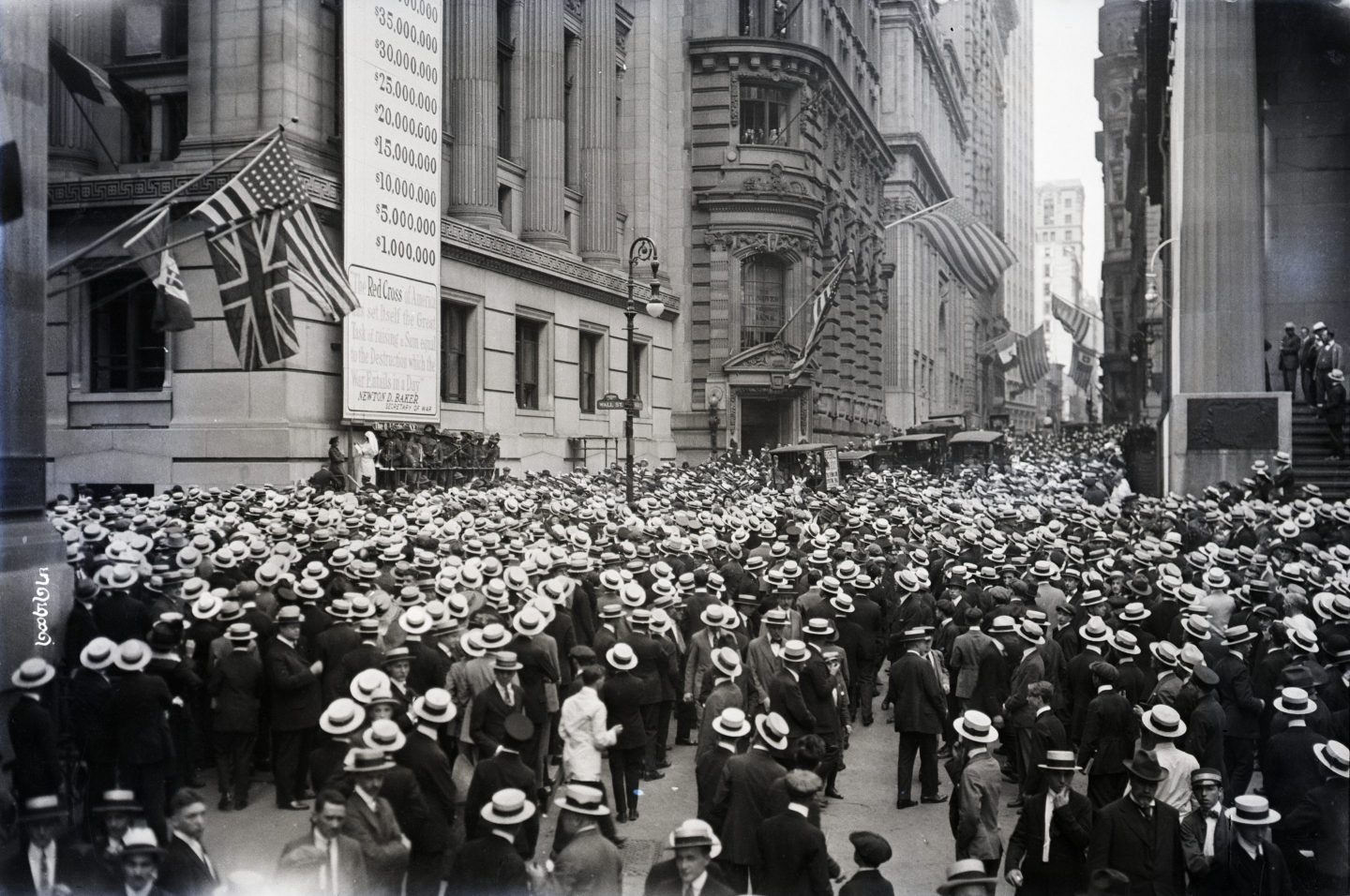
Crowd at Wall Street watching Red Cross Fund swell.
A bustling Wall Street in 1923.Bettmann / Contributor - Getty Images

The American economy is seemingly fairing so well that UBS has signaled a potential return to the glory days.

The European finance giant believes Uncle Sam is inching closer to a “Roaring ’20s” scenario, placing the likelihood of an incoming booming economic cycle at 50%.

The phrase harkens back to the same decade a century ago, when massive economic growth prompted a construction boom and rising prosperity for families.

With the benefit of hindsight, the 1920s had the hallmarks of a strong economic cycle: a wider adoption of electricity and automobiles, as well as a postwar boom in consumption.

At the time, the average person may not have realized their luck—and this is the phenomenon the U.S. finds itself in at present, writes Jason Draho, head of asset allocation Americas at UBS.

While economists are concerned about a potential rise in unemployment, a recession, or stagflation, Draho argues the balance is only tipping higher toward a period of prosperity for Americans.

In a note released yesterday, Draho wrote that by the bank’s criteria the U.S. economy is already in another Roaring ’20s.

He said: “It’s no longer too soon nor too optimistic to suggest that the US will experience a Roaring ‘20s economy. It already is by our criteria, with the relevant question being whether these conditions will continue, not whether they will materialize.

“The odds continue to rise for this bull-case scenario, with many recent developments on the demand side, supply side, and monetary policy all supportive.”

Investors are increasingly coming around to a soft-landing consensus, he added.

A September survey of 37 economists from the Financial Times found the majority did not expect to see a contraction in the next couple of years.

The survey—and its optimistic outlook—took place ahead of the Fed’s anticipated rate cut last month, which markets have since seen as a rebalancing toward the unemployment side of the Federal Open Market Committee’s (FOMC) mandate, thus ensuring a level of productivity and activity.

“The way things have been trending, it’s quite possible that by early 2025 only the most pessimistic investors will need rose-colored glasses to see a clear path to a Roaring ‘20s outcome,” Draho added.

Powell’s 2% target

Draho outlined UBS’s criteria to officially declare the 2020s a “Roaring ’20s”: sustained GDP growth of 2.5% or higher, inflation in the 2-3% range, a Fed funds rate around 3.5%, and the 10-year Treasury yield around 4%. 

According to the Bureau of Economic Analysis, real GDP for Q2 2024 increased at an annual rate of 3%—ticking the first box.

Following Jerome Powell’s intense wrangle with inflation, the 12-month CPI percentage for August 2024 came in at 2.5%—ticking the second box.

The fed funds rate—despite a higher-than-expected cut last month—sits above UBS’s threshold at 4.75% to 5%.

And in a bid to foster employment—and as a result productivity and consumer spending—Draho believes the Fed might have to compromise on its target inflation rate of 2%.

It’s a notion the likes of JPMorgan CEO Jamie Dimon has already floated, with Draho adding: “The relevance for the Roaring ’20s outcome is that the Fed signaled a strong desire to preserve the soft landing and maintain full employment, even if it means inflation descends more gradually back to 2%.”

The FOMC would never publicly admit it would accept inflation above 2%, Draho added but countered: “A 50bps rate cut is not an explicit signal that the Fed is targeting this outcome, but the bread crumbs suggest a policy reaction function that is directionally supportive of a Roaring ’20s outcome.”

Unemployment is the sticking point

Rising unemployment has been the factor which has caused even the more hawkish members of the FOMC to pause.

The Sahm Rule—which in the past has been accurate in predicting when an economy will enter a recession—was triggered back in July.

The Sahm Rule looks at two factors: the current three-month moving average of U.S. unemployment and the lowest three-month moving average of U.S. unemployment over the past year.

If the current average is higher than the lowest average by more than half a percentage point, the American economy is headed for a recession. Its latest reading for August sits at 0.57 pp.

Draho admits that the labor market could prove to be the snag in America’s return to an economic heyday, writing: “Cooling over the past six months has done more than just rebalance the labor market, it has left it looser than it was pre-pandemic.”

“The U.S. election and the escalating war in the Middle East are also sources of potential risks,” adds Draho.

Of course, the original Roaring ’20s had their end as well. The Great Depression kicked off with the Black Tuesday Wall Street stock market crash in October 1929.

Join us at the Fortune Workplace Innovation Summit May 19–20, 2026, in Atlanta. The next era of workplace innovation is here—and the old playbook is being rewritten. At this exclusive, high-energy event, the world’s most innovative leaders will convene to explore how AI, humanity, and strategy converge to redefine, again, the future of work. Register now.
About the Author
Eleanor Pringle
By Eleanor PringleSenior Reporter, Economics and Markets
LinkedIn icon

Eleanor Pringle is an award-winning senior reporter at Fortune covering news, the economy, and personal finance. Eleanor previously worked as a business correspondent and news editor in regional news in the U.K. She completed her journalism training with the Press Association after earning a degree from the University of East Anglia.

See full bioRight Arrow Button Icon

Latest in Finance

Real EstateHousing
A ‘new era’ in the housing market is about to begin as affordability finally improves ‘for the first time in a bunch of years,’ economist says
By Jason MaDecember 14, 2025
2 hours ago
Middle EastMilitary
Attacker who killed US troops in Syria was a recent recruit to security forces and was suspected of Islamic State ties prior to shooting
By Abby Sewell and The Associated PressDecember 14, 2025
4 hours ago
AsiaChina
The Asian Infrastructure Investment Bank’s first president defends China’s role as ‘responsible stakeholder’ in a less multilateral world
By Nicholas GordonDecember 14, 2025
5 hours ago
PoliticsDonald Trump
Trump admits he can’t tell if the GOP will control the House after next year’s elections. ‘I don’t know when all of this money is going to kick in’
By Jason MaDecember 14, 2025
5 hours ago
EconomyFederal Reserve
Kevin Hassett says he’d be happy to talk to Trump everyday as Fed chair, but the president’s opinion would have ‘no weight’ on the FOMC
By Jason MaDecember 14, 2025
7 hours ago
Investingspace
Alphabet poised for another paper gain as SpaceX valuation jumps
By Edward Ludlow and BloombergDecember 14, 2025
9 hours ago

Most Popular

placeholder alt text
Success
Apple cofounder Ronald Wayne sold his 10% stake for $800 in 1976—today it’d be worth up to $400 billion
By Preston ForeDecember 12, 2025
2 days ago
placeholder alt text
Success
40% of Stanford undergrads receive disability accommodations—but it’s become a college-wide phenomenon as Gen Z try to succeed in the current climate
By Preston ForeDecember 12, 2025
2 days ago
placeholder alt text
Economy
Tariffs are taxes and they were used to finance the federal government until the 1913 income tax. A top economist breaks it down
By Kent JonesDecember 12, 2025
3 days ago
placeholder alt text
Uncategorized
Transforming customer support through intelligent AI operations
By Lauren ChomiukNovember 26, 2025
18 days ago
placeholder alt text
Economy
More financially distressed farmers are expected to lose their property soon as loan repayments and incomes continue to falter
By Jason MaDecember 13, 2025
1 day ago
placeholder alt text
Economy
The Fed just ‘Trump-proofed’ itself with a unanimous move to preempt a potential leadership shake-up
By Jason MaDecember 12, 2025
2 days ago
Rankings
  • 100 Best Companies
  • Fortune 500
  • Global 500
  • Fortune 500 Europe
  • Most Powerful Women
  • Future 50
  • World’s Most Admired Companies
  • See All Rankings
Sections
  • Finance
  • Leadership
  • Success
  • Tech
  • Asia
  • Europe
  • Environment
  • Fortune Crypto
  • Health
  • Retail
  • Lifestyle
  • Politics
  • Newsletters
  • Magazine
  • Features
  • Commentary
  • Mpw
  • CEO Initiative
  • Conferences
  • Personal Finance
  • Education
Customer Support
  • Frequently Asked Questions
  • Customer Service Portal
  • Privacy Policy
  • Terms Of Use
  • Single Issues For Purchase
  • International Print
Commercial Services
  • Advertising
  • Fortune Brand Studio
  • Fortune Analytics
  • Fortune Conferences
  • Business Development
About Us
  • About Us
  • Editorial Calendar
  • Press Center
  • Work At Fortune
  • Diversity And Inclusion
  • Terms And Conditions
  • Site Map

© 2025 Fortune Media IP Limited. All Rights Reserved. Use of this site constitutes acceptance of our Terms of Use and Privacy Policy | CA Notice at Collection and Privacy Notice | Do Not Sell/Share My Personal Information
FORTUNE is a trademark of Fortune Media IP Limited, registered in the U.S. and other countries. FORTUNE may receive compensation for some links to products and services on this website. Offers may be subject to change without notice.