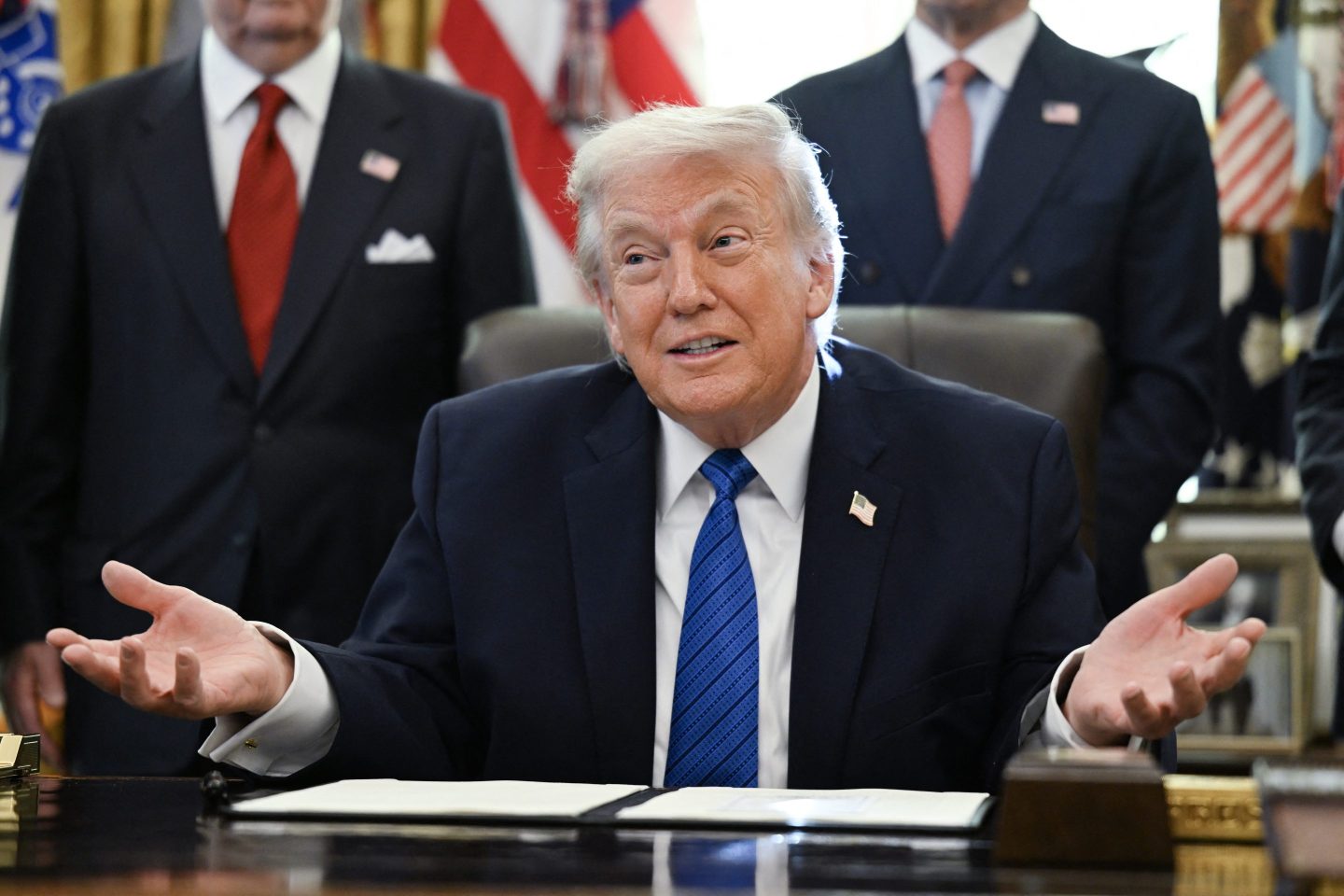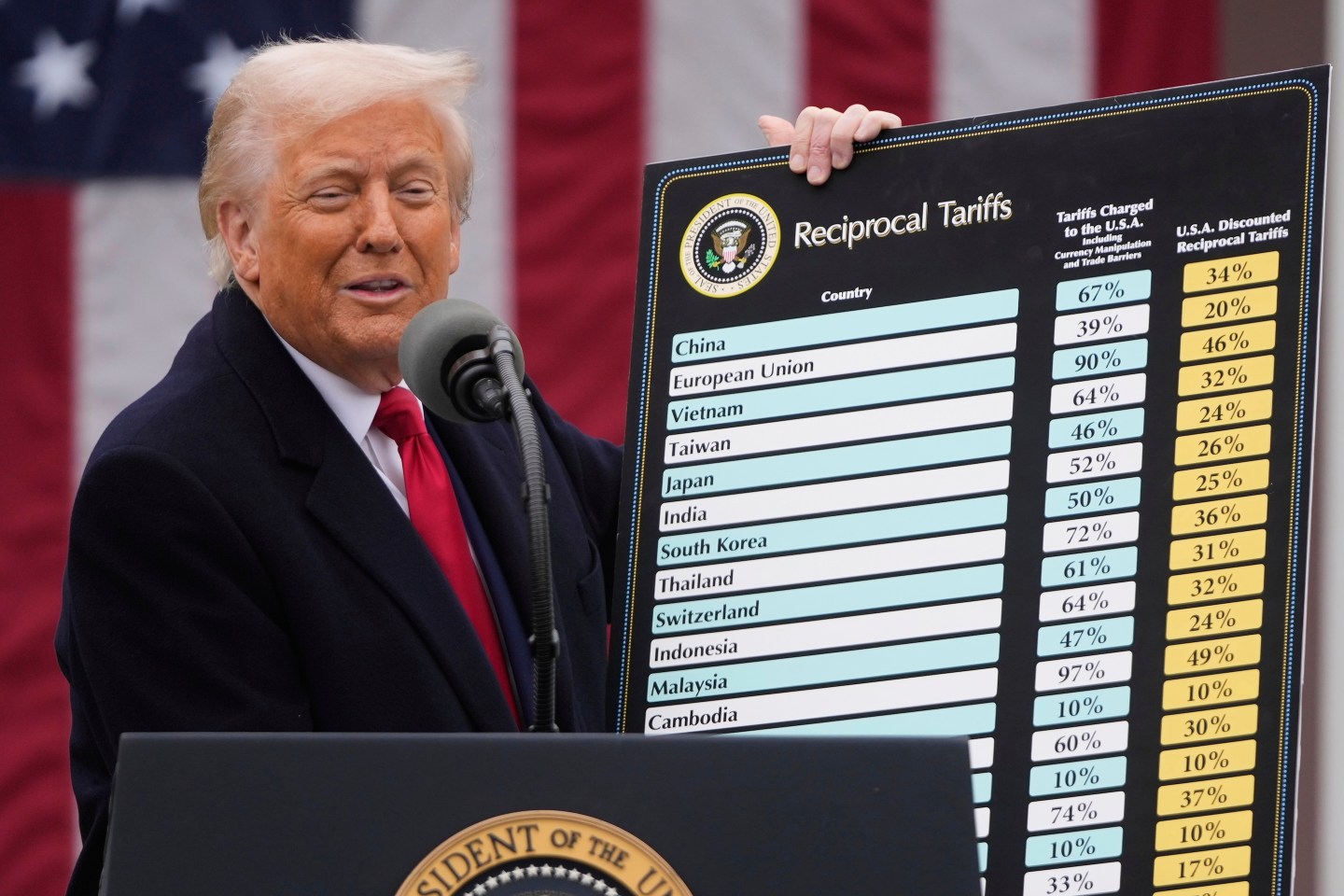
Donald Trump has identified what he sees as an all-purpose fix for what ails America: Slap huge new tariffs on foreign goods entering the United States.
The former president and current Republican nominee asserts that tariffs — basically import taxes — will create more factory jobs, shrink the federal deficit, lower food prices and allow the government to subsidize childcare.
He even says tariffs can promote world peace.
“Tariffs are the greatest thing ever invented,’’ Trump said this month in Flint, Michigan.
As president, Trump imposed tariffs with a flourish — targeting imported solar panels, steel, aluminum and pretty much everything from China.
“Tariff Man,” he called himself.
This time, he’s gone much further: He has proposed a 60% tariff on goods from China — and a tariff of up to 20% on everything else the United States imports.
This week, he raised the ante still higher. To punish the machinery manufacturer John Deere for its plans to move some production to Mexico, Trump vowed to tax anything Deere tried to export back into the United States — at 200%.
And he threatened to hit Mexican-made goods with 100% tariffs, a move that would risk blowing up a trade deal that Trump’s own administration negotiated with Canada and Mexico.
Mainstream economists are generally skeptical of tariffs, considering them a mostly inefficient way for governments to raise money and promote prosperity. They are especially alarmed by Trump’s latest proposed tariffs.
This week, a report from the Peterson Institute for International Economics concluded that Trump’s main tariff proposals – assuming that the targeted countries retaliated with their own tariffs — would slash more than a percentage point off the U.S. economy by 2026 and make inflation 2 percentage points higher next year than it otherwise would have been.
Vice President Kamala Harris has dismissed Trump’s tariff threats as unserious. Her campaign has cited a report that found that Trump’s 20% universal tariff would cost a typical family nearly $4,000 a year.
But the Biden-Harris administration itself has a taste for tariffs. It retained the taxes Trump imposed on $360 billion in Chinese goods. And it imposed a 100% tariff on Chinese electric vehicles.
Indeed, the United States in recent years has gradually retreated from its post-World War II role of promoting global free trade and lower tariffs. That shift has been a response to the loss of U.S. manufacturing jobs, widely attributed to unfettered tree trade and an increasingly aggressive China.
Tariffs are a tax on imports
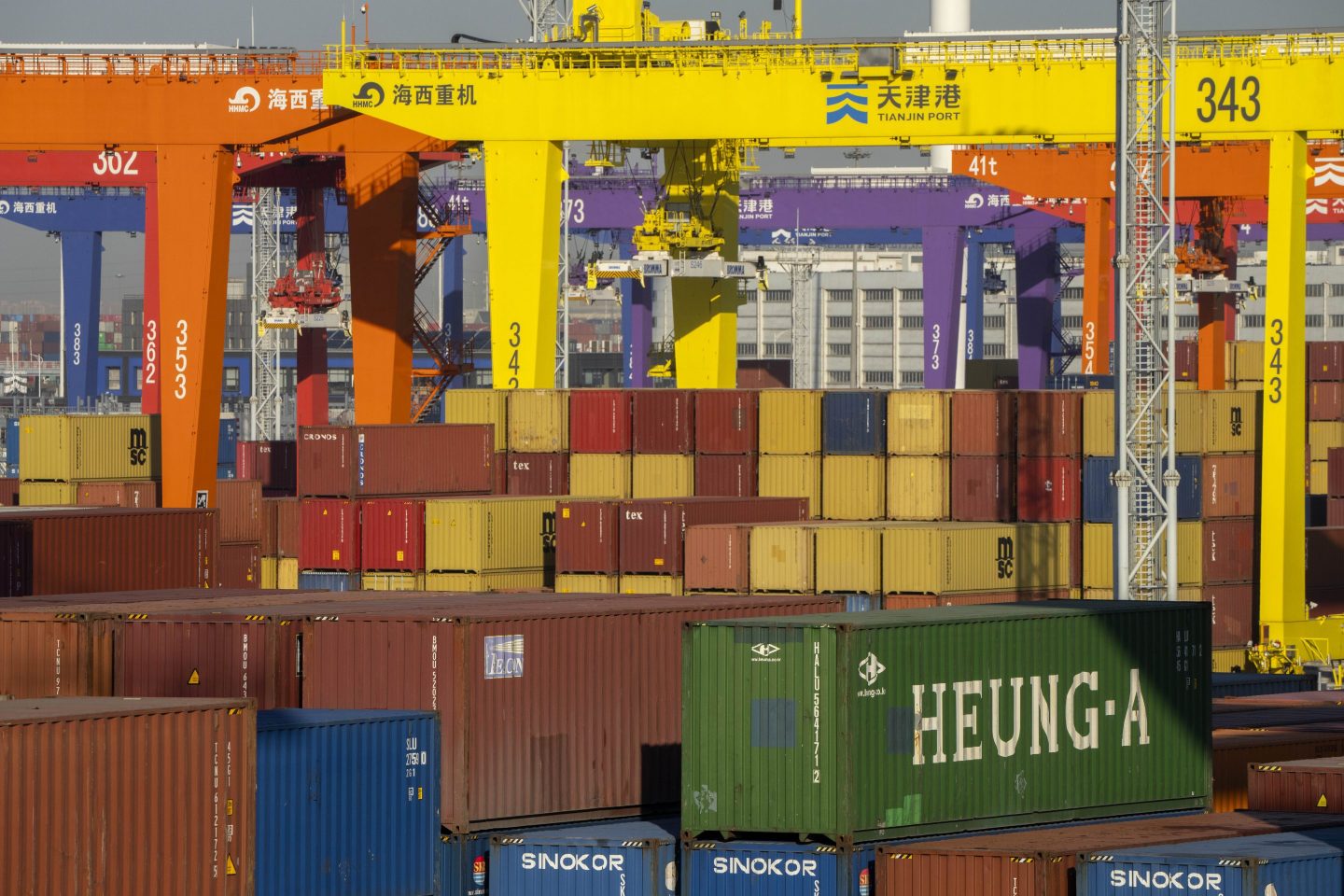
They are typically charged as a percentage of the price a buyer pays a foreign seller. In the United States, tariffs are collected by Customs and Border Protection agents at 328 ports of entry across the country.
The tariff rates range from passenger cars (2.5%) to golf shoes (6%). Tariffs can be lower for countries with which the United States has trade agreements. For example, most goods can move among the United States, Mexico and Canada tariff-free because of Trump’s US-Mexico-Canada trade agreement.
There’s much misinformation about who actually pays tariffs
Trump insists that tariffs are paid for by foreign countries. In fact, its is importers — American companies — that pay tariffs, and the money goes to U.S. Treasury. Those companies, in turn, typically pass their higher costs on to their customers in the form of higher prices. That’s why economists say consumers usually end up footing the bill for tariffs.
Still, tariffs can hurt foreign countries by making their products pricier and harder to sell abroad. Yang Zhou, an economist at Shanghai’s Fudan University, concluded in a study that Trump’s tariffs on Chinese goods inflicted more than three times as much damage to the Chinese economy as they did to the U.S. economy
Tariffs are intended mainly to protect domestic industries
By raising the price of imports, tariffs can protect home-grown manufacturers. They may also serve to punish foreign countries for committing unfair trade practices, like subsidizing their exporters or dumping products at unfairly low prices.
Before the federal income tax was established in 1913, tariffs were a major revenue driver for the government. From 1790 to 1860, tariffs accounted for 90% of federal revenue, according to Douglas Irwin, a Dartmouth College economist who has studied the history of trade policy.
Tariffs fell out of favor as global trade grew after World War II. The government needed vastly bigger revenue streams to finance its operations.
In the fiscal year that ended Sept. 30, the government is expected to collect $81.4 billion in tariffs and fees. That’s a trifle next to the $2.5 trillion that’s expected to come from individual income taxes and the $1.7 trillion from Social Security and Medicare taxes.
Still, Trump wants to enact a budget policy that resembles what was in place in the 19th century.
He has argued that tariffs on farm imports could lower food prices by aiding America’s farmers. In fact, tariffs on imported food products would almost certainly send grocery prices up by reducing choices for consumers and competition for American producers.
Tariffs can also be used to pressure other countries on issues that may or may not be related to trade. In 2019, for example, Trump used the threat of tariffs as leverage to persuade Mexico to crack down on waves of Central American migrants crossing Mexican territory on their way to the United States.
Trump even sees tariffs as a way to prevent wars.
“I can do it with a phone call,’’ he said at an August rally in North Carolina.
If another country tries to start a war, he said he’d issue a threat:
“We’re going to charge you 100% tariffs. And all of a sudden, the president or prime minister or dictator or whoever the hell is running the country says to me, ‘Sir, we won’t go to war.’ ”
Economists generally consider tariffs self-defeating
Tariffs raise costs for companies and consumers that rely on imports. They’re also likely to provoke retaliation.
The European Union, for example, punched back against Trump’s tariffs on steel and aluminum by taxing U.S. products, from bourbon to Harley-Davidson motorcycles. Likewise, China responded to Trump’s trade war by slapping tariffs on American goods, including soybeans and pork in a calculated drive to hurt his supporters in farm country.
A study by economists at the Massachusetts Institute of Technology, the University of Zurich, Harvard and the World Bank concluded that Trump’s tariffs failed to restore jobs to the American heartland. The tariffs “neither raised nor lowered U.S. employment’’ where they were supposed to protect jobs, the study found.
Despite Trump’s 2018 taxes on imported steel, for example, the number of jobs at U.S. steel plants barely budged: They remained right around 140,000. By comparison, Walmart alone employs 1.6 million people in the United States.
Worse, the retaliatory taxes imposed by China and other nations on U.S. goods had “negative employment impacts,’’ especially for farmers, the study found. These retaliatory tariffs were only partly offset by billions in government aid that Trump doled out to farmers. The Trump tariffs also damaged companies that relied on targeted imports.
If Trump’s trade war fizzled as policy, though, it succeeded as politics. The study found that support for Trump and Republican congressional candidates rose in areas most exposed to the import tariffs — the industrial Midwest and manufacturing-heavy Southern states like North Carolina and Tennessee.