
The wait is over. After more than a year of will-they-or-won’t-they, the Federal Reserve on Sept. 18 announced the first cut to its benchmark federal funds rate since the early days of the COVID-19 pandemic, a 50-basis-point drop that Chairman Jerome Powell signaled is likely the first of many.
With inflation at its lowest level since early 2021, an uptick in the unemployment rate, and growing worries about softening consumer spending, the cut was anything but a surprise. But it does signal the start of a pivot in how the average investor should position her portfolio, as wealth planners and other experts tell Fortune.
For starters, investors should expect short-term volatility, especially if the Fed embarks on a sequence of rate changes, says Chester Spatt, finance professor at Carnegie Mellon’s Tepper School of Business. That will be doubly so considering that the timing of the first cut coincides with the home stretch of a presidential race, when investors tend to overreact to political plot twists. “These periods where the direction of rates is changing tend to be periods of uncertainty,” says Spatt.
Driving that uncertainty, of course, is the question that’s been ricocheting around investors’ minds for months: Has the Fed nailed a “soft landing,” slowing inflation without causing a recession? Or is September’s rate cut a sign that higher interest rates have gone too far and made the economy too weak?
The bad news is that in recent years, declining interest rates and recessions have often gone hand in hand as the Fed tries to backstop Wall Street and Main Street: Seven out of 11 periods of sustained rate cutting since 1980 have coincided with recessions, according to research by Hartford Funds.
The good news is that even a recession isn’t necessarily terrible for investors. Tracie McMillion, head of global asset allocation strategy at the Wells Fargo Investment Institute (WFII) notes that there are a few asset classes that tend to pop after a cut, U.S. stocks being one of them. Studying historical stock market data, WFII found that the S&P 500 rises steadily in the 18 months following a rate cut when those cuts don’t correspond with a recession. But even when there is a recession—which WFII considers unlikely—performance is “essentially flat.”
Indeed, some sectors actually perform better when rate cuts correspond with a recession than they do when it doesn’t. Financials, health care, consumer staples, and tech fall into that category.
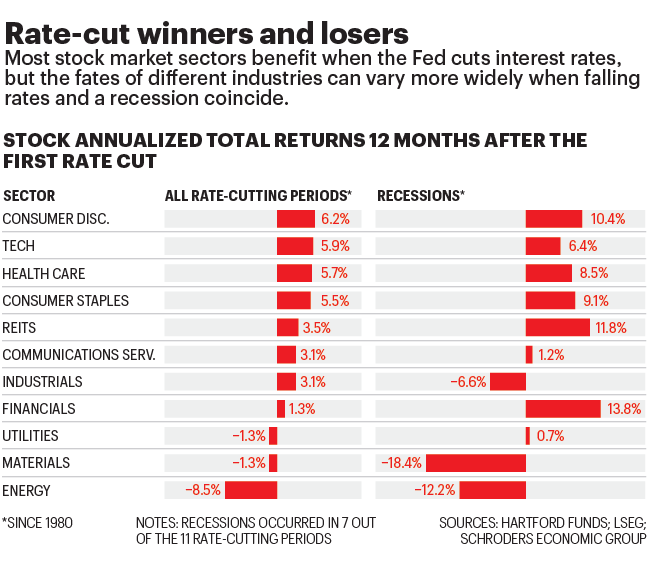
With or without a recession, lower interest rates make it worth taking a second look at some categories that have been out of favor. Small-cap stocks, which have underperformed for years, in particular could see a boost, says McMillion. These companies tend to rely on borrowing to fuel growth to a greater degree than big companies do, meaning they have more to gain from better lending rates.
Commercial real estate presents another opportunity. Though the sector has been sorely wounded since COVID sent workers home—where many remain—lower rates could encourage developers to take on conversions of offices that have sat empty post-pandemic, says Doug Ornstein, director of TIAA’s wealth management team.
That said, you don’t necessarily have to sell off the stocks that were winners before the Fed’s recent action: Falling rates, Ornstein argues, are also good news for high-quality growth stocks like Nvidia, which also rely on low-cost financing to expand.
Other investments, bonds, and mortgages
Outside of their stock portfolios, investors could see a mixed bag if rates keep falling. Rates on auto loans, credit cards, and potentially mortgages could follow the Fed’s lead, making it a better time to refinance and even make big purchases.
For those recently reveling in the higher rates on deposits, however, this could be a disappointing time, as banks lower the yields they offer on accounts and CDs. Some insurance or annuity products could provide fixed rates that are more attractive than the market alternatives, says Spatt. Moving some excess cash into equities could also be an answer, notes McMillion, particularly for any savings that investors know they won’t need near-term.
Investment-grade corporate bond funds can also pay higher rates to savers looking for a cash alternative. “Bonds have been the ugly duckling in the portfolio for the past few years, but now they’re looking more attractive again,” says Sandi Bragar, chief client officer at Aspiriant, which oversees $13 billion in client assets. “They should see more popping in return opportunities, and they should be more stable than stocks.”
Of course, if the Fed hasn’t stuck the landing, and recession looms, U.S. bonds become a favored defensive play, and commodities could also become more compelling. Exiting equities altogether is almost never a good idea. But Ornstein suggests that investors review their portfolios and consider whether they’re overweighted on stocks, after two great years for the market, given their goals, risk tolerance, and time horizon. “Investors who haven’t rebalanced may be out of alignment with those targets,” he says.
This story was featured in The Reader, a weekly newsletter of the biggest stories from Fortune. Sign up here.
How many times the Fed will cut rates and by how much are, of course, questions that can’t be answered at the moment. By its November meeting, the Fed will have more jobs reports and inflation data to analyze for a clearer view of the overall health of the economy. Spatt suggests sticking with a wait-and-see mindset. “In some medical contexts, they call that watchful waiting—where the doctors don’t want to intervene too aggressively,” he says.
Above all, nothing the market does should prompt a complete change in an investor’s strategy, says Ornstein. Investors should already have a well-diversified portfolio that aligns with their goals, and recession or no, they should stay the course regardless of what the Fed plans for the rest of the year.
“Let’s lean one direction or the other; let’s add a little bit of dressing to the salad, not decide we’re never eating salad again,” says Ornstein. “We still want a meal with all the different food groups in it.”
More from the October/November issue of Fortune:
–What businesses can expect in a Kamala Harris presidency
–See which companies made the 2024 Fortune Change the World list
–Where Silicon Valley is spending its millions in political donations, charted
–Who has time for a power lunch? The real business happens at 4 p.m. ‘power hour’