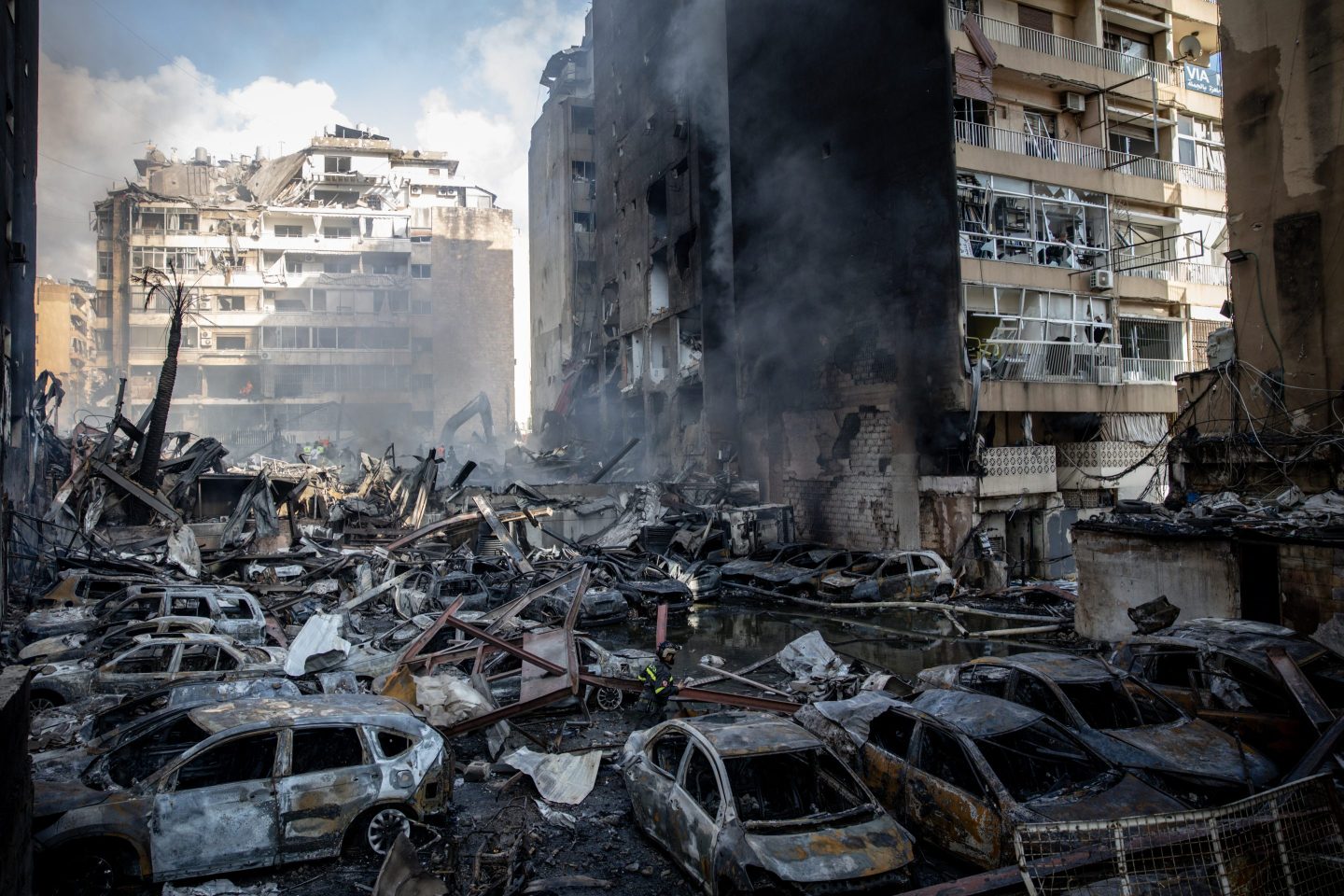

Two straight days of explosions surgically targeting Hezbollah militants across Lebanon pulled the covers off what appears to be an elaborate and sophisticated mass infiltration by Israel of the supply chain equipping its enemy.
On Tuesday, thousands of pagers booby-trapped with explosives blew up at the same time before an unknown number of two-way radios were triggered to detonate just 24 hours later.
The coordinated attacks on Hezbollah, a Shiite paramilitary backed by Iran, are estimated to have killed over two dozen people and incapacitated scores more.
Experts are still puzzling together evidence in the hopes of explaining how this remarkable feat was achieved. But one thing is clear, it dramatically hurts Hezbollah’s capacity to target IDF positions in the north of Israel.
“In two waves—each in a matter of minutes—Hezbollah lost thousands of its battle-ready militants in an impactful operation that seriously disrupted its command-and-control capabilities,” wrote Avi Melamed, a former Israeli intelligence official and author, in comments to Fortune.
Two children were also among the dead, and more than 2,800 people have been injured—many of whom may be innocent.
“This was a brilliant operation in terms of intelligence and execution — truly on a global scale,” Israeli reserve brigadier general Amir Avivi was quoted by Bloomberg. “I have been saying for many years that we are good at missions and bad at wars.”
Who made the exploding pagers?
The pagers that blew up on Tuesday were a model sold under the brand Gold Apollo.
Hsu Ching-kuang, founder and president of the Taiwanese company, said however he had granted authorization for a Hungarian company called BAC Consulting to engineer and manufacture the pager in question using his trademark.
“They designed it themselves,” he said in comments quoted by the Associated Press. Gold Apollo merely collected a royalty fee for granting them use of his company’s brand, according to his statement.
When German publicly funded broadcaster DW sought out the company at its Budapest address, the trail ran cold.
All it found to confirm its sheer existence was a page of paper with its name printed in conventional inkjet. This suggests it was working only as a shell company to provide the cover of a legitimate enterprise.
Israel’s allies may have intercepted devices en route to Hezbollah
Company CEO Cristiana Bársony-Arcidiacono furthermore refuted any direct involvement in their manufacturing. “I do not make the pagers. I am just the intermediary,” she told NBC News.
She did not say who was responsible for their manufacture, and Bársony-Arcidiacono did not respond to a Fortune request for comment.
While it’s conceivable an Israeli company manufactured the pagers, it could also have been a company linked to Hezbollah that simply wished to remain in the shadows.
Brussels-based military analyst Elijah Magnier suggested another possibility: Israel was most likely tipped off by friendly intelligence services in the Middle East that ensured the pagers would be held up en route before reaching Hezbollah.
They could then grant Israeli agents enough time and access to the devices to manually implant the explosives across thousands of pagers likely hidden directly within their lithium-ion battery cells.
“They had all the time in the world,” he told Al Jazeera’s English language service on Wednesday.
Radios may have been procured on the black market
How exactly the walkie-talkies were compromised is also a mystery at this point. Visual evidence suggests the devices were two-way ham radios sold by the Japanese company Icom, a leading manufacturer. However, the company said it had discontinued all production of the model in question, the IC-V82, around ten years ago. Icom also no longer supplies replacement battery packs.
Hezbollah operatives could have procured the handheld radios from any number of sources without relying on written records that could be traced to them—for an organization designated as terrorists by most western governments it would make sense to cover one’s own tracks.
The IC-V82s may also not have been originals, but cheap knockoffs from the black market, which are impossible to trace.
“A hologram seal to distinguish counterfeit products was not attached, so it is not possible to confirm whether the product shipped from our company,” Icom said in a statement to the BBC.
With so many details unclear, it may be weeks, months or even years before substantive light can be shed on this week’s events.
History of booby-trapping communications devices
The Israeli government has neither confirmed nor denied responsibility, and the office of prime minister Benjamin Netanyahu did not respond to a Fortune request for comment.
But the country’s intelligence services have demonstrated multiple times in the past the capacity to target enemy operatives surgically. Yahya Ayyash, a ranking figure in Hamas’ military wing, was assassinated back in 1996 after his booby-trapped mobile telephone exploded.
This scale, however, appears unprecedented.
“You can do it to a single device remotely, and even then, you can’t be sure if it will catch fire or actually explode,” one anonymous ex-Israeli counterterrorism official told the Financial Times. “To do it to hundreds of devices at the same time? That would be incredible sophistication.”
The operation comes shortly after the targeted assassination of Ismail Haniyeh in Tehran, where the top Hamas figure had been a personal guest of Iranian leader Ayatollah Ali Khamenei, and days before the one-year anniversary of the October 7th attack by Hamas that killed roughly 1,200 Israelis.
The price of Europe’s North Sea ‘Brent’, the global crude oil benchmark, jumped 1.3% to $73.70 a barrel as fears of a broader conflagration in the Middle East returned.
Hezbollah’s military effectiveness likely crippled
Should the Israeli government be behind the attack, as is widely believed, it would have succeeded in compromising the very supply of Hezbollah’s critical infrastructure.
By wiping out much of their communications in one fell swoop, it cripples their ability to respond effectively to an Israeli attack as the focus shifts from fighting Hamas in Gaza to the north of the country and Hezbollah.
“The loss of [Hezbollah’s] wireless communications capabilities severely compromises its flexibility, connectivity, and maneuverability,” Melamed told Fortune.
Furthermore, any machine powered by a lithium-ion battery could potentially be a miniature time bomb and, therefore, is now suspect. Combing through their supplies to locate vulnerabilities diverts attention away from the battlefield.
“Hezbollah will now thoroughly scrutinize anything remotely serving as a communications device,” Fabian Hinz, a military analyst with the International Institute for Strategic Studies, said in an interview with German television broadcaster ZDF on Thursday. “Examining everything they have procured for explosives will prove a mammoth task.”