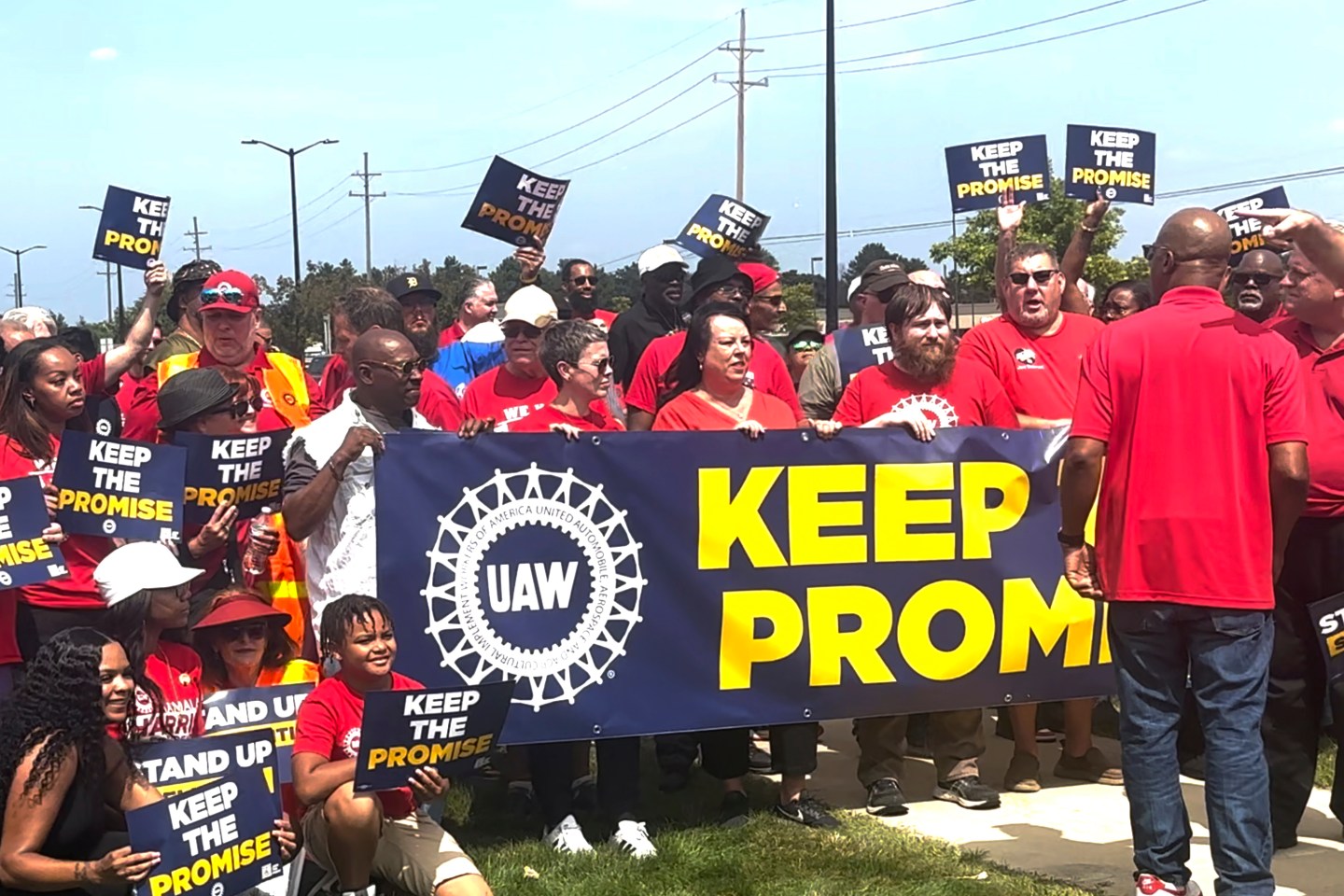
To Ruth Breeden, whose job is to assemble Ram trucks in this Detroit suburb, a simmering dispute between the United Auto Workers union and Stellantis isn’t merely about whether her employer will reopen a distant factory in Illinois. To her, the standoff is a danger sign for all UAW workers.
Belvidere, Illinois, is the site of an assembly plant that Stellantis had pledged to reopen under a contract it forged last year with the union. But the company, which reported poor sales and earnings this year, has delayed the reopening given what it calls unfavorable “market conditions.” Stellantis says it will eventually meet its commitment to reopen the plant.
Yet no date has been given for the company to restart the factory or to open a new battery plant and a new parts warehouse, both which were also promised in the contract agreement that ended the UAW’s strike against Stellantis last year. At stake are about 2,700 jobs.
Breeden and other union members say they fear that Stellantis will break other commitments in other states, eventually jeopardizing their jobs.
“It’s the whole company,” she said at a union rally last month in front of her factory in Sterling Heights. “Who knows which plant is next?”
Anxious and angry about Stellantis’ delay, union leaders have threatened to strike, a move that could extend beyond Stellantis. Labor experts say its two Detroit-area rivals, Ford and General Motors, are watching as they weigh their own strategies, including whether to move future production sites out of the United States and away from the UAW.
Detroit automakers have been expanding production in Mexico for years. And after last fall’s strikes shut down a Ford truck plant, its CEO warned that the company would have to rethink where it builds new vehicles.
“There’s plenty of history of the U.S. manufacturing sector moving its operations to low-wage countries,” said Bob Bruno, a labor and employment relations professor at the University of Illinois. “It seems reasonable to me for the UAW to be concerned about not opening here, not investing here, but beginning to move operations someplace else as the company looks at essentially how they can build their cars for the cheapest cost.”
In February 2023, the last Jeep Cherokee small SUV rolled off the line at the Belvidere Assembly Plant, about an hour northwest of Chicago, and 1,350 workers were laid off. Stellantis had plans to shutter the factory for good.
A few months later, Belvidere emerged as an issue in the UAW’s first direct election of its officers in the wake of a bribery-and-embezzlement scandal involving the union’s previous leadership. Shawn Fain, who won the UAW presidency, demanded that Belvidere be reopened.
After the six-week strike against all three Detroit automakers last fall, each company signed a new contract with the UAW. Under the deal with Stellantis, it agreed to reopen the Belvidere assembly plant in 2027, with plans to build up to 100,000 electric and gas-powered midsize pickups annually.
It also agreed to open a parts distribution hub in Belvidere this year and an electric-vehicle battery factory with 1,300 workers in 2028. In all, the company pledged $18.9 billion of U.S. investments during the contract, which runs until April 2028.
So promising was the prospect of reopening Belvidere that it drew a celebratory visit from President Joe Biden and a pledge of $335 million in federal dollars to revamp the 5-million-square-foot plant, which began building vehicles in 1965.
A year later, there’s no parts hub and no definitive plan to open the assembly and battery plants. Stellantis’ vague pledge to eventually open the facilities sounded the alarm among the union members.
“If they violate this, what are they going to violate moving forward?” asked Kevin Gotinsky, who leads the UAW’s talks with Stellantis.
On Wednesday, Stellantis did announce that it would spend roughly $400 million to revamp three Michigan factories to build electric vehicles or parts. Breeden’s plant will receive about $235 million of the money, which was included in the UAW’s contract.
Still, Breeden said she fears that the company’s CEO, Carlos Tavares, who talks frequently about cutting costs, wants to move more production to low-wage Mexico. The company already builds Ram pickups in Saltillo, Mexico. She fears that Stellantis might decide to move some production there and away from her plant.
“The truth is Stellantis doesn’t want to invest in America,” Fain said in a recent UAW video.
Tavares has told reporters that one reason Stellantis needs to slash costs is so it can make electric vehicles — which cost roughly 40% more to build than gas-powered cars do — affordable to typical customers.
Breeden’s friend Jazmine Johnson, who has spent a decade with the company helping build Jeep SUVs, shares Breeden’s concerns. Both say they’re willing to strike.
“You’ve got to be ready to fight,” Johnson said.
In the end, experts say, the Belvidere matter could end up in court.
Tavares has taken the unusual step of singling out the Sterling Heights Ram plant for criticism for encountering problems with trucks that were built there but not yet shipped. The company has also complained about high absenteeism among workers at Stellantis’ U.S. factories.
Local union officials counter that Stellantis has made a high number of temporary hires who have caused much of the absenteeism. Fain also argues that Stellantis’ management has tended to buy poorly made low-cost parts.
In August, Stellantis stopped producing older Ram pickups at a plant in Warren, Michigan, and laid off up to 2,400 workers. It was the latest sign that Stellantis’ U.S. workers face an uncertain future, said Marick Masters, business professor emeritus at Wayne State University who follows labor issues.
“I think the apprehension workers have is well-founded,” he said.
Stellantis said it stands by its commitment to Belvidere under the contract it signed with the UAW. But it said it needs the delay so it can afford to remain competitive and preserve U.S. factory jobs.
“It is critical that the business case for all investments is aligned with market conditions and our ability to accommodate a wide range of consumer demands,” Jodi Tinson, a Stellantis spokeswoman, said in a statement.
Tinson said the company isn’t violating its commitments, noting language in a letter detailing investments that’s part of the UAW contract. The letter said Stellantis and the UAW agree that investment and jobs in North America are “contingent upon plant performance, changes in market conditions, and consumer demand continuing to generate sustainable and profitable (sales) volumes.”
Maite Tapia, an associate professor at Michigan State University’s School of Human Resources and Labor Relations, noted that language in union contracts is often intended to appease both parties.
“The union could sell the agreement to their members,” Tapia said, “because it has clear language about investment and reopening Belvidere, whereas the employer was fine with it as well, given this broad clause that could potentially give them the right not to invest.”
The UAW counters that its contract with Stellantis authorizes it to strike over plant closures and broken investment promises.
Stellantis, which has been slow to shift its production toward increasingly popular lower-cost vehicles, has struggled this year. Its U.S. sales fell nearly 16% in the first half of the year. Profits tumbled 50%. As a result, the company’s inventory reached nearly 400,000 as of July, the highest level in the industry.
Still, overall U.S. sales of new vehicles rose 2.4% in the first half of the year. The union argues that GM and Ford are doing well and that Stellantis would be, too, if not for poor management by Tavares.
Fueling the angst on U.S. assembly lines is a statement made in February by Ford’s CEO Jim Farley, who said his company would rethink where it builds vehicles. Farley sounded that warning after the UAW’s 2023 strikes shut down Ford’s largest and most profitable plant, which makes heavy-duty trucks in Louisville, Kentucky. In July, Ford said it would revamp a factory in Ontario to build the same trucks.
Before last year’s strikes, Farley said, Ford continued to make pickups in the United States despite higher labor costs and competitors that had opened plants in Mexico. The CEO said he was particularly upset that the union strike shut down the Louisville plant.
Fain, the union president, scoffed at the notion that Detroit’s automakers will be compelled to move production out of the U.S. because of the new contract and a more aggressive union. He complained that over the past 20 years, the companies have closed or sold 65 factories during a period where the UAW was more cooperative.
“That’s hundreds of thousands of jobs that cost us,” Fain said in an interview with The Associated Press. “So don’t talk to me about your commitment to the American worker when that’s your traditional history.”
In the meantime, the standoff with Stellantis over Belvidere has led the UAW to threaten to strike as early as October.
“We expect them to honor the commitment they made,” Fain said. “If they don’t, we put language in this agreement so that we can hold them accountable. And we’re going to.”