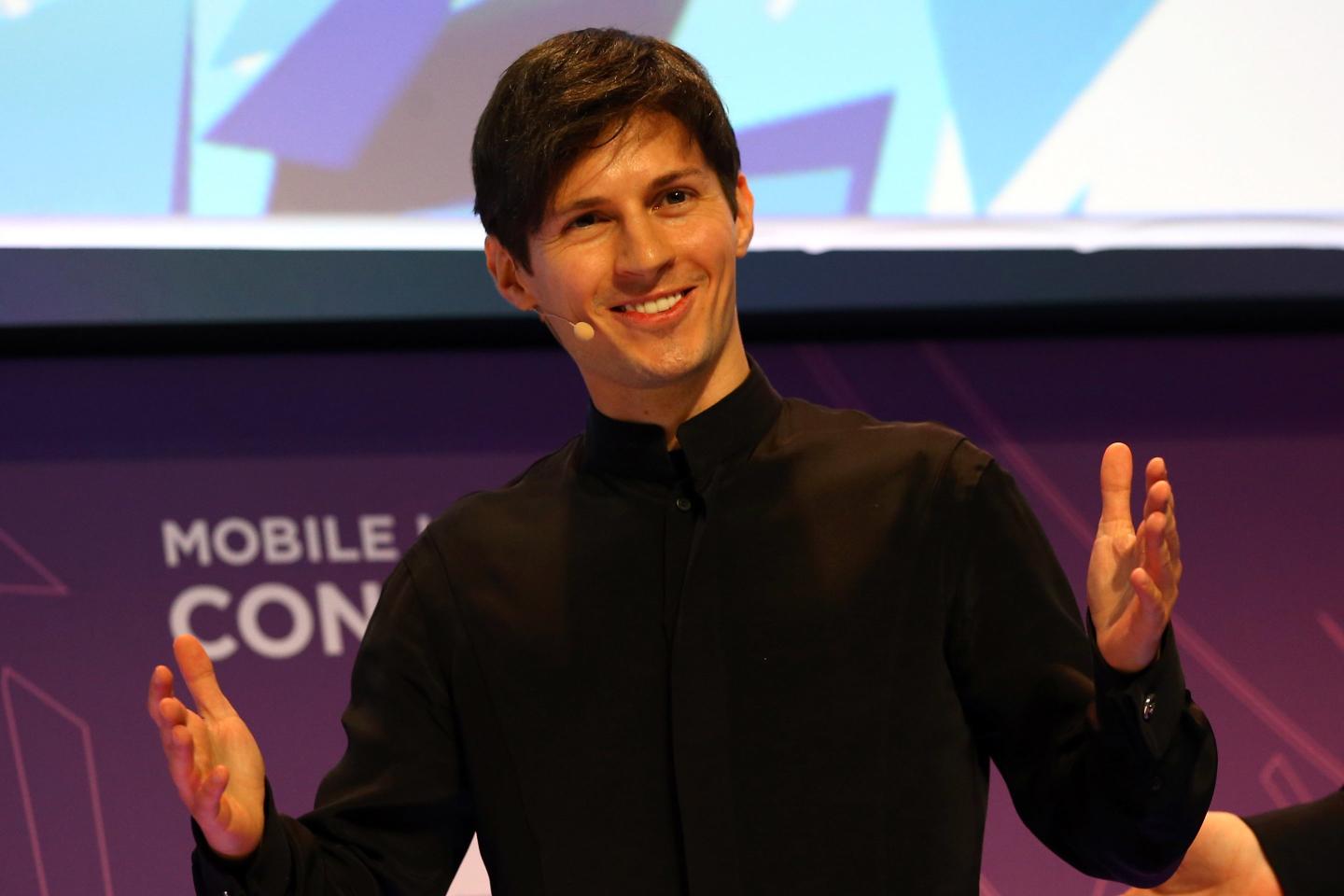
Telegram’s “people nearby” feature, which was hugely popular with drug dealers and the like, has shuffled off this mortal coil. It’s being replaced by a “businesses nearby” feature, listing only what CEO Pavel Durov calls “legitimate, verified businesses.”
On Friday, Durov also announced the disabling of new media uploads to Telegram’s blogging tool, Telegraph. He said it “seems to have been misused by anonymous actors.” Crucially, he also indicated that the platform’s legendarily light-touch approach to content moderation would change, pledging: “This year we are committed to turn moderation on Telegram from an area of criticism into one of praise.”
The Russia-born billionaire was arrested near Paris a couple weeks back, in an investigation we now know was triggered by Telegram’s refusal to help authorities identify a user who was a self-confessed and active pedophile. French investigators say Telegram has been widely used to disseminate child sexual abuse material and many other types of illegal content, while doing little to help national authorities go after the criminals.
Whatever the future of Durov’s case—for now, he has received preliminary charges and is stuck in France—the action against him has already been successful. His promises around moderation can only be judged in the implementation, over time, but Telegram is already markedly less useful for criminals and their customers. Job done, at least partly.
Which makes me wonder how long it will be before we see another tech high-flyer brought down to earth in this way.
Pavel Durov is certainly not your standard big social media CEO. He and Telegram aren’t American, for one thing. Telegram has also been unusually popular with criminals, because of its unusually poor moderation and cooperation with law enforcement. It’s also important to remember that this is a French criminal case with no connection to EU-wide Big Tech laws like the Digital Services Act (covering content) or Digital Markets Act (antitrust)—neither of these laws gives anyone the power to arrest anyone.
But nonetheless, the once-fanciful idea of a major tech CEO being arrested and (preliminarily) charged, because of the stuff that happens on their platform, has become a reality. And the move’s apparent success shows that it’s an idea that can work.
The calculus of enforcement really does change when you can physically get your hands on someone. Just ask Elon Musk. X’s recent Brazilian ban may be the endpoint of a long-gestating feud about fake news and a far-right coup, but its immediate trigger was X’s refusal to appoint a legal representative in the country, which Brazilian law requires to ensure accountability.
One could argue that no one wins when a service is banned—Musk and others have certainly called out the implications for freedom of speech—but Brazil has now demonstrated that it’s willing to go all the way when enforcing its laws. No surprise that, threatened with the suspension of its license to operate in Brazil, Musk’s Starlink has now agreed to block access to X, like other internet service providers have been doing to comply with the ban.
France and Brazil have now both flexed their muscles and won. Other countries are no doubt watching.
More news below.
David Meyer
Want to send thoughts or suggestions to Data Sheet? Drop a line here.
NEWSWORTHY
New iPhones. Wall Street has high hopes for Apple’s big iPhone 16 launch today, in the expectation of new AI features driving upgrades. According to the Financial Times, analyst consensus has next year seeing around 5% iPhone revenue growth. The newspaper also reports that the iPhone 16 will use a more advanced Arm chip technology than last year’s iPhone 15 Pro and Pro Max, which are currently the only available models that will be able to support the new “Apple Intelligence” AI experience.
xAI and Tesla. Elon Musk has denied reports that said xAI and Tesla had talked about the Musk car company licensing models from the Musk AI company to improve its driver assistance features. Musk tweeted that there was “no need” for Tesla to “license anything from xAI.” He said xAI’s models are way too big to run on an in-car computer, though “Tesla has learned a lot from discussions with engineers at xAI that have helped accelerate achieving unsupervised [full self driving].”
Squarespace offer. Private equity firm Permira has boosted its offer for website design firm Squarespace from $44 to $46.50 a share, for a total valuation of $7.2 billion. Reuters reports that the proxy advisory firm Institutional Shareholder Services had given Permira’s earlier bid a thumbs-down.
SIGNIFICANT FIGURES
36%
—The cut of ad sales that Google sometimes collects from advertisers, according to the Justice Department and a coalition of states, which face Google in an ad-tech antitrust trial that begins today.
IN CASE YOU MISSED IT
Huawei’s tri-fold phone crosses 3 million pre-orders as Chinese tech giant keeps up pressure on Apple in China, by Lionel Lim
This German startup is Europe’s best hope for developing AI advancement outside Silicon Valley, by Bloomberg
Federal judge gives DOJ deadline to decide Google’s antitrust punishment, by the Associated Press
Roblox boosts developer payouts in new plan to supercharge growth, by Jenn Brice
Navy officer demoted for secretly installing Starlink on warship to check social media, by the Associated Press
Jeff Bezos has a house rule. No phones in the morning, says partner Lauren Sánchez, by Marco Quiroz-Gutierrez
BEFORE YOU GO
Tech 4 Harris. Workers at Amazon, Microsoft, and Alphabet are sending way more cash to Kamala Harris’s campaign than they are to former President Donald Trump, according to OpenSecrets. Per Reuters, the political transparency group looked at data including “donations made by company employees, owners, and workers’ and owners’ immediate family members.” Companies themselves can’t legally contribute directly to presidential campaigns, though employees can, and companies can donate through their political action committees.